
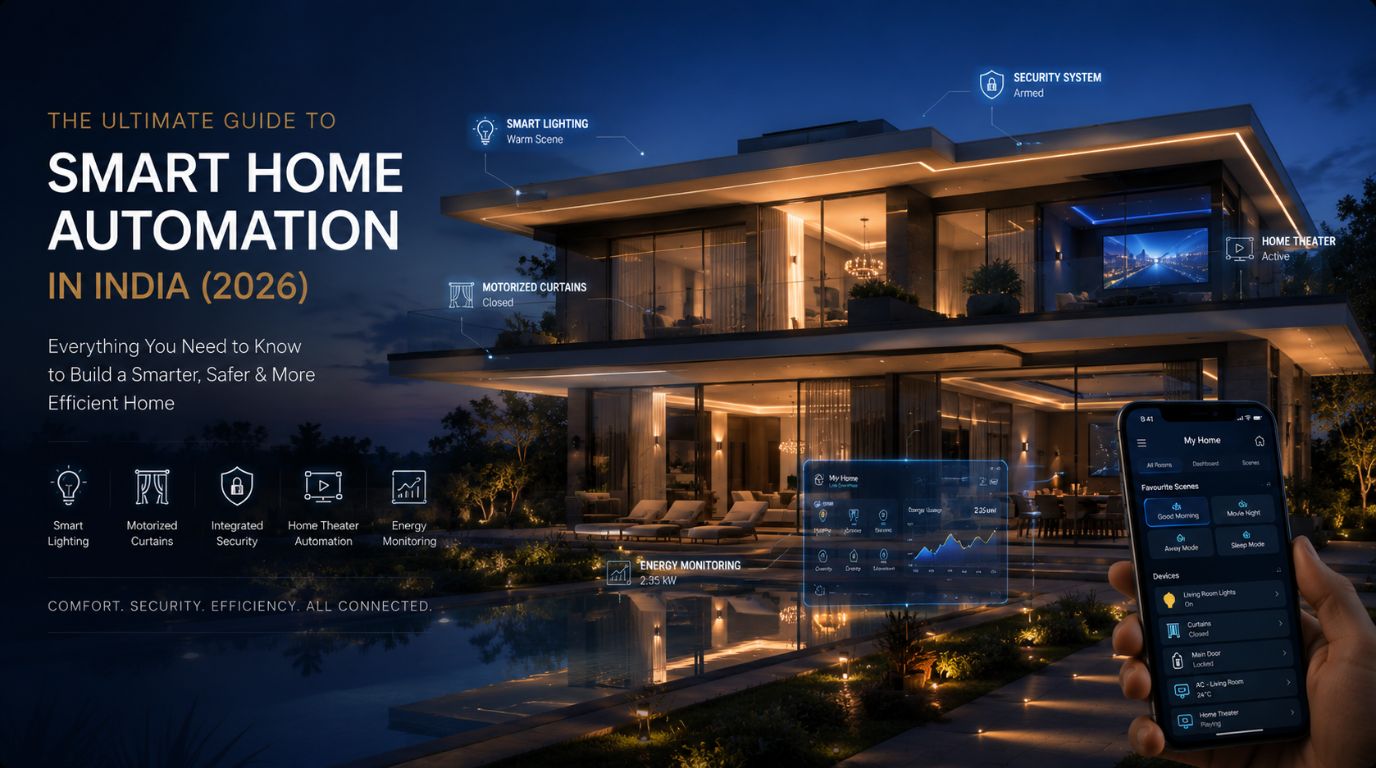
Smart home automation is no longer a luxury reserved for futuristic homes. Across India, homeowners, architects, interior designers, and developers are increasingly looking to deploy robust smart home automation setups to elevate modern homes, villas, apartments, offices, and commercial spaces.
At Techtastic, we have witnessed this transformation firsthand. What started as simple smart lighting and remote-controlled devices has evolved into fully integrated smart living environments where lighting, climate control, security, entertainment, energy management, and motorized curtains work together seamlessly.
Whether you are building a new villa in Nashik, renovating an apartment in Navi Mumbai, designing a luxury residence in Lonavala, or developing a premium project in Sangli, investing in smart home automation (India) systems can dramatically improve convenience, security, energy efficiency, and your overall lifestyle.
However, many people still have questions:
- What exactly is smart home automation (India)?
- Is it worth investing in?
- How much does it cost in India?
- Is KNX better than Wi-Fi automation?
- Can automation be added to existing homes?
- What are the best smart home automation (India) systems available today?
In this comprehensive guide, we answer all of these questions and more. Drawing from our experience designing and implementing smart home automation (India) systems, we will help you understand how modern automation works, which technologies are best suited for different projects, what costs to expect, and how to make the right decisions for a future-ready home.
Summary
Smart home automation is the integration of technology that allows homeowners to control lighting, curtains, air conditioning, security systems, entertainment systems, appliances, and energy management through a centralized platform such as a smartphone, touchscreen, voice assistant, or automation controller.
In the rapidly evolving landscape of smart home automation (India), integrated systems have become increasingly popular because they improve convenience, enhance security, reduce energy consumption, and create a premium living experience. Modern systems can automate daily routines such as turning lights on and off, adjusting room temperatures, opening motorized curtains, managing home theater systems, and monitoring security cameras.
The most common automation technologies include KNX automation, Wi-Fi automation, Zigbee, Z-Wave, Matter-enabled devices, and hybrid automation systems. Among these, KNX remains one of the most reliable and scalable solutions for luxury homes and large residential projects.
For homeowners looking to build a future-ready home, deploying smart home automation (India) is no longer just about convenience—it is about creating an intelligent living environment that adapts to modern lifestyles while increasing property value and long-term efficiency.
What Is Smart Home Automation?
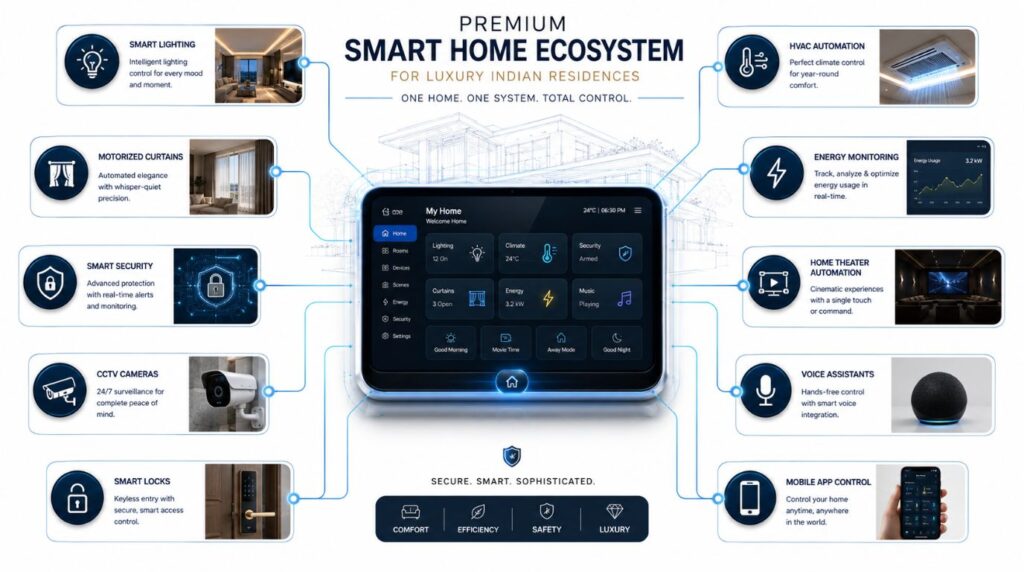
Smart home automation refers to the use of connected devices, sensors, controllers, and software to automate and control various functions within a property. Rather than operating every system independently, automation brings everything together into one ecosystem.
For example, instead of:
- Turning lights on manually
- Adjusting AC temperatures separately
- Opening curtains yourself
- Switching entertainment systems individually
A smart home allows all of these actions to happen automatically or through a single command.
Imagine saying: “Good Night”
And your home automatically:
- Turns off lights
- Closes curtains
- Arms security systems
- Adjusts air conditioning
- Locks smart doors
This is the power of integrated automation.
Why Smart Home Automation (India) Matters
The modern homeowner expects more from a home than ever before. Today’s homes are not just living spaces. They are:
- Workspaces
- Entertainment centers
- Wellness environments
- Security hubs
- Energy management systems
As homes become more sophisticated, managing multiple devices manually becomes inefficient. Setting up a dedicated system for smart home automation (India) solves this challenge by creating seamless interactions between devices and systems.
At Techtastic, we often find that clients initially approach us for one feature—usually smart lighting or motorized curtains—but eventually discover the value of integrating their entire home into a cohesive automation ecosystem. The result is:
- Better convenience
- Improved comfort
- Enhanced security
- Reduced energy wastage
- Higher property value
Key Benefits of Smart Home Automation (India)
1. Convenience
Perhaps the most obvious advantage of smart home automation (India) is convenience. Instead of managing multiple switches, remotes, and applications, everything can be controlled through a centralized interface.
Examples include:
- One-touch scenes
- Voice control
- Automated schedules
- Mobile app access
2. Enhanced Security
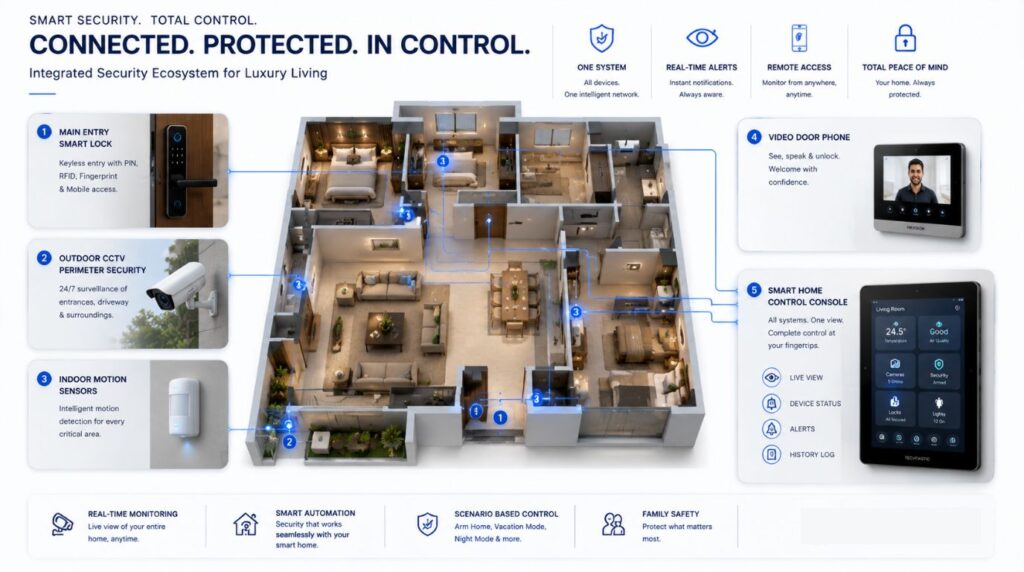
Modern smart home security systems can integrate:
- CCTV cameras
- Smart locks
- Motion sensors
- Video door phones
- Intrusion detection systems
This provides real-time monitoring and alerts.
3. Energy Efficiency
Energy management is becoming increasingly important. Automation helps reduce unnecessary consumption by:
- Turning off unused lighting
- Managing HVAC systems
- Optimizing occupancy-based lighting
- Monitoring energy usage
4. Increased Property Value
Luxury buyers increasingly expect automation features. Properties utilizing integrated smart home automation India solutions often enjoy:
- Better market positioning
- Improved buyer appeal
- Future-ready infrastructure
5. Personalized Living Experiences
Every family uses their home differently. Automation enables personalized experiences through scenes such as:
- Movie Mode
- Dinner Mode
- Vacation Mode
- Morning Routine
- Good Night Scene
How Smart Home Automation (India) Works
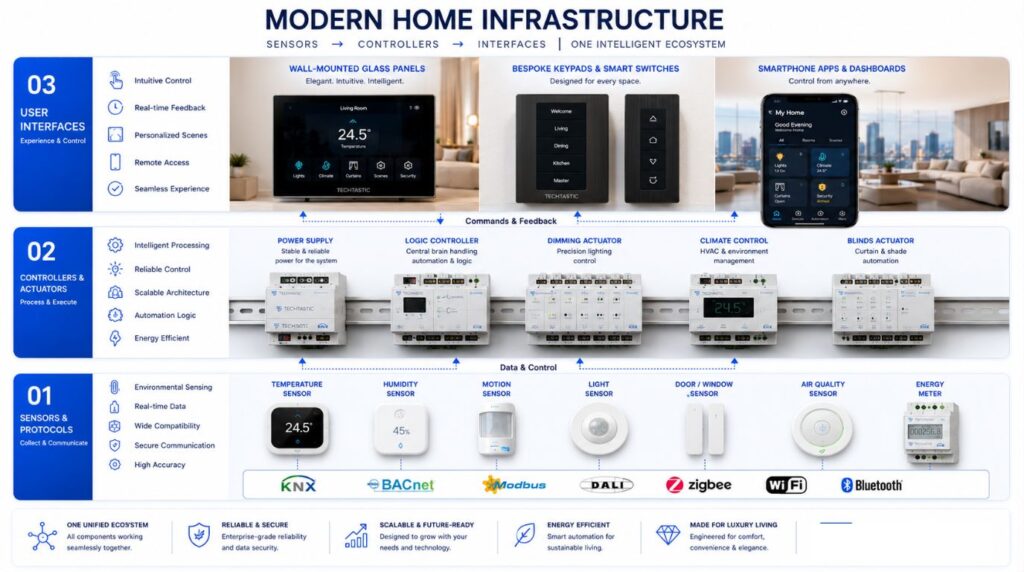
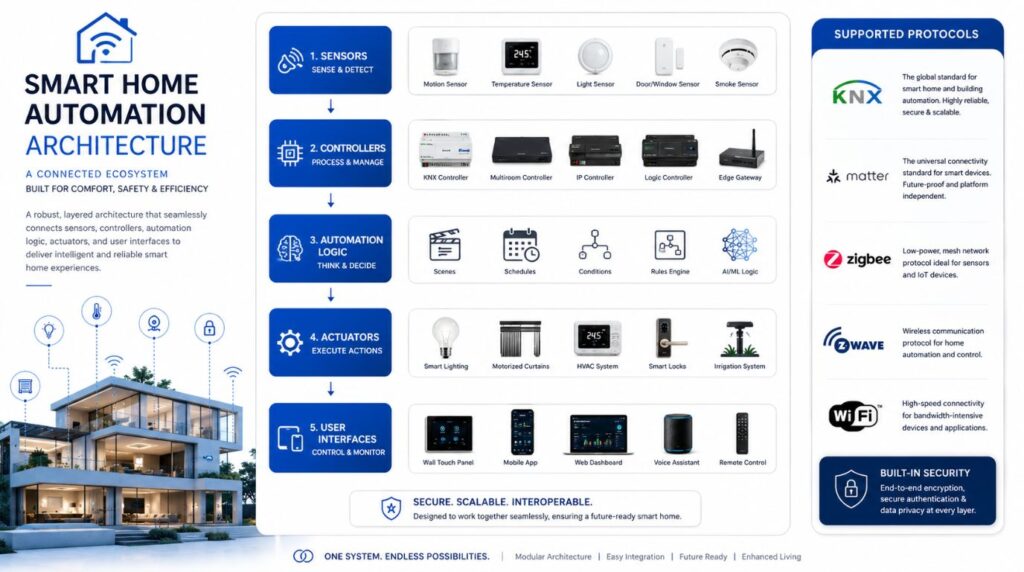
A smart home ecosystem consists of several layers working together.
Sensors
Sensors collect data. Examples:
- Motion sensors
- Occupancy sensors
- Temperature sensors
- Light sensors
- Door sensors
Controllers
Controllers process information and execute commands. These can include:
- KNX controllers
- Automation servers
- Smart hubs
Actuators
Actuators perform actions. Examples:
- Dimming lights
- Adjusting curtains
- Controlling HVAC systems
- Operating smart locks
User Interfaces
Users interact through:
- Mobile apps
- Touchscreens
- Voice assistants
- Keypads
Examples:
- Alexa
- Google Home
- Apple HomeKit
Communication Protocols
Devices communicate using technologies such as:
- KNX
- Wi-Fi
- Zigbee
- Z-Wave
- Matter
Types of Smart Home Automation (India) Systems
Not all automation systems are created equal. Choosing the right technology is one of the most important decisions in any smart home automation (India) project.
1. KNX Home Automation
KNX is considered one of the most reliable automation standards globally. It is a wired automation protocol designed specifically for intelligent buildings.
Advantages:
- Exceptional reliability
- Scalability
- Long lifespan
- Vendor independence
- High customization
Ideal For:
- Luxury homes
- Villas
- Large residences
- Premium commercial projects
At Techtastic, KNX is often our preferred recommendation for clients seeking long-term performance and future scalability.
KNX Benefits Table
| Feature | KNX |
|---|---|
| Reliability | Excellent |
| Scalability | Excellent |
| Security | High |
| Future-Proofing | Excellent |
| Maintenance | Low |
| Initial Cost | Higher |
2. Wireless Home Automation
Wireless automation systems use:
- Wi-Fi
- Zigbee
- Z-Wave
- Matter
Advantages:
- Lower upfront costs
- Easier installation
- Suitable for retrofits
Challenges:
- Network dependency
- Potential reliability concerns
- Scalability limitations
Ideal For:
- Apartments
- Existing homes
- Entry-level smart homes
[VISUAL ASSET: Wireless Automation Network Diagram]
3. Hybrid Home Automation
Hybrid systems combine wired and wireless technologies.
Benefits:
- Flexibility
- Scalability
- Easier expansion
- Balanced investment
Many modern homes increasingly adopt hybrid architectures.
Comparison Table
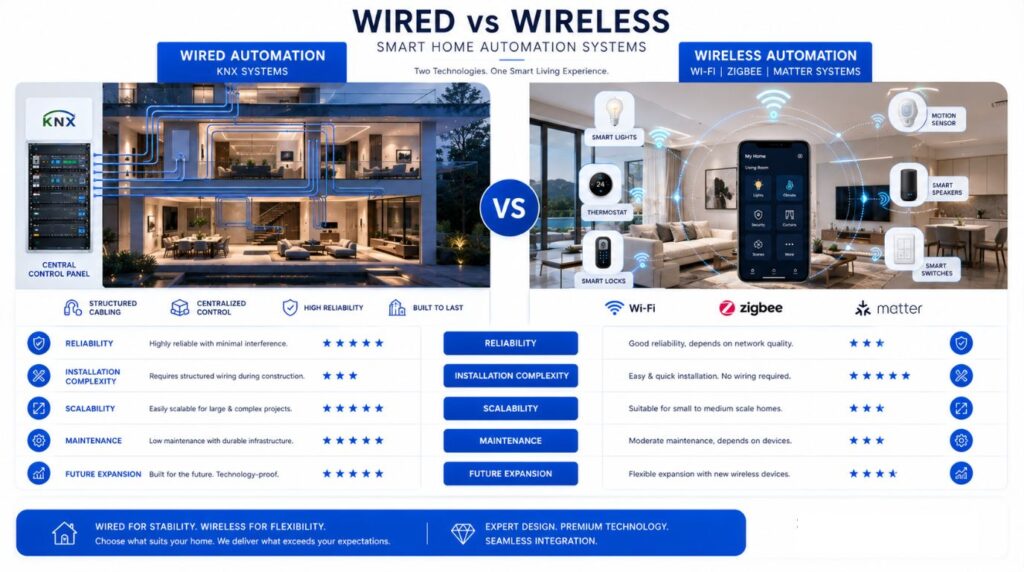
| Feature | KNX | Wi-Fi | Hybrid |
|---|---|---|---|
| Reliability | High | Medium | High |
| Scalability | High | Medium | High |
| Installation Complexity | High | Low | Medium |
| Future Expansion | Excellent | Limited | Excellent |
| Ideal For | Villas | Apartments | Most Homes |
Components: Smart Home Automation (India)
A complete, integrated system designed for smart home automation (India) may include:
- Smart Lighting
- Motorized Curtains
- HVAC Automation
- Smart Security
- Home Theater Automation
- Energy Monitoring
- Smart Locks
- Video Door Phones
- Multi-Room Audio
- Occupancy Sensors
Each component can function independently or as part of a unified automation ecosystem.
1. Smart Lighting Automation
Lighting remains the most requested smart home automation (India) feature among homeowners.
Benefits include:
- Energy savings
- Mood enhancement
- Convenience
- Security
Common lighting scenes:
- Welcome Home
- Movie Night
- Reading Mode
- Dining Mode
- Good Night
2. Motorized Curtains & Blinds
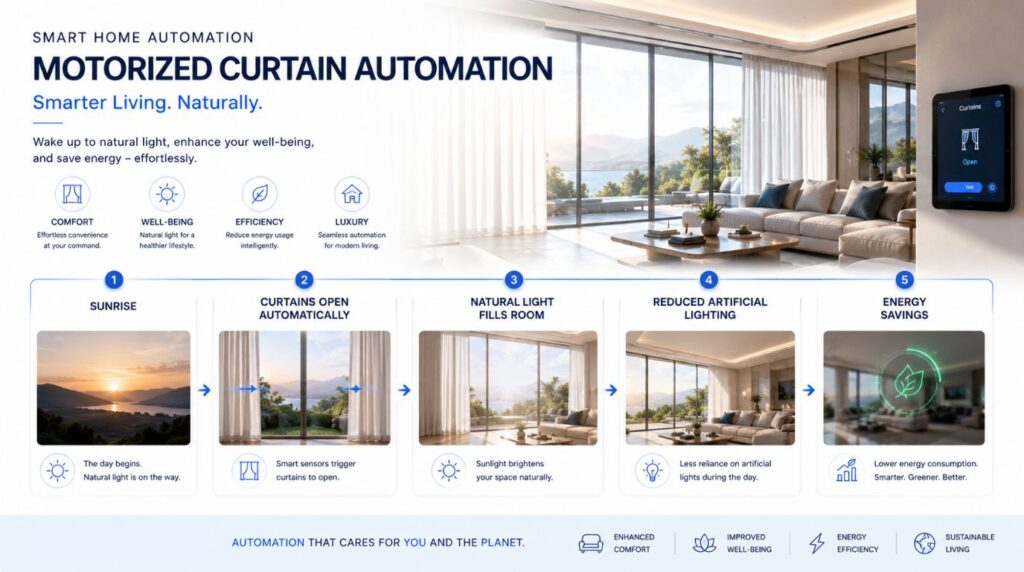
Motorized curtains add both luxury and practicality.
Automation enables curtains to:
- Open at sunrise
- Close during peak sunlight
- Coordinate with lighting scenes
- Improve privacy
Benefits:
- Convenience
- Energy efficiency
- Improved aesthetics
- Better daylight management
3. Smart Home Security Systems
Security is one of the strongest drivers of smart home adoption.
A smart security ecosystem can include:
- CCTV Integration
- Video Door Phones
- Smart Locks
- Motion Sensors
- Intrusion Detection
- Remote Monitoring
At Techtastic, we believe security works best when integrated rather than deployed as isolated systems.
4. Home Theater Automation
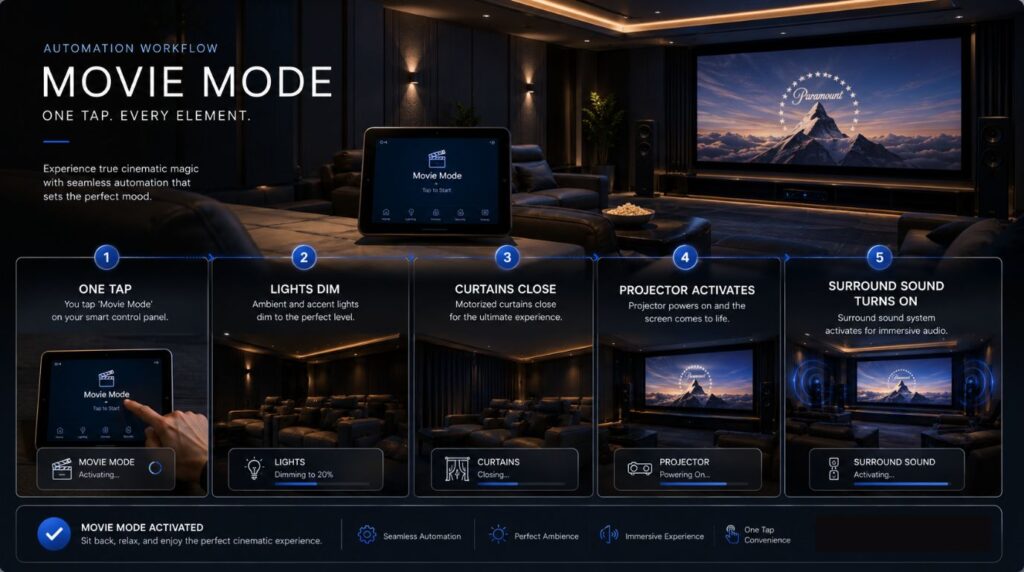
Modern entertainment spaces are becoming increasingly automated.
Features include:
- One-touch movie scenes
- Automated lighting adjustments
- Motorized projector screens
- Integrated sound systems
With a single command, homeowners can transform a room into a cinematic experience.
5. Energy Management Systems
Energy monitoring is becoming a critical aspect of smart home automation (India).
Benefits include:
- Reduced electricity bills
- Consumption insights
- Sustainability improvements
- Load optimization
Smart energy management systems can track and optimize energy usage in real time.
Smart Home Automation India Cost
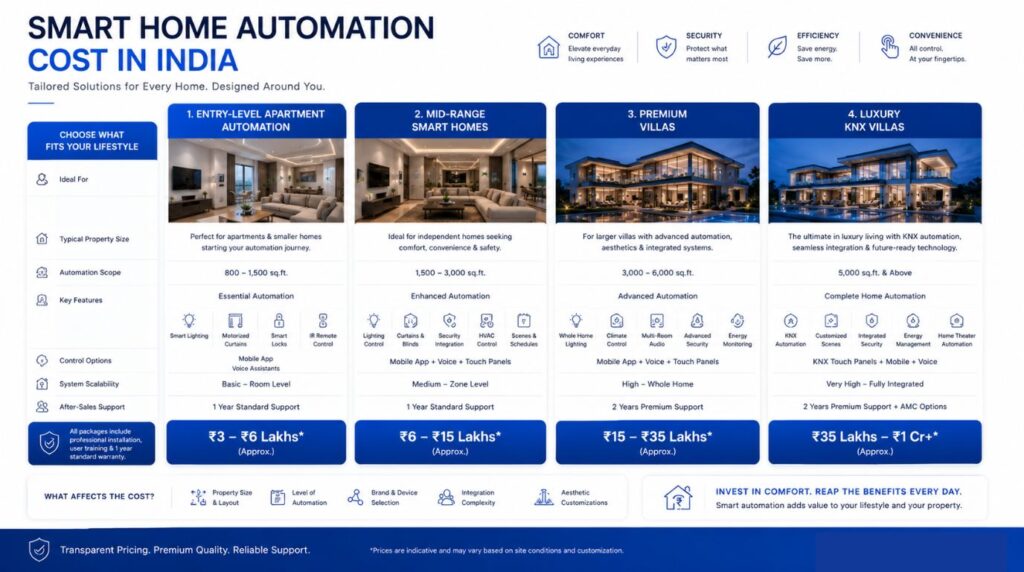
One of the most common questions we receive is: “How much does smart home automation cost in India?”
The answer depends on:
- Property size
- Number of devices
- Technology selected
- Integration level
- Customization requirements
Entry-Level Smart Home
| Home Size | Approximate Smart Home Automation India Cost |
|---|---|
| 1–2 BHK Apartment | ₹50,000–₹2 Lakhs |
Mid-Range Smart Home
| Home Size | Approximate Smart Home Automation India Cost |
|---|---|
| 3–4 BHK Apartment | ₹2–₹8 Lakhs |
Premium KNX Automation
| Home Size | Approximate Smart Home Automation India Cost |
|---|---|
| Luxury Villas | ₹8 Lakhs–₹50 Lakhs+ |
At Techtastic, we always recommend designing automation systems around lifestyle goals rather than focusing solely on upfront costs. A well-designed system should remain useful, scalable, and relevant for years to come.
Installation Process: How We Implement Smart Home Automation
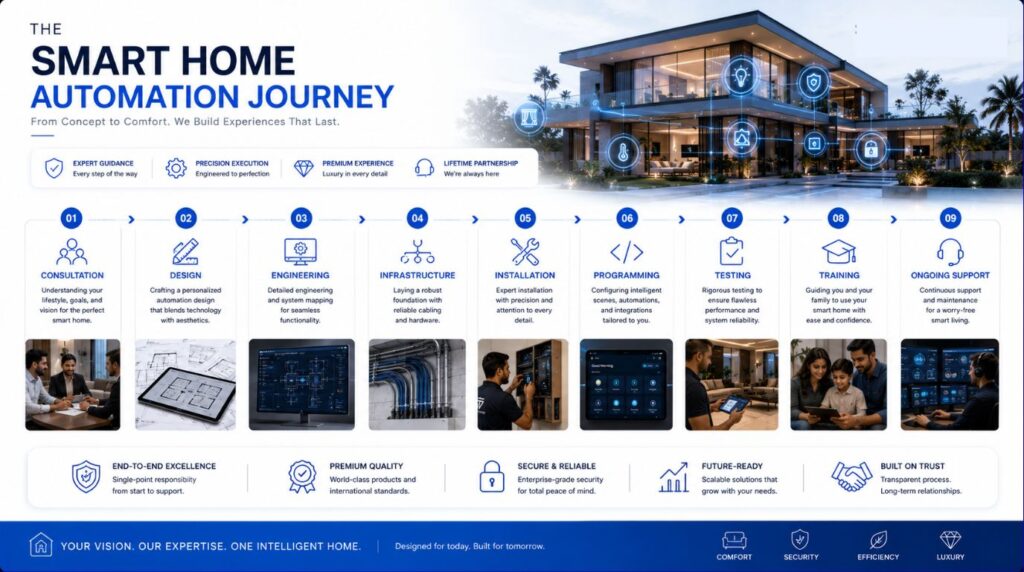
One of the biggest misconceptions about smart home automation (India) is that it is simply about installing a few smart devices and connecting them to a mobile app. In reality, a well-designed automation system requires careful planning, engineering, integration, programming, testing, and future-proofing.
At Techtastic, we approach every project as a complete ecosystem rather than a collection of gadgets.
Step 1: Consultation & Lifestyle Discovery
Before recommending any technology, we first understand how our clients live and use their spaces.
We discuss:
- Daily routines
- Security concerns
- Entertainment preferences
- Lighting requirements
- Energy-saving goals
- Future expansion plans
For example, a family that frequently entertains guests may prioritize lighting scenes and multi-room audio, while another homeowner may focus heavily on security and surveillance.
Step 2: System Design & Planning
Once requirements are identified, we create a detailed automation plan.
This includes:
- Device selection
- Control philosophy
- Wiring requirements
- Network architecture
- User interface planning
- Integration strategy
This phase is particularly important for KNX automation projects because infrastructure decisions made during construction can significantly impact future scalability.
Step 3: Infrastructure & Wiring
For wired automation systems such as KNX, proper cabling infrastructure is installed during construction.
This stage may include:
- KNX bus cabling
- Network cabling
- Security wiring
- Audio/video infrastructure
- Motorized curtain wiring
- Sensor placement
Step 4: Device Installation
Devices are installed throughout the property, including:
- Keypads
- Touchscreens
- Sensors
- Smart switches
- Smart locks
- Cameras
- Curtain motors
- Audio systems
Step 5: Programming & Integration
This is where automation becomes intelligent.
We configure:
- Scenes
- Schedules
- Occupancy-based automation
- Security integrations
- HVAC controls
- Energy management systems
Examples include:
Good Morning Scene
- Curtains open automatically
- Lights gradually brighten
- Air conditioning adjusts
- Favorite music begins playing
Away Mode
- The lights switch off
- The security system activates
- Cameras enter monitoring mode
- Energy consumption is reduced
Step 6: Testing & Optimization
Every automation sequence is tested extensively.
We verify:
- Device responsiveness
- Network stability
- Scene functionality
- Security protocols
- User experience
This ensures reliability before handover.
Step 7: Training & Support
Technology should simplify life—not create confusion.
We train homeowners on:
- Mobile applications
- Voice assistants
- Touchscreen controls
- Scene management
- System customization
We also provide ongoing support to ensure the system continues performing optimally.
Common Mistakes Homeowners Make – Smart Home Automation (India)
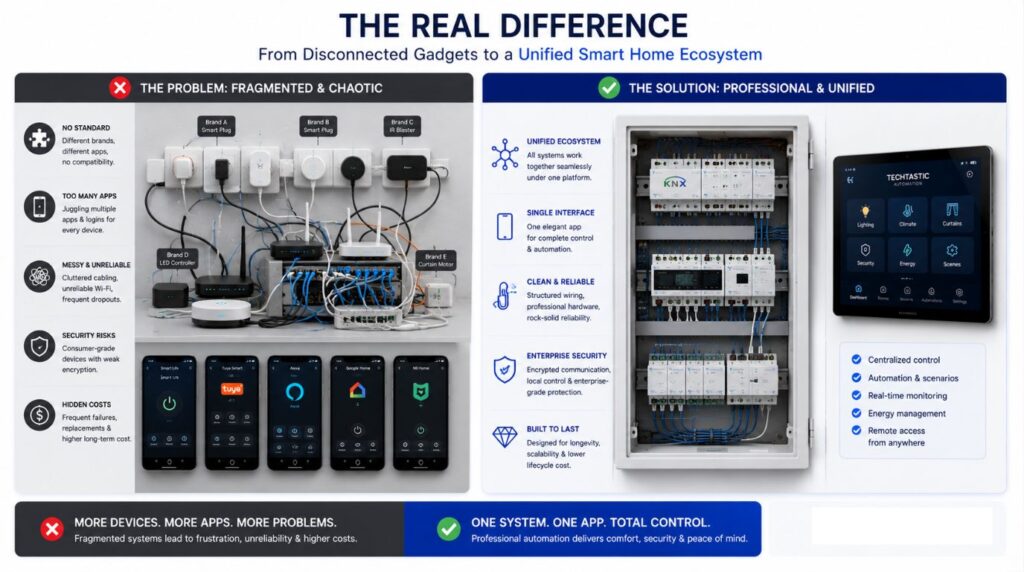
After working on numerous smart home projects, we have observed several recurring mistakes. Avoiding these mistakes can save significant time, money, and frustration.
Mistake #1: Focusing Only on Price
Many homeowners compare automation systems based solely on upfront costs.
However, the cheapest system often becomes the most expensive over time due to:
- Reliability issues
- Compatibility problems
- Limited scalability
- Frequent replacements
We recommend evaluating long-term value instead.
Mistake #2: Choosing Devices Before Planning
Buying smart devices before creating a comprehensive strategy often leads to disconnected systems.
Examples include:
- Separate lighting apps
- Different curtain controls
- Isolated security platforms
A unified ecosystem creates a much better experience.
Mistake #3: Ignoring Future Expansion
A home built today may require additional automation features in the future.
Examples include:
- EV charging systems
- Solar integration
- Additional security zones
- Multi-room audio expansion
Scalability should always be considered during the design stage.
Mistake #4: Overlooking Network Infrastructure
Even the best automation devices cannot perform properly on poor network infrastructure.
Reliable networking is the foundation of every successful smart home.
Mistake #5: Selecting Technology Without Expert Guidance
Technology evolves rapidly.
Choosing protocols, brands, and architectures without professional guidance can result in expensive mistakes.
At Techtastic, we help clients evaluate solutions based on actual project requirements rather than marketing claims.
Best Practices for Smart Home Automation (India)
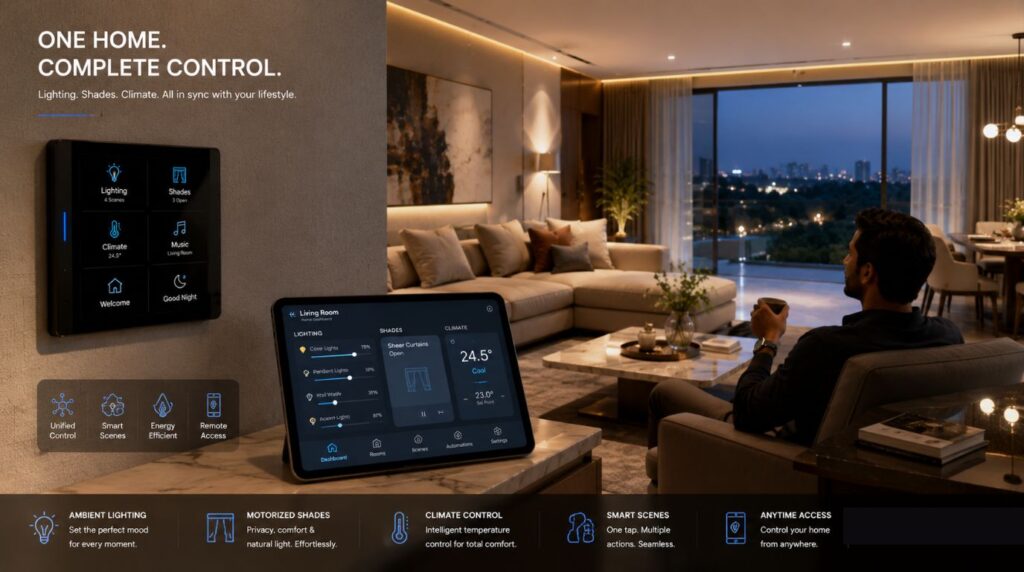
The most successful smart homes follow several key principles.
Design Around Lifestyle
Technology should adapt to people—not the other way around.
We always start with how clients live before discussing devices.
Prioritize Reliability
A system that works consistently is more valuable than one with dozens of rarely used features.
This is one reason many premium homeowners choose KNX automation.
Think Long-Term
A smart home should continue evolving with changing needs.
Future-ready infrastructure prevents costly upgrades later.
Focus on User Experience
The best automation systems feel effortless.
Users should not need technical knowledge to operate their homes.
Integrate Rather Than Isolate
Lighting, security, HVAC, entertainment, and energy management should work together. Integrated systems provide far greater value than standalone devices.
Comparison Section
One of the most common questions we receive is: “Which smart home technology should I choose?”
The answer depends on project requirements.
KNX vs Wi-Fi Automation
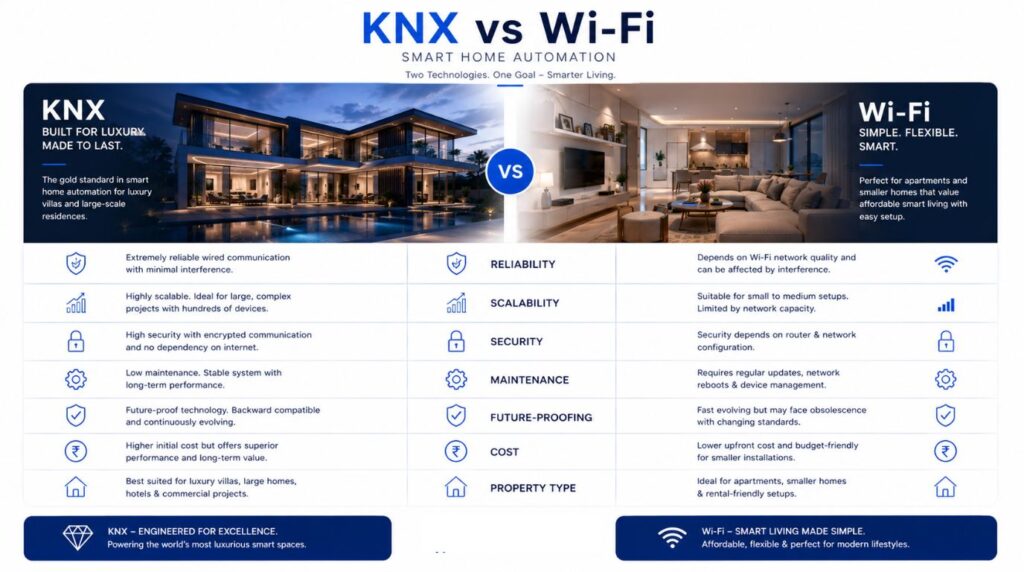
| Feature | KNX | Wi-Fi Automation |
|---|---|---|
| Reliability | Excellent | Good |
| Scalability | Excellent | Moderate |
| Security | High | Moderate |
| Maintenance | Low | Moderate |
| Initial Cost | Higher | Lower |
| Ideal For | Villas & Luxury Homes | Apartments |
Wired vs Wireless Automation
| Feature | Wired | Wireless |
|---|---|---|
| Reliability | High | Medium |
| Latency | Low | Variable |
| Expansion | Excellent | Moderate |
| Retrofit Friendly | No | Yes |
| Lifespan | Long | Moderate |
KNX vs Zigbee
| Feature | KNX | Zigbee |
|---|---|---|
| Protocol Type | Wired | Wireless |
| Reliability | High | Medium |
| Scalability | Excellent | Good |
| Professional Grade | Yes | Limited |
Zigbee vs Z-Wave
| Feature | Zigbee | Z-Wave |
|---|---|---|
| Ecosystem Size | Large | Moderate |
| Device Availability | High | Moderate |
| Interference Resistance | Moderate | High |
Matter vs Traditional Smart Devices
| Feature | Matter | Traditional Ecosystems |
|---|---|---|
| Interoperability | Excellent | Limited |
| Future Compatibility | High | Varies |
| Vendor Lock-In | Low | Higher |
Real-Life Applications of Smart Home Automation (India)
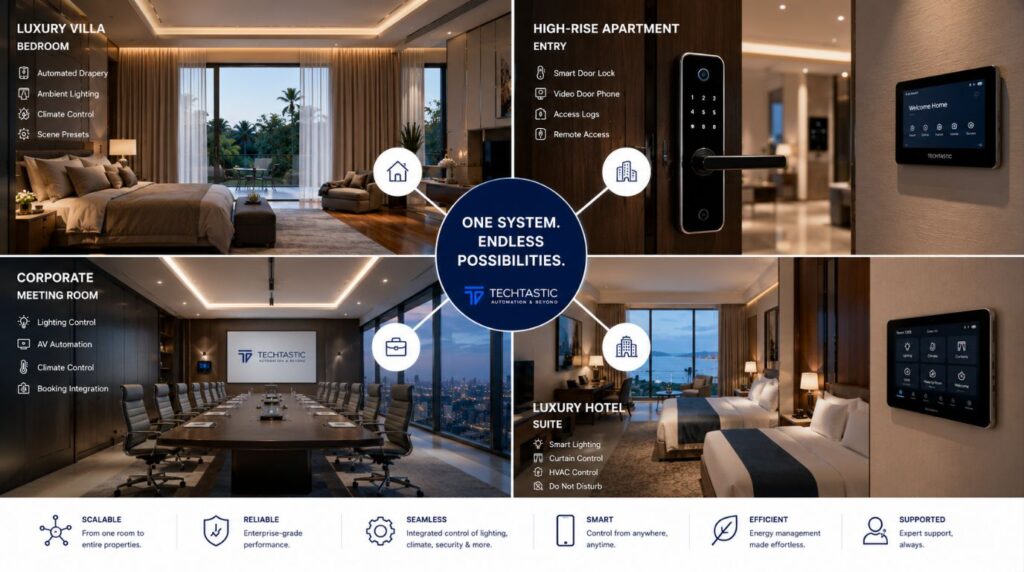
Smart home technology is not limited to luxury villas. Different property types can benefit in different ways.
Apartments
Popular features of smart home apartments include:
- Smart lighting
- Smart locks
- Video door phones
- Voice control
Luxury Villas
Luxury homeowners often choose:
- KNX automation
- Whole-home lighting control
- Multi-room audio
- Motorized curtains
- Advanced security integration
Holiday Homes
Automation provides:
- Remote monitoring
- Energy management
- Occupancy simulation
- Security alerts
Commercial Offices
Businesses increasingly use automation for:
- Energy savings
- Meeting room control
- Security management
- Occupancy analytics
Hospitality Projects
Hotels and resorts leverage automation to improve:
- Guest experiences
- Energy efficiency
- Operational control
Future Trends in Smart Home Automation (India)
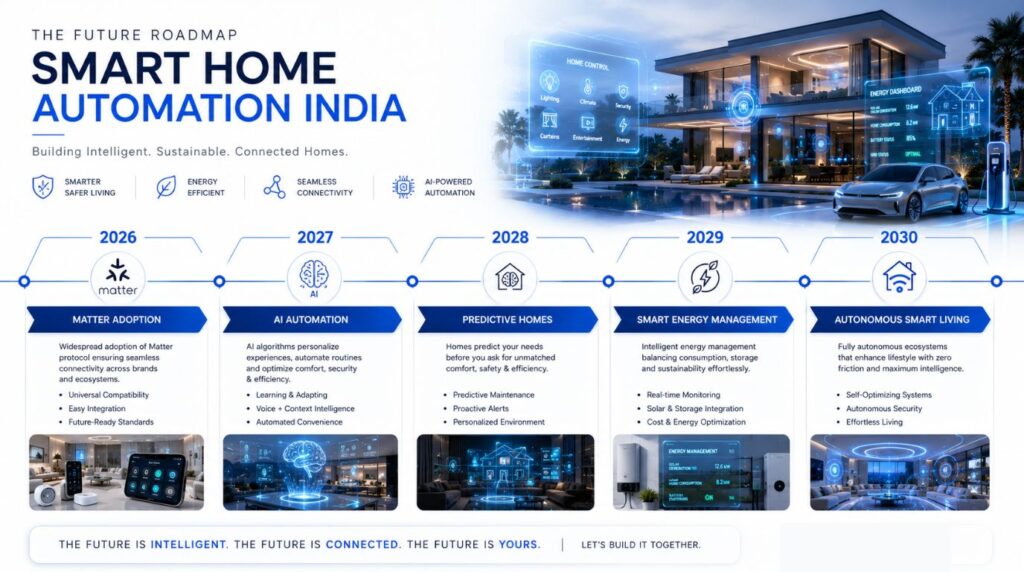
The smart home industry continues to evolve rapidly. Several trends are shaping the future.
Artificial Intelligence
AI-powered systems are becoming increasingly predictive.
Future homes may automatically learn:
- Preferred lighting levels
- Temperature preferences
- Daily routines
- Entertainment habits
Matter Adoption
Matter is expected to improve compatibility across devices from different manufacturers.
This will simplify smart home deployments significantly.
Energy Optimization
As energy costs rise, automation systems will increasingly focus on:
- Consumption monitoring
- Load balancing
- Renewable energy integration
- EV charging management
Voice Control Evolution
Voice assistants will become more natural and context-aware.
Future systems may understand intent rather than specific commands.
Wellness-Centric Homes
Smart homes are increasingly supporting health and wellness through:
- Circadian lighting
- Indoor air quality monitoring
- Climate optimization
- Sleep-enhancing automation
Sustainable Smart Homes
Environmental sustainability is becoming a major design priority.
Automation will play a critical role in:
- Water conservation
- Energy efficiency
- Carbon reduction
Why Trust Techtastic for Smart Home Automation (India)?
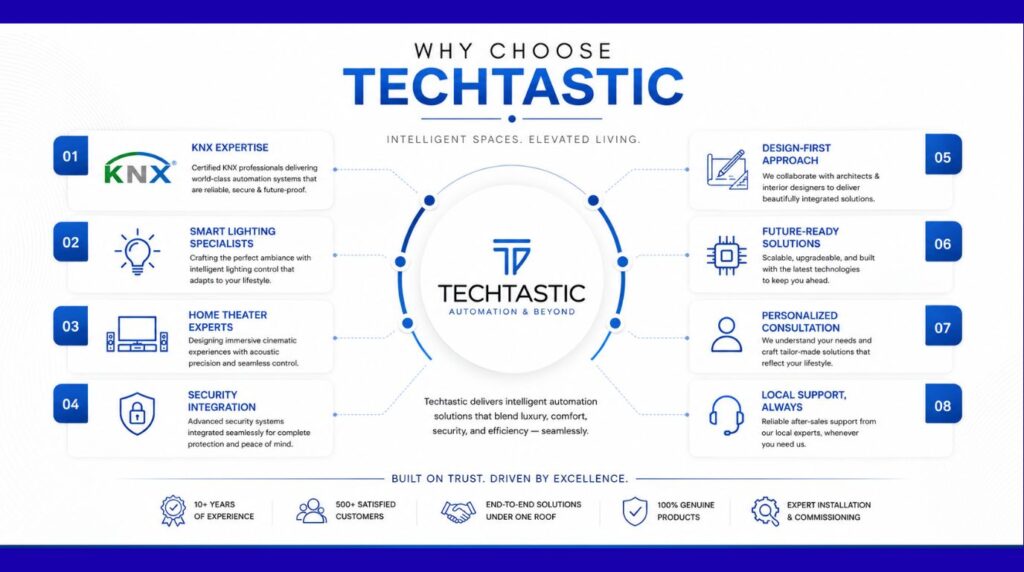
Choosing a smart home automation partner is just as important as choosing the technology itself. A well-designed automation system should continue delivering value for years. It should be reliable, scalable, easy to use, and capable of adapting as technology evolves.
At Techtastic, we approach automation differently. Rather than simply selling products, we focus on designing intelligent living experiences tailored to each client’s lifestyle, property type, and long-term goals.
Our Design-First Approach
Many automation projects begin with product discussions. We believe they should begin with lifestyle discussions.
Before recommending any technology, we focus on understanding:
- How you use your home
- Your daily routines
- Security priorities
- Entertainment preferences
- Future expansion plans
- Budget considerations
This helps us design automation systems that feel natural rather than complicated.
Expertise Across Multiple Technologies
No single automation technology is right for every project.
Our experience spans:
- KNX Home Automation
- Smart Lighting Control
- Motorized Curtains
- Smart Security Systems
- Home Theater Automation
- Energy Management Systems
- Hybrid Automation Systems
- Commercial Automation Solutions
This allows us to recommend solutions based on project requirements rather than pushing a one-size-fits-all approach.
Long-Term Scalability
One of the biggest concerns homeowners have is whether today’s investment will remain relevant in the future.
Our design philosophy prioritizes:
- Expandability
- Future integration
- Technology compatibility
- Ease of maintenance
A properly designed automation system should grow alongside your needs.
Local Expertise
We serve clients across:
- Navi Mumbai
- Nashik
- Sangli
- Lonavala
Because we understand the local architecture, construction practices, climate conditions, and homeowner expectations, we can create automation systems that are practical as well as innovative.
Ongoing Support Philosophy
Technology should never become a burden.
We believe support does not end when installation is complete.
Our objective is to ensure clients continue enjoying their smart homes long after project handover.
Localized Services: Smart Home Automation India by Region
Smart Home Automation India – Services in Navi Mumbai
Navi Mumbai is one of India’s fastest-growing urban regions, with a strong demand for premium residences, luxury apartments, and integrated living experiences.
At Techtastic, our smart home automation India services in Navi Mumbai focus heavily on:
- Smart lighting systems
- Home theater automation
- Smart security systems
- Motorized curtains
- Voice-controlled smart homes
Many new residential developments are increasingly incorporating automation-ready infrastructure during construction.
This allows homeowners to build future-ready homes without extensive retrofitting later.
📞 Call/WhatsApp: 9769145145
📍 Our Operational Hubs: Navi Mumbai | Nashik | Lonavla | Sangli
Common Navi Mumbai Projects
- Luxury apartments
- Premium penthouses
- Smart villas
- Commercial offices
- Builder-led developments
Smart Home Automation India – Services in Nashik
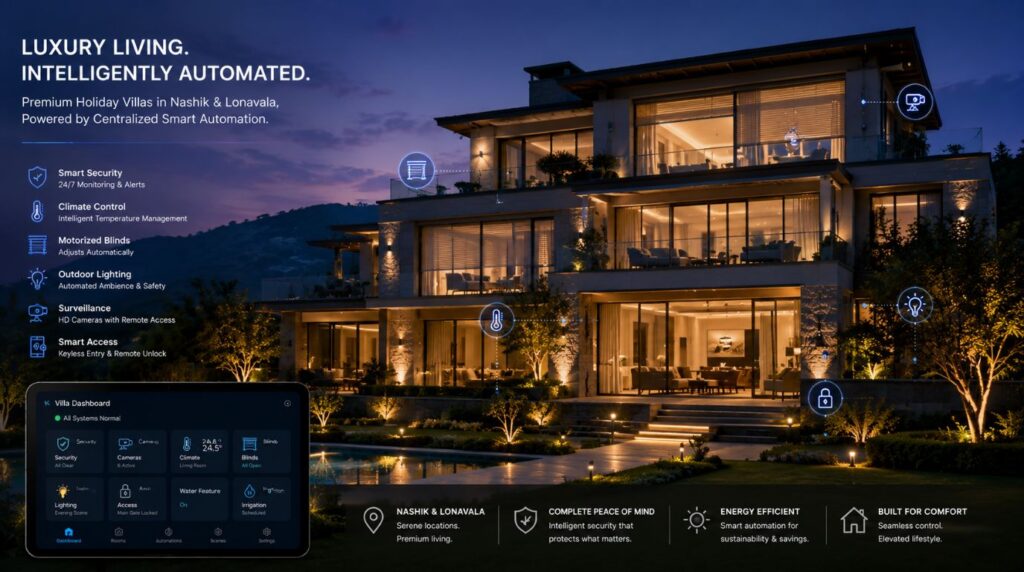
Nashik has experienced significant growth in premium residential projects and luxury villas.
Our team specializes in designing comprehensive KNX-based smart home automation (India) systems for Nashik villas, bringing
- Enhanced security
- Energy efficiency
- Comfort
- Smart lighting experiences
Villa automation is particularly popular in Nashik due to larger property sizes and the need for centralized control.
📞 Call/WhatsApp: 9769145145
📍 Our Operational Hubs: Navi Mumbai | Nashik | Lonavla | Sangli
Common Nashik Automation Requests
- KNX automation
- Luxury villa automation
- Security integration
- Smart irrigation systems
- Energy management
[VISUAL ASSET: Smart Villa Automation Concept]
Smart Home Automation India – Services in Sangli
Sangli is seeing increased demand for modern homes that blend convenience with practicality.
Homeowners are increasingly interested in:
- Smart lighting
- Security monitoring
- Automated curtains
- Energy-saving automation
Many projects begin with essential automation features and gradually expand into larger integrated systems.
📞 Call/WhatsApp: 9769145145
📍 Our Operational Hubs: Navi Mumbai | Nashik | Lonavla | Sangli
Typical Sangli Projects
- Independent homes
- Villas
- Office spaces
- Renovation projects
Smart Home Automation India – Services in Lonavala
Lonavala is known for luxury villas, second homes, holiday properties, and resort-style developments. Automation plays a particularly important role in these properties because owners may not occupy them year-round.
Key Lonavala – smart home automation (India) requirements include:
- Remote monitoring
- Security surveillance
- Climate control
- Lighting automation
- Energy management
Many villa owners appreciate the ability to monitor and control their properties from anywhere in the world.
📞 Call/WhatsApp: 9769145145
📍 Our Operational Hubs: Navi Mumbai | Nashik | Lonavla | Sangli
Popular Lonavala Automation Features
- KNX automation
- Smart security
- Motorized curtains
- Outdoor lighting automation
- Multi-room entertainment
Partner With Techtastic For Smart Home Automation (India)
Smart home automation delivers the best results when it is considered early in the design and construction process. That is why we actively collaborate with architects, interior designers, builders, and developers.
1. For Architects
Architects play a critical role in shaping how technology integrates into a property. By involving automation planning early, we can help create homes that are cleaner, smarter, and more future-ready.
How We Support Architects
Automation-Ready Planning
We help identify infrastructure requirements before construction begins. This minimizes future modifications.
Lighting Design Integration
Smart lighting works best when integrated with architectural planning.
We assist with:
- Scene planning
- Lighting zoning
- User experience design
Technical Consultation
We work alongside architects to ensure automation enhances the overall design vision.
Future-Proof Infrastructure
Our goal is to help create homes that remain technologically relevant for years.
2. For Interior Designers
Modern homeowners increasingly expect technology to blend seamlessly into interiors. We help designers create beautiful spaces without compromising functionality.
How We Support Interior Designers
Hidden Technology Integration
Technology should feel invisible.
We help integrate:
- Sensors
- Keypads
- Speakers
- Motorized curtain systems
without disrupting design aesthetics.
Smart Lighting Experiences
Lighting is one of the most powerful tools in interior design.
We help create:
- Mood scenes
- Entertainment scenes
- Wellness lighting
- Circadian lighting environments
Motorized Curtain Integration
Motorized curtains enhance:
- Convenience
- Privacy
- Luxury appeal
While maintaining clean interior aesthetics.
3. For Builders & Developers
Smart home readiness is increasingly becoming a competitive advantage. Developers who incorporate automation infrastructure can position projects as future-ready premium offerings.
How We Support Developers
Automation-Ready Projects
We help integrate smart infrastructure into:
- Residential developments
- Villas
- Luxury projects
- Commercial buildings
Premium Positioning
Automation can increase the perceived value of a property.
Modern buyers increasingly expect:
- Smart lighting
- Security systems
- Voice control
- Energy efficiency
Future Scalability
Infrastructure planning allows homeowners to add features over time without major reconstruction.
Collaboration Opportunity
If you are an architect, interior designer, builder, or developer planning a new project, we would be happy to collaborate from the early design stage to ensure technology enhances both functionality and user experience.
Frequently Asked Questions
1. What is smart home automation?
Smart home automation is the integration of connected devices and systems that allow homeowners to control lighting, security, climate, entertainment, and other functions through centralized controls, mobile apps, or voice assistants.
2. Is smart home automation (India) worth it?
Yes. Smart home automation (India) improves convenience, security, energy efficiency, and property value. As technology becomes more accessible, it is increasingly viewed as a practical investment rather than a luxury feature.
3. How much does smart home automation (India) cost?
Smart home automation (India) costs vary depending on property size, technology, and level of integration. Entry-level systems may start around ₹50,000, while luxury KNX-based villa automation can range from several lakhs to significantly higher depending on project scope.
4. Is KNX better than Wi-Fi automation?
KNX is generally considered more reliable, scalable, and suitable for premium projects. Wi-Fi automation can be a good option for smaller homes and retrofit installations with lower budgets.
5. Can smart home automation be installed in existing homes?
Yes. Wireless and hybrid automation systems are often ideal for retrofitting existing homes without requiring major structural modifications.
6. Does home automation work during internet outages?
Many professionally designed automation systems continue operating locally even if internet connectivity is lost. Remote access features may be temporarily unavailable.
7. Are smart homes secure?
When properly designed and configured, smart homes can be highly secure. Security best practices include strong passwords, network protection, regular updates, and professional system configuration.
8. What is the lifespan of a smart home automation system?
A professionally designed automation system can remain operational for many years. Wired systems such as KNX are particularly known for long-term reliability and scalability.
9. Can I automate only lighting?
Absolutely. Many homeowners begin with smart lighting and later expand into curtains, security, HVAC, and entertainment systems.
10. What voice assistants work with smart homes?
Popular options include Amazon Alexa, Google Home, and Apple HomeKit, depending on device compatibility and user preferences.
11. Can smart homes reduce electricity bills?
Yes. Automation can optimize lighting, HVAC usage, occupancy-based controls, and energy monitoring to reduce unnecessary consumption.
12. What are motorized curtains?
Motorized curtains use electric motors to automate opening and closing. They can be controlled manually, through schedules, scenes, mobile apps, or voice assistants.
13. What is home theater automation?
Home theater automation integrates lighting, audio, video, and projection systems into a single control interface, creating a seamless entertainment experience.
14. Is smart home automation (India) suitable for villas?
Yes. Villas often benefit significantly from automation because larger properties require centralized control for lighting, security, climate management, and entertainment.
15. What should I look for in a home automation company?
Look for expertise, design capability, technology knowledge, scalability planning, support services, and experience working on projects similar to yours.
Conclusion
Smart home automation is transforming how people interact with their homes. What was once considered futuristic has become increasingly practical, accessible, and valuable. Whether your goal is convenience, security, luxury, energy efficiency, or future readiness, a properly designed automation system can significantly improve how your property functions every day.
At Techtastic, we believe successful automation starts with understanding people, not products. The best smart homes are those that feel intuitive, reliable, and tailored to the way their owners live.
As technologies such as KNX, Matter, AI-driven automation, smart energy management, and integrated security continue evolving, homeowners who invest in future-ready infrastructure today will be best positioned to benefit tomorrow.
Ready to Get Started?
Whether you are building a new home, renovating an existing property, planning a luxury villa, or developing a premium residential project, we can help you design the right automation solution. We offer:
✓ Smart Home Consultation
✓ Site Assessment
✓ Automation Planning
✓ KNX System Design
✓ Smart Lighting Design
✓ Home Theater Planning
✓ Motorized Curtain Integration
✓ Smart Security Design
✓ Energy Management Solutions
✓ Future-Ready Infrastructure Planning
📞 Call/WhatsApp: 9769145145
📍 Our Operational Hubs: Navi Mumbai | Nashik | Lonavla | Sangli
Contact Techtastic today to explore how smart home automation (India) can transform your property into an intelligent, connected, and future-ready living space.