
Summary
Building a genuine future-proof smart home requires deploying a decentralized, open-protocol hardwired backbone—specifically the global KNX standard—during the raw civil construction phase rather than relying on proprietary wireless gadgets. By routing a dedicated low-voltage shielded green bus cable alongside your high-voltage mains, you decouple your home’s physical infrastructure from volatile internet connections, temporary cloud servers, and rapid battery lifecycles. This architectural approach guarantees seamless compatibility with future technologies over a 30+ year lifespan, lowers ongoing electrical maintenance overheads, and cuts whole-home energy consumption by 30% to 50%.
The Tech Graveyard: Why Today’s Wireless Smart Gadgets Are Tomorrow’s Landfill
The traditional approach to residential technology is fundamentally broken. When I consult on high-end architectural sites across premium pockets like Navi Mumbai, Nashik, or Lonavla, homeowners proudly show me the latest wireless smart switches, sleek app-controlled hubs, and Wi-Fi-enabled lighting fixtures they just imported. They view this as cutting-edge design, but through an engineering lens, they are installing a ticking clock of operational obsolescence directly inside their walls.
The harsh reality of consumer tech is short product lifecycles. If you want a true future-proof smart home, you cannot build it on a three-to-five-year commercial replacement loop that relies heavily on third-party cloud servers and proprietary mobile apps. The moment a manufacturer updates its corporate focus, modifies an API, or shuts down its remote servers, your expensive switches become useless wall ornaments overnight.
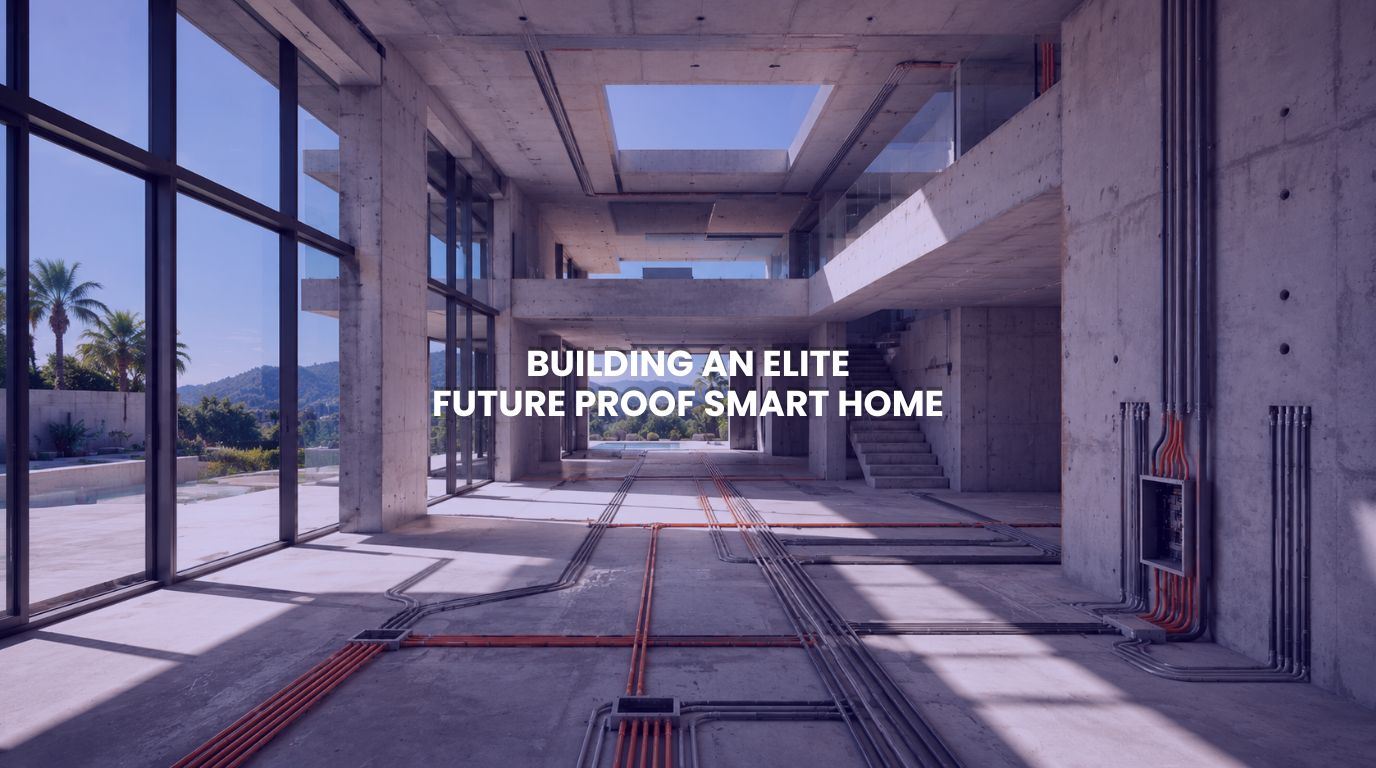
Furthermore, high-density brickwork, metallic glass coatings, and heavy reinforced concrete slabs continuously shield and degrade airborne radio frequencies, leading to dropped automation sequences and network lag. Designing a successful future-proof smart home requires moving past temporary retail trends and building a physical, offline data highway right into the core layout of your home.
What is The Best Standard for Long-Term Future-Proof Smart Home Longevity?
The best standard for long-term future-proof smart home longevity is the globally recognized, open-protocol KNX architecture, a hardwired international standard backed by more than 500 independent manufacturers. Because this infrastructure protocol requires every device to communicate natively over a shared, low-voltage physical bus line, it permanently removes your home’s mechanics from proprietary single-brand ecosystems.
The Interoperability Sovereignty
In a standard closed-system home, you are completely trapped by the single brand you purchased. If that specific company goes bankrupt or stops updating its hardware, your entire automation setup breaks down.
With a hardwired future-proof smart home built on an open standard, like KNX, devices from entirely different manufacturers—whether a German lighting controller, a French touch keypad, or an Italian climate module—interact seamlessly over the same green bus cable. If one brand stops production decades from now, you simply snap a module from a different provider onto the panel rail as a direct, perfect replacement.
Decentralized Intelligence Network Topology
Mass-market wireless smart homes rely on a central master hub or a single Wi-Fi router to handle all system commands. If that single hub overheats, drops its internet connection, or encounters a software loop, your entire house goes dark and unresponsive.
An industrial future-proof smart home network operates on decentralized intelligence. Every individual keypad, motion tracker, and panel actuator contains its own onboard microprocessor and flash memory, meaning automation commands execute locally and instantly with sub-10 millisecond speeds, completely independent of external master hubs or cloud servers.
How do You Design an Electrical Layout to Adapt to Future Technologies?
You design an electrical layout to adapt to future technologies by replacing traditional localized loop wiring with a centralized star-topology framework, where every lighting loop, motorized shade line, and appliance circuit routes directly back to a central distribution board. This physical structural layout keeps the raw high-voltage distribution safely separated from your changing in-room user interfaces, establishing the foundation of a future-proof smart home.
[In-Room DALI-2 Lights] ───┐
[Motorized Shade Pockets] ─┼─ (Direct Radial Paths) ─> [Central Distribution Board]
[VRF AC Control Lines] ────┘ │
[Upgradable DIN-Rail Actuators]
Oversizing Panel Spatial Footprints
Because a future-proof smart home shifts switching and dimming modules out of living room walls and moves them directly inside your electrical distribution boards, these panels require significantly more spatial planning.
When designing your electrical closets, I always recommend allocating 30% to 40% empty DIN-rail space inside your enclosures. This unassigned physical space allows you to cleanly snap in future hardware advancements—such as advanced energy storage managers or predictive AI logic modules—without tearing open your masonry or replacing your main panel boards.
Isolating the Low-Voltage Control Pathway
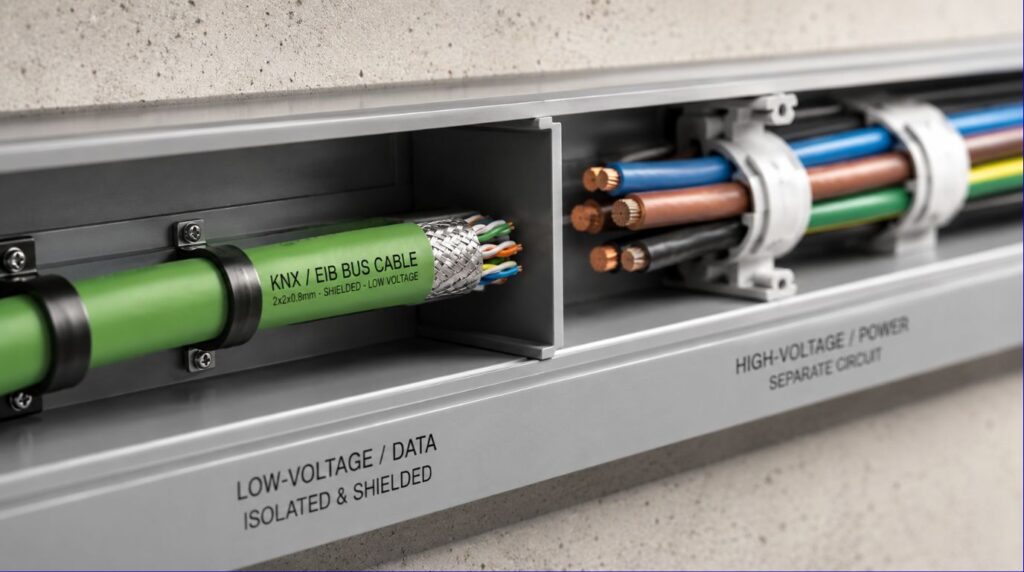
Traditional properties route high-voltage 230V mains power directly behind every manual switch plate, creating substantial electromagnetic noise and high physical wear. A properly engineered future-proof smart home pulls a safe, low-voltage shielded green bus cable parallel to your mains lines but inside independent conduit tracks.
Your wall interfaces become purely data-driven points, running on low current. This allows you to upgrade a room’s aesthetic from a basic push-button keypad to a high-resolution glass touchscreen down the line using the same physical wire.
Why Does a Hardwired Building Infrastructure Lower Ongoing Maintenance Costs?
A hardwired building infrastructure lowers ongoing maintenance costs by completely removing battery-replacement dependencies across your property and isolating sensitive electronics from destructive municipal grid voltage surges. By grounding your home’s communication pathways in physical cables, you transform your automation into a maintenance-free utility built to last for decades, fulfilling the economic promise of a future-proof smart home.
The Eradication of Toxic Battery Tracing Loops
A sprawling premium estate or luxury villa can easily scale to incorporate 150 to 200 distinct automated nodes, including multi-zone climate sensors, motorized drape tracks, and security contacts. If these points run on wireless networks, they require independent battery cells, forcing you or your technical team into a continuous cycle of tracking dropped connections and changing dead lithium batteries hidden inside ceilings.
By pulling a safe, low-voltage shielded green bus cable alongside your high-voltage mains power lines during the raw construction phase, a future-proof smart home supplies continuous local power to every device, achieving a completely maintenance-free layout.
Panel-Level Sequence Power Staggering
In major Indian metropolitan areas and rural vacation landscapes, the single most dangerous millisecond for your home’s luxury infrastructure is the exact second municipal power returns after a blackout. The abrupt, volatile current surge can instantly fry the highly sensitive internal circuit boards of imported kitchen appliances, variable refrigerant flow (VRF) air conditioning compressors, and high-end LED drivers.
I eliminate this massive hardware risk by building intelligent power recovery logic directly into our centralized electrical distribution panels. Instead of allowing the property to draw full load current all at once upon power restoration, the hardwired automation actuators safely delay and stagger high-load electrical loops online, sequence-by-sequence over several seconds, protecting your expensive electronics from terminal damage.
Technical Architectural Comparison: Disposable Tech vs. Lifelong Infrastructure
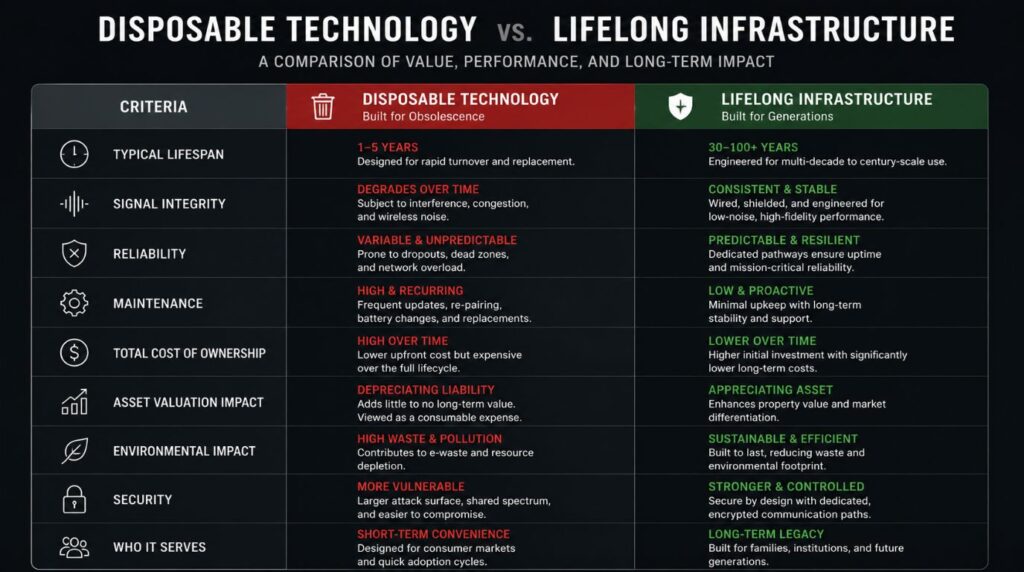
| System Engineering & Lifecycle Metric | Mass-Market Wireless Gadget Retros | Hardwired Open Infrastructure (KNX) |
| Operational Lifespan Expectancy | 3 to 5 years (Rapid product aging) | 30+ Years (Built to match concrete frame) |
| System Signal Integrity | Volatile (Subject to concrete shielding) | Pristine physical cable data transmission |
| Core Network Logic | Public internet cloud dependency | 100% Offline local flash memory chips |
| Device Maintenance Overheads | High (Continuous battery tracking) | Absolute Zero (Continuous bus line power) |
| Interoperability Ecosystem | Closed (Locked into a single brand app) | Universal (500+ global brands cross-link) |
| Whole-Home Energy Efficiency | Minimal/Uncoordinated scheduling | 30% to 50% Savings via physical loops |
| Long-Term Real Estate Asset Value | Negligible / Viewed as temporary clutter | High (Valued as permanent structural asset) |
Turning Your Structural Framework Into an Enduring Environmental Legacy
True eco-luxury and technological future-proofing are invisible, high-performance assets that actively protect your investment while safeguarding your home’s capital and comfort. A future-proof smart home cannot rely on superficial green trends, manual lifestyle adaptations, or temporary wireless gadgets. It requires a permanent building framework engineered from the ground up to handle real-world energy and software challenges efficiently.
At Techtastic, I don’t build our reputation on temporary tech toys or volatile cloud-connected boxes. I look at sustainable home automation through an uncompromising engineering lens, using hardwired international standards to transform your property into an invisible, self-optimizing ecosystem that reduces emissions and preserves capital for generations.
🤝 The Partnership Corner
- For Discerning Homeowners: I design custom, offline-first automation blueprints that deliver a future-proof smart home electrical infrastructure, keeping your home agile and adaptable through every tech generation.
- For Luxury Architects & MEP Consultants: I collaborate directly with your design teams during the raw brickwork phase, providing precise electrical panel schematics, load calculations, and conduit maps to secure verified building efficiency scores for your future-proof smart home projects.
Let’s build a sustainable digital foundation engineered to endure.
📞 Call/WhatsApp: 9769145145
📍 Engineering Premium Reliability Across: Navi Mumbai | Nashik | Lonavla | Sangli
Technical FAQs on Future-Proof Smart Home
Q: Can a wireless smart home system be truly future-proofed against software obsolescence?
A: No. Wireless smart home products rely on proprietary, brand-specific mobile applications and remote internet cloud servers. When a manufacturer goes out of business, changes its subscription model, or stops releasing firmware updates, the physical hardware becomes obsolete, making a hardwired, open-protocol infrastructure the only viable path to genuine longevity.
Q: How does centralized star-topology wiring make a future-proof smart home?
A: Centralized star topology runs every lighting loop, mechanical circuit, and appliance feed directly back to your main electrical panel instead of looping high-voltage lines behind your wall switches. This keeps your home’s heavy power distribution entirely separate from its data controls, allowing you to completely update or swap out your control interfaces down the line without breaking walls or altering your core wiring layout.
Q: What happens if a hardwired KNX device fails 15 or 20 years after installation?
A: Because KNX is an open international standard shared by more than 500 global manufacturers, your system is fully protected against brand dependency. If an individual lighting module or keypad fails two decades from now, you do not have to rebuild your system; you simply replace that specific module with any current KNX device from any manufacturer, and it will communicate natively over your existing green bus wire.