
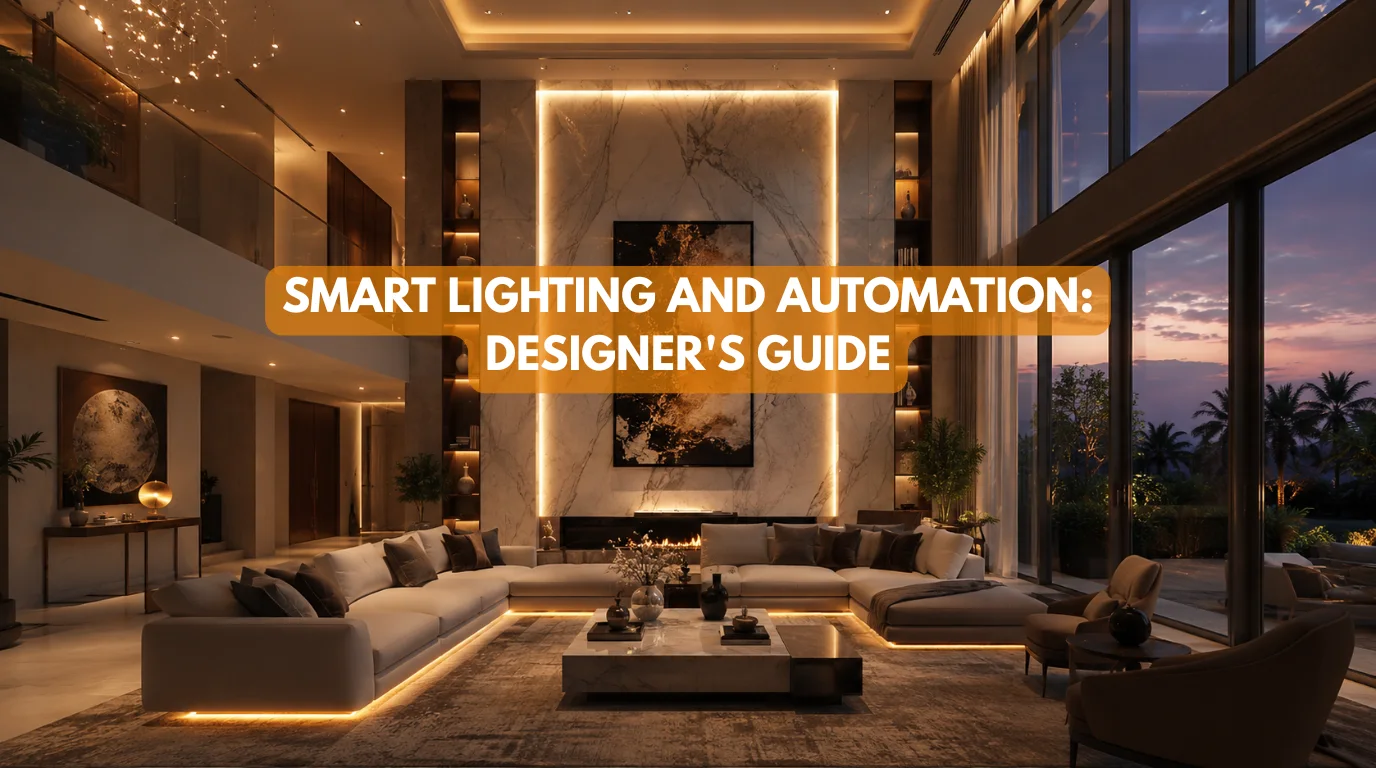
Interior design has always been about creating spaces that look beautiful and feel right. But in modern homes, aesthetics are only one part of the experience. Homeowners increasingly expect their spaces to be comfortable, efficient, intuitive, and responsive to the way they live.
This is where smart lighting and automation are changing the role of the interior designer.
Lighting is no longer limited to selecting fixtures and deciding where to place switches. Designers can now create lighting environments that change according to the time of day, activity, occupancy, and mood. When combined with curtains, climate control, security, and entertainment, lighting becomes part of a larger intelligent ecosystem.
At Techtastic, we work with architects, interior designers, builders, and homeowners to integrate automation into luxury residences across Mumbai, Navi Mumbai, Pune, Lonavala, Nashik, and Sangli. Our approach is simple: technology should enhance the design rather than compete with it.
When smart lighting and automation are considered during the design stage, controls, sensors, wiring, and fixtures can be incorporated naturally into the architecture.
In this guide, we’ll explore how interior designers can use smart lighting and automation to create sophisticated spaces without allowing technology to dominate the visual experience.
Quick Answer
Smart lighting and automation allow interior designers to control lighting levels, colour temperature, scenes, schedules, curtains, and other connected systems through intelligent controls. By planning automation during the design phase, designers can create cleaner walls, better ambience, improved energy efficiency, and more personalized spaces.
Quick Summary
✔ Smart lighting and automation can transform the ambience of a room with one touch.
✔ Designers can create customized scenes for relaxation, entertainment, work, and sleep.
✔ Sensors can automatically respond to occupancy and natural daylight.
✔ Motorized curtains can work together with lighting to balance natural and artificial light.
✔ Smart keypads reduce wall clutter while providing intuitive physical control.
✔ Early planning allows automation infrastructure to blend seamlessly with interiors.
✔ KNX provides a reliable wired foundation for premium residential projects.
The Growing Role of Smart Lighting in Interior Design
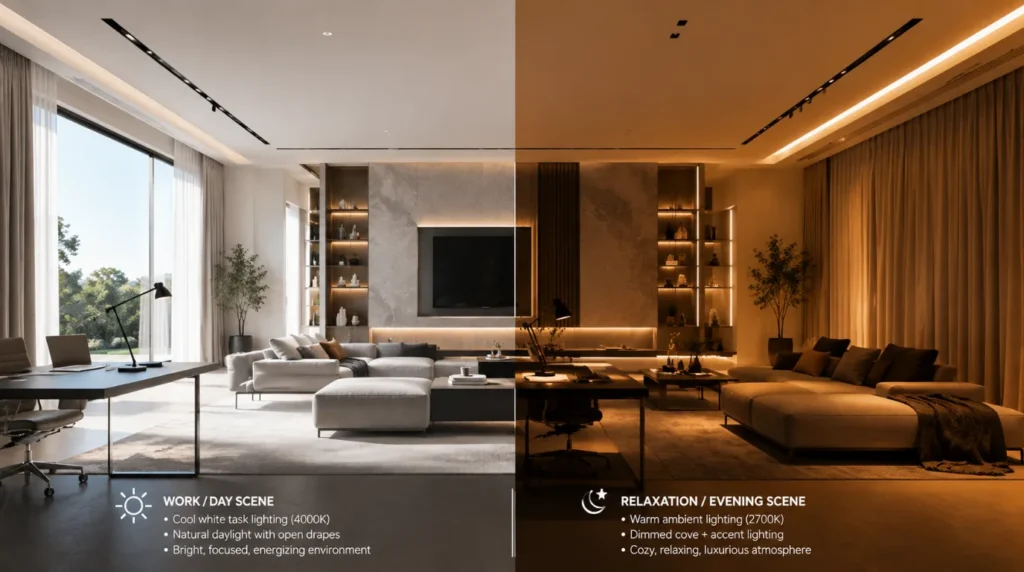
Lighting has always been one of the most powerful tools available to an interior designer. The same room can feel completely different depending on whether it uses bright task lighting, soft ambient illumination, or dramatic accent lighting.
Traditional lighting gives designers control over fixtures and placement. Smart lighting and automation take that control several steps further by allowing the entire lighting environment to change according to the homeowner’s needs.
Instead of designing one fixed lighting arrangement, designers can create multiple experiences within the same space. A living room can feel bright and energetic during the day, warm and relaxing in the evening, and cinematic when the family watches a movie.
This flexibility gives designers another dimension to work with, and lighting becomes dynamic rather than static.
Why Interior Designers Should Consider Automation
Automation is no longer something that should be added after the interiors are complete.
When smart lighting and automation are incorporated during the design process, technology can be planned alongside the architecture rather than being forced into an existing layout.
This gives designers greater control over:
- Switch placement
- Sensor positioning
- Lighting zones
- Ceiling details
- Curtain pockets
- Control panels
- Electrical provisions
- Scene requirements
It also helps prevent one of the most common problems in luxury interiors: too many switches.
A carefully planned automation system can replace multiple conventional switches with elegant keypads or touch interfaces. The result is a cleaner wall while providing significantly more functionality.
1. Design Lighting Around Activities, Not Just Rooms
One of the biggest advantages of smart lighting and automation is the ability to design lighting around activities. Instead of asking, “What lights does this room need?” designers can ask, “How will this room be used?”
Consider a multifunctional living room. During the day, it might be used for:
- Reading
- Conversations
- Working
- Entertaining guests
In the evening, it might become a:
- Relaxation space
- Dining area
- Movie room
- Social gathering space
2. Create Lighting Scenes for Different Ambiences
A lighting scene combines multiple lighting settings into one programmed command.
For interior designers, this is one of the most creative applications of smart lighting and automation.
Relaxation Scene
The room could use:
- Warm ambient lighting
- Reduced ceiling-light intensity
- Soft cove lighting
- Selected accent lights
The result is a calmer environment for evenings.
Entertainment Scene
When guests arrive, the system can activate:
- Decorative lighting
- Accent lighting
- Cove illumination
- Selected architectural features
This allows the interior design to become more visually expressive.
Work Scene
A brighter, more focused lighting environment can be created for:
- Home offices
- Study rooms
- Reading areas
- Creative workspaces
Movie Scene
A single command can:
- Dim the lights
- Switch off unnecessary fixtures
- Close motorized curtains
- Activate the home theatre
- Adjust the room environment
This is where smart lighting and automation become part of the overall experience rather than simply another technology layer.
3. Use Colour Temperature as a Design Tool
Brightness isn’t the only aspect designers can control. A modern automation system can allow lighting colour temperature to change throughout the day.
| Time | Suggested Lighting |
|---|---|
| Morning | Brighter, cooler tones |
| Afternoon | Neutral balanced lighting |
| Evening | Warmer tones |
| Night | Soft, low-intensity lighting |
This approach can be particularly effective in bedrooms, living spaces, wellness areas, and home offices.
With smart lighting and automation, designers can therefore use colour temperature as part of the interior concept rather than treating it as a fixed specification.
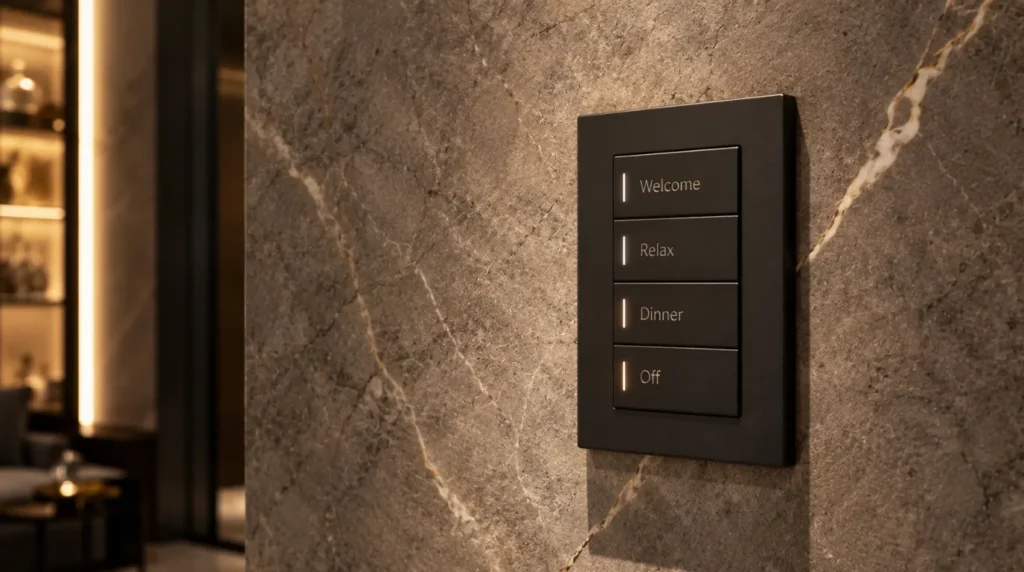
4. Integrate Smart Switches and Keypads Into the Interior
One of the biggest challenges for designers is making technology visually disappear.
Modern automation keypads can control:
- Multiple lighting circuits
- Lighting scenes
- Curtains
- Climate
- Music
- Security functions
The interface can also be selected to complement the interior.
Depending on the product, designers can explore finishes such as:
- Glass
- Metal
- Stone
- Premium matte surfaces
- Custom engraved interfaces
This allows smart lighting and automation controls to become part of the interior language.
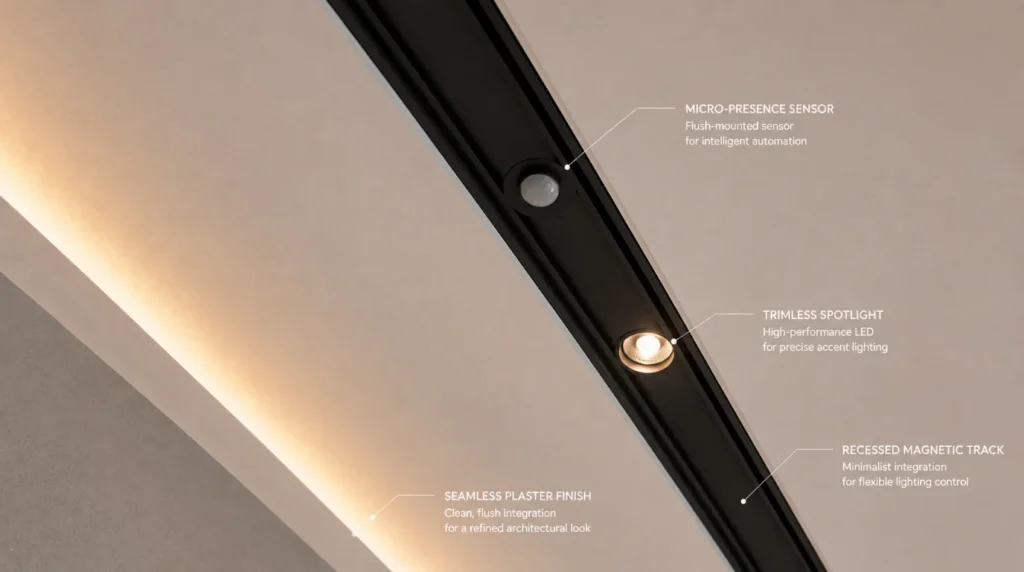
5. Use Sensors Without Making Them the Focus
Sensors are an important part of intelligent lighting, but they don’t need to dominate the visual design.
A well-planned system can use:
Motion Sensors
These detect movement and activate selected lighting.
Presence Sensors
These can detect whether a person remains in a room, making them useful for offices, bedrooms, and living areas.
Daylight Sensors
These measure available natural light and allow artificial lighting levels to respond accordingly.
6. Plan Automation During the Design Phase
The earlier automation is considered, the easier it becomes to integrate technology without compromising the interior.
Designers should coordinate with the automation specialist before finalizing:
- Electrical layouts
- Ceiling plans
- Lighting circuits
- Curtain pockets
- Furniture placement
- Switch locations
- Sensor positions
- Control panels
Early collaboration allows smart lighting and automation to become part of the architectural planning rather than something installed after the interiors are finished.
7. Layer Your Lighting Before Automating It
Automation works best when the underlying lighting design is already strong.
Interior designers should first consider the three fundamental lighting layers:
Ambient Lighting
Provides overall illumination for the room.
Task Lighting
Provides focused illumination for activities such as reading, cooking, working, or dressing.
Accent Lighting
Highlights artwork, architectural details, furniture, textures, or decorative features.
Once these layers are properly designed, smart lighting and automation can coordinate them into scenes.
Smart Lighting for Different Areas of the Home
The best smart lighting and automation strategy isn’t necessarily the one with the most technology. It is the one that responds appropriately to how each space is used.
Every room has a different purpose, so lighting scenes and automation should be designed accordingly.
Living Room
The living room usually needs the greatest flexibility.
A designer can create scenes such as:
- Welcome: Soft ambient lighting with selected accent lights.
- Relax: Warm, low-intensity lighting.
- Entertain: Brighter decorative and accent lighting.
- Movie: Dimmed lighting with curtains closed.
- All Off: Selected lighting switched off when leaving.
This allows one room to transition between different experiences without changing the physical lighting design.
Bedroom
Bedrooms benefit from simple, intuitive automation.
A bedside keypad can control:
- Main lighting
- Bedside lights
- Reading lights
- Curtains
- Climate
- Good Night scene
Kitchen
Kitchen lighting should prioritize functionality.
Designers can combine:
- Bright task lighting
- Under-cabinet lighting
- Pendant lighting
- Ambient ceiling lighting
Automation can allow different combinations depending on whether the homeowner is cooking, dining, entertaining, or cleaning.
Home Theatre
Theatre rooms are ideal for smart lighting and automation because lighting directly affects the viewing experience. A single Movie scene can dim the lights, close blackout curtains, activate the AV system, and adjust the room environment.
Energy Efficiency: Designing Smarter Lighting
Good lighting design isn’t only about aesthetics. It also needs to consider energy consumption.
Smart lighting and automation can reduce unnecessary electricity usage by responding to occupancy, daylight, schedules, and homeowner behaviour.
For example, a corridor doesn’t need full lighting throughout the night. The system could use low-level illumination during late hours and increase brightness when someone enters. Similarly, a room receiving sufficient daylight doesn’t need artificial lights operating at maximum brightness.
Practical Energy-Saving Strategies
- Automatically switch off lights in unoccupied rooms.
- Dim lights when sufficient daylight is available.
- Schedule exterior lighting around sunrise and sunset.
- Use lower brightness for nighttime pathways.
- Create occupancy-based lighting in utility spaces.
- Integrate lighting with motorized blinds and curtains.
This makes energy efficiency part of the design rather than something homeowners have to remember manually.
Smart Lighting and Natural Daylight
Interior designers should not view artificial lighting and daylight as separate systems. They should work together. A well-designed smart lighting and automation system can respond to changing daylight throughout the day.
For example, consider a large living room with floor-to-ceiling windows. In the morning, natural light may provide most of the illumination. As clouds move in or the sun changes position, the system can gradually increase artificial lighting.
During strong afternoon sunlight, motorized blinds can reduce glare and heat. In the evening, the system can transition toward warmer artificial lighting.
This creates a more natural lighting experience while reducing unnecessary energy consumption.
Wired vs Wireless Smart Lighting
Wireless systems are convenient for existing homes because they can often be installed with minimal structural work. However, new luxury homes provide an opportunity to install dedicated infrastructure.
| Feature | Wired Lighting Automation | Wireless Lighting Automation |
|---|---|---|
| Installation | Best during construction | Easy retrofit |
| Reliability | Excellent | Good |
| Network Dependency | Low | Higher |
| Scalability | Excellent | Good |
| Maintenance | Low | Moderate |
| Best For | New luxury homes | Existing properties |
For new premium residences, a wired KNX-based system can provide reliable communication between lighting, sensors, keypads, curtains, HVAC, and other systems. For completed interiors, wireless solutions can provide greater flexibility.
The choice should therefore be made according to the project stage rather than simply following a technology trend.
Why KNX Is Valuable for Designer-Led Projects
For architects and interior designers working on premium residences, KNX offers an important advantage: automation can be treated as part of the building infrastructure.
Instead of creating a collection of independent smart products, a KNX system can connect:
- Lighting
- HVAC
- Curtains
- Security
- Access control
- AV
- Sensors
- Energy management
This creates a unified environment.
A smart lighting and automation strategy based on KNX can also provide greater flexibility in choosing switches, sensors, actuators, and other components because KNX is an open standard supported by multiple manufacturers.
Common Mistakes Interior Designers Should Avoid
1. Adding Automation Too Late
Trying to integrate automation after the interior design is finalized can result in visible wiring, poorly positioned controls, and unnecessary modifications. Plan the technology alongside the design.
2. Installing Too Many Switches
A wall covered with switches can make even a luxury interior look cluttered. Use programmable keypads to consolidate frequently used functions.
3. Ignoring Sensor Placement
A poorly positioned sensor may produce inconsistent automation. Sensor locations should be coordinated with furniture, doors, circulation paths, and lighting zones.
4. Automating Without a Lighting Strategy
Automation cannot fix a poorly designed lighting layout. First establish ambient, task, and accent lighting. Then automate those layers.
5. Choosing Hardware Based Only on Appearance
A beautiful switch isn’t enough.
Designers should also consider:
- Reliability
- Compatibility
- Programming flexibility
- Maintenance
- Future expansion
6. Forgetting the Homeowner’s Lifestyle
Every automation system should reflect how the residents actually use the space. A family with children will have different requirements from a couple living in a weekend villa.
Designing for the Future
Interior design projects often last for decades, while technology changes much faster. This makes future-readiness particularly important.
When planning smart lighting and automation, designers should consider how the system could evolve.
A homeowner may eventually add:
- Motorized curtains
- Solar energy monitoring
- EV charging
- Smart security
- Home theatre
- Multi-room audio
- Advanced climate control
- AI-powered automation
A scalable infrastructure makes these additions easier.
Our Recommendation for Interior Designers
At Techtastic, we believe smart lighting and automation should enhance an interior rather than dominate it. The best smart home is not the one with the most screens. It is the one where technology quietly performs useful tasks while the homeowner experiences the space naturally.
For new luxury residences, we generally recommend considering KNX-based wired automation because it provides reliable infrastructure and allows lighting to work together with climate control, curtains, security, and entertainment.
For completed homes, wireless solutions can be a practical alternative where extensive rewiring isn’t possible. In both cases, the most important step is early collaboration.
When designers, architects, electricians, and automation specialists work together from the beginning, technology can disappear into the design.
Key Takeaways
- Smart lighting and automation give interior designers greater control over ambience, comfort, and functionality.
- Lighting scenes can transform one room into multiple experiences.
- Colour temperature can be adjusted throughout the day.
- Sensors can improve both convenience and energy efficiency.
- Motorized curtains can work with lighting to balance daylight and artificial illumination.
- Programmable keypads can reduce wall clutter.
- KNX provides a strong wired foundation for premium new homes.
- Wireless systems remain useful for retrofit projects.
- Automation should be designed around the homeowner’s lifestyle.
- Early collaboration produces cleaner, more reliable, and more aesthetically integrated results.
Frequently Asked Questions
1. What is smart lighting and automation?
A. Smart lighting and automation combine intelligent lighting controls with sensors, scenes, schedules, and broader home automation systems. It allows lighting to respond automatically to occupancy, daylight, time, and homeowner preferences.
2. Why should interior designers use smart lighting?
A. It gives designers greater control over ambience, brightness, colour temperature, and lighting scenes while allowing spaces to adapt to different activities.
3. Can smart lighting work with KNX automation?
A. Yes. KNX can integrate lighting with other systems such as HVAC, curtains, security, sensors, and AV equipment to create a unified automation environment.
4. Can smart lighting reduce electricity consumption?
A. Yes. Automated dimming, occupancy detection, scheduling, and daylight-based control can reduce unnecessary lighting usage.
5. Should lighting automation be planned before interior work?
A. Ideally, yes. Planning smart lighting and automation early allows wiring, sensors, control locations, and lighting zones to be coordinated with the interior design.
6. Can smart lighting control motorized curtains?
Yes. Lighting and curtains can be integrated into scenes. For example, a Movie scene could dim the lights while automatically closing the curtains.
7. Are wireless smart lights suitable for luxury homes?
A. They can be suitable for some applications, especially retrofit projects. However, new luxury homes can benefit from the reliability and scalability of professionally installed wired automation.
8. How can designers prevent smart switches from cluttering walls?
A. Programmable keypads can combine multiple lighting circuits and scenes into one elegant control interface, reducing the number of conventional switches required.
9. What is the difference between smart lighting and lighting automation?
A. Smart lighting generally refers to connected lighting products and controls. Lighting automation goes further by allowing lights to respond automatically to sensors, schedules, scenes, occupancy, and other home systems.
10. Is smart lighting and automation worth adding to a luxury interior?
A. Yes. When properly designed, smart lighting and automation can improve ambience, convenience, energy efficiency, and the overall experience without compromising the visual design of the space.
Collaboration Opportunities for Builders, Architects & Interior Designers
Great automation begins during the design stage.
At Techtastic, we collaborate with:
- Interior Designers
- Architects
- Builders
- Real Estate Developers
- Project Management Consultants
- Luxury Villa Developers
We can support your projects with:
- Smart Lighting Planning
- KNX Automation Design
- Lighting Scene Programming
- Electrical Layout Coordination
- Sensor Placement
- Keypad Planning
- Motorized Curtain Integration
- HVAC Automation
- Home Theatre Integration
- Smart Security
- Structured Cabling
- Future Expansion Planning
By involving Techtastic early, design professionals can ensure that automation supports the architectural concept instead of disrupting it.
Areas We Serve
Techtastic provides smart lighting and automation solutions across:
- Mumbai
- Navi Mumbai
- Pune
- Lonavala
- Nashik
- Sangli
Whether you’re designing a luxury villa, premium apartment, farmhouse, or residential development, our team can help integrate intelligent lighting and automation into the project from the planning stage.
Ready to Bring Your Interior Design to Life?
The best smart lighting and automation doesn’t compete with good interior design. It makes good design work harder.
The right lighting scene can change the mood of a room. The right sensor can eliminate unnecessary energy consumption. The right keypad can remove a wall full of switches. And the right automation infrastructure can allow lighting, curtains, climate, security, and entertainment to work together seamlessly.
At Techtastic, we help architects, interior designers, builders, and homeowners create intelligent spaces where technology feels natural, and the design remains the focus.
Book your consultation today and experience the comfort of smart lighting and automation.
Contact Techtastic
🌐 Website: Techtastic Website
📞 Phone: 9769145145
📍 Service Areas: Mumbai • Navi Mumbai • Pune • Lonavala • Nashik • Sangli
Wondering when you need professional help with smart lighting? Explore our guide on Smart Lighting Installation 2026: When To Call An Expert?