
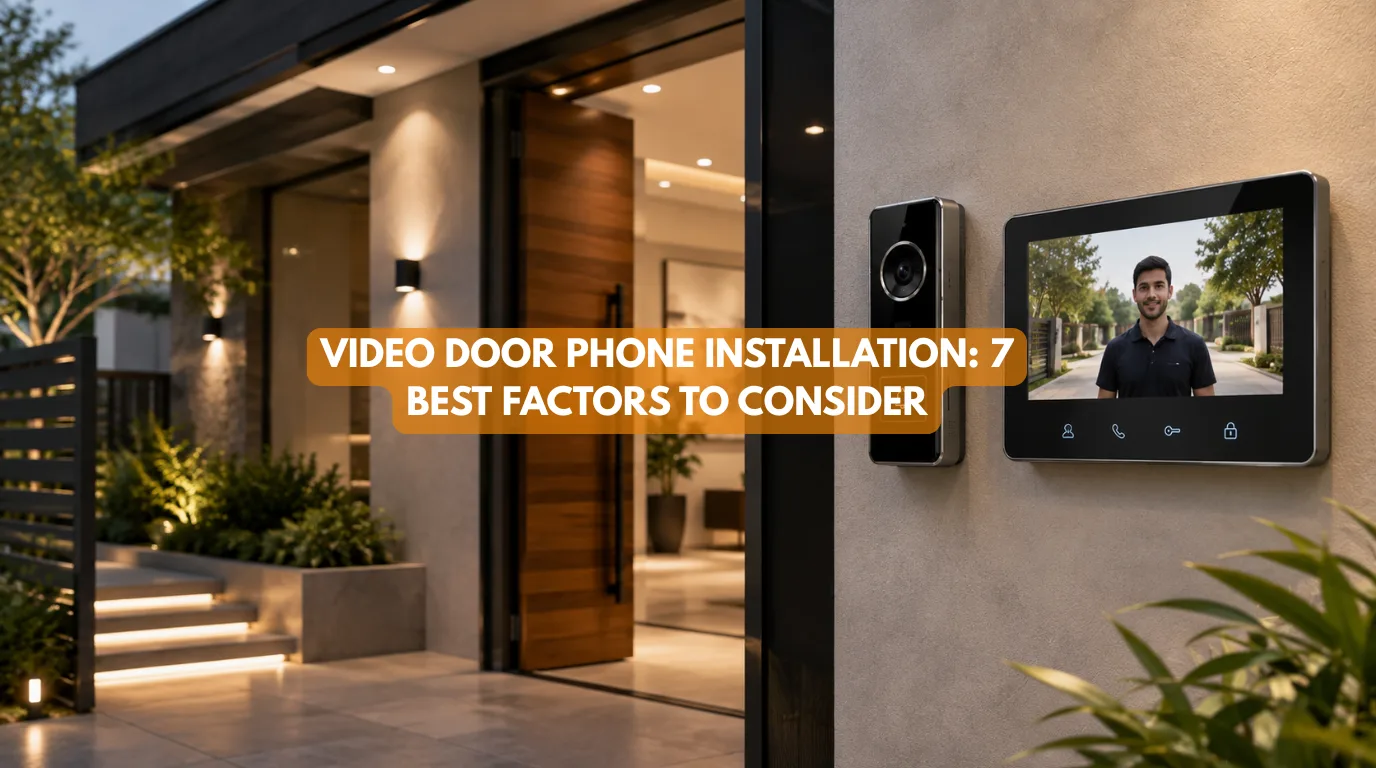
A video door phone is no longer simply a device that lets you see who is standing outside your door. For modern homes, apartments, villas, offices, and gated properties, it can become an important part of a broader security and access-control system.
However, successful video door phone installation requires more than mounting an indoor screen and connecting a camera. The location of the outdoor unit, viewing angle, wiring, power supply, network connectivity, lock integration, audio quality, and future expansion all affect the system’s performance.
At Techtastic Technologies, we help homeowners, architects, builders, and businesses plan technology around the property rather than treating security devices as isolated products.
In this guide, we’ll explain the important factors to consider during video door phone installation, how to choose the right system, common mistakes to avoid, and how a video door phone can become part of a larger smart security setup.
Quick Answer
The most important factors in video door phone installation are camera placement, viewing angle, wiring, power supply, audio quality, display location, access-control integration, and future connectivity. The right system should provide clear video, reliable communication, secure access, and simple operation for everyone in the home.
Quick Summary
✔ Camera placement affects visitor visibility.
✔ A wide viewing angle helps cover the entrance effectively.
✔ Wiring should be planned before finishing work.
✔ The indoor monitor should be positioned somewhere convenient.
✔ Night vision is important for entrances with limited lighting.
✔ Two-way audio should remain clear even in noisy surroundings.
✔ Smart locks can be integrated with compatible systems.
✔ Weather-resistant outdoor units are important for exposed entrances.
✔ Professional video door phone installation improves reliability and long-term performance.
What Is a Video Door Phone?
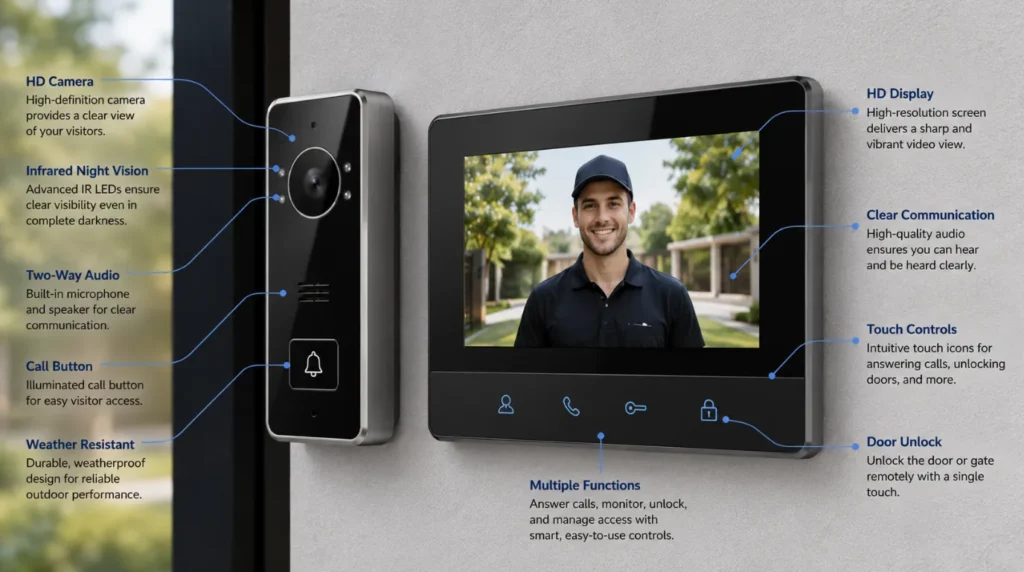
A video door phone is an electronic communication and security system that allows occupants to see and communicate with visitors before granting them access.
A typical system includes an outdoor camera unit and an indoor monitor. When a visitor presses the call button, the indoor display shows the visitor’s image. The homeowner can communicate through two-way audio and, depending on the system, unlock the entrance remotely.
Depending on the model, a video door phone may support:
- HD or Full HD video
- Wide-angle cameras
- Night vision
- Two-way audio
- Multiple indoor monitors
- Door-lock integration
- Mobile notifications
- Remote answering
- Access control
- Recording
- Smart-home integration
This makes video door phone installation relevant not only to standalone security but also to complete home automation projects.
Factors to Consider for Video Door Phone Installation
1. Choose the Right Camera Location
The first consideration during video door phone installation is camera placement. The outdoor unit should provide a clear view of the person standing at the entrance.
The installer needs to consider:
- Visitor height
- Door position
- Gate position
- Camera height
- Viewing angle
- Nearby walls
- Lighting conditions
- Potential blind spots
A camera positioned directly against a wall or inside a narrow recess may have a restricted viewing angle. The objective is not simply to install the camera at a convenient height. It is to create the best possible identification view.
2. Consider the Viewing Angle and Image Quality
A high-quality camera is only useful if it can see the area you actually need to monitor. Wide-angle cameras can be particularly useful for entrances where visitors may stand slightly to the side of the door. Image quality also matters.
Important specifications can include:
- Resolution
- Lens type
- Field of view
- Low-light performance
- Night vision
- Dynamic range
- Image processing
During video door phone installation, the installer should consider where sunlight falls throughout the day. A camera pointed directly toward bright sunlight may produce an image with strong contrast or washed-out areas.
Good positioning and suitable camera technology work together to provide clearer visitor identification.
3. Plan Wiring and Power Before Installation
Wiring is one of the most important technical considerations.
For new construction, video door phone installation should ideally be coordinated with the electrical and low-voltage planning.
This allows the project team to determine:
- Cable routes
- Power requirements
- Indoor monitor locations
- Outdoor-unit connections
- Network connections
- Gate connections
- Door-lock wiring
- Backup power requirements
Planning these details early can prevent visible cables and unnecessary modifications later.
For an existing property, the installer can evaluate available conduits, electrical points, network infrastructure, and possible cable routes. Depending on the selected system, IP networking may also be used.
A professional installation should therefore consider both the current system and potential future upgrades.
4. Select the Right Indoor Monitor Location
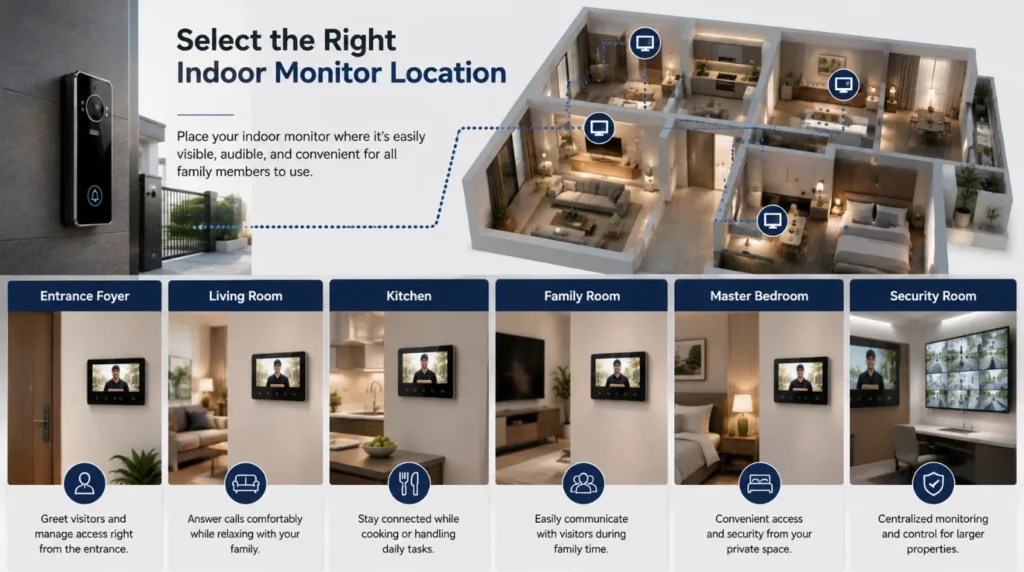
The indoor monitor is the part of the video door phone that homeowners interact with most frequently. Its position matters. An ideal location should be convenient for residents and easily accessible when a visitor calls.
Possible locations include:
- Entrance foyer
- Living room
- Kitchen
- Family room
- Master bedroom
- Security room
During video door phone installation, the number and placement of indoor screens should be considered based on the property’s layout rather than simply choosing the location with the easiest wiring route.
5. Don’t Overlook Audio Quality
People often focus heavily on the camera and forget that communication is equally important. A video door phone should allow residents to clearly understand the visitor and for the visitor to hear the resident.
Poor audio can become a serious issue when the entrance is located near:
- Busy roads
- Traffic
- Gardens with water features
- Construction areas
- Large gates
- Commercial spaces
- High-density residential areas
Good video door phone installation should consider microphone and speaker placement, ambient noise, echo, and the distance between the visitor and outdoor unit.
Clear two-way communication is particularly important when the resident cannot physically approach the entrance.
6. Consider Door Lock and Access-Control Integration
A video door phone becomes much more useful when it can work with the entrance lock. Depending on the system, residents may be able to verify a visitor and unlock the door from the indoor monitor.
Compatible systems may integrate with:
- Electric locks
- Magnetic locks
- Smart locks
- Access-control systems
- Gates
- Boom barriers
- Electric strikes
During video door phone installation, the lock type should therefore be considered before finalizing the hardware. The video door phone, lock, power supply, and access-control mechanism need to work together correctly.
7. Plan for Smart-Home and Mobile Integration
Modern video door phones can offer more than communication through an indoor screen. Some systems can connect with smartphones or broader smart-home platforms.
Depending on the selected system, homeowners may be able to:
- Receive visitor notifications
- Answer calls remotely
- View the entrance
- Communicate with visitors
- Unlock compatible entrances
- Record visitor activity
- Integrate security events
This can be especially useful when you’re away from home. For example, a delivery person arrives while you’re at work. Instead of simply missing the visitor, a compatible system may allow you to communicate with them remotely.
When planning video door phone installation, it is therefore worth considering whether mobile or smart-home integration may be required later.
Wired vs Wireless Video Door Phones
One of the major decisions during Video Door Phone Installation is whether to choose a wired or wireless solution.
Wired Systems
Wired systems can provide reliable communication between the outdoor unit, indoor monitor, lock, and other components.
They are particularly suitable for:
- New homes
- Luxury villas
- Large properties
- Multi-monitor installations
- Projects with planned structured cabling
The main advantage is that the infrastructure is planned permanently.
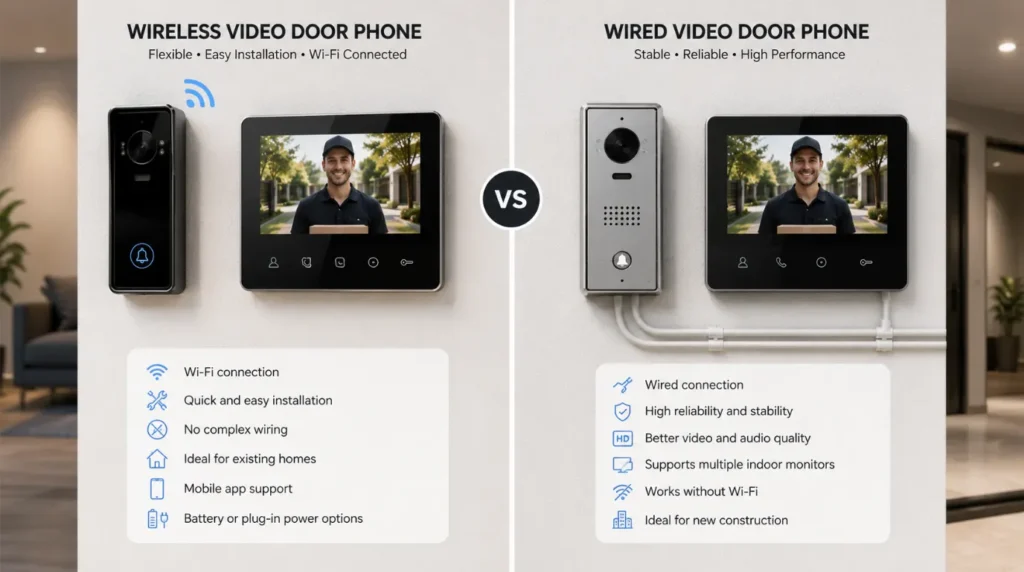
Wireless or Network-Based Systems
Wireless solutions can simplify installation in some existing properties. They can be useful where running new cables would be difficult or disruptive.
However, wireless systems depend on the property’s network environment, signal coverage, and power arrangements. For a new luxury home, professional wiring like KNX can provide a more structured foundation. For an existing apartment, a network-based or wireless solution may be more practical.
The correct decision depends on the building and project stage.
Night Vision and Low-Light Performance
A visitor doesn’t always arrive during daylight. Entrances may be poorly lit at night, especially in large properties or garden areas. Night vision can help the camera maintain visibility when ambient light is low.
However, good video door phone installation also considers the surrounding lighting. A properly positioned entrance light can improve both security and visitor experience.
For smart homes, lighting can potentially be linked with visitor detection or access events, depending on the automation system. For example, entrance lighting could activate when a visitor presses the call button.
Common Mistakes to Avoid
Before starting video door phone installation, avoid these common mistakes.
Installing the Camera Too High
The visitor’s face may not be properly visible.
Ignoring Sunlight
Direct sunlight can affect image quality.
Choosing Hardware Without Checking the Lock
The door-release mechanism needs to be compatible.
Forgetting Network Requirements
IP-based systems require suitable network infrastructure.
Placing the Monitor in an Inconvenient Location
A monitor that residents rarely hear or see reduces the system’s usefulness.
Ignoring Future Expansion
A basic system today may need additional cameras, monitors, locks, or automation later.
Treating Installation as an Afterthought
Security infrastructure should ideally be planned alongside electrical and interior design work.
When Should You Plan Video Door Phone Installation?
The best time is during the early planning stage of a new property.
Early planning makes it easier to coordinate:
- Electrical layouts
- Network cabling
- Door frames
- Gate infrastructure
- Lock systems
- Security cameras
- Indoor monitors
- Automation systems
However, existing properties can also be upgraded. During a retrofit, the installer evaluates the current infrastructure and recommends the least disruptive approach.
This is why video door phone installation should be treated as part of the property’s security planning rather than simply purchasing a device after construction is complete.
Why Choose Techtastic Technologies?
At Techtastic Technologies, we look at video door phone installation as part of a complete smart-home or security ecosystem.
Rather than selecting hardware in isolation, we consider how the video door phone can work alongside:
- Smart locks
- CCTV
- Access control
- Smart lighting
- KNX automation
- Gate automation
- Mobile control
- Home networking
This approach helps create a more coordinated security environment. For homeowners, the goal is simple: a system that is reliable, easy to use, and appropriate for the property.
Key Takeaways
- Good video door phone installation begins with planning rather than simply mounting a camera.
- The outdoor camera should provide a clear view of visitors.
- Wiring and power should be coordinated with the property’s electrical and network infrastructure.
- The indoor monitor should be positioned where residents can easily hear and access it.
- Audio quality is just as important as video quality.
- Smart locks and gates can add convenient access control.
- Night vision and outdoor protection should be considered for exposed entrances.
- Wireless solutions can be useful for some existing homes, while wired infrastructure can be ideal for new properties.
- Mobile and smart-home integration can make the system considerably more useful.
- Professional video door phone installation helps ensure that the complete system works reliably together.
Frequently Asked Questions
1. What is the best location for a video door phone camera?
A. The camera should be positioned to provide a clear view of visitors’ faces while covering the entrance effectively. Height, angle, sunlight, and surrounding structures should all be considered.
2. Is Video Door Phone Installation possible in an existing home?
A. Yes. Existing homes can use wired, network-based, or wireless solutions depending on the available infrastructure and installation requirements.
3. Can a video door phone open the main door?
A. Compatible systems can connect to electric strikes, magnetic locks, smart locks, and other access-control mechanisms, allowing authorized users to release the entrance remotely.
4. Can I connect a video door phone to my smartphone?
A. Some modern systems support mobile applications and remote notifications. The exact functionality depends on the selected hardware and network configuration.
5. Do video door phones work at night?
A. Many systems include infrared night vision or low-light technology. Proper entrance lighting can further improve visitor visibility.
6. Can one video door phone have multiple indoor monitors?
A. Yes. Depending on the system, multiple indoor monitors can be installed in different rooms or floors of a property.
7. Should I choose a wired or wireless video door phone?
A. Wired systems are often ideal for new construction and larger properties because infrastructure can be planned. Wireless or network-based systems can be convenient for some existing homes.
8. Can a video door phone integrate with a smart home?
A. Yes. Compatible systems can integrate with smart locks, lighting, security systems, gate automation, mobile control, and broader automation platforms.
9. Does Video Door Phone Installation require internet?
A. Not necessarily. Basic systems can operate through their own wired connections. Internet connectivity becomes useful when features such as remote mobile access or cloud services are required.
10. What should I consider before buying a video door phone?
A. Consider camera quality, viewing angle, night vision, audio quality, wiring, power, indoor monitor placement, door-lock compatibility, weather resistance, mobile connectivity, and future smart-home integration.
Collaboration Opportunities for Architects, Builders & Interior Designers
Security technology works best when it is considered during the design stage.
Techtastic Technologies collaborates with:
- Architects
- Interior Designers
- Builders
- Real Estate Developers
- Project Management Consultants
- Luxury Villa Developers
Our team can assist with:
- Video door phone planning
- Camera placement
- Electrical coordination
- Network infrastructure
- Door-lock integration
- Gate automation
- CCTV integration
- Smart lighting coordination
- KNX automation
- Security system planning
- Future expansion
Early collaboration helps prevent visible wiring, unsuitable equipment placement, and unnecessary rework. For luxury residential projects, it also allows security technology to blend naturally with the architectural and interior design.
Areas We Serve
Techtastic Technologies provides smart-home automation, security, and access-control solutions across:
- Mumbai
- Navi Mumbai
- Pune
- Lonavala
- Nashik
- Sangli
Whether you’re planning a new luxury villa, upgrading an existing apartment, or developing a premium residential project, our team can help design the right security infrastructure.
Build a Smarter and Safer Entrance
A front door is the first point of interaction between your home and the outside world. A properly designed video door phone can make that interaction safer, more convenient, and more intelligent.
With professional video door phone installation, you can combine visitor identification, two-way communication, access control, and smart-home integration in one coordinated system.
At Techtastic Technologies, we design technology around the property and its occupants rather than treating security devices as isolated products. Whether you need a simple video door phone for an apartment or an integrated security solution for a luxury villa, we can help you select and implement the right approach.
Contact Techtastic
🌐 Website: Techtastic Website
📞 Phone: 9769145145
📍 Service Areas: Mumbai • Navi Mumbai • Pune • Lonavala • Nashik • Sangli
Running into issues with your smart home setup? Explore our guide on Common Problems With Smart Home Systems (2026 Solutions) to understand common challenges and practical fixes.