
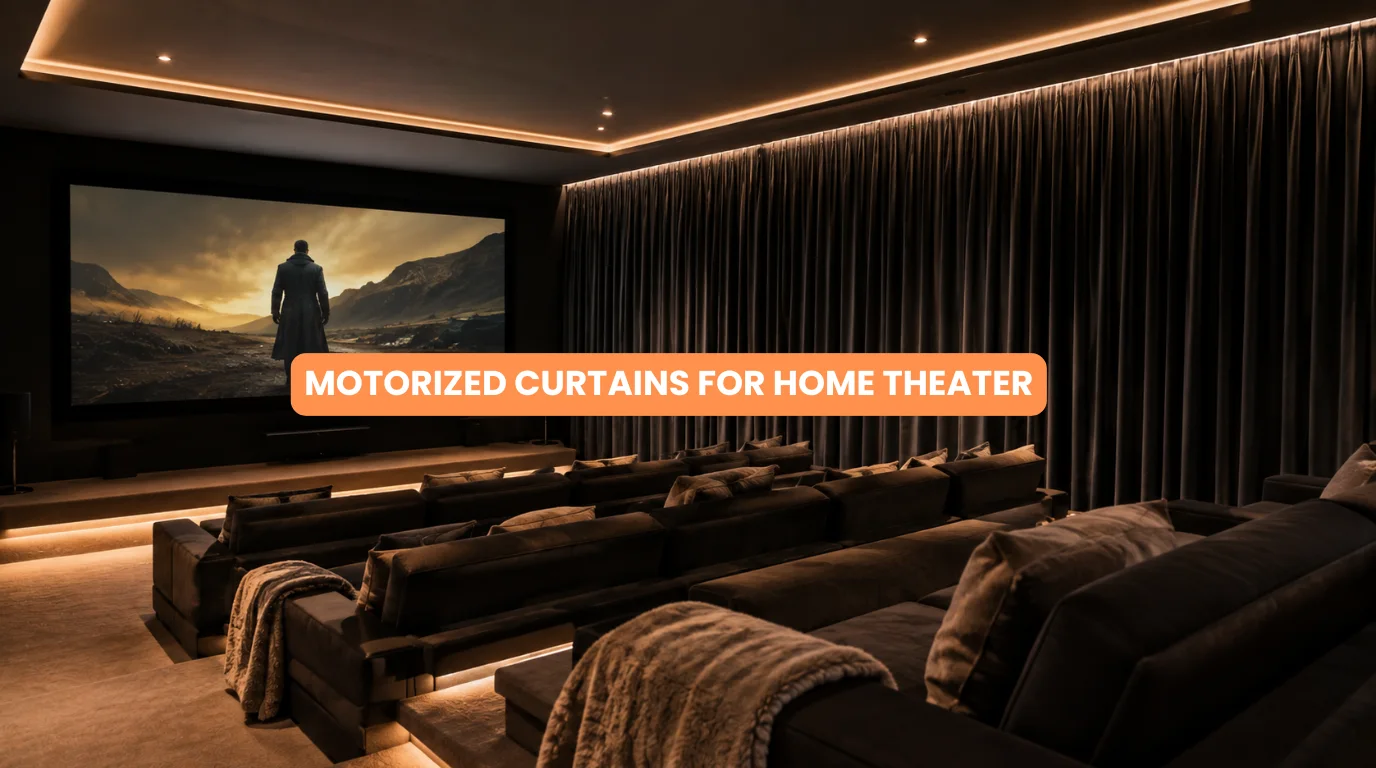
A great home theater isn’t only about the projector, screen, speakers, and seating. Light control matters as much. Even a small amount of unwanted daylight can affect projector contrast, screen visibility, and the overall cinematic experience. In a media room, curtains provide privacy. They can also be part of automated lighting and entertainment scenes.
That’s why motorized curtains are essential for premium home theaters and media rooms. For homeowners looking for motorized curtains for a home theater, the right system can combine blackout performance, quiet operation, and smart automation in one solution.
Instead of closing heavy curtains before each movie, homeowners can use one Movie Mode. It closes the curtains, dims the lights, and turns on the entertainment system. But choosing curtains for a theater requires more consideration than simply buying blackout fabric and adding a motor.
You need to think about light control, curtain fabric, motor noise, track design, room acoustics, screen placement, smart-home integration, and installation.
This guide explains how motorized curtains can enhance your home theater or media room viewing experience. It also covers what to consider before installing them.
Quick Summary
Motorized curtains for home theater optimize your media room by automatically blocking out light and syncing with your home theater setup.
- Improve blackout and light control
- Reduce glare on screens
- Add privacy
- Automate movie scenes
- Work with smart lighting
- Provide convenient one-touch operation
- Help manage large windows
- Complement premium theater interiors
- Can be integrated with broader smart home systems
For the best results, select the curtain fabric, track, motor, and automation system together.
Quick Answer
Motorized curtains for home theaters and media rooms are useful when windows let in light that affects viewing. The right blackout curtains close automatically when you start a movie, syncing seamlessly with your lighting and home theater controls.
For premium installations, you should consider motor noise, curtain weight, track placement, fabric opacity, and smart-home compatibility. Motorized curtains for home theater can be especially valuable when windows introduce daylight or glare that affects projector-based viewing.
Why Do Home Theaters Need Curtains?
The primary reason to consider motorized curtains for home theater and media rooms is light management. A projector performs best when the room can control ambient light.
Windows can introduce:
- Direct sunlight
- Reflected daylight
- Street lighting
- Exterior glare
Even with a high-quality projector, uncontrolled ambient light can reduce the perceived contrast and impact of the image.
Curtains provide a physical barrier between the entertainment space and external light. Motorized curtains for home theater add convenient and repeatable control.
1. Better Blackout Performance
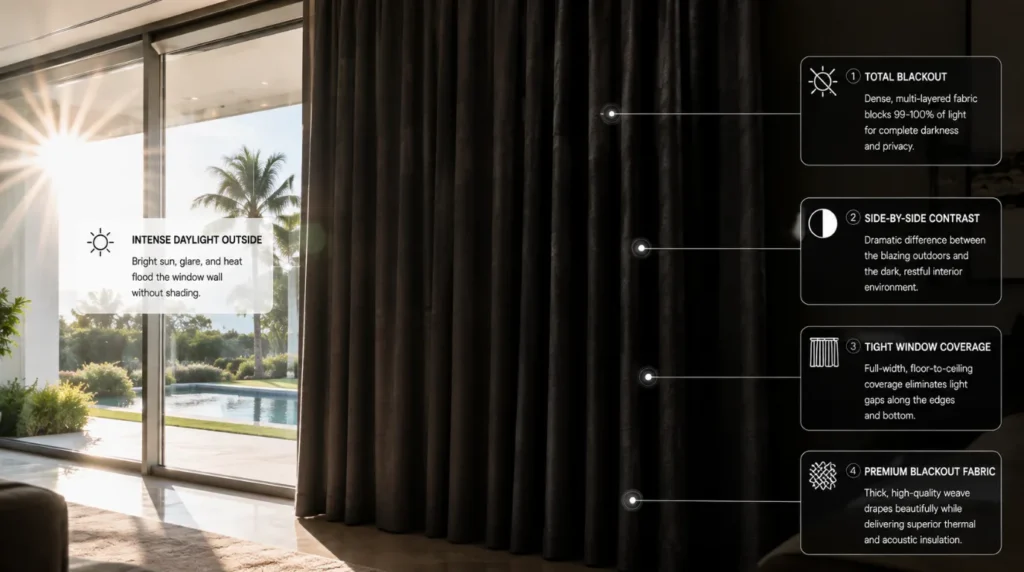
For dedicated theater rooms, blackout performance should be one of the first considerations. When selecting motorized curtains for home theater, blackout performance should be evaluated alongside fabric quality, track design, and installation.
A good system can help block:
- Daylight
- Exterior lighting
- Reflections
- Glare
For particularly bright rooms, consider a combination of: Blackout fabric + appropriate track + overlapping curtains + proper installation.
Motorized operation then allows the entire window treatment to close before the movie begins.
2. Motorized Curtains Make Movie Mode Possible
One of the biggest advantages of motorized curtains for home theater is automation.
This makes motorized curtains for home theater more than a window-treatment solution, and they can become part of the complete entertainment experience.
Imagine pressing one button:
Movie Mode
- Curtains close.
- Lights dim.
- Projector turns on.
- AV system activates.
- Screen lowers.
This is much more convenient than controlling every component separately. Specific capabilities depend on your chosen automation platform and equipment.
3. Motor Noise Matters
When choosing motorized curtains for home theater, quiet and smooth operation should be treated as an important specification rather than an afterthought. A loud curtain motor can be distracting in a quiet movie scene.
For theater applications, consider:
- Motor noise
- Track noise
- Curtain movement
- Speed
- Soft-start functionality
- Soft-stop functionality
A motor that is appropriate for a living room may not be the ideal choice for a dedicated theater. The goal is smooth, controlled movement that doesn’t unnecessarily interrupt the viewing experience.
4. Large Windows and Glass Walls
Modern homes often have large windows or glass walls adjacent to entertainment areas. Manual curtains become increasingly inconvenient as window size increases.
Motorized curtains for home theater and media rooms can be particularly useful for:
- Floor-to-ceiling windows
- Large sliding doors
- Wide glass façades
- Double-height spaces
- Multi-panel curtain systems
Size the motor appropriately for the curtain weight and track length.
5. Blackout Fabric Selection
The motor is only one part of the solution. For motorized curtains for home theater, fabric selection directly affects how effectively the system can control unwanted light.
For a theater, consider:
Blackout Fabric
Designed to significantly reduce incoming light.
Lined Curtains
Additional lining can improve light control and the overall appearance.
Heavy Drapery
Can provide a more substantial theater aesthetic and may offer some acoustic benefits depending on the material and installation.
However, select fabrics based on actual performance requirements rather than appearance alone.
6. Can Curtains Improve Theater Acoustics?
Curtains can improve room acoustics, but treat them as a supplement rather than a replacement for dedicated acoustic treatment. Heavy fabrics can absorb some reflected sound, particularly at higher frequencies.
However, the acoustic performance depends on:
- Fabric type
- Thickness
- Distance from the wall
- Curtain fullness
- Room geometry
- Other acoustic materials
For a serious home theater, curtains should complement, not replace, proper acoustic design. When properly selected, motorized curtains for home theater can therefore complement the room’s acoustic strategy while also providing light control.
7. Smart Home Integration
A major advantage of motorized curtains for home theater and media rooms is smart home system compatibility.
Curtains can potentially integrate with:
- Lighting
- Projectors
- Screens
- AV receivers
- HVAC
- Security
- Smart home controllers
This allows the room to respond to one command rather than several independent controls.
8. Create a Complete Movie Scene
A properly designed automation system can turn multiple actions into one scene. With motorized curtains for home theater, this entire sequence can be triggered through a single scene.
Movie Mode
Curtains: Close
Lighting: Dim
Projector: Turn on
Screen: Lower
AV: Activate
HVAC: Adjust
The exact sequence depends on the equipment and automation platform. The goal is to create a seamless entertainment space, not just a room full of separate devices.
9. Privacy
Home theaters are often located in rooms facing:
- Gardens
- Streets
- Neighbouring properties
- Balconies
- Large exterior windows
This is another reason motorized curtains for home theater can be valuable in rooms with large exterior-facing windows. Automated curtains can close automatically when the room enters entertainment mode. You can also incorporate them into broader privacy routines.
For example:
Evening Scene → Curtains Close → Interior Lights Adjust
This can improve both comfort and privacy.
Wired vs. Battery-Powered Curtains
The right power configuration is an important consideration when specifying motorized curtains for home theater, particularly for large or frequently operated curtains.
| Factor | Wired | Battery-Powered |
|---|---|---|
| Dedicated Theater | Excellent | Good |
| Large Curtains | Excellent | Model-dependent |
| Heavy Curtains | Excellent | Model-dependent |
| New Construction | Excellent | Good |
| Retrofit | More involved | Excellent |
| Battery Maintenance | No | Required |
| Whole-Home Integration | Excellent | Depends on system |
| Frequent Operation | Strong | Depends on battery capacity |
For a dedicated theater being built from scratch, wired motorization is often worth considering. For an existing media room, a suitable battery-powered system may simplify installation.
Curtain Track Design Matters
The curtain track should be selected along with the motor. For motorized curtains for home theater, the track should be coordinated with the screen, speakers, ceiling details, and other theater components.
Consider:
- Track length
- Curtain weight
- Opening direction
- Single vs dual track
- Ceiling mounting
- Wall mounting
- Curtain pocket
- Clearance around the screen
For example, curtains may need to move behind or next to a projection screen. Coordinate the track position with the screen and the room layout. Address this during the design stage for optimal results.
Single vs. Dual Curtains
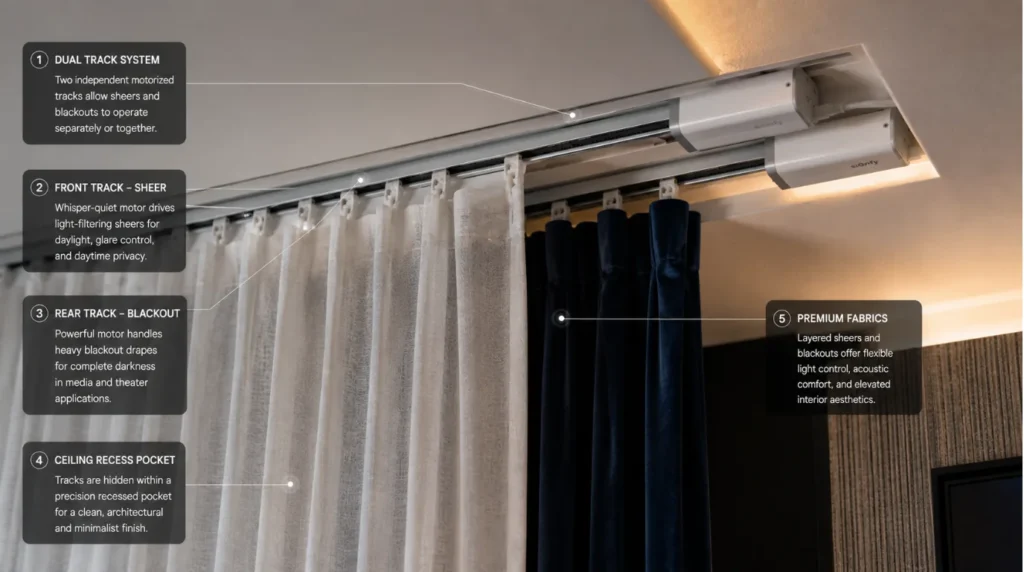
A theater may benefit from two curtain layers.
Sheer Layer
Provides daylight diffusion and visual softness.
Blackout Layer
Provides stronger light control during viewing. With independent motorization, homeowners can control each layer separately.
For example:
- Daytime: Sheer curtains partially closed.
- Movie Mode: Both layers closed.
This provides greater flexibility than a single curtain. This layered approach can make motorized curtains for home theater more versatile by allowing homeowners to control daylight and complete blackout independently.
Installation Considerations
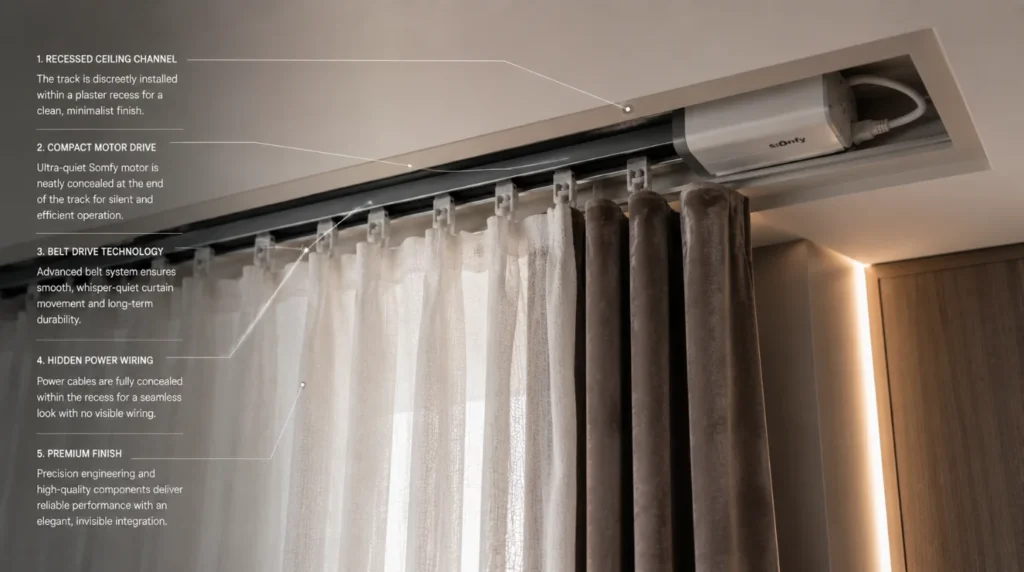
Installing motorized curtains for home theater and media room should ideally happen as part of the room’s overall design.
The installer should consider:
- Curtain track location
- Motor position
- Power supply
- Screen location
- Projector position
- Speaker placement
- Ceiling construction
- Curtain pocket dimensions
- Smart-home wiring
- Access for future maintenance
For new construction, these decisions should be made before ceilings and finishes are finalized.
Cost Factors
The cost of motorized curtains for home theater and media rooms varies depending on:
- Window size
- Curtain fabric
- Curtain weight
- Track length
- Motor type
- Number of curtains
- Wired or battery operation
- Smart-home integration
- Installation complexity
- Customization
A simple retrofit can cost significantly less than a fully concealed dual-track system for a large luxury theater. Rather than comparing only the motor price, compare the complete installed system.
The total investment in motorized curtains for home theater depends on the complete system rather than the motor alone.
Are Motorized Curtains Worth It for a Media Room?
For a room with no windows, obviously not. But if your media room has significant external light, the answer can be different.
Motorized curtains for home theater and media rooms are particularly valuable when:
- The room has large windows
- Daylight affects viewing
- Curtains are heavy
- The room is used frequently
- You want automated Movie Mode
- Privacy matters
- The home already uses smart automation
For a small media room with one easy-to-operate window, manual blackout curtains may be sufficient.
Home Theater Curtain Decision Matrix
The following matrix can help determine whether motorized curtains for home theater are appropriate for your space.
| Requirement | Recommended Solution |
|---|---|
| Large windows | Motorized curtains |
| Strong daylight | Blackout curtains |
| Dedicated theater | Wired motorized system |
| Existing media room | Retrofit/battery option |
| Dual curtain layers | Dual motorized track |
| Smart lighting integration | Smart-compatible motor |
| Quiet environment | Low-noise motor |
| No windows | Curtains unnecessary |
| Occasional media use | Manual may be sufficient |
Common Mistakes
Choosing Curtains Based Only on Appearance
A beautiful curtain isn’t necessarily suitable for blackout performance.
Ignoring Motor Noise
Noise becomes more noticeable in quiet theater environments.
Using an Undersized Motor
Large, heavy curtains require appropriate motor capacity.
Installing the Track Too Close to the Screen
Curtain movement and screen operation need to be coordinated.
Forgetting Future Automation
If the room may eventually become part of a whole-home system, plan the integration early.
Treating Curtains as Acoustic Treatment
Curtains can influence acoustics but shouldn’t replace dedicated acoustic engineering.
Representative Example
Illustrative Example: This is a planning scenario, not a specific Techtastic client project.
Imagine a luxury media room with a large glass wall. During afternoon movie sessions, sunlight creates reflections on the screen. The homeowner installs a motorized blackout curtain system.
A custom Movie Mode is then programmed: Curtains close → Lights dim → Projector activates → Screen lowers → AV system starts
At the end of the movie: Screen rises → Curtains open partially → Ambient lighting increases
The curtain has become part of the entertainment experience rather than simply a window covering.
Our Recommendation
When selecting motorized curtains for home theater and media rooms, prioritize the complete system:
Fabric → Track → Motor → Power → Control → Automation
For a dedicated luxury theater, focus particularly on:
- Blackout performance
- Quiet operation
- Reliable motor capacity
- Proper track placement
- Smart-home integration
- Professional installation
For existing media rooms, retrofit or battery-powered options may be practical when new wiring isn’t desirable. For new construction, plan the curtain infrastructure alongside the theater, electrical, lighting, and automation design.
At Techtastic, motorized curtains can connect with lighting, home theater gear, HVAC, and smart home systems. This creates a seamless entertainment environment.
Key Takeaways
- Motorized curtains for home theater and media rooms provide convenient light and privacy control.
- Blackout performance is particularly important for projector-based theaters.
- Motor noise matters more in quiet entertainment environments.
- Large windows benefit significantly from motorization.
- Curtain fabric and track design are as important as the motor.
- Dual curtain layers can provide greater light-control flexibility.
- Motorized curtains can become part of a complete Movie Mode.
- Wired systems are well suited to new theater construction.
- Battery-powered systems can be useful for suitable retrofit projects.
- Professional planning helps coordinate curtains with screens, lighting, speakers, and automation.
Frequently Asked Questions
1. Are motorized curtains good for home theaters?
A. Yes. Smart motorized curtains offer effortless blackout control, privacy, and system integration for windowed media rooms.
2. Do home theater curtains need to be blackout?
A. If your media room gets natural light, blackout curtains will dramatically improve projector performance.
3. Are motorized curtains noisy?
A. Motor noise varies by product and installation. For theaters, choose a system specifically suited to quiet operation and have it professionally installed.
4. Can motorized curtains work with a projector?
A. Yes. Integrate them into a movie scene so curtains close as or before the projector activates.
5. Can curtains and theater lights work together?
A. Yes, provided the motor and lighting-control systems support the required integration.
6. Are battery-powered curtains suitable for media rooms?
A. They can be suitable for smaller or retrofit applications. For large, heavy curtains and frequent operation, a wired system may be preferable depending on the installation.
7. Can curtains improve home theater acoustics?
A. Curtains absorb some reflected sound, but treat them as a supplement rather than a replacement for dedicated acoustic treatment.
8. Should I use one or two curtain layers?
A. Two layers can provide greater flexibility, especially when you want daytime light control and complete blackout during movie sessions.
9. Can users control motorized theater curtains manually?
A. Most systems offer manual overrides, though specific features depend on the motor and control setup.
10. Should you plan motorized curtains before building the theater?
A. Ideally, yes. Curtain tracks, power, screen placement, ceiling details, and automation should be coordinated during the design stage.
Collaboration Opportunities for Architects & Interior Designers
Motorized curtains for home theater and media rooms should ideally be coordinated with the entire entertainment-room design.
Techtastic can collaborate with:
- Architects
- Interior Designers
- Builders
- Developers
- Luxury Villa Developers
- Project Management Consultants
Services include:
- Motorized Curtain Planning
- Curtain Track Design
- Home Theater Automation
- Smart Lighting
- KNX Integration
- HVAC Integration
- Smart Home Integration
- Electrical Coordination
- Programming
- Testing & Commissioning
Early coordination aligns your lighting, power, screen placement, and motorized curtains without compromising room aesthetics.
Areas We Serve
Techtastic provides smart home and home theater automation solutions across:
Navi Mumbai • Nashik • Lonavla • Sangli
The company also serves projects across the wider Mumbai and Thane region.
Create a Better Home Theater Experience
A home theater should feel effortless. You shouldn’t have to manually prep the room by closing curtains, adjusting lights, and turning on equipment every time you watch a movie. Properly designed media room curtains integrate seamlessly into a single automated scene.
The best system combines: Blackout → Quiet Motor → Smart Control → Lighting → AV → Climate
Techtastic integrates motorized curtains into custom home theater and automation systems tailored to your room, windows, and lifestyle.
Talk to Techtastic about designing a smarter, more immersive home theater.
Contact Techtastic
🌐 Website: Techtastic Website
📞 Phone: 9769145145
📍 Service Areas: Mumbai • Navi Mumbai • Pune • Lonavala • Nashik • Sangli
Want a sleek entertainment space without bulky equipment on display? Explore our Invisible Home Theater Systems: 5 Epic Ways to Hide Them for smart ways to blend technology into your interiors.