
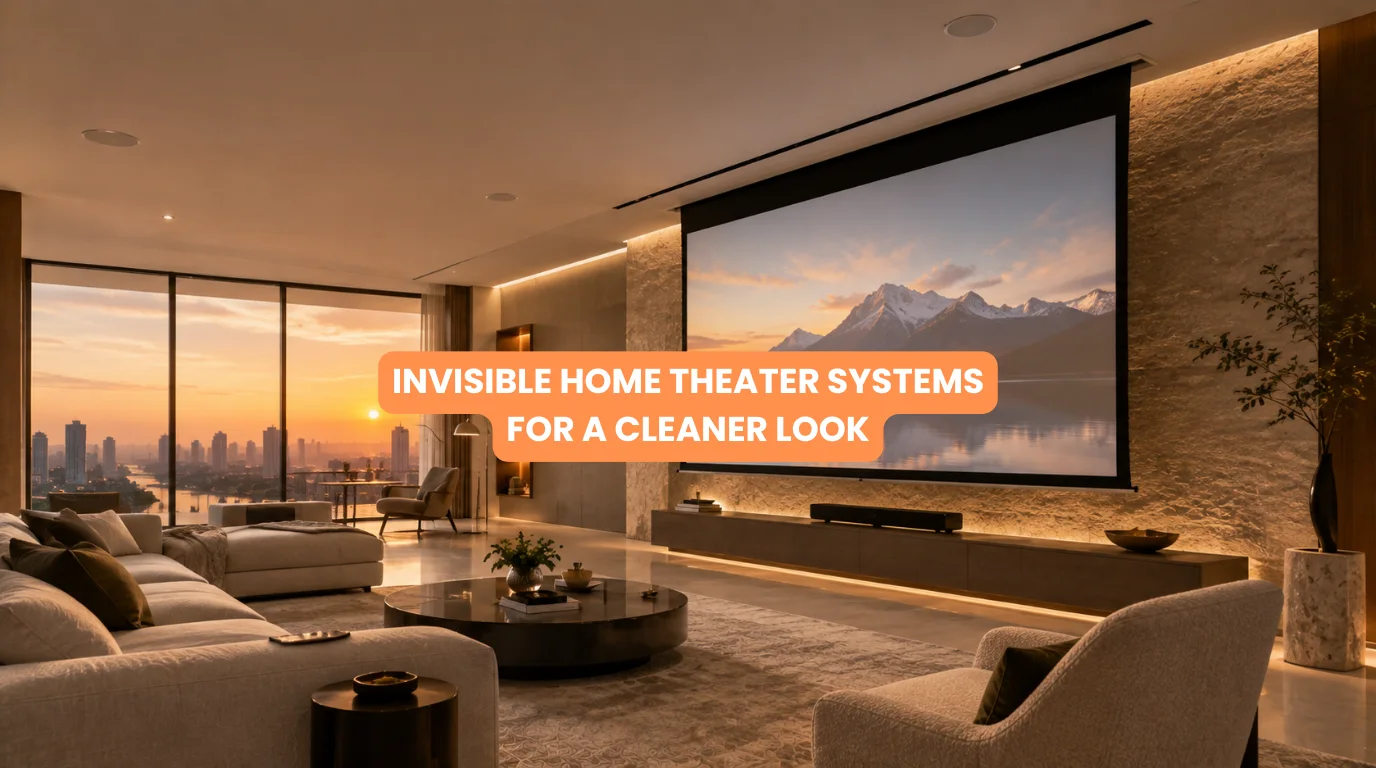
Luxury interiors are increasingly designed around clean lines, open spaces, premium materials, and minimal visual clutter. But entertainment technology can easily disrupt that aesthetic. Large speakers, projectors, AV receivers, cables, and subwoofers can quickly turn an elegant living room into a technical setup.
Invisible home theater systems offer a smarter alternative.
Instead of making technology the focal point, these systems integrate the entertainment infrastructure into ceilings, walls, cabinetry, furniture, and architectural elements. A projector can disappear into a false ceiling, speakers can sit behind finished walls, and a large screen can remain hidden until movie night.
The result is a room that looks refined during the day and transforms into an immersive cinema when required.
For luxury residences in Navi Mumbai, Nashik, Sangli, Lonavla, and other premium markets, invisible home theater systems combine sophisticated entertainment with minimalist interior design.
Quick Answer
Invisible home theater systems hide projectors, speakers, subwoofers, screens, cables, and AV equipment within the architecture or furniture of a room. Common solutions include ceiling-recessed projector lifts, in-wall speakers, hidden AV racks, motorized acoustic curtains, and concealed subwoofers. When planned during the architectural or interior design stage, these systems can deliver a powerful cinematic experience without compromising the appearance of a luxury living space.
Quick Summary
✓ Invisible home theater systems keep entertainment technology hidden when it is not being used.
✓ Motorized projector lifts can conceal projectors inside false ceilings.
✓ In-wall and in-ceiling speakers reduce visible equipment and floor clutter.
✓ Centralized AV racks can keep amplifiers and media equipment outside the main room.
✓ Motorized acoustic curtains can improve both blackout performance and room acoustics.
✓ Concealed subwoofers can deliver powerful bass without a large visible speaker cabinet.
✓ Smart automation can activate the entire cinema with a single command.
✓ Early planning makes it easier to integrate technology with architecture and interiors.
Invisible Cinema: Why Minimalist Homes Need Smarter Entertainment Design
A beautifully designed living room can lose its visual balance when several pieces of technology are placed around it.
A projector hanging from the ceiling, five large speakers positioned around the seating area, visible cables running toward an AV receiver, and a bulky subwoofer in the corner can make even a premium interior feel unfinished.
The problem isn’t the technology itself but where and how the technology is installed. With invisible home theater systems, the goal is to make the entertainment experience visible only when you want it to be.
During the day, the living room can remain clean and understated. When movie mode is activated, a screen can descend, curtains can close, lights can dim, and the audio system can switch on automatically. This approach changes the relationship between technology and interior design.
Instead of designing the room around visible equipment, architects and interior designers can design the room first and integrate the technology into it.
1. Hide the Projector Inside the Ceiling
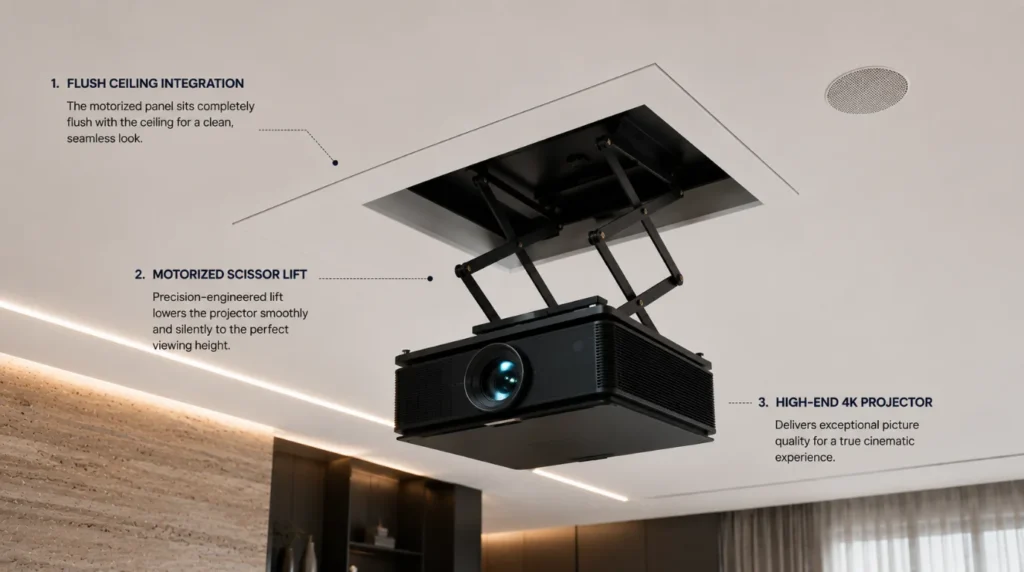
One of the most effective ways to create invisible home theater systems is to conceal the projector inside the false ceiling. Traditional projector installations often involve a ceiling-mounted unit that remains visible throughout the day. While functional, this can interrupt a minimalist ceiling design.
A motorized projector lift solves this problem.
How a Motorized Projector Lift Works
The projector is installed inside a dedicated ceiling cavity. When the system is switched off, a flush panel conceals the equipment.
When the homeowner activates movie mode, the lift lowers the projector into its calibrated position. Once the movie is finished, the projector retracts automatically.
The result is a clean ceiling with no permanently visible projector.
Planning the Ceiling Cavity
This solution works best when planned before the false ceiling is completed.
The design team needs to consider:
- Projector dimensions
- Required ventilation
- Throw distance
- Lens position
- Service access
- Power and signal cabling
- Lift mechanism dimensions
This is why invisible home theater systems should ideally be discussed during the architectural planning stage rather than after the interior work is complete.
2. Use Architectural Speakers Instead of Floor-Standing Speakers
Speakers are often the biggest visual challenge in invisible home theater systems.
Traditional surround sound can require multiple large cabinets around the room. In a minimalist interior, these speakers can occupy valuable floor space and compete with furniture and artwork.
Architectural speakers offer another approach.
In-Wall Speakers
In-wall speakers are installed within the wall structure and finished with grilles that can be painted to complement the surrounding surface.
This allows the audio system to remain visually discreet.
In-Ceiling Speakers
In-ceiling speakers can be useful for overhead channels and other applications where ceiling integration makes sense.
However, speaker selection and positioning should be based on the room’s acoustic requirements rather than simply hiding every speaker overhead.
Acoustically Transparent Screens
For a dedicated theater, an acoustically transparent screen can provide another major advantage. The center speaker, which is responsible for much of the dialogue, can be positioned behind the screen.
This creates the impression that voices are coming directly from the actors on screen. That combination of concealed speakers and carefully positioned audio is a major part of invisible home theater systems.
3. Conceal the AV Equipment in a Centralized Rack
A home theater includes much more than speakers and a screen.
There may be:
- AV receivers
- Amplifiers
- Streaming devices
- Media players
- Network equipment
- Control processors
- Power management equipment
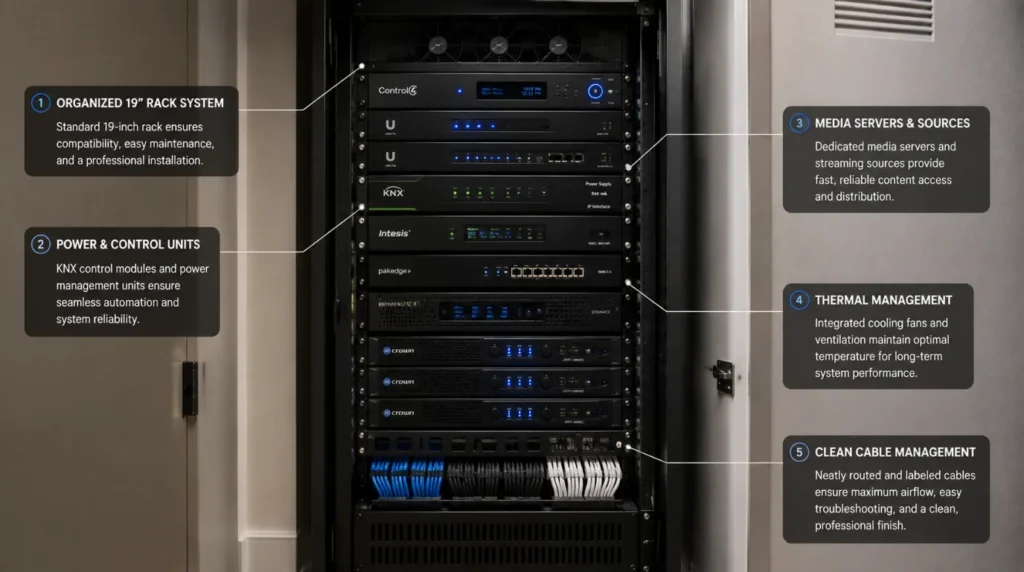
Leaving all of this equipment inside the living room creates unnecessary visual and acoustic clutter. A centralized AV rack can solve the problem.
Creating a Dedicated Equipment Location
The equipment can be placed in:
- A utility room
- A dedicated AV closet
- An under-stair space
- A concealed cabinet
- A nearby service room
The rack should remain accessible for maintenance while staying outside the primary viewing area. This approach allows invisible home theater systems to keep the technology out of sight without making it inaccessible.
Don’t Forget Ventilation
AV equipment generates heat. A completely enclosed cabinet without adequate airflow can cause equipment temperatures to rise.
Professional installations should therefore consider:
- Ventilation
- Cooling fans
- Temperature monitoring
- Cable management
- Service access
If the equipment is placed in a dedicated room or rack, ventilation should be planned as part of the system rather than added as an afterthought.
4. Turn Motorized Curtains Into Part of the Cinema
Luxury living rooms often contain large windows, glass surfaces, and open layouts. These features are beautiful during the day but can create glare and unwanted reflections during movie viewing.
Motorized curtains provide a practical solution. When the homeowner activates the Movie Scene, the curtains can automatically close. If blackout fabrics are selected appropriately, they can help create a darker viewing environment.
But curtains can also influence room acoustics.
Acoustic Curtains
Hard surfaces such as glass, marble, and exposed walls can reflect sound. Heavy acoustic curtains can help reduce certain reflections and contribute to a more controlled listening environment.
This doesn’t replace professional acoustic treatment, but it can complement the overall design.
One-Touch Movie Mode
Imagine pressing one button.
The system can:
- Close the motorized curtains.
- Lower the projector.
- Activate the AV equipment.
- Switch the display input.
- Dim the lights.
- Start the audio system.
This is where invisible home theater systems become more than concealed equipment. They become a complete automated experience.
5. Conceal the Subwoofer Without Losing Powerful Bass
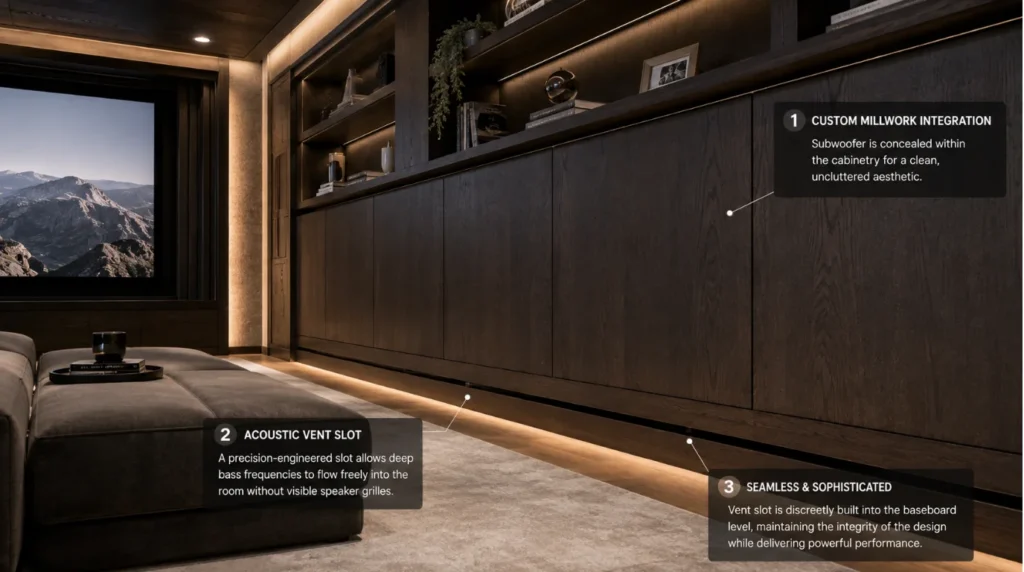
The subwoofer is often the most difficult component to hide. Unlike small satellite speakers, subwoofers need to move significant amounts of air to reproduce low-frequency sound.
A large black cabinet sitting beside an elegant sofa isn’t always compatible with a minimalist interior. There are several ways to approach the problem.
In-Wall Subwoofers
Specialized in-wall subwoofers can be integrated into suitable wall structures. The installation must account for enclosure requirements, structural constraints, vibration, and acoustic performance.
Furniture Integration
Depending on the equipment, some slim subwoofer solutions can be integrated into furniture or custom cabinetry. The important point is to maintain sufficient ventilation and avoid obstructing the acoustic output.
Hidden Doesn’t Mean Compromised
The goal of invisible home theater systems isn’t simply to hide equipment at any cost. Every concealed component still needs to perform correctly.
The installation should therefore consider acoustic performance, serviceability, ventilation, and structural requirements.
How Smart Automation Completes the Invisible Cinema
Concealing equipment is only one part of creating a sophisticated entertainment environment. Automation can connect everything.
A suitable control system can manage:
- Projector lifts
- Screens
- Curtains
- Lighting
- AV equipment
- Climate control
- Media playback
A single Movie Scene can trigger several functions simultaneously. This eliminates the need to operate multiple remotes or switches.
For premium residences, invisible home theater systems combined with automation can create a particularly seamless experience because the technology remains largely unnoticed. The homeowner focuses on the movie rather than the equipment.
Designing Invisible Technology During the Construction Stage
The easiest time to create invisible home theater systems is before walls and ceilings are finished.
Early planning allows the team to determine:
Cable Pathways
Dedicated conduits can be installed for HDMI, networking, speaker cables, control wiring, and future upgrades.
Equipment Locations
The AV rack, projector lift, speakers, and other equipment can be assigned appropriate locations before the interior finishes begin.
Ceiling Requirements
Projector lifts, motorized screens, lighting, and acoustic treatments can be coordinated within the false ceiling.
Acoustic Planning
Consider wall construction, acoustic panels, speaker positions, and room dimensions before finalizing furniture and decorative finishes.
This design-first approach helps prevent expensive modifications later.
Can Invisible Home Theater Systems Be Installed in Existing Homes?
Yes, although the possibilities depend heavily on the existing structure. New construction provides the greatest flexibility because walls and ceilings are accessible.
Existing homes may still accommodate concealed solutions such as:
- Slim architectural speakers
- Motorized screens
- Concealed projector installations
- Custom cabinetry
- Hidden equipment racks
- Motorized curtains
However, completely concealing wiring and large equipment may require renovation work. For retrofit projects, the objective should be to identify the highest-impact concealment opportunities without unnecessarily disturbing finished interiors.
Why Professional Integration Matters
A home theater is not simply a collection of expensive components.
A premium projector can perform poorly if the screen size and throw distance are incorrect. Excellent speakers can sound disappointing if they are positioned or calibrated incorrectly. A powerful subwoofer can create unwanted vibration if the room isn’t acoustically managed.
Professional integration for invisible home theater systems brings these elements together.
A specialist can coordinate:
- Room geometry
- Speaker positioning
- Screen size
- Projector placement
- Acoustic treatment
- Equipment ventilation
- Wiring
- Automation
- Interior design
This is particularly important when the objective is to create invisible home theater systems that must remain hidden without sacrificing performance.
Key Takeaways
- Concealed projector lifts keep large projection equipment out of sight.
- Architectural speakers can reduce visible equipment and floor clutter.
- Centralized AV racks keep electronics away from the primary living space.
- Motorized acoustic curtains can improve blackout performance and complement acoustic design.
- Specialized concealed subwoofers can deliver powerful bass without visible cabinets.
- Automation can activate the entire cinema through a single Movie Scene.
- Early planning makes concealed wiring and equipment integration significantly easier.
- Professional calibration ensures aesthetics do not come at the expense of performance.
Frequently Asked Questions
1. What are invisible home theater systems?
A. Invisible home theater systems integrate projectors, speakers, screens, subwoofers, wiring, and AV equipment into walls, ceilings, cabinetry, or other architectural elements so the technology remains visually discreet.
2. Can a projector be completely hidden?
A. Yes. Motorized projector lifts can conceal compatible projectors inside false ceilings and lower them automatically when the theater is activated.
3. Do in-wall speakers provide good sound quality?
A. Yes. High-quality architectural speakers can provide excellent performance when properly selected, positioned, installed, and calibrated for the room.
4. Can a home theater work without visible speakers?
A. Yes. In-wall, in-ceiling, and other architectural speaker solutions can significantly reduce visible equipment. The specific configuration depends on the room and acoustic requirements.
5. Where should the AV receiver and amplifiers be installed?
A. They can be installed in a dedicated, ventilated AV rack, utility room, concealed cabinet, or another accessible location outside the main viewing area.
6. Can motorized curtains be integrated with the invisible home theater systems?
A. Yes. Curtains can be connected to the automation system and programmed to close automatically when Movie Scene is activated.
7. Can invisible home theater systems be installed in existing homes?
A. Yes, depending on the existing construction. Retrofit solutions can include architectural speakers, concealed screens, custom cabinetry, and motorized equipment, although completely hidden installations are generally easier during construction or renovation.
8. How do you prevent concealed AV equipment from overheating?
A. Concealed equipment requires appropriate ventilation. Dedicated racks, ventilation fans, temperature monitoring, and adequate airflow should be considered during system design.
9. Can a regular TV be used for an invisible cinema?
A. Yes. Art-style displays, recessed televisions, motorized lifts, and custom cabinetry can help conceal a display when it is not being used.
10. Are invisible home theater systems suitable for apartments?
A. Yes. In fact, concealment can be particularly useful in apartments because it reduces floor clutter and allows entertainment technology to blend into multipurpose living spaces.
Collaboration Opportunities For Architects, Interior Designers & Developers
The best invisible home theater systems are planned alongside the architecture rather than added after the interiors are finished.
Techtastic Technologies collaborates with architects, interior designers, builders, and developers to integrate premium entertainment technology into residential projects.
Design-First Planning
We coordinate projector locations, speaker positions, equipment racks, screens, curtains, and control interfaces with the interior design.
Architectural Integration
Technology can be incorporated into ceilings, walls, cabinetry, and furniture while maintaining the intended visual language of the project.
Smart Automation
Lighting, curtains, screens, projectors, and AV equipment can be integrated into automated scenes for simple one-touch control.
Project Support
From initial planning and wiring to installation and commissioning, professional coordination helps ensure the entertainment system performs correctly while remaining visually discreet.
Planning a luxury residential project? Bring the technology discussion into the design stage before walls and ceilings are finalized.
Areas We Serve
Techtastic Technologies provides smart home automation and premium home theater solutions across:
Navi Mumbai | Nashik | Lonavla | Sangli
Our solutions include:
- Home Theatre Automation
- Invisible Home Theater Systems
- KNX Automation
- Wired Home Automation
- Smart Lighting
- Motorized Curtains & Blinds
- Home Security
- Multi-Room Audio
- Luxury Villa Automation
- AV Integration
Create Your Invisible Cinema with Techtastic
The right invisible home theater systems can transform a luxury living room without making technology the center of attention.
From concealed projectors and architectural speakers to motorized curtains, hidden AV racks, smart lighting, and automated Movie Scenes, Techtastic Technologies designs entertainment environments where performance and architecture work together.
Contact Techtastic
🌐 Website: Techtastic Website
📞 Phone: 9769145145
📍 Service Areas: Mumbai • Navi Mumbai • Pune • Lonavala • Nashik • Sangli
Not sure whether to choose motorized or traditional curtains? Explore our Motorized Curtains vs. Manual: Which Is Better? (2026 Guide) to compare convenience, cost, and functionality.