
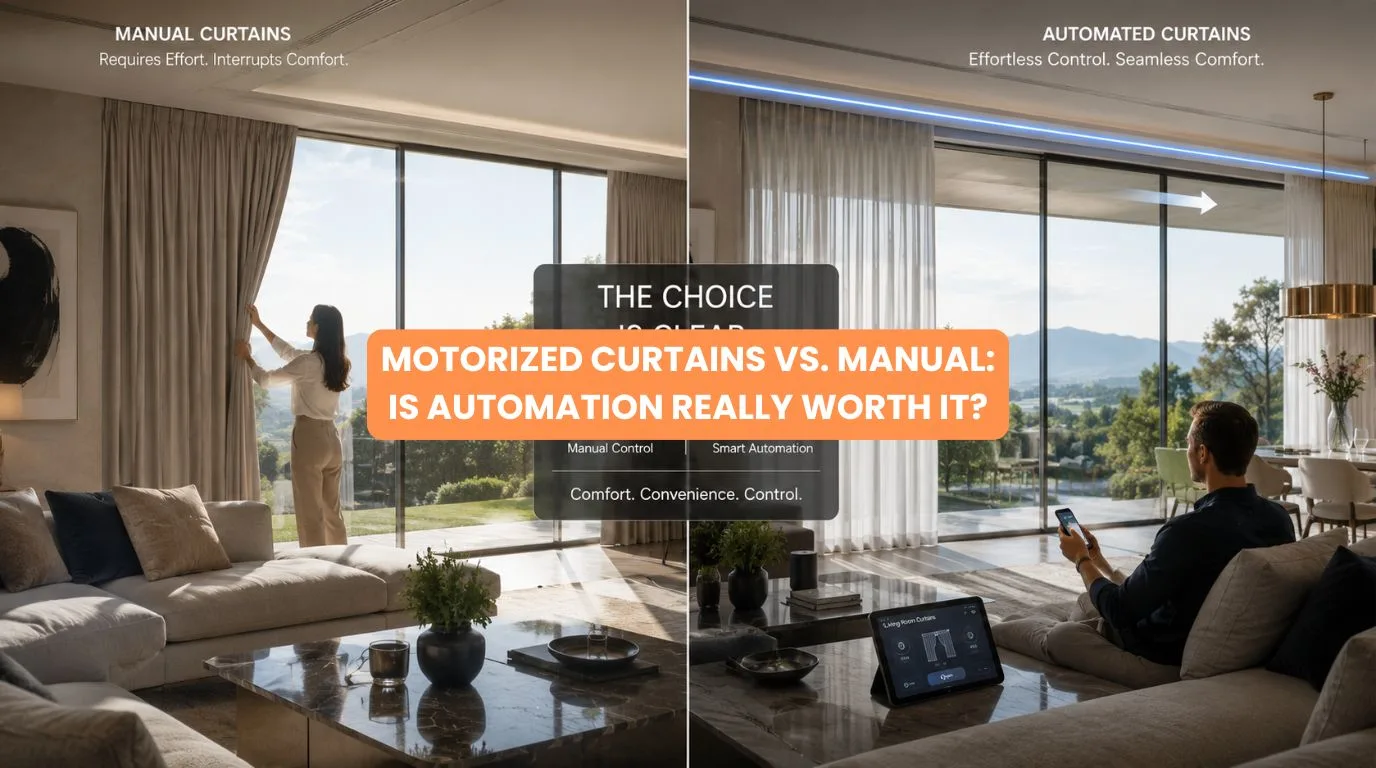
Curtains are one of those home features that seem simple—until you have to operate several of them every day. Opening bedroom curtains in the morning can feel repetitive. Closing living-room curtains in the evening can also feel repetitive.
Adjusting blackout curtains during a movie can be a hassle. Reaching across a large window can feel repetitive too. That raises an increasingly common question:
Motorized Curtains vs. Manual: Is Automation Worth It?
For some homeowners, manual curtains remain perfectly practical. They’re inexpensive, straightforward, and don’t require electricity, batteries, apps, or automation. For some people, automation is very convenient. This is especially true for homeowners. It helps if they have large windows or high ceilings. It is also useful with layered curtains. It fits well in luxury interiors. It works well in smart homes.
The right choice isn’t about replacing every manual curtain with a motor. It’s about understanding where motorization provides genuine value and where manual curtains may still make more sense.
This guide compares motorized curtains vs manual. It asks if automation is worth it. It covers convenience, cost, installation, privacy, energy savings, accessibility, maintenance, aesthetics, and smart home integration.
Quick Summary
To find out Motorized Curtains vs. Manual, we know motorized curtains are usually worth considering when convenience, large windows, privacy, accessibility, scheduling, and smart home integration are important. Manual curtains remain a practical choice for smaller windows, low-use rooms, and budget-conscious projects.
- Manual: Lower upfront cost and simple operation
- Motorized: Greater convenience and automation
- Large windows: Motorization becomes more valuable
- Bedrooms: Scheduling can improve comfort
- Smart homes: Motorized curtains integrate naturally
- Budget projects: Manual curtains may be sufficient
- Luxury homes: Motorization can provide a more seamless experience
The best approach is to automate the curtains where automation solves a real problem.
Quick Answer
Motorized curtains can be worth the cost. They offer easier use and set open and close times. They can improve privacy and manage daylight better. They can also work with smart home scenes.
Manual curtains are usually more economical and work well for smaller, easily accessible windows. The right choice between motorized curtains vs manual depends on window size, curtain weight, frequency of use, budget, and desired automation level.
Motorized Curtains vs. Manual: What’s the Difference?
The fundamental difference between motorized curtains vc manual lies in how you operate the curtains.
Manual Curtains
You physically pull the curtains open or closed.
Motorized Curtains
An electric motor moves the curtains along a compatible track. The motor can potentially be controlled through:
- Remote controls
- Wall switches
- Smartphone apps
- Voice commands
- Sensors
- Schedules
- Smart home scenes
The curtain itself can look almost identical. The difference is what happens behind it.
Manual Curtains: Where They Still Make Sense
Before deciding motorized curtains vs. manual, it’s important to acknowledge that manual curtains aren’t outdated. They have several advantages.
Lower Initial Cost
Manual systems generally cost less because there is no motor, power supply, control system, or programming.
Simple Operation
There is little to learn.
No Electricity Required
A manual curtain can continue operating regardless of power or network availability.
Easy Maintenance
There are fewer mechanical and electronic components.
Ideal for Small Windows
If you have one small bedroom window that you open twice a day, automation may not add enough value to justify the cost.
Motorized Curtains: Where They Shine
The value of motorized curtains becomes more obvious when the curtains are:
- Large
- Heavy
- Difficult to reach
- Used frequently
- Installed at height
- Part of a smart home
- Required to follow schedules
A motor can transform curtain operation from a physical task into an automated routine.
1. Convenience
Convenience is probably the biggest reason homeowners choose motorized curtains.
Imagine waking up and saying: “Good Morning.”
The curtains open automatically.
Or pressing: “Movie Mode.”
The curtains close, the lights dim, and the home theatre starts. This is where motorized curtains vs. manual becomes less about the curtain itself. It becomes more about the overall experience.
2. Large Windows
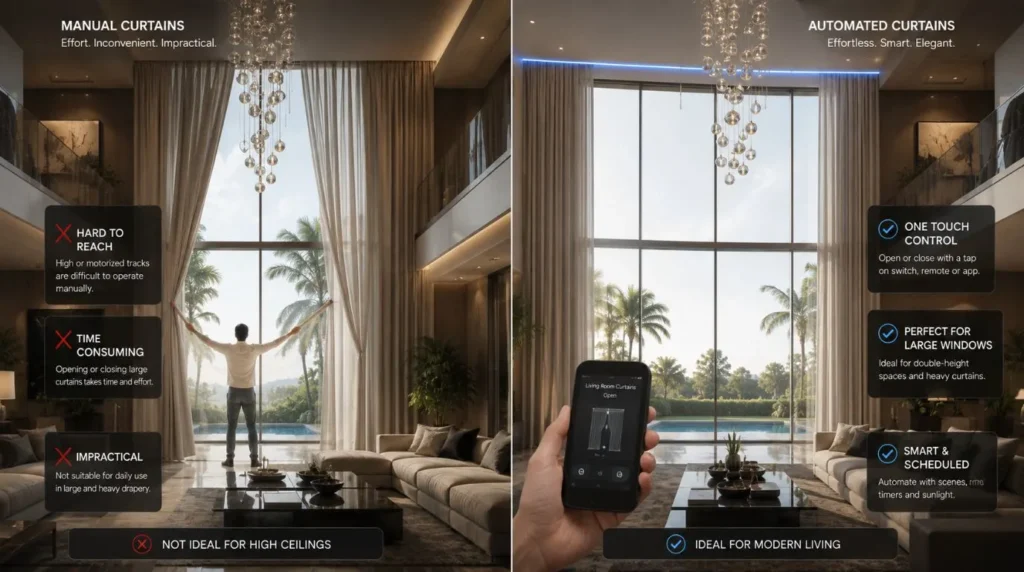
Large windows are one of the strongest use cases for motorization. Consider a floor-to-ceiling glass wall spanning several metres.
With manual curtains, you may need to physically move a large amount of fabric. Motorization makes the process effortless.
For:
- Floor-to-ceiling windows
- Double-height spaces
- Large living rooms
- Luxury villas
- Home theatres
Motorized curtains can provide considerably more convenience.
3. Heavy Curtains
Blackout and luxury curtains can become surprisingly heavy. Repeatedly moving heavy fabric manually can also place additional stress on curtain hardware. A correctly sized motorized system can move the curtain smoothly with a simple command.
However, the motor must be selected according to the actual curtain weight and track configuration.
4. Bedrooms and Privacy
Bedrooms are another strong application.
You can program curtains to open gradually in the morning and Close automatically at night. You can also create privacy routines based on time or scenes. For homes overlooking streets, neighbouring buildings, or public spaces, automated privacy control can be particularly useful.
5. Smart Home Integration
This is where motorized curtains become significantly more valuable. Instead of operating independently, they can work alongside:
- Lighting
- Security
- HVAC
- Home theatre
- Sensors
- Energy management
For example:
Good Morning
Curtains open → Lights brighten → HVAC adjusts.
Away
Curtains close → Lights turn off → Security activates.
Movie Mode
Curtains close → Lights dim → Theatre starts.
Good Night
Curtains close → Lights switch off → Security arms.
A manual curtain cannot participate in these automated sequences.
6. Daylight Management
Motorized curtains can also help manage sunlight.
Instead of simply: Open / Close, you can potentially create intermediate positions.
For example:
Morning: Open
Afternoon: Partially close
Evening: Close
This can help manage glare and direct sunlight while maintaining some natural light.
7. Accessibility
Motorized curtains can help people who struggle to open heavy curtains or reach high windows. A remote, wall switch, app, or voice command can eliminate the need to physically pull the fabric. Accessibility can therefore be a practical reason to choose automation rather than simply a luxury feature.
Cost Comparison
When considering motorized curtains vs. manual, cost naturally becomes a major factor.
| Factor | Manual Curtains | Motorized Curtains |
|---|
| Curtain Cost | Lower | Similar or higher depending on fabric |
| Track | Basic | Motor-compatible track |
| Motor | Not required | Required |
| Electrical Work | Usually not required | May be required |
| Installation | Simpler | More involved |
| Automation | No | Yes |
| Scheduling | No | Yes |
| Remote Control | No | Yes |
| Smart Home Integration | Limited | Available with compatible systems |
| Maintenance | Minimal | Motor/system servicing may be required |
| Initial Investment | Lower | Higher |
The price difference between motorized curtains vs. manual depends on curtain size, fabric, track, motor, power source, number of windows, and integration level.
Wired vs. Battery-Powered Motorized Curtains
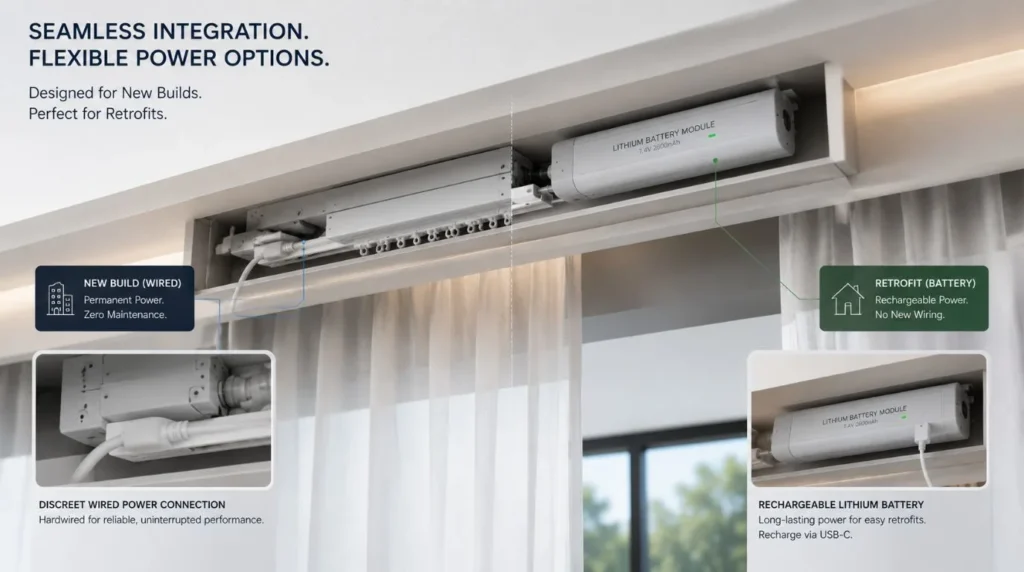
Not every motorized curtain needs permanent wiring.
Wired Systems
Best suited to:
- New construction
- Luxury villas
- Large curtains
- Whole-home automation
Advantages include consistent power and reduced battery maintenance.
Battery-Powered Systems
Can be useful for:
- Existing homes
- Apartments
- Retrofit projects
- Locations where wiring is difficult
The best option depends on the curtain weight, frequency of operation, and installation environment.
Installation and Maintenance
Manual curtains are relatively simple to install. Motorized systems require more planning. The installer needs to consider:
- Track length
- Curtain weight
- Motor capacity
- Mounting surface
- Power supply
- Curtain opening direction
- Smart home compatibility
Once installed correctly, maintenance is generally manageable. However, homeowners should monitor:
- Unusual motor noise
- Slow movement
- Track resistance
- Failed commands
- Battery levels where applicable
Is Motorization Worth It for Every Window?
No. This is one of the most important conclusions when comparing motorized curtains vs. manual. You don’t need to motorize every curtain.
Motorize These First
Living room: Large or frequently used curtains
Master bedroom: Automated morning/night routines
Home theatre: Blackout curtains and movie scenes
Double-height windows: Difficult manual operation
Large glass walls: Heavy curtains
Keep These Manual
Small guest-room windows
Low-use rooms
Storage areas
Windows that are already easy to operate
This approach gives you the benefits of automation without unnecessarily increasing the project cost.
A Practical Decision Matrix: Motorized Curtains vs. Manual
| Your Situation | Recommended Choice |
|---|
| Small, easily accessible window | Manual |
| Large floor-to-ceiling window | Motorized |
| Heavy blackout curtains | Motorized |
| Double-height window | Motorized |
| Bedroom with scheduled routines | Motorized |
| Home theatre | Motorized |
| Budget-conscious project | Manual |
| Luxury smart home | Motorized |
| Difficult-to-reach curtains | Motorized |
| Guest room with limited use | Manual |
Are Motorized Curtains Worth the Investment?
The answer to motorized curtains vs. manual depends on how much you value convenience. It also depends on how much you value integration.
Motorization is probably worth it if:
- You have large windows
- Curtains are heavy
- You operate them frequently
- They’re difficult to reach
- You want scheduled opening and closing
- You already have smart home automation
- You want one-touch scenes
- Privacy and daylight management are priorities
Manual curtains may be better if:
- Windows are small
- Curtains are rarely used
- Budget is your primary concern
- You don’t need automation
- The curtains are already easy to operate
A Simple ROI Question
Instead of asking only:
“How much does motorization cost?”
Ask:
“How often will I use it, and how much effort will it remove?”
If you’re opening and closing six large curtain panels every day, the convenience adds. If you’re operating one small curtain once a week, the value is much lower.
This simple calculation can help you decide where automation deserves priority.
Representative Example
Illustrative Example: This example demonstrates a typical decision process and is not presented as a specific Techtastic client project.
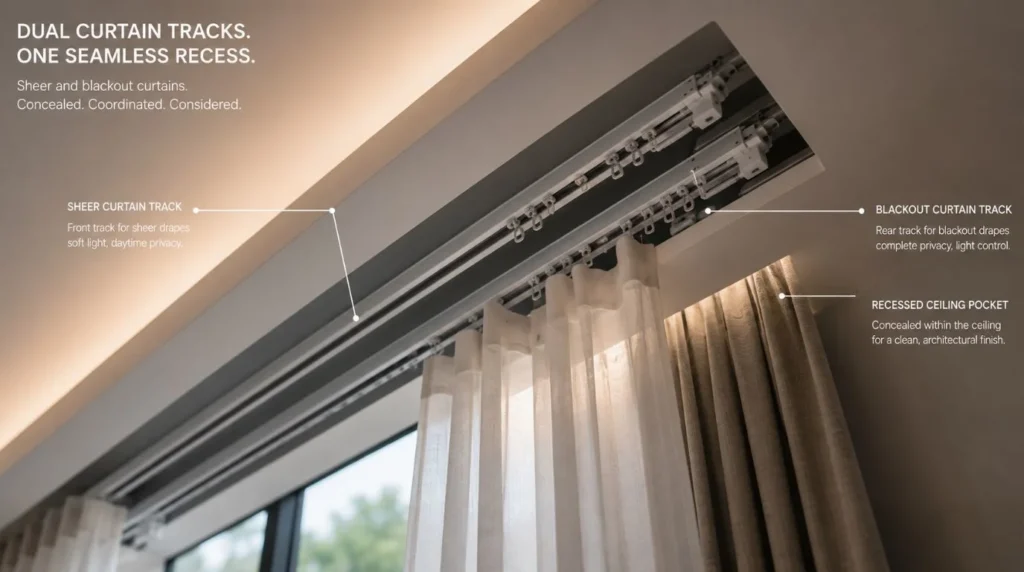
Imagine a luxury living room with a 6-metre-wide glass façade and two layers of curtains. The homeowner manually opens both layers every morning and closes them every evening. That’s a significant amount of fabric to move every day.
A motorized dual-track system could create:
Morning Scene
Sheers open → Natural light enters.
Afternoon
Sheers partially close → Glare is reduced.
Evening
Both layers close → Privacy increases.
Movie Mode
Blackout curtains close → Lights dim → Theatre activates.
In this situation, motorization provides more than convenience. It becomes part of the home’s overall experience.
Common Mistakes When Choosing Motorized Curtains
Automating Every Window
Not every window needs a motor.
Choosing the Cheapest Motor
Motor quality affects reliability, noise, and longevity.
Ignoring Curtain Weight
You must rate the motor appropriately.
Adding Automation Too Late
New construction should account for curtain power and track requirements early.
Forgetting Smart Home Compatibility
If integration matters, confirm compatibility before purchasing.
Poor Installation
Incorrect track alignment or mounting can affect performance.
Our Recommendation: Motorized Curtains vs. Manual
When asking motorized curtains vs manual, don’t think of it as an all-or-nothing decision. A selective automation strategy is often the smartest approach. Automate the curtains that are:
- Large
- Heavy
- Frequently used
- Difficult to reach
- Part of important smart home scenes
Keep simpler curtains manual where automation doesn’t provide meaningful value. For luxury homes, new villas, large windows, and smart home projects, motorized curtains can be a clear daily upgrade.
At Techtastic, motorized curtains can work with lighting, security, climate control, and home theatre. You can create scenes that run multiple systems together.
Key Takeaways: Motorized Curtains vs Manual
- Motorized curtains vs manual depends on your home, lifestyle, and curtain requirements.
- Manual curtains remain practical for small, accessible, low-use windows.
- Motorized curtains provide greater convenience for large and heavy curtains.
- Bedrooms benefit from scheduled opening and closing.
- Home theatres benefit from automated blackout curtains.
- Motorized curtains can integrate with lighting, HVAC, security, and entertainment.
- Battery-powered systems can simplify retrofit installations.
- Wired systems are particularly suitable for new construction and larger projects.
- You don’t need to motorize every window.
- Selective automation can provide the best balance between cost and convenience.
Frequently Asked Questions
1. Are motorized curtains better than manual curtains?
Neither is universally better. Manual curtains are simpler and less expensive, while motorized curtains provide convenience, automation, scheduling, and smart home integration.
2. Are motorized curtains worth the extra cost?
They can be, particularly for large windows, heavy curtains, bedrooms, home theatres, and integrated smart homes.
3. Can I motorize only some curtains?
Yes. Selective automation is often a practical way to control project costs. It also helps you automate the areas that provide the most value.
4. Do motorized curtains use a lot of electricity?
Generally, curtain motors operate for relatively short periods rather than continuously. Actual energy consumption depends on the specific motor and usage.
5. Can motorized curtains work without Wi-Fi?
Some systems can operate through dedicated remotes, switches, local controllers, or other communication methods. Wi-Fi isn’t necessarily required for basic operation.
6. Are battery-powered motorized curtains reliable?
They can be reliable when you match the motor correctly to the curtain and maintain it according to the manufacturer’s recommendations.
7. Are motorized curtains suitable for large windows?
Yes. They can be very useful for large, heavy, floor-to-ceiling curtains if the motor and track are the right size.
8. Can motorized curtains integrate with smart lighting?
Yes. Compatible systems can combine curtains and lighting into scenes such as Movie Mode, Good Morning, or Good Night.
9. Are motorized curtains difficult to maintain?
They often need more upkeep than manual curtains because they have motors and electronic parts. Properly installed systems usually need little routine attention.
10. Should I install motorized curtains during construction?
Ideally, yes. Early planning coordinates power points, curtain pockets, track positions, and smart home wiring with the architecture.
Collaboration Opportunities for Architects & Interior Designers
Motorized curtain planning works best when coordinated early with the architectural and interior design process.
Techtastic works with:
- Architects
- Interior Designers
- Builders
- Developers
- Luxury Villa Developers
- Project Management Consultants
Services can include:
- Motorized Curtain Planning
- Curtain Track Design
- Smart Home Integration
- KNX Integration
- Smart Lighting
- HVAC Integration
- Home Theatre Automation
- Electrical Coordination
- Programming
- Testing & Commissioning
Early coordination can help conceal motors, plan power points, create curtain pockets, and maintain a clean architectural finish.
Areas We Serve
Techtastic provides smart home and motorized curtain automation solutions across: Navi Mumbai • Nashik • Lonavla • Sangli
The company also serves projects across the wider Mumbai and Thane region.
Ready to Decide – Motorized Curtains vs Manual?
The question of motorized curtains vs manual doesn’t have to result in an all-or-nothing decision. Start with the windows where automation provides the most value. Large glass walls, heavy curtains, bedrooms, home theatres, and hard-to-reach windows are often the best candidates. For smaller or rarely used windows, manual curtains may remain the smarter choice.
At Techtastic, we help homeowners, architects, and designers plan motorized curtain systems. These systems fit the home’s architecture, interior design, and smart home automation plan.
Talk to Techtastic about choosing the right curtain automation for your home.
Contact Techtastic
Website: Techtastic Website
Call / WhatsApp: 9769145145
Service Areas: Navi Mumbai • Nashik • Lonavla • Sangli