
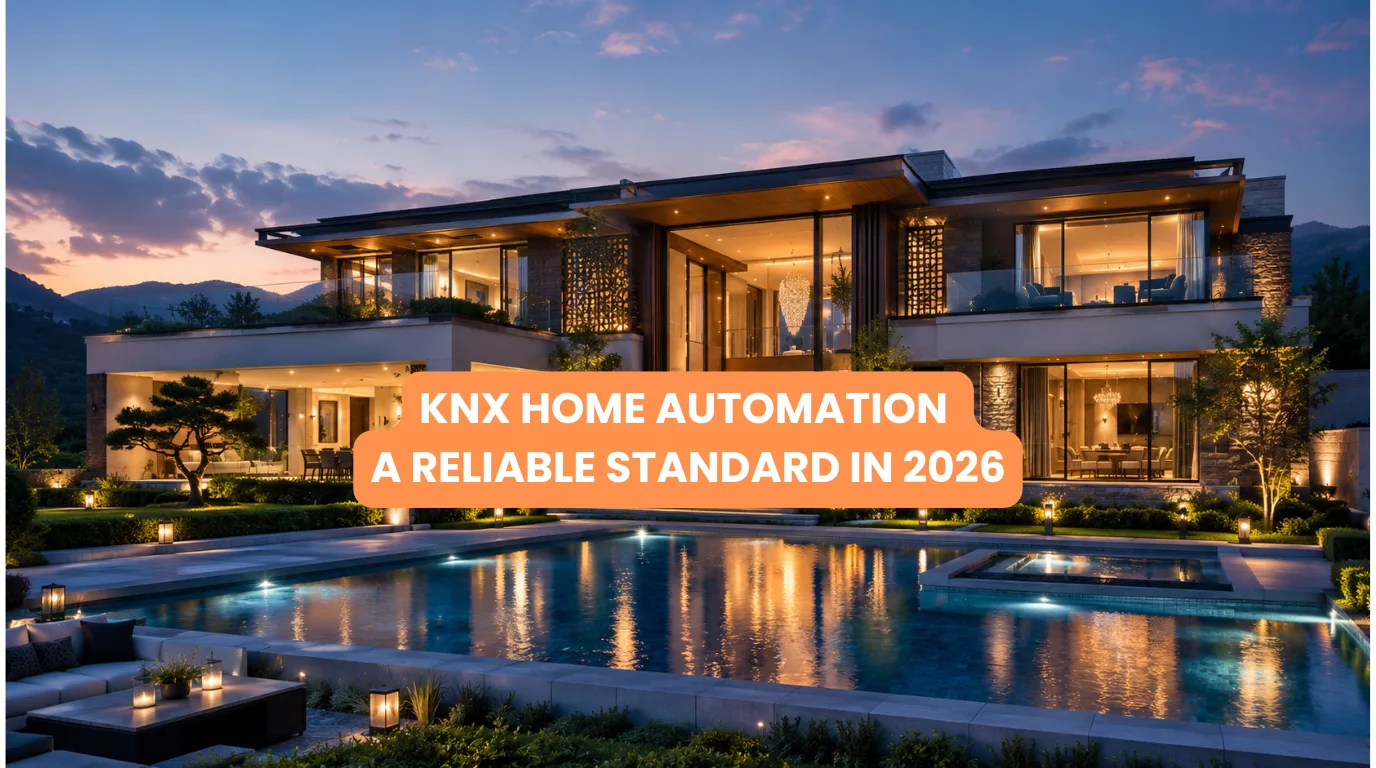
Magnificent 15,000-square-foot bungalows in Lonavala and Nashik often feature flawless marble, hand-carved teak, and breathtaking architecture. Yet, when the owner tries to turn on the lights, the system lags, or worse, the “smart” app crashes because the Wi-Fi can’t reliably reach every corner of the property.
This creates a frustrating problem for architects and homeowners. You can design an exceptional home, but unreliable technology can quickly damage the experience.
The industry has often promoted wireless gadgets as the easiest way to create a smart home. Wireless devices certainly have their place, especially for smaller upgrades and existing homes. But critical functions in a large luxury residence need a more carefully engineered foundation. That is where KNX home automation becomes relevant.
Instead of treating automation as a collection of individual gadgets, KNX home automation approaches the property as one integrated building-control system. Lighting, climate, blinds, security, and other systems can communicate through a structured infrastructure designed for long-term use. For a luxury project, that difference matters.
In this guide, we’ll explore how KMX home automation can make your home smarter, more convenient, secure, and energy-efficient.
Quick Answer
KNX home automation is a wired, open-standard approach to smart-home control that connects lighting, climate, curtains, security, and other systems through a reliable building-automation network. For luxury villas and large residential projects, it offers strong reliability, scalability, local control, and long-term flexibility.
Quick Summary
✓ KNX home automation provides a reliable wired foundation for luxury residences.
✓ It reduces dependence on Wi-Fi and cloud services for core home functions.
✓ Lighting, AC, curtains, security, and AV can work together through programmed scenes.
✓ Its open standard allows products from different manufacturers to work within the same system.
✓ Local control means essential automation can continue even when the internet is unavailable.
✓ Early planning helps architects integrate automation without compromising interior aesthetics.
✓ KNX home automation is particularly suitable for large villas, premium apartments, and high-end residential projects.
What Is KNX Home Automation?
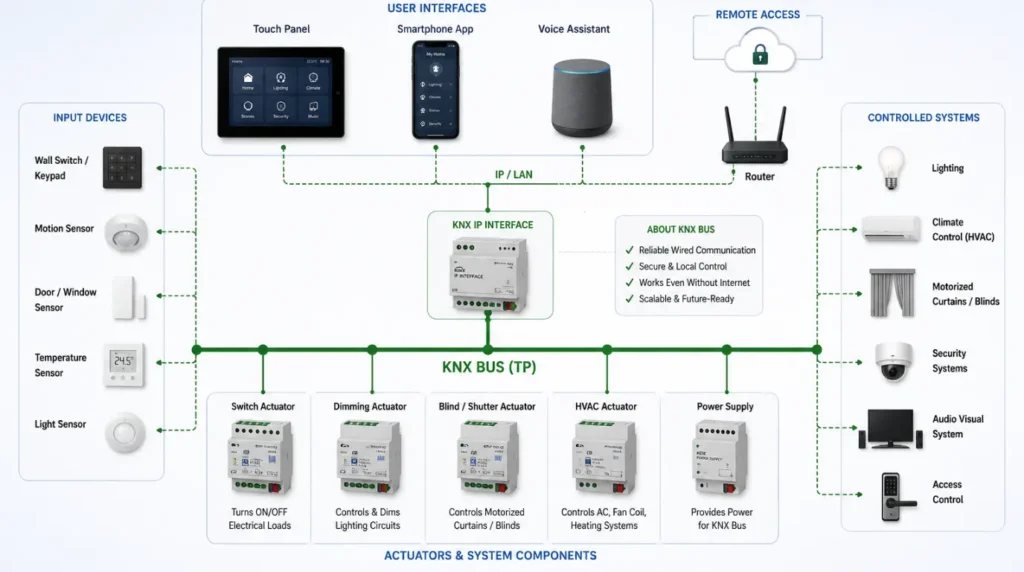
KNX home automation is based on the KNX open standard for building automation and control. It allows compatible devices from different manufacturers to communicate within the same automation environment.
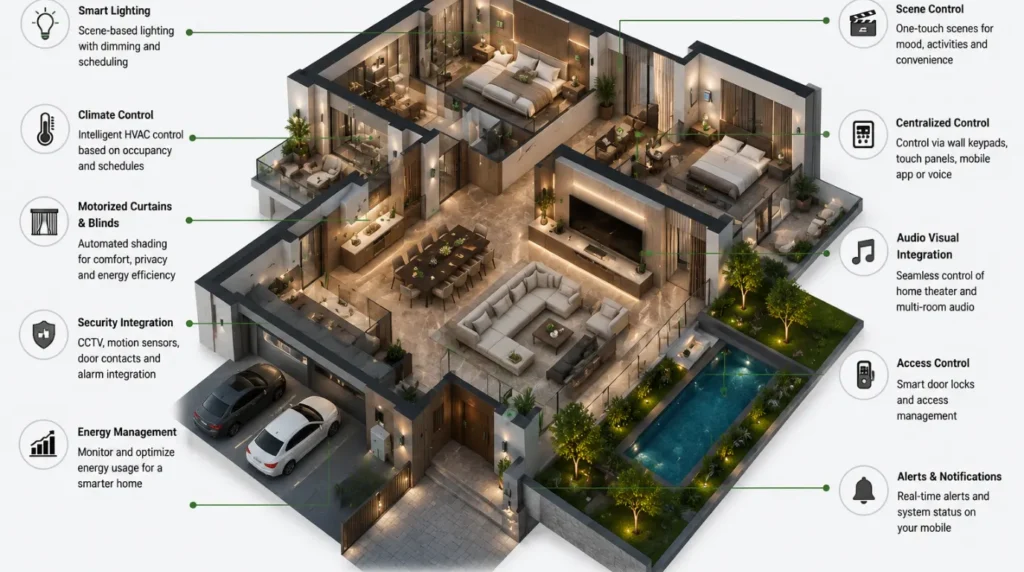
The system can be used to coordinate:
- Lighting
- Dimming
- Air conditioning and climate control
- Motorized curtains and blinds
- Security systems
- Access control
- Energy management
- Sensors
- Audio-visual systems
- Scene control
Unlike a collection of disconnected smart gadgets, the KNX approach is designed around communication between building systems.
A sensor can detect occupancy, for example, while the automation logic determines what should happen next. The system can then instruct lighting, climate, or shading equipment to respond. This creates automation based on conditions rather than simply remote control.
How Does KNX Work?
A typical KNX installation uses a dedicated bus network through which devices exchange control information.
Think of the bus as a communication highway running through the property. A wall keypad sends a command, a sensor sends information, and an actuator receives the instruction and operates the relevant electrical load.
The key point is that these devices do not depend on a consumer Wi-Fi network for every action. A professional KNX home automation installation can therefore provide local control for essential functions such as lighting, blinds, and climate systems.
The system can also be connected to higher-level interfaces, allowing homeowners to use smartphones, tablets, touchscreens, or voice assistants when desired.
This creates an important distinction: The app is an interface. It does not have to be the foundation of the home.
The Reliability of the KNX Bus
One of the major reasons architects consider KNX home automation for large properties is its dedicated communication infrastructure.
The KNX bus cable carries control information between compatible components. The building’s electrical system handles the power requirements of connected loads.
This structured approach can help avoid the limitations associated with trying to make every critical home function communicate through a congested wireless network.
Imagine a three-storey villa with:
- Reinforced concrete walls
- Multiple bedrooms
- Large entertainment areas
- Outdoor spaces
- Extensive glazing
- Multiple AC zones
- Several lighting circuits
A wireless network may require careful coverage planning, additional access points, and ongoing network management. A properly engineered wired automation network provides a different foundation. That is particularly valuable when the homeowner expects the system to operate reliably for many years.
Why Large Luxury Homes Need a Different Approach
A smart apartment with a few lights and plugs has very different requirements from a 15,000-square-foot villa. Large properties introduce challenges involving distance, network coverage, electrical infrastructure, multiple floors, and the number of connected systems.
Instead of treating every device as an independent smart product, KNX home automation allows the project to be designed as an integrated system.
For example, the homeowner could create a single “Away” scene.
When activated, the system could:
- Switch off selected lights.
- Adjust the AC.
- Close motorized curtains.
- Turn off designated appliances.
- Arm appropriate security functions.
- Confirm the status through a control interface.
One action can therefore coordinate several systems. That is where KNX home automation becomes genuinely useful.
Why Architects Should Consider KNX for Luxury Projects
Architects have to balance aesthetics, functionality, electrical planning, technology, and the long-term expectations of their clients.
A smart-home system should not create problems for any of these areas. KNX home automation can be considered during the architectural planning stage so that the infrastructure becomes part of the project rather than something added later.
Early planning allows the team to determine:
- Keypad locations
- Sensor positions
- Electrical requirements
- Automation panels
- Bus cable routes
- Equipment rack locations
- Curtain motor provisions
- Lighting zones
- Climate-control interfaces
- Security integration
- Future expansion requirements
This approach reduces the risk of having to compromise the interior after construction.
What Happens When the Internet Goes Down?
This is one of the most important questions homeowners ask. A professionally designed KNX home automation system can keep essential local automation functions operating even when the internet connection is unavailable.
Your wall keypad does not suddenly become useless because your broadband connection has stopped. Lighting control, programmed scenes, and other local automation functions can continue depending on the system’s configuration.
What may stop working is a cloud-dependent feature or remote access through the internet. This distinction is important. A home should not become “dumb” simply because the internet is temporarily unavailable.
For luxury residences, local control can therefore provide an additional level of reliability and independence.
Smart Lighting with KNX
Lighting is one of the most effective applications of KNX home automation.
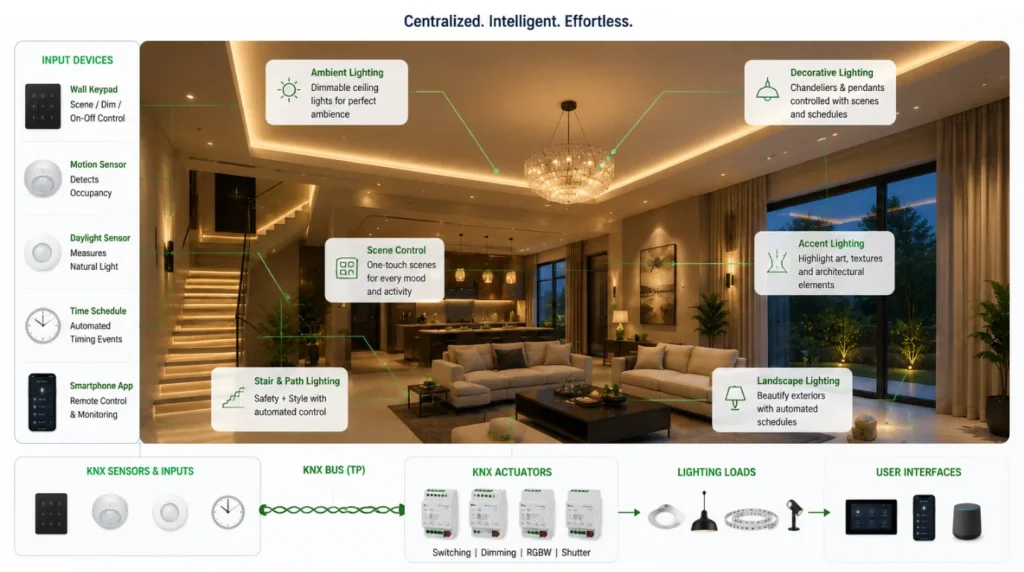
A luxury home may contain dozens of lighting circuits, including:
- Cove lighting
- Chandeliers
- Downlights
- Wall washers
- Accent lighting
- Landscape lighting
- Stair lighting
- Decorative fixtures
Managing all these circuits individually can create unnecessary switch clutter. Instead, KNX can combine them into scenes.
Welcome Scene
Selected entrance and living-room lights activate at predefined levels.
Evening Scene
Warm ambient lighting creates a relaxed atmosphere.
Movie Scene
Selected lights dim while other decorative lighting switches off.
Night Scene
Pathway and bedroom lighting operate at lower brightness.
Away Scene
Non-essential lighting switches off automatically.
These scenes make the lighting experience easier while giving architects greater freedom to reduce visible switchboards.
Climate Control and Energy Management
A large luxury home can contain several AC zones, each with different requirements.
Instead of treating every AC unit as a completely separate appliance, automation can coordinate climate control with occupancy, schedules, shading, and other conditions.
For example, if a guest bedroom is unoccupied, the system can adjust its climate settings, or if intense sunlight enters a west-facing room, motorized blinds can respond to the programmed conditions. This coordination can improve energy management while maintaining comfort.
It is important to avoid promising a fixed percentage of energy savings because actual results depend on the property, equipment, climate, user behavior, and automation strategy.
The real advantage is better control over where and when energy is used.
Motorized Curtains and Blinds
Window shading is another area where KNX home automation can make a noticeable difference.
Motorized curtains and blinds can be integrated with:
- Time schedules
- Lighting scenes
- Occupancy
- Solar conditions
- Security routines
- Climate strategies
For example, curtains can open gradually in the morning. During intense afternoon sunlight, selected blinds can close. In the evening, privacy blinds can activate automatically. In a luxury villa, this can also protect furniture, flooring, artwork, and interior finishes from excessive direct sunlight.
Security Integration
Security should not be treated as an isolated system. Automation can connect appropriate security functions with lighting, access control, sensors, and other building systems.
For example, an entrance event could trigger selected pathway lighting. A security scene could turn off interior lights while keeping exterior security lighting active. A homeowner could receive system status through a compatible interface.
KNX can also work alongside other security technologies through appropriate interfaces and gateways. The result is a more coordinated approach to residential security rather than a collection of unrelated devices.
Invisible Technology and Interior Design
One of the biggest advantages of KNX home automation for luxury interiors is the ability to reduce visible technology clutter. Instead of installing multiple switches for every lighting circuit, designers can use sophisticated multi-function keypads.
Sensors can be positioned discreetly. Automation equipment can be centralized in a technical rack. Speakers can be integrated into walls or ceilings where suitable.
The objective is simple: The technology should support the architecture, not compete with it. This design philosophy is particularly useful for interiors featuring marble, wood, wallpaper, stone, or other premium finishes.
The Importance of Professional Design
Installing KNX home automation is not simply a matter of purchasing switches and connecting wires. The system requires proper planning, addressing, programming, testing, and commissioning.
A professional automation integrator should understand:
- Electrical design
- KNX topology
- Device selection
- Programming
- Lighting control
- HVAC integration
- Motor control
- Security interfaces
- Networking
- User-interface design
- Future expansion
The automation team should also coordinate with the architect, interior designer, electrical contractor, HVAC contractor, and other project stakeholders. This collaboration is particularly important during new construction.
When Should KNX Be Planned?
The ideal time to consider KNX home automation is before electrical work begins. The earlier the system is planned, the more opportunities there are to integrate it cleanly.
- During the architectural stage, the team can decide where sensors and controls should go.
- During electrical planning, the wiring infrastructure can be coordinated.
- During interior design, keypad finishes and positions can be finalized.
- During installation, the automation system can be commissioned and tested before handover.
Waiting until the house is nearly finished can restrict options and increase installation complexity.
Is KNX Suitable for Existing Homes?
KNX is particularly attractive for new construction and major renovations because the required infrastructure can be planned from the beginning.
However, existing homes are not automatically excluded. The feasibility depends on the existing electrical conduits, accessibility, renovation scope, and required functions. In some retrofit projects, wireless or hybrid technologies may make more practical sense. The correct solution should therefore be based on the property rather than a one-size-fits-all approach.
A professional site assessment can determine whether a wired KNX infrastructure is practical.
Is KNX Home Automation Worth the Investment?
For a small apartment requiring only a few smart devices, a full professional automation system may not be necessary. For a luxury villa, however, the calculation is different. The homeowner is not simply purchasing smart switches.
They are investing in:
- Infrastructure
- Reliability
- Integration
- Scalability
- Convenience
- Energy management
- Long-term serviceability
- Architectural coordination
The value therefore needs to be evaluated over the life of the property rather than against the price of a few consumer smart gadgets.
A well-designed KNX home automation system can become part of the property’s infrastructure, much like electrical, HVAC, or networking systems.
The Techtastic Perspective
At Techtastic Technologies, we believe luxury automation should be engineered around the property and the people living in it. We do not believe that adding more gadgets automatically creates a smarter home. The system needs to be reliable, intuitive, scalable, and aligned with the architecture.
Our approach combines KNX home automation with lighting control, climate management, motorized curtains, security, entertainment, and other technologies according to each project’s requirements.
For homeowners and design professionals in Navi Mumbai, Nashik, Lonavla, Sangli, and surrounding areas, our focus is on creating automation that works quietly in the background.
The objective is not to make the house feel like a technology showroom but to make the house feel effortless.
Key Takeaways
- KNX home automation provides a structured wired foundation for luxury residential automation.
- It can control lighting, climate, curtains, security, and AV through an integrated system.
- Local control can keep essential functions working even when the internet is unavailable.
- The open KNX ecosystem provides greater long-term flexibility than many closed systems.
- Early planning helps architects integrate automation without compromising interior design.
- Smart scenes can combine multiple home functions into one simple command.
- Professional engineering and commissioning are essential for reliable performance.
- KNX is particularly suitable for large villas and premium residential projects requiring long-term infrastructure.
Frequently Asked Questions
1. Is KNX home automation more expensive than wireless systems?
A. The initial investment can be higher because a professional KNX installation requires dedicated infrastructure, certified components, engineering, programming, and commissioning. For large luxury properties, however, its long-term reliability, scalability, and serviceability can make the investment worthwhile.
2. Can KNX home automation work without Wi-Fi?
A. Yes. Core KNX functions communicate through the KNX infrastructure and do not need Wi-Fi for basic local operation. Internet connectivity may still be required for remote access, cloud services, or certain third-party integrations.
3. Can I control KNX home automation using my smartphone?
A. Yes. A suitable KNX IP interface, server, or gateway can connect the system to compatible smartphone applications. This allows homeowners to control and monitor selected functions remotely.
4. Can KNX integrate with voice assistants?
A. Yes. KNX can be integrated with compatible voice platforms through suitable gateways or servers. This allows homeowners to combine the reliability of a wired automation backbone with voice control.
5. Can KNX control air conditioning?
A. Yes. KNX can integrate with compatible HVAC equipment through appropriate interfaces and gateways. The exact integration method depends on the AC manufacturer and model.
6. Is KNX suitable for a large villa?
A. Yes. KNX home automation is particularly suitable for large villas because its structured infrastructure can support multiple rooms, floors, lighting zones, climate systems, sensors, and other building functions.
7. Can KNX systems be expanded later?
A. Yes. One of the advantages of the KNX ecosystem is its scalability. Additional compatible devices and functions can be introduced later, provided the original infrastructure has been planned appropriately.
8. Does KNX require a central hub?
A. KNX uses a decentralized architecture in which many devices can communicate directly on the bus. Additional servers or gateways may be added for visualization, remote access, voice control, or third-party integrations, but essential local automation does not have to depend on a single consumer hub.
9. When should KNX be planned in a new home?
A. Ideally, KNX home automation should be considered during the architectural and electrical planning stages. Early coordination allows bus wiring, control locations, sensors, equipment spaces, and lighting circuits to be incorporated properly.
10. Is KNX suitable for luxury apartments as well as villas?
A. Yes. While large villas are an excellent application, KNX can also be used in luxury apartments and premium residential developments where homeowners require reliable lighting, climate, shading, security, and integrated control.
Collaboration Opportunities for Architects, Interior Designers & Builders
Smart-home planning works best when automation specialists become part of the project team early.
Techtastic Technologies collaborates with architects, interior designers, builders, and developers to integrate KNX home automation into architectural and electrical plans.
Our team can assist with:
- Automation infrastructure planning
- KNX system design
- Lighting control
- Sensor placement
- Climate integration
- Motorized curtain integration
- Security coordination
- AV integration
- Equipment-rack planning
- Programming and commissioning
The objective is to make technology part of the architecture from the beginning rather than an afterthought.
Upgrade Your Luxury Home with KNX
Planning a new luxury residence or major renovation?
Techtastic Technologies designs and implements integrated KNX home automation solutions for premium homes, villas, and residential developments.
Our systems can bring together:
- Smart lighting
- Climate control
- Motorized curtains
- Security
- Energy management
- Home theatre
- AV integration
- Centralized control
Contact Techtastic
🌐 Website: Techtastic Website
📞 Phone: 9769145145
📍 Service Areas: Mumbai • Navi Mumbai • Pune • Lonavala • Nashik • Sangli
Want smart technology that blends seamlessly into your interiors? Explore our Invisible Smart Home Technology: 7 Luxury Design Ideas for elegant ways to create a connected home without compromising on design.