
Luxury interiors are becoming cleaner, quieter, and more intentional. Homeowners no longer want technology to dominate their walls, ceilings, or furniture. They want the comfort and functionality of automation without seeing a collection of screens, speakers, sensors, wires, and switches everywhere. That is where invisible smart home technology comes in.
The result is a home where technology works continuously in the background while the architecture remains the star.
For luxury residences in Navi Mumbai, Nashik, Lonavla, Sangli, and surrounding areas, this design-first approach can be particularly valuable. It allows architects and interior designers to preserve clean lines, premium materials, and carefully designed spaces without sacrificing advanced functionality.
In this guide, we explore how invisible smart home technology works, where it can be used, what architects should consider during planning, and why early collaboration between designers and automation specialists can make such a significant difference.
Quick Answer
Invisible smart home technology integrates automation, speakers, sensors, lighting, security, and AV systems into walls, ceilings, furniture, and architectural surfaces so homeowners enjoy advanced functionality without visible technology clutter.
Quick Summary
✓ Invisible smart home technology keeps automation hidden within walls, ceilings, furniture, and architectural surfaces.
✓ Concealed speakers and sensors maintain clean, minimalist interiors.
✓ Flush-mounted KNX keypads reduce visible switch clutter.
✓ Hidden curtains, screens, and AV systems create a seamless luxury experience.
✓ Centralized equipment keeps technical hardware organized and out of sight.
✓ Early planning helps architects integrate technology without compromising design.
✓ Invisible smart home technology combines luxury, functionality, comfort, and future-ready automation.
What Is Invisible Smart Home Technology?
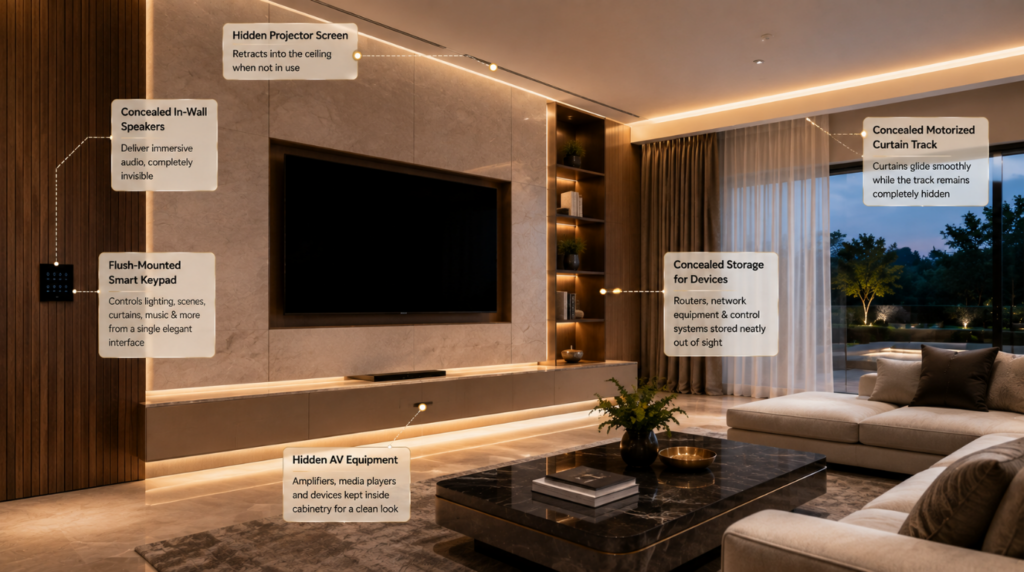
Invisible smart home technology refers to automation, audio-visual, security, and control equipment that is integrated into the architecture so that it remains hidden or visually discreet.
Traditional smart-home products are often designed to be seen. You may have a smart speaker sitting on a table, a camera attached to a wall, a thermostat mounted beside a door, or several switches grouped on a large panel.
Invisible design takes a different approach. The objective is to integrate the technology into:
- Walls
- Ceilings
- Furniture
- Cabinetry
- Doors
- Joinery
- Marble surfaces
- Wooden panels
- False ceilings
- Architectural details
This allows the technology to perform its function without competing with the interior.
The homeowner still gets lighting control, climate automation, entertainment, security, and other smart functions. The difference is that the technology becomes part of the architecture rather than an added layer.
The Visual Clutter Problem in Luxury Interiors
Imagine spending months selecting Italian marble, custom furniture, handcrafted woodwork, designer wallpaper, and architectural lighting. Then imagine covering that carefully designed wall with six switches, a thermostat, two speakers, a camera, and several visible cables.
The technology may work perfectly, but visually, something has been lost. This is one of the biggest reasons invisible smart home technology is becoming increasingly relevant to luxury residential design.
Luxury is often associated with simplicity. A well-designed space does not necessarily need to show how much technology it contains. In fact, the more sophisticated the system becomes, the less visible it may need to be.
This is particularly important in premium residences where every surface has been carefully considered. The goal is not to remove technology but to remove unnecessary visual evidence of technology.
Different Ways to Integrate Invisible Smart Home Technology
1. Hide Speakers Behind Walls and Ceilings
Audio is one of the easiest areas where technology can disrupt an interior.
Traditional speakers require visible grilles, cabinets, stands, or wall-mounted units. While these can look attractive in some interiors, they may interfere with minimalist architectural concepts.
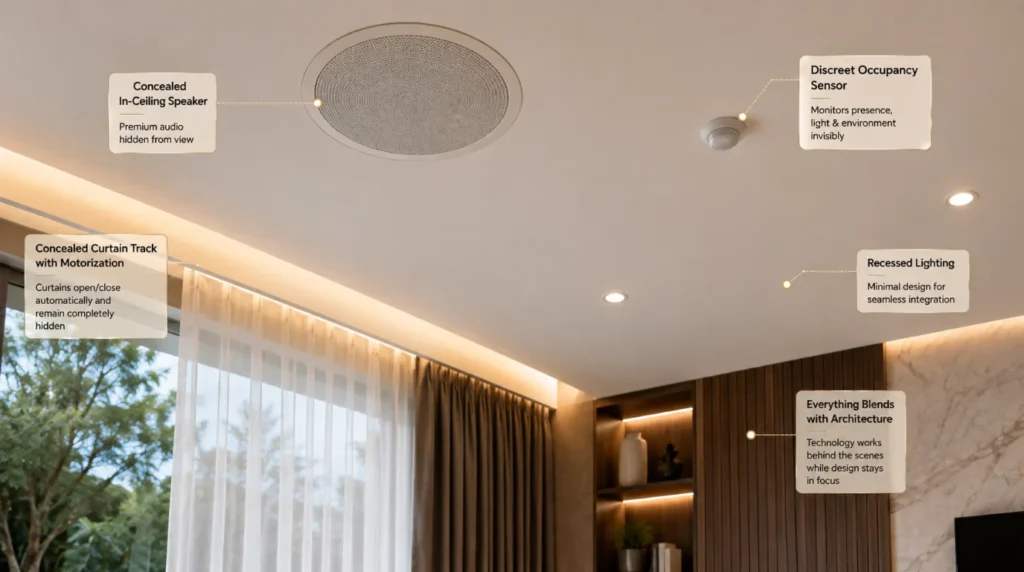
Invisible or plaster-in speakers provide another option. These speakers are installed within the wall or ceiling structure and finished with the same plaster, paint, or selected surface treatment as the surrounding architecture.
This approach works particularly well in:
- Living rooms
- Dining rooms
- Bedrooms
- Corridors
- Home theatres
- Lounges
- Entertainment spaces
For a premium residence, invisible smart home technology can therefore transform the way audio is experienced.
Instead of seeing where the music comes from, the homeowner simply experiences the sound.
2. Use Flush-Mounted Smart Keypads
Traditional switchboards can quickly become visually overwhelming.
A large room may require separate controls for:
- Multiple lighting circuits
- Fans
- Air conditioning
- Curtains
- Scenes
- Music
- Security
- Other automation functions
Instead of installing a large collection of switches, designers can use sophisticated multi-function keypads. A single keypad can be programmed to perform several functions through different button presses, touch actions, or scenes.
The interface can also be selected to complement the interior through finishes such as glass, metal, stone, or custom materials. This is where invisible smart home technology becomes more than simply hiding hardware. It is about reducing the number of visible elements while increasing functionality.
3. Conceal Sensors Within the Architecture
Sensors are essential to automation, but conventional sensors can sometimes look like small plastic boxes attached to ceilings and walls.
A design-led automation system can minimize this visual impact. Depending on the application, sensors can be integrated into ceilings, lighting details, wall surfaces, or carefully selected architectural locations.
A sophisticated multi-sensor may monitor several environmental conditions, such as:
- Presence
- Temperature
- Humidity
- Brightness
- Air quality
- Motion
For architects, this is an important benefit because ceiling composition can have a significant impact on the overall visual quality of a luxury interior.
4. Hide Technology Behind Furniture and Joinery
Not every piece of automation needs to be hidden inside the wall. Furniture and cabinetry can also become part of the technology strategy.
For example, a designer can create concealed compartments for:
- AV equipment
- Projectors
- Media players
- Speakers
- Gaming consoles
- Control equipment
- Motorized mechanisms
A projector could remain hidden inside a custom cabinet and appear only when required. A television can be concealed behind a decorative panel. A motorized screen can disappear into a ceiling slot when it is not being used.
This creates an especially powerful combination of interior design and invisible smart home technology.
5. Create an Invisible Home Theatre
Home theatres are often filled with technology. Projectors, screens, speakers, amplifiers, media players, remotes, and lighting equipment can easily make a room feel more like a technical installation than a luxury entertainment space. A better approach is to integrate the technology into the room from the beginning.
For example, a movie scene can trigger several actions simultaneously:
- Curtains close.
- Decorative lighting dims.
- Architectural lights switch off.
- The projection screen descends.
- The projector activates.
- The AV system selects the correct source.
- Audio levels are adjusted.
The hardware itself can remain concealed within cabinetry, ceilings, walls, or dedicated equipment spaces.
This is one of the clearest examples of how invisible smart home technology can improve both the aesthetics and functionality of a luxury residence.
6. Centralize the Technical Equipment
One of the easiest ways to make a luxury home look cleaner is to keep the technical equipment away from the living spaces.
Instead of placing amplifiers, controllers, network equipment, and automation processors throughout the home, they can be centralized in a dedicated technical area.
This can be:
- A utility room
- Server room
- Ventilated equipment rack
- Dedicated cabinet
- Technical closet
- Service area
Centralization means the living areas can remain visually clean while the technical infrastructure stays organized and serviceable.
This is a major principle behind invisible smart home technology: the equipment does not need to disappear completely if it is located somewhere the homeowner does not have to see it.
7. Integrate Technology Behind Premium Materials
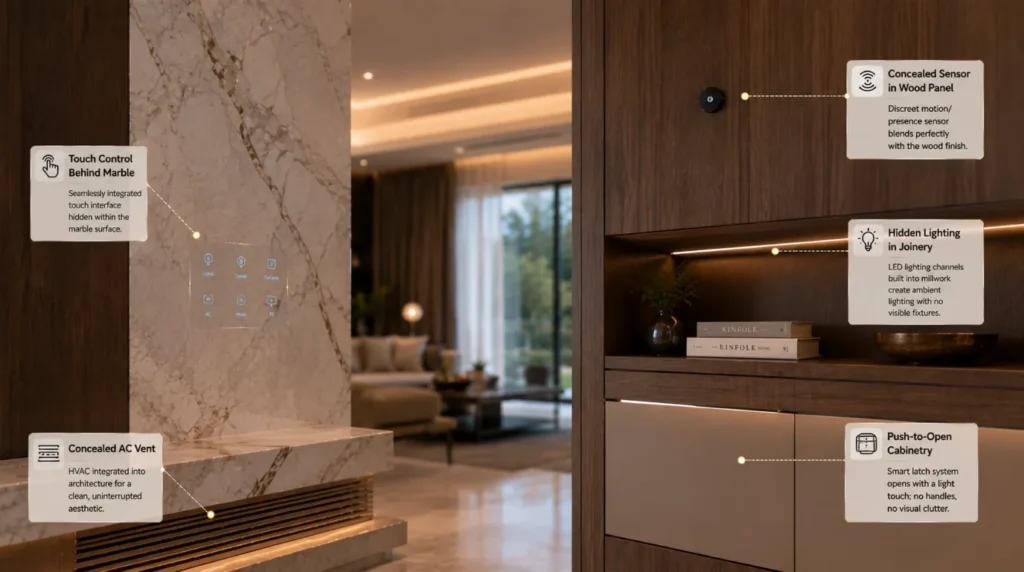
Luxury interiors often use materials such as marble, wood, stone, glass, and decorative panels. Some automation interfaces can be carefully integrated with these materials to create an extremely discreet result.
For example, a touch interface may be positioned behind or within a carefully selected surface, depending on the technology and material involved. However, this requires careful engineering. The automation specialist and interior designer need to test the proposed solution and confirm that it will function reliably.
When properly planned, invisible smart home technology can become almost indistinguishable from the architecture itself.
Why Early Planning Is So Important
The biggest mistake with concealed technology is trying to hide it after the interior has already been completed. Invisible integration works best when it is considered during the early design and construction stages.
During the planning phase, architects and automation specialists can coordinate:
- Electrical layouts
- KNX bus wiring
- Speaker locations
- Sensor positions
- Lighting circuits
- Curtain pockets
- Equipment racks
- Network infrastructure
- AV requirements
- Access panels
- Ceiling details
- Furniture requirements
This avoids expensive modifications later.
For example, if a plaster-in speaker is planned after the wall has already been completed, installation becomes considerably more complicated. Similarly, if a motorized projector lift is added after custom cabinetry has been finalized, the carpenter may need to redesign the furniture.
Early planning allows the technology and architecture to develop together.
Invisible Technology and KNX Automation
KNX can provide a strong foundation for design-led smart homes because it allows multiple building systems to communicate through a structured automation infrastructure.
Lighting, HVAC, curtains, sensors, keypads, and other systems can be integrated into the same overall automation strategy. This is particularly useful for luxury projects where multiple systems need to work together. The homeowner does not need to operate each system independently.
This combination of centralized logic and discreet hardware is what makes invisible smart home technology particularly effective in premium residences.
Invisible Technology for Luxury Villas
Larger villas create different challenges.
A villa may include several floors, landscaped outdoor areas, entertainment rooms, guest bedrooms, and extensive glazing. This makes infrastructure planning particularly important.
For luxury residences in Navi Mumbai, Nashik, Lonavla, and Sangli, where homeowners may also want to preserve a strong connection between indoor and outdoor spaces, automated curtains, lighting, climate systems, and entertainment can all be integrated discreetly.
The goal is to make the villa responsive without filling it with visible gadgets. A properly designed invisible smart home technology strategy can help maintain the architectural character of a luxury villa while providing advanced automation.
What About Maintenance?
A common concern with concealed technology is accessibility. If something is hidden, how can it be repaired? The answer is proper planning.
Not every component should be permanently inaccessible. Critical equipment such as controllers, amplifiers, processors, network switches, and power supplies should remain accessible through a dedicated technical space.
Speakers, sensors, and other architectural components should be selected and installed according to the manufacturer’s intended application. Service access should also be considered wherever mechanical equipment is involved.
Good invisible smart home technology is therefore not about hiding everything at any cost. It is about hiding what can be hidden while keeping essential service points accessible.
Benefits of Invisible Smart Home Technology
A properly designed invisible approach provides several advantages.
Cleaner Interiors
Fewer visible devices help preserve minimalist architectural compositions.
Better User Experience
Homeowners interact with the environment rather than constantly managing individual gadgets.
Greater Design Freedom
Architects can specify finishes without having to accommodate large technology components.
Integrated Functionality
Lighting, climate, audio, security, and curtains can work together.
Future Readiness
Proper infrastructure can make it easier to introduce additional automation later.
Premium Experience
The technology feels effortless because it does not constantly demand attention.
These benefits explain why invisible smart home technology is becoming an increasingly important concept in luxury residential design.
Common Mistakes to Avoid
Concealed technology requires coordination. Some common mistakes include:
Planning It Too Late
Trying to conceal speakers, wiring, or equipment after construction can increase costs.
Ignoring Service Access
A hidden component still needs an appropriate maintenance strategy.
Choosing Hardware Only for Appearance
A beautiful keypad is not useful if it does not perform reliably.
Forgetting Heat Management
Amplifiers, processors, and network equipment require suitable ventilation.
Over-Automating
Not every feature needs to be automated. Automation should solve real problems.
Poor Coordination
Interior designers, architects, electrical contractors, and automation specialists should work from coordinated plans.
The objective of invisible smart home technology is not simply to make equipment disappear. It is to create a better relationship between technology and architecture.
The Techtastic Approach
At Techtastic Technologies, we believe automation should enhance architecture rather than compete with it.
Our approach starts with understanding the property, interior concept, lifestyle requirements, and future technology goals. We then coordinate the technical infrastructure around those requirements.
Our solutions can include:
- KNX wired automation
- Smart lighting
- Motorized curtains
- Invisible audio
- Home theatre automation
- Climate control
- Smart security
- Networking
- AV integration
- Centralized equipment racks
For architects and interior designers, this approach means technology can be considered from the beginning instead of being added after the design has been finalized. The result is a home where invisible smart home technology becomes part of the architecture rather than an interruption to it.
Key Takeaways
- Invisible smart home technology integrates automation directly into architecture.
- Concealed speakers can preserve clean walls and ceilings.
- Flush keypads reduce switchboard clutter.
- Sensors can be integrated discreetly into ceilings and selected surfaces.
- Projectors and screens can disappear into custom cabinetry and ceilings.
- Centralized technical racks keep equipment away from living spaces.
- Early planning is essential for successful concealed installations.
- KNX can provide a reliable foundation for integrated luxury automation.
- Maintenance access should always be considered during design.
- The goal is not to hide everything but to make technology feel effortless.
Frequently Asked Questions
1. What is invisible smart home technology?
A. Invisible smart home technology refers to automation, audio-visual, security, and control equipment that is integrated into walls, ceilings, furniture, or architectural surfaces so that it remains hidden or visually discreet.
2. Can speakers really be hidden behind plaster?
A. Yes. Specialized in-wall and plaster-in speakers are designed to be installed behind suitable wall finishes. When properly installed, the surrounding wall can become part of the speaker’s visible surface.
3. Can KNX switches be hidden?
A. KNX controls can be made highly discreet using flush-mounted keypads, minimalist interfaces, and appropriately selected architectural finishes. The exact solution depends on the material and application.
4. Is invisible smart home technology suitable for existing homes?
A. Some solutions can be retrofitted, particularly concealed equipment within furniture or cabinetry. However, completely hidden wiring and plaster-in speakers are generally easier to plan during new construction or major renovation.
5. Where should smart-home equipment be installed?
A. Core controllers, amplifiers, network equipment, and processors should ideally be centralized in an accessible and properly ventilated technical room, rack, or utility space.
6. Does hiding technology reduce performance?
A. Not necessarily. Purpose-built concealed products can provide excellent performance when installed according to their specifications. However, the material, installation method, room acoustics, and equipment selection all matter.
7. Can invisible smart home technology work with luxury marble interiors?
A. Yes, but the specific sensor or control technology must be compatible with the material. Marble thickness, density, and installation method should be evaluated before selecting a concealed interface.
8. How early should architects plan invisible technology?
A. Ideally, it should be discussed during the architectural and interior design stages, before electrical layouts, ceilings, cabinetry, and wall finishes are finalized.
9. Can invisible smart home technology integrate with home automation?
A. Yes. Concealed speakers, sensors, keypads, curtains, lighting, climate control, security, and AV equipment can be integrated into a broader automation system depending on compatibility.
10. Is invisible smart home technology expensive?
A. The cost depends on the products, infrastructure, finishes, installation complexity, and level of integration. Concealed solutions can require more planning and specialized installation than conventional devices, but they can provide significant aesthetic and functional value in premium projects.
Collaboration Opportunities for Architects, Interior Designers & Developers
The best concealed technology projects begin with collaboration.
Techtastic Technologies works with:
- Architects
- Interior Designers
- Builders
- Real Estate Developers
- Luxury Villa Developers
- Project Management Consultants
Our team can coordinate:
- KNX automation planning
- Smart lighting infrastructure
- Concealed audio
- Motorized curtains
- Home theatre integration
- AV infrastructure
- Network planning
- Security systems
- Equipment racks
- Electrical coordination
Whether you are designing a luxury apartment in Navi Mumbai, a villa in Lonavla, or a premium bungalow in Nashik or Sangli, early technical coordination can help ensure that the technology supports your design vision.
Areas We Serve
Techtastic provides smart home and motorized curtain automation solutions across: Navi Mumbai • Nashik • Lonavla • Sangli
The company also serves projects across the wider Mumbai and Thane region.
Upgrade Luxury Interiors with Invisible Automation
Luxury technology does not have to announce itself.
The best systems often work quietly in the background, responding to the homeowner’s needs while keeping the architecture as the focus.
With invisible smart home technology, speakers can disappear into walls, sensors can become part of ceilings, screens can hide inside cabinetry, and multiple automation functions can be consolidated into discreet control interfaces.
At Techtastic Technologies, we help homeowners, architects, and developers create intelligent environments where technology and design work together.
Contact Techtastic
🌐 Website: Techtastic Website
📞 Phone: 9769145145
📍 Service Areas: Mumbai • Navi Mumbai • Pune • Lonavala • Nashik • Sangli
Wondering how to blend smart technology with your interiors? Explore our Smart Home Automation in Interior Design: 2026 Best Guide for ideas that combine style, comfort, and functionality.