
Many homeowners use the terms smart home and home automation interchangeably. At first glance, they seem to mean the same thing.
After all, both involve:
- Smart lighting
- Smart security
- Mobile app control
- Connected devices
- Voice assistants
However, there is an important difference.
At Techtastic, we often meet homeowners who already own several smart devices and believe they have a fully automated home. Then they discover that true home automation offers an entirely different level of convenience and intelligence.
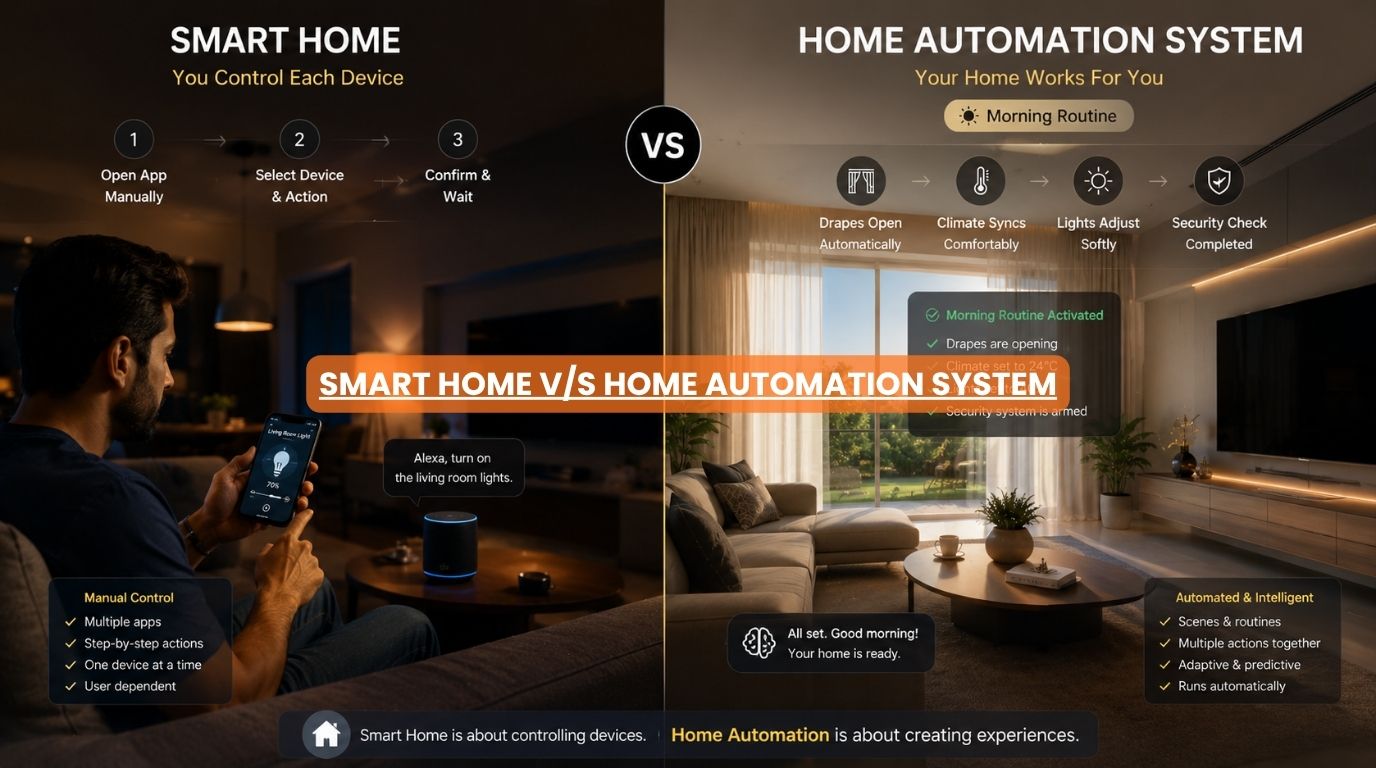
One of the easiest ways to understand the difference is this: A smart home gives you control. A home automation system gives you intelligence.
Let’s explore what that means.
Summary
A smart home and a home automation system are related but not identical. A smart home typically consists of connected devices that can be controlled individually through apps or voice assistants. A home automation system goes a step further by enabling devices and systems to communicate, coordinate, and operate automatically without requiring user input. While every home automation system creates a smart home, not every smart home offers true automation.
Quick Answer
A smart home allows homeowners to control connected devices such as lights, cameras, locks, and speakers through apps or voice assistants. A home automation system takes this a step further by enabling those devices to work together automatically based on schedules, sensors, occupancy, environmental conditions, or predefined scenes. In simple terms, a smart home responds when you tell it to, while a home automation system can respond on its own.
What Is a Smart Home?
A smart home consists of devices connected to the internet or a local network. These devices can often be controlled through:
- Smartphone apps
- Voice assistants
- Touch panels
- Remote controls
Examples include:
- Smart bulbs
- Smart plugs
- Smart speakers
- Smart locks
- Smart cameras
- Smart TVs
The primary feature of a smart home is connectivity. Devices can communicate with you.
Smart Home Example
Imagine you arrive home and say: “Alexa, turn on the living room lights.”
The lights switch on. That’s smart home technology. The device responded to your command.
However, you still initiated the action.
What Is a Home Automation System?
A home automation system goes beyond connectivity. Instead of waiting for commands, it can make decisions automatically based on:
- Time of day
- Occupancy
- Temperature
- Sunlight levels
- Security status
- User preferences
The system responds automatically without requiring user interaction.
Home Automation Example
Imagine you arrive home.
The system automatically:
- Unlocks the gate
- Adjusts lighting
- Opens curtains
- Activates air conditioning
- Turns on pathway lighting
No voice commands. No app. No manual control.
The home simply responds. That’s automation.
The Biggest Difference: Control vs Automation
This is the easiest way to understand the distinction.
| Smart Home | Home Automation System |
| Device control | Intelligent automation |
| User initiates actions | System initiates actions |
| Individual devices | Integrated ecosystem |
| App-focused | Scenario-focused |
| Convenience | Convenience + intelligence |
Both are valuable. However, automation delivers a much more seamless experience.
Smart Devices vs Smart Experiences
Many homeowners start with individual smart products.
Examples:
- Smart bulbs
- Smart speakers
- Smart plugs
- Smart cameras
Each device works independently. Over time, however, managing multiple apps becomes frustrating. This is where automation becomes valuable.
Automation connects systems to create experiences rather than isolated functions.
Example: Smart Lighting vs Automated Lighting
Smart Lighting
You open an app.
You turn lights on.
Automated Lighting
The system detects occupancy.
Lights turn on automatically.
When the room becomes empty:
Lights switch off automatically.
No interaction required.
Example: Smart Curtains vs Automated Curtains
Smart Curtains
You use an app or voice assistant to open curtains.
Automated Curtains
Curtains automatically respond to:
- Sunrise
- Sunset
- Room temperature
- Occupancy
The homeowner doesn’t need to think about them.
Example: Smart Security vs Automated Security
Smart Security
You manually arm the system.
Automated Security
When everyone leaves:
- Security arms automatically
- Doors lock automatically
- Lights adjust
- Energy-saving mode activates
Multiple systems work together.
Why Home Automation Feels More Intelligent
True automation focuses on outcomes rather than devices. Homeowners don’t care about controlling:
- 40 lights
- 10 curtains
- 8 climate zones
They care about:
- Comfort
- Security
- Convenience
- Energy efficiency
Automation manages the complexity behind the scenes.
How KNX Fits Into Home Automation
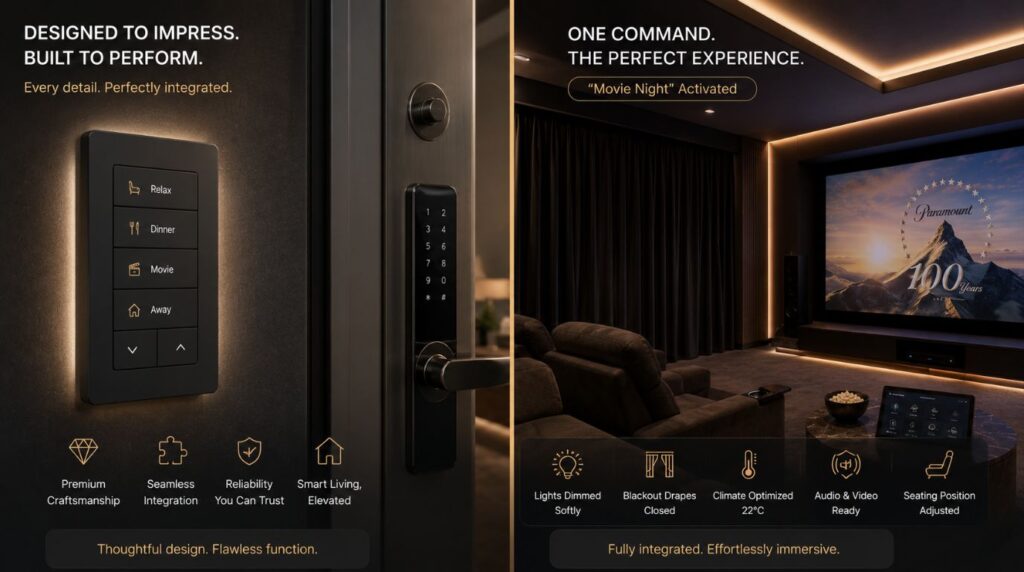
At Techtastic, many premium projects utilize KNX home automation because it supports deep integration between systems.
KNX can coordinate:
- Lighting
- Climate control
- Security
- Motorized curtains
- Entertainment systems
- Energy management
Instead of managing devices separately, KNX creates a unified ecosystem.
This is one reason KNX is widely used in luxury homes worldwide.
Smart Home vs Home Automation: Real-World Comparison
| Feature | Smart Home | Home Automation System |
| App Control | Yes | Yes |
| Voice Control | Yes | Yes |
| Device Connectivity | Yes | Yes |
| Automatic Responses | Limited | Extensive |
| Occupancy Detection | Sometimes | Common |
| Scene Automation | Basic | Advanced |
| Multi-System Integration | Limited | Extensive |
| Scalability | Moderate | High |
| User Interaction Required | Frequent | Minimal |
The difference becomes more noticeable as the home grows larger.
Which Is Better for Homeowners?
The answer depends on goals.
Smart Home Is Ideal If You Want
- Basic convenience
- Entry-level automation
- Lower initial investment
- Individual device control
Home Automation Is Ideal If You Want
- Whole-home intelligence
- Seamless experiences
- Advanced automation
- Long-term scalability
- Integrated control
Most homeowners eventually move toward automation as their needs evolve.
Common Misconceptions
Myth 1: Smart Home and Home Automation Are the Same
They overlap, but automation goes much deeper.
Myth 2: Automation Removes Control
Automation actually provides more control while reducing manual effort.
Myth 3: Automation Is Only for Luxury Homes
Modern automation solutions are available for many property types.
Myth 4: Smart Devices Automatically Create Automation
Without integration and logic, smart devices remain individual products.
Why It Matters for Modern Homes
Today’s homeowners expect technology to simplify life. The challenge is that adding more devices can sometimes create more complexity.
Automation solves this problem by making technology work together. Instead of managing dozens of devices individually, homeowners interact with a cohesive living environment.
Our Perspective at Techtastic
At Techtastic, we believe the future of residential technology lies in intelligent automation rather than isolated smart devices.
When designing projects, we focus on:
- User experience
- System integration
- Scalability
- Reliability
- Long-term value
The goal isn’t to create a home filled with gadgets. The goal is to create a home that understands how its occupants live. That’s where automation truly shines.
Collaboration Opportunities for Developers, Architects & Interior Designers
The distinction between smart homes and home automation becomes especially important during project planning.
At Techtastic, we collaborate with:
- Architects
- Interior designers
- Luxury home builders
- Residential developers
- Hospitality consultants
- Commercial project planners
Smart Infrastructure Planning
Prepare homes for future automation.
Integrated Technology Design
Create seamless user experiences.
KNX Automation Planning
Enable whole-home intelligence.
Lighting & Climate Integration
Improve comfort and efficiency.
Luxury Residential Projects
Deliver premium smart living experiences.
Future-Ready Developments
Support evolving homeowner expectations.
Early collaboration ensures technology enhances both functionality and design.
Key Takeaways
- A smart home connects devices.
- A home automation system connects experiences.
- Smart homes rely more on user commands.
- Home automation enables automatic responses.
- Automation improves convenience, efficiency, and comfort.
- KNX is one of the most powerful home automation platforms available.
- Every automated home is smart, but not every smart home is truly automated.
Frequently Asked Questions
1. What is the difference between a smart home and a home automation system?
A. A smart home allows device control, while a home automation system enables devices to operate automatically and work together intelligently.
2. Is home automation better than a smart home?
A. Home automation typically offers greater convenience, integration, and scalability.
3. Can a smart home become a home automation system?
A. Yes. Additional integration, sensors, automation logic, and centralized control can transform a smart home into a fully automated environment.
4. Does home automation require internet?
A. Not always. Many professional systems such as KNX can operate locally.
5. Are smart devices enough for a complete smart home?
A. They can provide convenience, but advanced automation often requires deeper integration.
6. Is KNX a smart home system?
A. KNX is a professional home automation platform that supports advanced smart home functionality.
7. Is home automation worth it?
A. For many homeowners, the improvements in comfort, security, convenience, and efficiency make it a valuable investment.
8. Can existing homes be automated?
A. Yes. Many automation solutions can be added to both new and existing homes.
Conclusion
While the terms are often used interchangeably, a smart home and a home automation system are not the same thing. Smart homes focus on connected devices and remote control, while home automation systems create intelligent environments where devices work together automatically to improve comfort, security, efficiency, and convenience.
At Techtastic, we help homeowners, architects, and developers move beyond simple smart devices and create truly intelligent living spaces.
📞 Call/WhatsApp: 9769145145
📍 Our Operational Hubs: Navi Mumbai | Nashik | Lonavla | Sangli
Whether you’re starting with a few connected products or planning a fully integrated KNX ecosystem, understanding this distinction is the first step toward building a smarter home that works for you rather than requiring constant management.
Ready to take the next step? Explore our comprehensive breakdown on Smart Home Investment: How Much Money Can You Save in 2026? to see how these requirements translate into real-world value for your property.