Quick Answer
It can be, but privacy depends heavily on the system architecture, devices, software, network configuration, and cloud services involved.
Not every smart-home system collects the same type or amount of information. A basic lighting automation system may require little personal data. A system containing cameras, microphones, smart locks, voice assistants, and cloud-connected applications can involve considerably more sensitive information. This makes home automation privacy a design consideration rather than a single product feature.
Before installing a system, ask: What data does this device collect? Where is that data processed? Who can access it? Can the system operate locally?
Those questions can tell you considerably more about privacy than the word “smart” on the product packaging.
A smart home can make everyday life remarkably convenient.
Lights turn on automatically. Curtains close when the sun becomes intense. Cameras alert you when someone approaches the entrance. Voice assistants respond to commands. Your HVAC system can adjust based on occupancy.
But all this convenience raises an important question: How much does your smart home actually know about you?
This is where home automation privacy becomes important.
Smart-home systems can potentially process information about your routines, devices, movements, voice commands, security events, and preferences. Depending on the products and architecture you choose, the system may process some information locally. Other data may be sent through cloud services. That doesn’t mean smart homes are inherently unsafe or invasive.
It means homeowners should understand what information others collect, where others send it, who can access it, and how long others retain it. For premium homes with multiple integrated systems, home automation privacy should be considered during system design—not after installation.
Quick Summary
When thinking about home automation privacy, homeowners should understand:
✓ What data their devices collect
✓ Whether processing happens locally or in the cloud
✓ Which devices contain microphones or cameras
✓ How remote access is secured
✓ What information mobile apps can access
✓ Whether third-party services are involved
✓ How long data may be stored
✓ Who can access the automation system
✓ How software and firmware are maintained
✓ What happens if the internet connection goes down
The most important principle is simple:
Don’t choose smart-home technology only for what it can do. Understand what information it needs to do it.
1. What Data Can a Smart Home Collect?
The type of information collected depends on the devices installed.
A smart home could potentially process information such as:
- Temperature
- Humidity
- Occupancy
- Motion
- Door and window status
- Lighting activity
- Energy consumption
- Camera footage
- Audio or voice commands
- Access events
- Device usage
- Automation schedules
For example, an occupancy sensor might detect that movement occurred in a particular room. A smart lock may record an access event. A camera can generate video footage. A voice assistant may process spoken commands.
None of these automatically compromises your privacy. However, understanding these data flows is central to home automation privacy.
2. Cameras Require Extra Attention
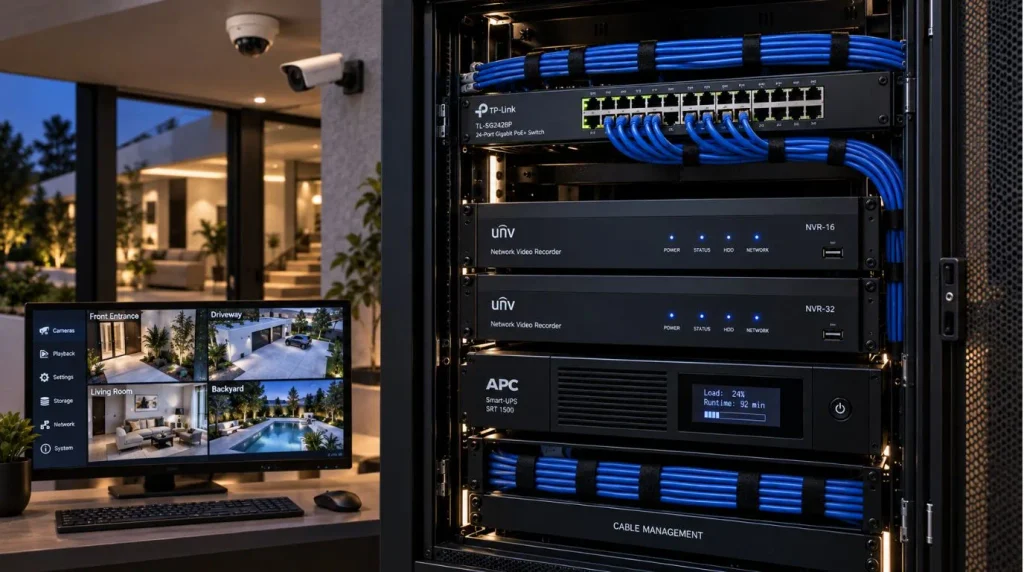
Security cameras are among the most privacy-sensitive devices in a smart home.
A camera can potentially capture:
- Family members
- Guests
- Domestic workers
- Neighbors
- Deliveries
- Visitors
- Private activities
Therefore, camera placement and storage architecture deserve careful consideration.
Ask:
Where is the camera pointing?
Avoid unnecessary coverage of private areas.
Where is footage stored?
Depending on the system, you can store it locally, on an NVR, on a memory card, or through a cloud service.
Who can view it?
Restrict access to authorized users.
How long is footage retained?
Longer retention means more data remains available if an account or system is compromised.
Good home automation privacy isn’t only about cybersecurity. It is also about collecting no more information than necessary.
3. What About Microphones and Voice Assistants?
Voice control is convenient.
You can say: “Turn off the living room lights.”
But microphones introduce another privacy consideration.
Before installing voice-controlled devices, understand:
- When the microphone is active
- How voice commands are processed
- Whether recordings are retained
- Whether processing occurs locally or remotely
- What account is associated with the device
- What third-party services are involved
This is particularly relevant in bedrooms, home offices, and other private spaces.
Home automation privacy becomes much easier to manage when homeowners know exactly which devices can listen and when.
4. Cloud vs Local Automation
One of the most important distinctions in home automation privacy is whether automation depends on cloud services.
Cloud-Based Automation
Some smart-home systems send information to remote servers to provide:
- Remote control
- Voice processing
- Data storage
- Analytics
- Notifications
- Device synchronization
This can provide useful functionality, but it introduces additional data-handling considerations.
Local Automation
In a local architecture, core automation logic can operate within the property or local network. This can reduce dependence on external cloud services for certain functions.
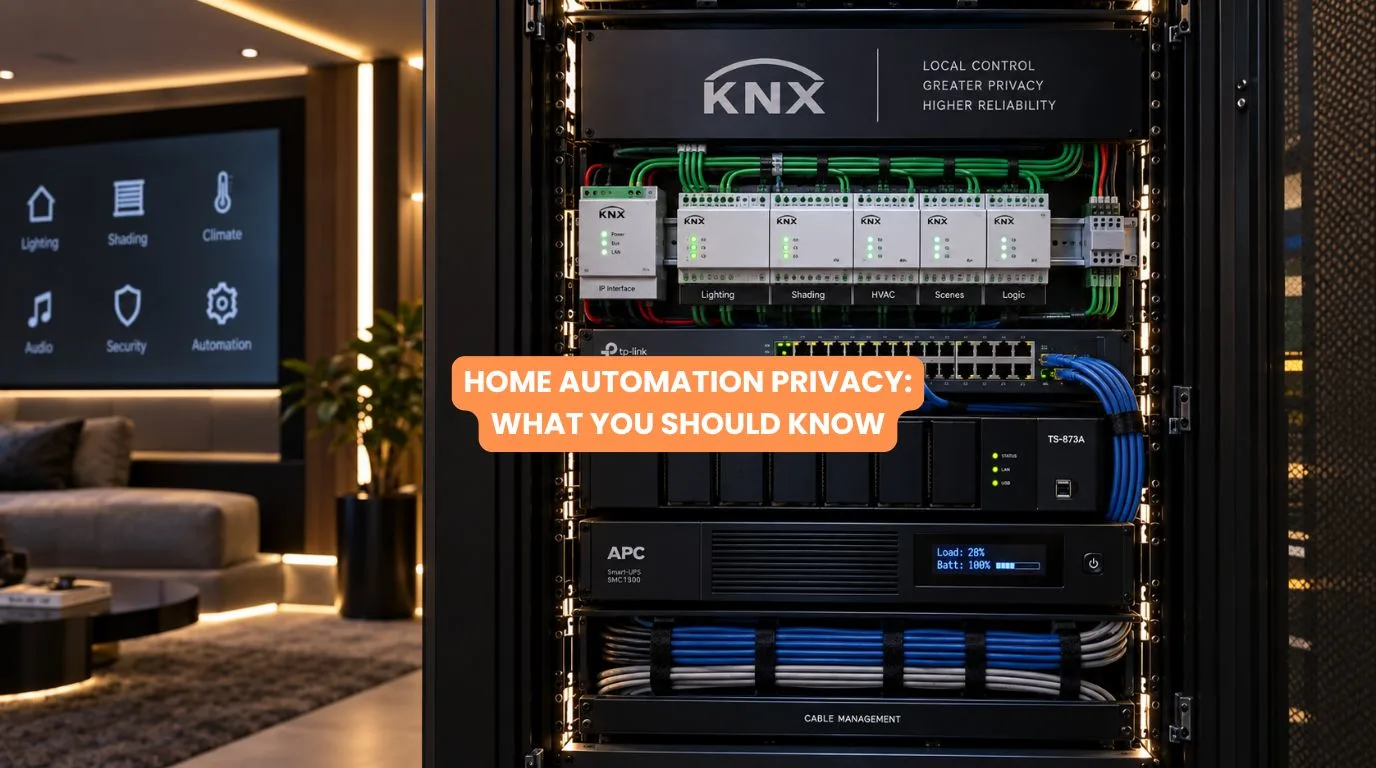
Professional automation platforms like KNX are relevant here because key building automation functions can run on local systems. However, “local” does not automatically mean “perfectly private.”
The complete system still needs secure networking, appropriate access controls, and properly configured connected devices.
5. Why KNX Can Be Interesting for Privacy
For premium residential projects, KNX home automation can provide a different architecture from many consumer smart-home ecosystems.
KNX is an open building-automation standard used to integrate functions such as:
- Lighting
- HVAC
- Shading
- Security
- Energy management
- Controls
A professionally designed KNX installation can operate locally rather than requiring every automation decision to be processed through a cloud platform. This can be useful when considering home automation privacy.
For example, a simple lighting rule such as: Motion detected → hallway light turns on doesn’t inherently need to be sent to an external server to function.
That doesn’t mean every KNX installation is completely offline or cloud-free. Integrations, remote access, and third-party devices can introduce external services. We need to assess the architecture as a whole.
6. Your Smart Home Network Matters
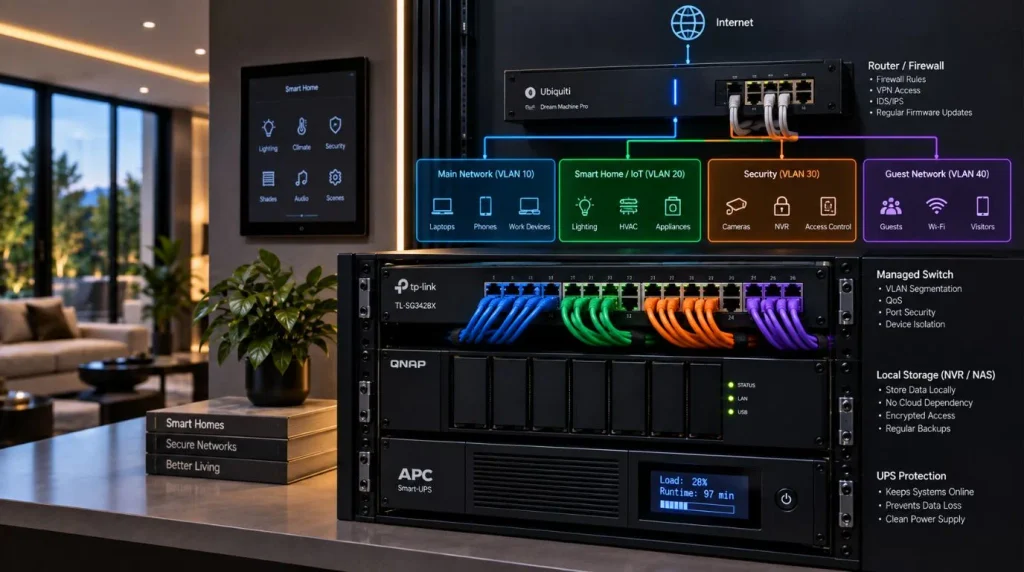
Even a privacy-conscious automation system can become vulnerable if the network is poorly secured.
Your home network may connect:
- Smart TVs
- Cameras
- Doorbells
- Automation controllers
- Smartphones
- Computers
- Speakers
- Appliances
- AV systems
This creates a larger digital environment. Good home automation privacy therefore requires attention to the network itself.
Useful practices include:
- Strong unique passwords
- Secure Wi-Fi
- Updated network equipment
- Firmware updates
- Appropriate network segmentation
- Restricted administrative access
- Removal of unused accounts
- Secure remote-access methods
For larger homes, network architecture should ideally be considered alongside automation planning.
7. Mobile Apps Can Become an Important Privacy Point
Many smart-home systems are controlled through smartphone applications.
The app may provide access to:
- Devices
- Cameras
- Door locks
- Scenes
- Notifications
- User accounts
- Automation schedules
That means your smartphone account can effectively become another gateway into your home. If someone gains unauthorized access to the account, the consequences can extend beyond simply losing access to an app.
Depending on the system, they could potentially gain visibility into connected devices or security information. Therefore, home automation privacy also means securing the accounts used to control the home.
8. Remote Access: Convenience vs Privacy
Being able to check your home while you’re traveling is extremely useful.
You might want to:
- View a camera
- Check whether a door is locked
- Turn lights on
- Adjust temperature
- Receive security notifications
But remote access creates another pathway into the system.
A professional installation should therefore use secure remote-access methods and minimize unnecessary exposure.
Ask your integrator: How is remote access implemented? Who can access the system remotely? Can individual users have different permissions? What happens if an employee or installer no longer needs access?
These are important home automation privacy questions.
9. Smart Locks and Access Data
Smart locks can make property access significantly more convenient. But access information is sensitive. Depending on the system, homeowners may have records showing:
- When a door was unlocked
- Which credential was used
- Which user accessed the property
- Whether access was granted or denied
That information can be useful for security. It also needs protection.
A good system should have clear user permissions and a process to remove users who no longer need access. This is particularly important for larger homes with staff, service personnel, or multiple family members.
10. Automation Data Can Reveal Your Routine
Here’s a subtle privacy issue many homeowners don’t consider. Automation schedules can potentially reveal patterns.
For example:
- Bedroom lights activate at 7 AM.
- Curtains open at 7:15 AM.
- Garage opens at 8:30 AM.
- Security changes state at 9 AM.
- Living room lights activate at 7 PM.
Individually, these are harmless automation rules. Together, they can reveal information about household routines. That’s why home automation privacy is about more than protecting passwords.
It is also about understanding what your connected home can reveal about your lifestyle.
Privacy Checklist Before Installing Smart Home Automation
| Question | Why It Matters |
|---|---|
| What data does the system collect? | Identifies privacy exposure |
| Is processing local or cloud-based? | Determines where information goes |
| Are cameras included? | Video is highly sensitive |
| Are microphones included? | Voice data requires consideration |
| Where is data stored? | Storage location affects control |
| Who has system access? | Limits unauthorized access |
| How is remote access secured? | Reduces external exposure |
| How long is data retained? | Limits stored information |
| Can users be removed? | Important for changing households |
| How are updates handled? | Helps maintain security |
Common Home Automation Privacy Mistakes
Installing Cameras Everywhere
More cameras don’t automatically mean better security. Use coverage where it is genuinely necessary.
Reusing Passwords
A smart-home account shouldn’t share a weak password with other services.
Ignoring Firmware Updates
Connected devices can require security and software updates.
Giving Everyone Administrator Access
Different users may need different levels of control.
Using Too Many Cloud Services
Every additional connected platform can introduce another data-handling relationship.
Forgetting About Old Devices
Replacing a smart device doesn’t necessarily mean the associated account or access credentials should remain active.
How We Approach Home Automation Privacy at Techtastic
At Techtastic, we believe privacy should be considered during system architecture, not added as an afterthought.
When planning an integrated smart home, we consider:
- What functions actually need connectivity
- Which systems can operate locally
- Network infrastructure
- Remote-access requirements
- User permissions
- Smart home security systems
- Camera locations
- Automation controllers
- Third-party integrations
- Future expansion
Our goal isn’t to eliminate connectivity. Modern homes benefit from remote access and connected services. Instead, the objective is to use connectivity deliberately.
For us, good home automation privacy means homeowners should understand what their system is doing and have appropriate control over who can access it.
Can a Smart Home Be Completely Private?
No connected system should be described as absolutely risk-free.
If a device connects to the internet, it needs cybersecurity and privacy care. If it uses an outside service, it needs cybersecurity and privacy care. If it stores data digitally, it needs cybersecurity and privacy care.
The goal should therefore be risk reduction and informed design, not unrealistic guarantees.
A good smart-home architecture minimizes unnecessary data collection, secures accounts and networks, uses trusted equipment, and keeps the system maintained. That is a much more realistic approach to home automation privacy.
Key Takeaways
When planning home automation privacy, remember:
- Know what information your devices collect.
- Cameras and microphones deserve special attention.
- Understand cloud vs local processing.
- Secure the home network.
- Protect mobile applications and user accounts.
- Use appropriate remote-access controls.
- Review smart-lock access permissions.
- Keep firmware and software updated.
- Remove unnecessary users and devices.
- Consider what automation schedules reveal about household routines.
- Choose professional systems with long-term support.
- Privacy should be part of the design—not an afterthought.
Frequently Asked Questions (FAQs)
1. What is home automation privacy?
Home automation privacy refers to protecting personal information and household activity data generated or processed by smart-home devices, automation systems, apps, and connected services.
2. Do smart homes record everything?
No. Data collection varies significantly by device and system. A simple lighting controller may collect little information, while cameras and voice assistants can process considerably more.
3. Is local home automation more private?
Local processing can reduce dependence on external cloud services for certain functions. However, network security, device security, and account management still matter.
4. Are smart cameras a privacy risk?
They can be if improperly configured or accessed by unauthorized people. You should consider camera placement, storage, retention, and account security.
5. Can KNX improve home automation privacy?
KNX can support locally operated building automation, which may reduce cloud dependence for core functions. The overall privacy characteristics still depend on the complete installation and any third-party integrations.
6. Should smart-home devices be on a separate network?
Network segmentation can be useful, particularly in larger smart homes with many connected devices. Design the exact architecture according to the home’s requirements.
7. Is voice control safe in a smart home?
Voice control can be useful. Homeowners should know how the device processes commands. They should also know what information the system stores. They should know which external services are involved.
8. How can I protect my smart home from hackers?
Use strong, unique credentials, secure networking, current firmware, appropriate permissions, and carefully configured remote access.
9. Does home automation collect information about my routine?
Some systems can generate information that reflects occupancy, schedules, access events, or device usage. The amount depends on the devices and architecture.
10. Should privacy be considered before installing home automation?
Absolutely. Home automation privacy should be considered during the initial design so that connectivity, data collection, networking, and access requirements can be planned appropriately.
Collaboration Opportunities for Architects & Interior Designers
Privacy and security should be considered alongside the architectural design of a smart home.
Architects and interior designers can collaborate with Techtastic to determine:
- Appropriate camera locations
- Discreet sensor placement
- Access-control points
- Equipment locations
- Network infrastructure
- Automation panels
- Concealed wiring
- Smart lock integration
- AV and smart-device locations
This ensures technology doesn’t compromise the aesthetics or privacy of the residence. For luxury homes, the objective is not to fill the property with visible technology. The best automation often works quietly in the background.
Areas We Serve
Techtastic works with homeowners, architects, interior designers, builders, and developers across: Navi Mumbai | Nashik | Lonavla | Sangli
We design integrated automation systems for premium apartments, villas, and residential projects.
Final Verdict
Home automation privacy is not about being afraid of smart-home technology. It is about understanding it.
Every connected device introduces a certain amount of data, connectivity, and access considerations. The right system can offer enormous convenience while designers still keep privacy and security in mind.
The most important questions aren’t simply: “Is this device smart?”
They are: “What does it know?” “Where does that information go?” “Who can access it?” “Does it actually need to be connected?”
When these questions get answered during design, homeowners can enjoy automation without giving up too much privacy.
For a premium smart home, home automation privacy should be treated as part of the system design itself—not as something to worry about after everything has already been installed.
Contact Techtastic
🌐 Website: Techtastic Website
📞 Phone: 9769145145
📍 Service Areas: Mumbai • Navi Mumbai • Pune • Lonavala • Nashik • Sangli