
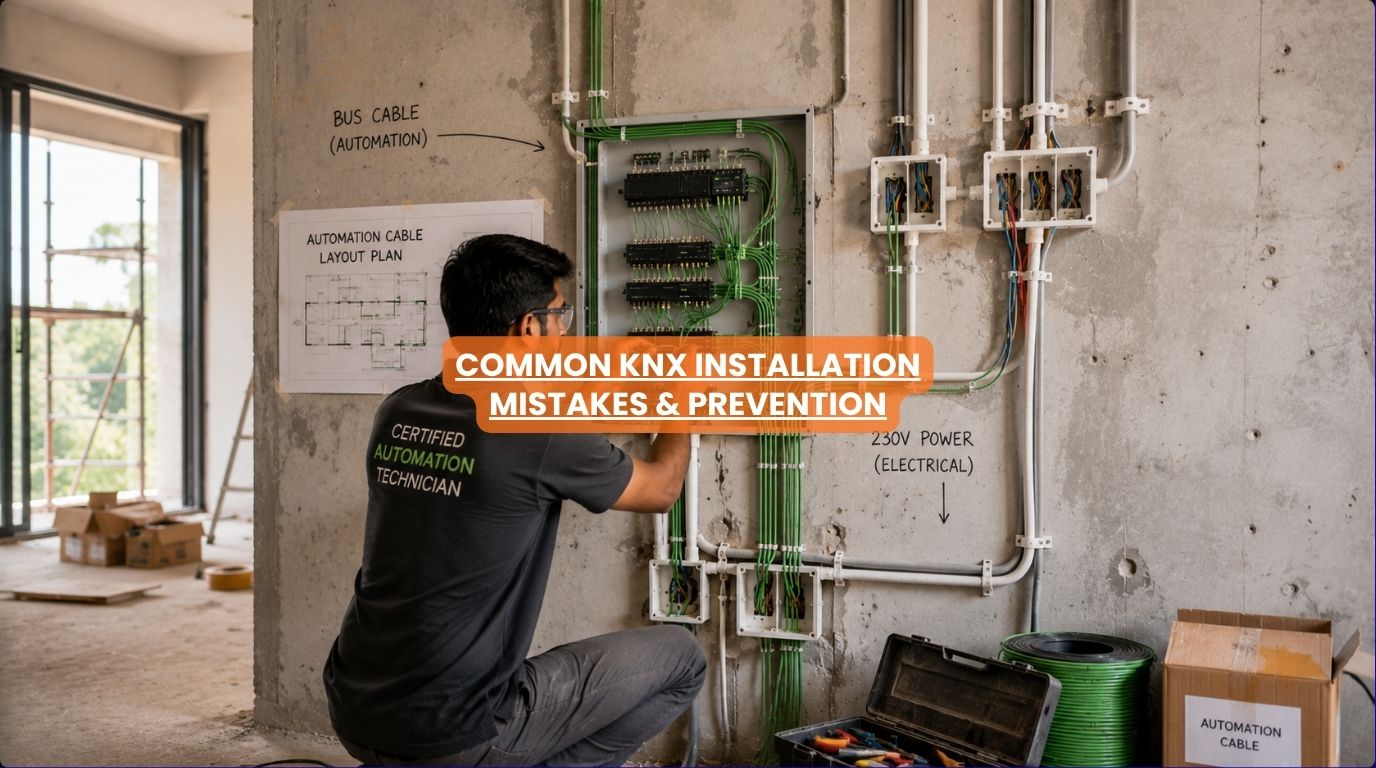
KNX is widely regarded as one of the most reliable and future-proof home automation systems available today. Its flexibility, scalability, and multi-brand compatibility make it a preferred choice for luxury homes, villas, apartments, hospitality projects, and commercial spaces. However, even the best technology can underperform if it’s installed incorrectly.
At Techtastic, we’ve seen many projects where homeowners invested significantly in automation but failed to achieve the desired experience because of planning and installation mistakes made early in the process.
The good news? Most KNX installation issues are entirely preventable.
Whether you’re building a new smart home or upgrading an existing property, understanding these common KNX installation mistakes can help you create a smarter, more reliable, and more future-ready home.
Summary
Most KNX installation problems occur due to poor planning, insufficient wiring preparation, inadequate networking infrastructure, lack of scalability considerations, and improper system integration. Successful KNX home automation projects require early-stage planning, coordinated design between stakeholders, structured cabling, centralized control strategies, and future expansion capabilities. Avoiding common KNX installation mistakes can significantly improve reliability, user experience, and long-term value.
Quick Answer
The most common KNX installation mistakes include planning too late, underestimating wiring requirements, ignoring future expansion, choosing poor device locations, neglecting networking infrastructure, and focusing on products instead of overall system design. A successful KNX installation starts with proper planning, scalable infrastructure, and collaboration between automation specialists, architects, electricians, and homeowners.
Why Proper KNX Planning Matters
Unlike standalone smart devices, KNX is infrastructure.
It influences:
- Lighting
- Climate control
- Security
- Motorized curtains
- Audio-video systems
- Energy management
- Future automation expansion
Decisions made during KNX installation often affect system performance for decades.
This is why planning is just as important as product selection.
Mistake #1: Starting Automation Planning Too Late
This is the most common mistake.
Many homeowners begin discussing automation after:
- Electrical work starts
- Ceiling layouts are finalized
- Interior design is complete
By this point, many opportunities have already been lost.
Why It Causes Problems
Late planning can result in:
- Limited wiring options
- Increased installation costs
- Design compromises
- Reduced automation flexibility
Better Approach
Involve your automation partner during:
- Architectural planning
- Electrical design
- Interior design development
Early planning delivers significantly better results.
Mistake #2: Underestimating KNX Wiring Requirements
Many homeowners focus on visible devices while overlooking infrastructure.
KNX depends on properly planned communication wiring.
Insufficient wiring can limit:
- Future expansion
- Device placement
- Automation capabilities
Better Approach
Plan wiring not only for today’s requirements but also for future upgrades.
Think long-term.
Mistake #3: Ignoring Future Expansion
A smart home should evolve.
Many homeowners initially automate:
- Lighting
- Security
- Curtains
Later they want:
- Energy monitoring
- Home theatres
- EV charging integration
- Solar management
Without expansion planning, upgrades become more difficult and expensive.
Better Approach
Design infrastructure that supports future growth.
KNX is built for scalability—take advantage of it.
Mistake #4: Poor Keypad and Control Placement
Automation is only useful if it’s convenient to use.
We’ve seen projects where:
- Switches are difficult to access
- Touch panels are poorly located
- Controls don’t align with room usage
This creates daily frustration.
Better Approach
Design control locations around real-world behavior and movement patterns.
Technology should feel intuitive.
Mistake #5: Focusing Only on Lighting
Many homeowners associate KNX primarily with lighting control.
While lighting is important, KNX can also manage:
- Climate control
- Security
- Access control
- Motorized curtains
- Entertainment systems
Limiting planning to lighting alone often reduces long-term value.
Better Approach
View KNX as a complete building automation platform.
Mistake #6: Neglecting Networking Infrastructure
Modern smart homes rely heavily on networking.
Yet networking is often treated as a separate project.
Poor networking can affect:
- Remote access
- Security systems
- Mobile control
- Entertainment systems
Even a perfectly installed KNX system benefits from strong network infrastructure.
Better Approach
Plan:
- Structured cabling
- WiFi coverage
- Equipment locations
- Network scalability
Automation and networking should be designed together.
Mistake #7: Choosing Technology Based Only on Initial Cost
Automation is a long-term investment.
Selecting components solely on price can lead to:
- Limited functionality
- Reduced flexibility
- Future upgrade challenges
Better Approach
Focus on:
- Reliability
- Scalability
- Integration capability
- Long-term value
The lowest upfront cost isn’t always the most economical decision.
Mistake #8: Not Planning Automation Scenes
Many homeowners think only in terms of controlling devices individually.
True automation comes from scenes.
Examples include:
Good Morning
- Curtains open
- Lights adjust
- Climate activates
Movie Mode
- Curtains close
- Lights dim
- Entertainment system activates
Good Night
- The lights switch off
- Security arms
- Curtains close
Without scene planning, automation often feels underutilized.
Mistake #9: Failing to Coordinate With Interior Designers
Automation affects:
- Wall aesthetics
- Lighting design
- Touch panel placement
- Curtain systems
Lack of coordination can create visual compromises.
Better Approach
Encourage collaboration between:
- Architects
- Interior designers
- Automation specialists
The best projects integrate technology seamlessly into design.
Mistake #10: Choosing a System Without Professional Support
KNX projects are highly customizable.
Proper commissioning, programming, and support are essential.
Poor implementation can result in:
- Unreliable behavior
- User frustration
- Difficult troubleshooting
Better Approach
Work with experienced KNX professionals who understand:
- System design
- Programming
- Integration
- Long-term support
Common KNX Installation Mistakes at a Glance
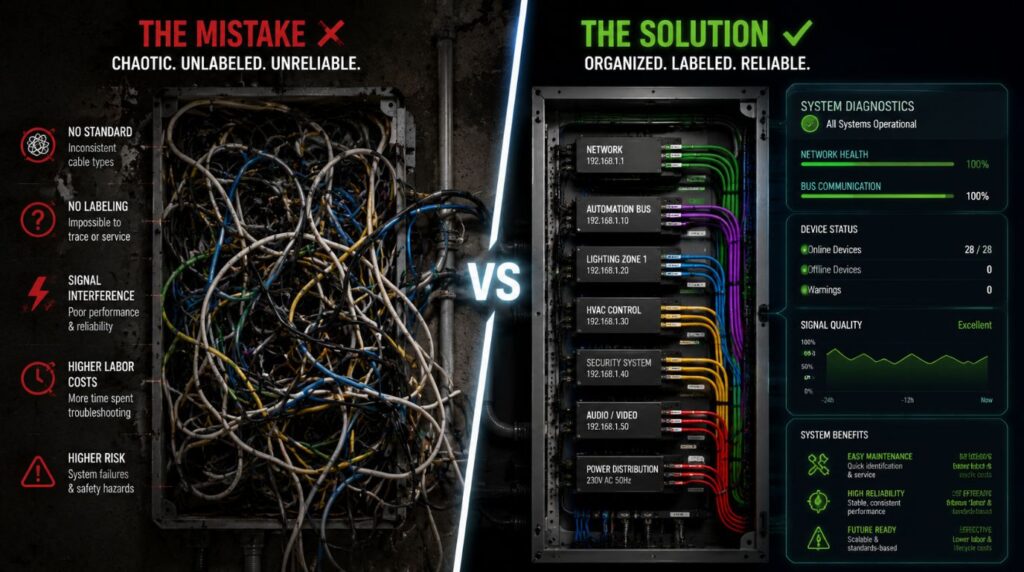
| KNX Installation Mistake | Impact |
| Late planning | Increased costs |
| Poor wiring strategy | Limited expansion |
| Ignoring future needs | Costly upgrades |
| Bad keypad placement | Poor user experience |
| Lighting-only focus | Reduced value |
| Weak networking | Connectivity issues |
| Cost-first decisions | Limited scalability |
| No scene planning | Underutilized automation |
| Poor design coordination | Aesthetic compromises |
| Inexperienced implementation | Reliability issues |
What a Successful KNX Project Looks Like
A well-designed KNX home automation system should provide:
- Reliable operation
- Simple control
- Future scalability
- Seamless integration
- Excellent user experience
The technology should feel invisible.
Homeowners should focus on living comfortably—not managing automation.
Why It Matters for Modern Homes
Today’s homeowners expect:
- Security
- Comfort
- Convenience
- Energy efficiency
- Future readiness
KNX supports all of these goals, but only when the KNX installation is planned correctly.
Avoiding common mistakes protects both the homeowner’s investment and the overall user experience.
Our Perspective at Techtastic
At Techtastic, we believe the success of a KNX project is determined long before the KNX installation begins.
Our approach focuses on:
- Early-stage planning
- Infrastructure-first thinking
- Future scalability
- Seamless design integration
- User-centric automation
We’ve found that homeowners who invest time in planning typically enjoy better performance, lower upgrade costs, and greater long-term satisfaction. The smartest KNX systems aren’t necessarily the most complex. They’re the ones that are thoughtfully designed.
Collaboration Opportunities for Developers, Architects & Interior Designers
The best KNX projects begin with collaboration.
At Techtastic, we work alongside:
- Architects
- Interior designers
- MEP consultants
- Luxury home builders
- Residential developers
- Hospitality consultants
KNX Infrastructure Planning
Create scalable automation foundations.
Lighting & Automation Design
Align technology with architecture.
Smart Home Coordination
Reduce installation conflicts.
Structured Networking Design
Support reliable connectivity.
Luxury Residential Projects
Deliver premium automation experiences.
Future-Ready Developments
Prepare properties for evolving technologies.
Early involvement helps eliminate costly mistakes before construction begins.
Key Takeaways
- Most KNX installation mistakes are planning-related.
- Early automation design dramatically improves outcomes.
- Wiring and networking should be planned together.
- Future scalability should be considered from day one.
- Scene-based automation delivers greater value than device-level control.
- Collaboration between designers and automation specialists improves both aesthetics and functionality.
- Professional implementation is critical for long-term reliability.
Frequently Asked Questions
1. What is the biggest KNX installation mistake?
A: Planning automation too late in the construction process is often the most costly KNX installation mistake.
2. Does KNX require special wiring?
A: Yes. KNX systems use dedicated communication cabling that should be planned during installation.
3. Can KNX be expanded later?
A: Yes. KNX is highly scalable, but expansion is easier when future growth is considered early.
4. Why is networking important for KNX projects?
A: Networking supports remote access, mobile control, security systems, and overall smart home performance.
5. Should KNX planning involve architects and interior designers?
A: Absolutely. Early collaboration improves both aesthetics and functionality.
6. Is KNX only for lighting control?
A: No. KNX can manage lighting, climate, security, curtains, energy systems, and more.
7. Are KNX upgrades expensive?
A: Costs are generally lower when expansion capabilities are planned during initial installation.
8. How can I ensure a successful KNX installation?
A: Work with experienced professionals, plan early, prioritize scalability, and focus on long-term infrastructure.
Conclusion
KNX home automation is one of the most powerful and future-ready automation platforms available, but its success depends heavily on planning and execution. By avoiding common installation mistakes such as late-stage planning, poor wiring strategies, inadequate networking, and limited scalability considerations, homeowners can create a system that remains reliable, flexible, and valuable for years to come.
At Techtastic, we help homeowners, architects, designers, and developers build KNX ecosystems that combine intelligent automation with thoughtful design.
📞 Call/WhatsApp: 9769145145
📍 Our Operational Hubs: Navi Mumbai | Nashik | Lonavla | Sangli
The right planning today can prevent costly challenges tomorrow while creating a smart home that’s ready for the future.
Want to ensure your system investment is fully protected? Head over to our deep dive on Smart Home Construction: 5 KNX Home Wiring Best Practices to learn how we future-proof your smart home infrastructure.