
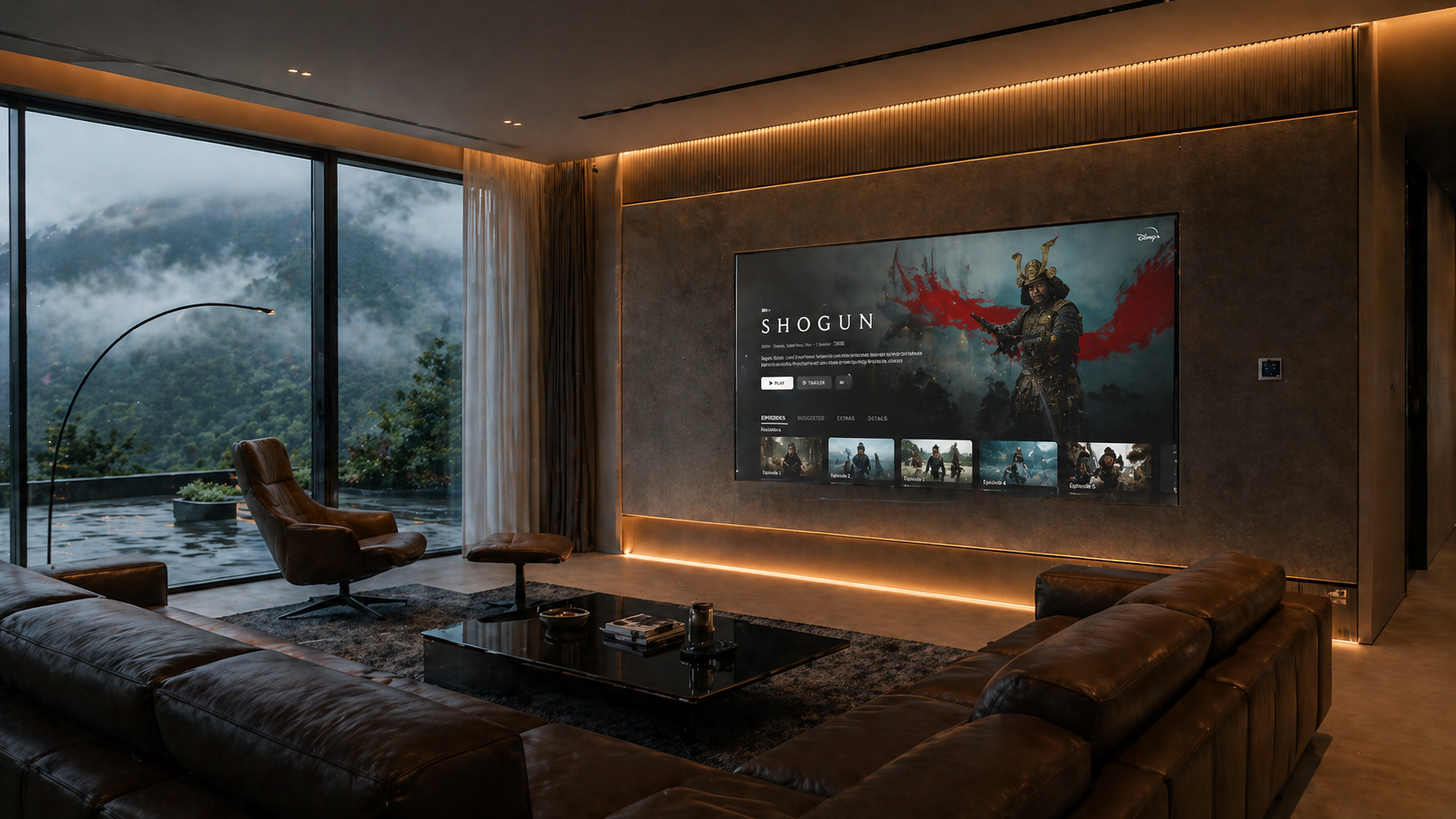
Summary
In Lonavla’s luxury villas, thick concrete and high humidity often kill Wi-Fi. While wireless setups are faster to install, wired home theaters are the only way to prevent lag and signal dropouts.
This guide explains why a physical “Bus System” (wired home theaters) is the superior choice for high-end properties. By prioritizing dedicated cabling like Cat6 and speaker wire during the construction phase, you ensure a theater that delivers uncompressed audio and 4K video regardless of weather conditions or network congestion.
Wireless vs. Wired Home Theaters: Why Luxury Villas in Lonavla Need a Physical Bus System
In Lonavla’s luxury villas, the rolling mist is beautiful, but the environment is tough on tech. Standard wireless gadgets often fail high-end expectations here. When consulting with owners, the biggest debate is usually whether to stick with wireless or invest in reliable wired home theaters.
In a modern apartment in Mumbai, you might get away with a wireless home theater speaker. But in a 5,000-square-foot villa in Lonavla? That’s a different story.
Here is why: if you are aiming for a true “Invisible Cinema” experience, the wires are actually your best friends.
The “Lonavla Factor”: Why Wireless Struggles in the Hills
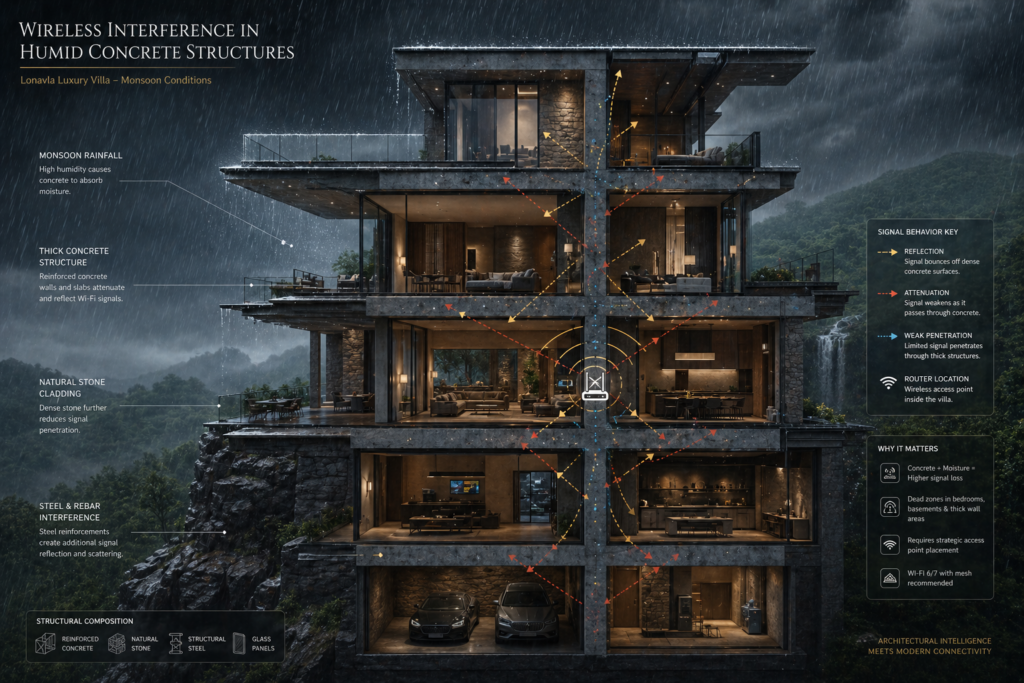
Before we discuss the tech, we have to discuss the architecture. Architects build luxury villas here like fortresses, using thick concrete, heavy brickwork, and stone cladding.
1. The Concrete Shield
Wireless signals (Wi-Fi and Bluetooth) hate concrete. In a large villa, your router and home theater are often on different floors, making a strong connection difficult. By the time that signal passes through two RCC slabs and three brick walls, your “High-Definition” stream is struggling to keep up. This leads to the “spinning wheel of death” right in the middle of a movie’s climax.
2. The Monsoon and Humidity Interference
It sounds like a myth, but high humidity and heavy rainfall can actually affect signal propagation. Lonavla’s power fluctuations often force wireless routers to reboot and lose their connection. Re-syncing speakers every time the generator kicks in is not a luxury experience.
What exactly is a “Physical Bus System”?
In automation, a wired “Bus System” acts like a central nervous system. High-grade cabling physically links every component, providing a direct, reliable connection instead of forcing devices to “shout” over Wi-Fi.
The “Zero-Lag” Guarantee
When you use a wired connection, you are dealing with zero latency. In a home theater, timing is everything. If your wireless rear speakers are even 50 milliseconds out of sync with the front soundstage, the human ear notices. It feels “off.”
Wired home theaters ensure perfectly synced audio and video that works at lightning speed every single time.
Uncompressed Audio Quality
Wireless systems often “compress” the audio to make it small enough to travel over Wi-Fi. This means you lose the rich, deep textures of a film’s score. Wired home theaters allow for Dolby Atmos and DTS:X in their full, uncompressed glory. You hear the rain in the movie as clearly as the rain hitting your villa’s roof outside.
Why Architects Should Prioritize the “Gray Structure” Phase
If you are currently at the “gray structure” stage (the brick and mortar phase), this is your golden window. This is the moment to install the “Physical Bus.”
1. Conduit is King
Running PVC conduits through the walls and ceilings now is remarkably cheap. We can pull speaker wires and Cat6 cables directly to your cinema locations now. Finishing the Italian marble and ceilings first makes adding wires a messy, expensive nightmare.
2. Centralized AV Racks
In a luxury villa, you don’t want to see a mess of wires under the TV. A wired system lets you hide all the bulky equipment—like receivers and servers—in a ventilated rack or electrical room. All the user sees is the screen and the speakers. This is the hallmark of a high-end “Invisible Cinema.”
The “Hybrid” Advantage: The Best of Both Worlds
Even when I advocate for a wired backbone, I still keep the system “smart.” This is where the Hybrid Smart Home System comes in.
We use the wires for the Mission-Critical tasks:
- Video: HDMI over Cat6 to the projector.
- Audio: Direct speaker wire to in-wall architectural speakers.
- Control: A wired “Bus” for the lighting and curtain controllers.
Then, we use the Cloud/Wireless for the User Interface:
- Using your iPad to select the movie.
- Voice commands to dim the lights.
- Remote updates for your streaming apps.
This approach ensures a wireless, easy experience while maintaining a wired, indestructible delivery.
Final Thoughts: Designing Wired Home Theaters for the Long Term
A luxury villa in Lonavla is more than a home; it’s an escape. You go there to disconnect from the stress of the city, not to spend your weekend troubleshooting a finicky Wi-Fi connection. A wired backbone chosen during design ensures reliability, quality, and peace of mind.
If you are planning wired home theaters in Lonavla, Nashik, Sangli, or Navi Mumbai, let’s make your entertainment system as solid as your villa’s foundation.
Collaboration Opportunities for Builders and Architects
I work with developers, architects, and interior designers to enhance residential projects by integrating wired home theaters during the planning and design stages. My team ensures that automation aligns seamlessly with your design layouts, electrical infrastructure, and interior concepts.
I invite you to partner with Techtastic to implement wired home theaters for your upcoming projects in Nashik, Navi Mumbai, Sangli, and Lonavla.
Contact Techtastic today at 9769145145 for a professional consultation to see how wired home theaters can elevate your design vision.
Technical FAQs on Wired Home Theaters
Q: If I have a wired system, can I still play music from my phone via Spotify?
A: Absolutely. Your phone talks to the system’s “brain” via Wi-Fi, which then transmits signals directly to the speakers through a wired connection. You get the convenience of your phone with the superior sound of a wired system.
Q: What kind of cables are we discussing? Is it just regular electrical wire?
A: Definitely not. We use high-purity copper speaker wires and shielded data cables to ensure a reliable home theater connection. This prevents “crosstalk” or interference from the electrical lines running through your walls.
Q: Does a wired system mean I will have ugly wires visible on my walls?
A: Quite the opposite. Planning the wiring during construction hides it completely behind the drywall or inside the conduits. Wired systems look much cleaner because wireless speakers still need power cords trailing to every unit.
Q: Can I upgrade a wired system in 10 years?
A: Yes! This is the biggest advantage of using conduits. If a new cable hits the market, we simply use the old one to pull it through the existing pipes. You never have to break a wall again.
Q: Why do you call it an “Invisible Cinema”?
A: Because when the system is off, you shouldn’t see it. Flush-mounted speakers blend into the walls, the projector hides in the ceiling, and the screen retracts into a concealed pocket. The “Physical Bus” makes this disappearing act possible.