

Summary
Choosing between KNX wired automation and wireless systems is the most critical decision in modern home design. While DIY wireless gadgets offer quick fixes, they often face signal interference, brand lock-in, and short lifespans.
In contrast, KNX wiring is a global, decentralized open standard. More than 500 manufacturers support it.
This guide explains why KNX wiring is the gold standard for luxury villas. It focuses on its strong reliability and “zero-latency” green bus technology. It also covers the full design freedom it gives architects and homeowners.
Why Choose KNX?
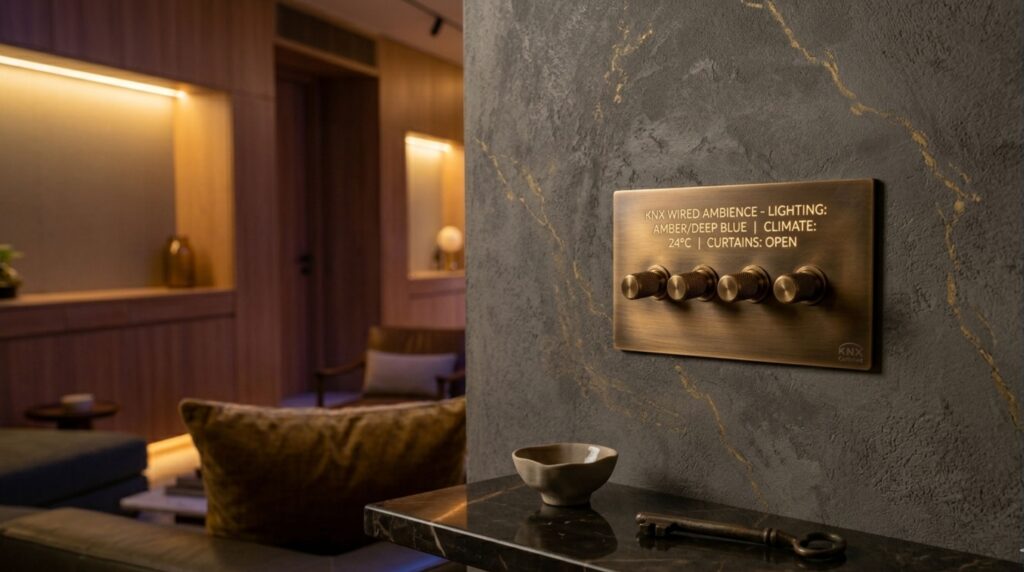
If you are an architect, a high-end homeowner, or a property developer, you’ve likely reached a crossroads in your smart home journey. You’ve likely seen glossy DIY gadgets in retail stores and heard about “wireless” solutions that promise easy setup. At this stage, you encounter KNX.
In the world of professional building automation, people often refer to KNX as the “Gold Standard.” But why? What makes a KNX wired automation system superior to a mesh Wi-Fi network or a smart hub?
Choosing the right wiring infrastructure is the most important decision you will make for your property. Unlike a smartphone or a TV, you cannot “upgrade” your home’s wiring easily once the walls are closed. This blog explores why KNX wiring remains the undisputed choice for luxury residences and commercial landmarks globally.
1. Decentralized Intelligence: No Single Point of Failure
Most smart home systems, especially wireless ones, rely on a “Central Brain” or a Bridge/Hub. If that hub fails, your entire house can lose smart functionality. You might not be able to turn on your lights, start your AC, or keep your security system secure.
KNX wiring is distinct. It operates on a decentralized model. Every single device on the network (a switch, a sensor, a motor controller) has its own processor. They communicate directly with each other through the “green bus cable.”
The Benefit:
If one sensor fails, the rest of the house continues to function perfectly. This level of reliability is why critical environments like hospitals, airports, and luxury hotels trust KNX.
2. The Power of Connection: 500+ Manufacturers, One Language
One of the biggest frustrations in home automation is being “locked in” to a single brand. If you buy a proprietary system, and the company shuts down or stops support, your smart home can become obsolete.
KNX is an Open Standard (ISO/IEC 14543). Over 500 manufacturers operate in the market, including global giants like Schneider Electric, ABB, Siemens, and Legrand. They all build products that use the same KNX language.
The Benefit:
The benefit is flexibility.
- You can use a Schneider switch in the living room.
- You can use an ABB actuator in the DB cabinet.
- You can use a Siemens weather station on the roof. They will all work together seamlessly.
You can always choose more than one brand. You are free to pick the best-looking switches and the strongest controllers worldwide.
3. Future-Proofing Your Investment (The 30-Year Rule)
Technology moves fast, but buildings are meant to last decades. Wireless standards (Wi-Fi 6, Zigbee, Matter) change every few years. A smart bulb you buy today might not connect to the router you buy in 2030.
Engineers designed KNX wired home automation for a 30+ year lifecycle. The core technology has remained backward compatible for over three decades. A KNX switch installed in 1995 can still communicate perfectly with a KNX controller manufactured in 2026.
The Benefit:
When you choose KNX wiring, you are installing an “industrial-grade” backbone. You won’t need to tear down your walls in ten years to “upgrade” the wiring. It is the most sustainable choice for luxury real estate.
4. Unmatched Stability: The “Green Wire” Advantage
Wireless devices are prone to interference. Thick concrete walls (common in Indian architecture), microwave ovens, and crowded Wi‑Fi areas can cause “latency.” Latency is that annoying two-second delay between pressing a button and the light turning on.
KNX cables use a dedicated, shielded Bus Cable (the famous green wire). This KNX wiring carries both data and a small amount of power to the devices.
The Benefit:
Command execution is instantaneous. No signal drop, no interference from your neighbor’s Wi-Fi, and no lag. It provides a “zero-latency” experience that wireless systems simply cannot guarantee in large-scale luxury villas.
5. Extreme Customization for Architects and Designers
For an architect, aesthetics are just as important as functionality. Most wireless brands offer limited switch designs—usually plastic and generic.
Because hundreds of manufacturers support KNX wiring, you can choose from an infinite number of design options. You can choose:
- Minimalist glass touch panels.
- Vintage-style brass toggle switches.
- Stone, wood, or leather-finished interfaces.
- Invisible sensors that hide inside the ceiling.
The Benefit:
KNX wired automation allows the technology to blend into the architecture rather than distracting from it.
6. Scalability: From One Room to a Township
Some systems work great in a small apartment but fall apart when you try to scale them to a 15,000 sq. ft. villa with a garden, basement theatre, and outdoor security.
KNX wiring is infinitely scalable. You can start with basic lighting control. Later, add HVAC, motorized curtains, pool management, and EV charger monitoring. All run on the same green wire.
The Benefit:
You don’t need separate “apps” for everything. A single, cohesive ecosystem unifies everything.
7. Data Privacy and Security
In an era where “hacking” is a real concern, wireless smart homes are more vulnerable to external breaches. KNX systems are primarily local. While you can connect them to the internet for remote mobile access, the house still runs offline. The core work happens on the physical wire.
The Benefit:
Your data doesn’t live in a random cloud server. Your home’s “logic” stays within your walls, providing a much higher layer of security for high-profile homeowners.
8. Energy Efficiency and Sustainability
KNX isn’t just about luxury; it’s about intelligence. A KNX power supply system can:
- Dim lights automatically based on the amount of natural sunlight (Daylight Harvesting).
- Turn off the AC in a room if someone leaves a window open.
- Adjust the heating/cooling depending on whether someone occupies the room.
The Benefit:
Studies show that a fully automated KNX building can save up to 50% on energy costs. We compare this to traditional buildings with manual controls.
Comparison Table: KNX Wiring & Wireless
| Feature | KNX Wiring | Wireless Systems (Wi-Fi/Zigbee) |
| Reliability | High. Affected by walls, microwaves, and neighbors’ Wi-Fi. | Medium. Dependent on router stability and signal strength. |
| Interference | Zero. Signal travels through shielded green bus cables. | Ultra-High. No single point of failure; it works without the internet. |
| Longevity | 30+ Years. Designed as a permanent building infrastructure. | 3–5 Years. Hardware and protocols update frequently |
| Scalability | Infinite. Can manage hotels, airports, and 20,000 sq. ft. villas. | Limited. Too many devices slow down the network. |
| Brand Freedom | 500+ Manufacturers. Mix and match any KNX-certified brand. | Vendor Lock-in. Usually limited to one brand’s ecosystem. |
| Data Privacy | High. Local control; doesn’t require cloud processing. | Ultra-High. No single point of failure; it works without the internet. |
Conclusion: Why Not Any Other Wiring?
While Wi-Fi and DIY systems work well in small apartments or retrofits, they lack industrial reliability.
They also lack brand independence and the long life needed for a permanent home.
If you are building your “forever home” or a landmark commercial project, you want a system you can trust. It should work every time you press a button. It should not fail for the next 30 years. That is why you choose KNX wiring.
Collaboration Opportunities for Builders and Architects
Developers, architects, and interior designers can enhance residential projects by using KNX wiring in India during the planning and design stages.
Techtastic collaborates with industry professionals to ensure automation technology integrates seamlessly with architectural layouts, electrical infrastructure, and interior design concepts.
Partner with Techtastic to implement KNX wiring for your upcoming residential projects in Nashik, Navi Mumbai, Sangli, and Lonavla.
Contact Techtastic today at 9769145145 for a professional consultation and see how KNX wiring can elevate your architectural vision.
Technical FAQ: Understanding KNX Wiring
Q1: Is KNX better than wireless systems like Zigbee or Wi-Fi?
For luxury homes and large-scale projects, KNX wiring is significantly superior. While wireless works well for small retrofits, KNX wiring offers industrial-grade reliability. It has no signal interference and supports a 30-year lifecycle. Wireless protocols cannot match this.
Q2: Can I mix different brands in a KNX system?
Yes! This is the biggest advantage of KNX. You can use a Schneider Electric switch to control an ABB actuator and a Siemens thermostat.
All 500+ certified manufacturers speak the same language.
Q3: Does KNX work if the internet goes down?
Absolutely. Unlike cloud-based smart home gadgets, the “intelligence” of KNX wiring lives in the physical green bus cable. Your lights, AC, and security will function perfectly even if your service provider has an outage.
Q4: Is KNX wiring difficult to install in an existing home?
KNX is a “wired-first” technology. For existing homes, a hybrid approach using KNX RF (Radio Frequency) can extend the system. It avoids heavy cabling.
Q5: How does KNX save energy in luxury villas?
Through “Integrated Control.” For example, a KNX system can dim lights when there is enough natural light (daylight harvesting). It can also switch off the HVAC when someone leaves a balcony door open. This can cut energy waste by up to 50%.