
Quick Answer
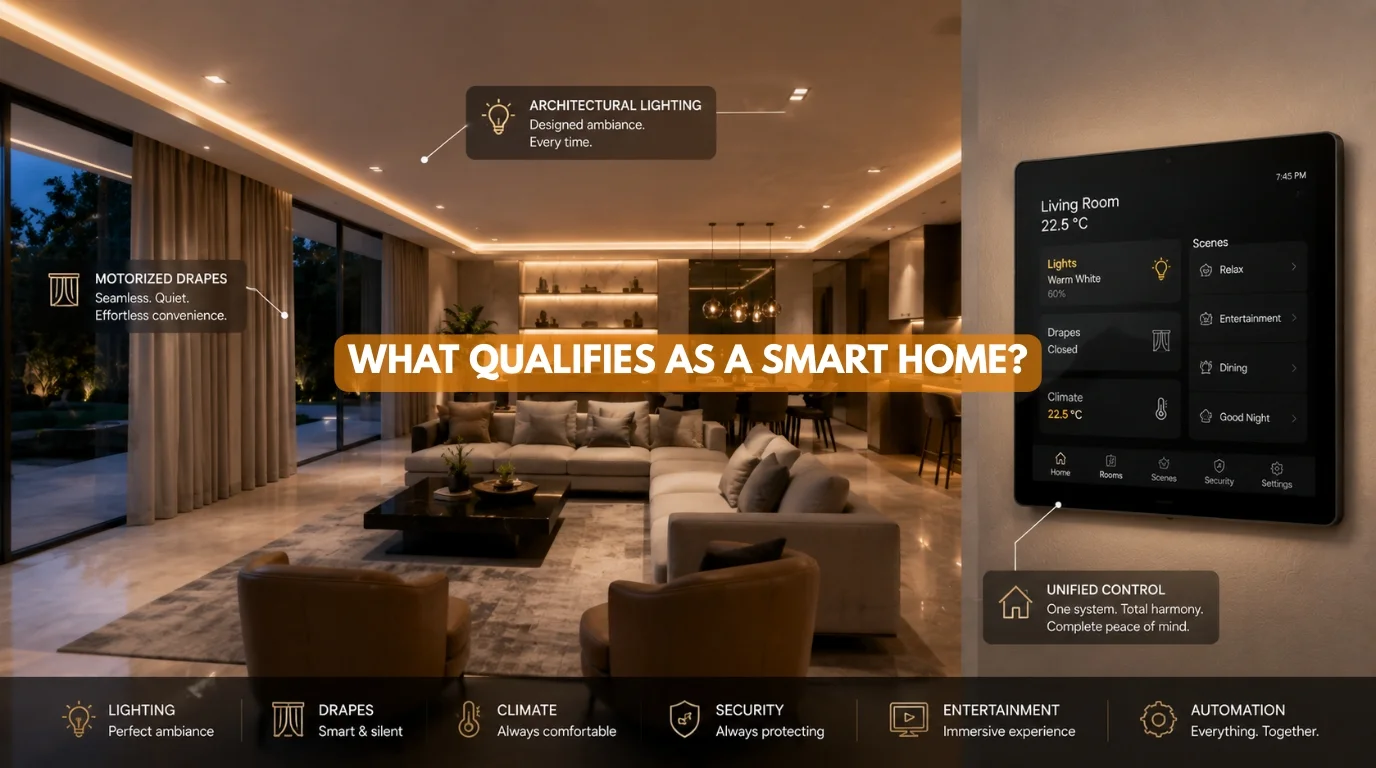
A home is a smart home when it has connected devices or systems. You can control them from anywhere. They can run automatically. You can monitor them.
They can also work together. Typical systems include smart lighting, motorized curtains, smart home security, climate control, entertainment, energy management, smart locks, sensors, and centralized control. A professionally integrated smart home goes beyond individual gadgets by creating automated interactions between different systems.
What Qualifies as a Smart Home?
A home does not become “smart” just because it has a smart TV, a Wi-Fi camera, or a few connected light bulbs. So, What Qualifies as a Smart Home?
A smart home connects devices and systems that you can monitor, control, automate, and coordinate to improve convenience, comfort, security, energy efficiency, and entertainment. The important distinction is integration. A house with ten unrelated smart devices simply connects individual gadgets. A home feels smart when its lights, curtains, temperature, entertainment, and security systems adjust to the homeowner’s routine.
At Techtastic, we approach smart home automation as an integrated ecosystem of devices, sensors, controllers, actuators, protocols, and interfaces. That means the answer to what qualifies as a smart home isn’t simply “how many smart devices you own.” It is about what those devices can do together.
If you’re building or upgrading your home, understanding what qualifies as a smart home can help you decide which technologies are actually worth investing in.
Quick Summary
What Qualifies as a Smart Home? – A smart home connects multiple systems—such as lighting, security, curtains, climate control, and entertainment—so they can be controlled, automated, and work together intelligently.
- Smart lighting & switches
- Motorized curtains & blinds
- Smart security
- Climate control
- Home entertainment
- Sensors & automation
- Centralized or voice control
In simple terms: A connected home has smart devices; a smart home makes those devices work together.
What Makes a Home “Smart”?
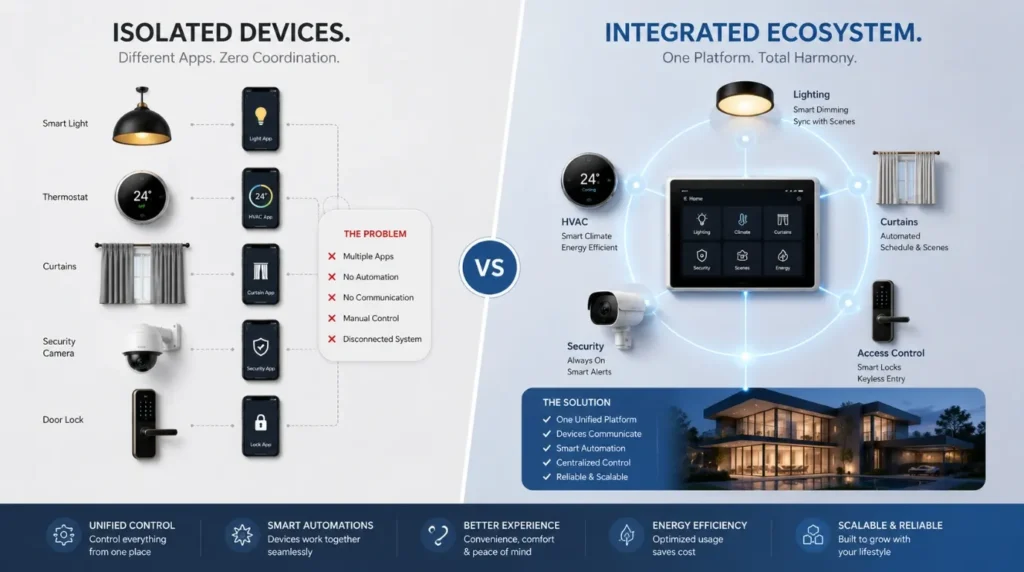
Before choosing products, it’s useful to understand what qualifies as a smart home from a practical, everyday-use perspective.
Several levels of connected living are possible:
Level 1: Connected Home
You might have:
- Smart TV
- Wi-Fi speaker
- Smart bulb
- Security camera
These devices connect to the internet but may operate independently.
Level 2: Controlled Home
You can control multiple systems through:
- Smartphone
- Voice assistant
- Remote
- Touchscreen
Level 3: Automated Home
The home begins performing actions automatically.
For example: Sunset → Curtains close → Lights turn on
Level 4: Integrated Smart Home
Different systems communicate and respond to conditions, schedules, and user routines.
For example: “Good Night” → Lights off → Curtains close → Security arms → AC changes temperature → Selected appliances switch off
This level of integration is what most people mean when they refer to professional home automation.
What Qualifies as a Smart Home in 2026?
A property doesn’t need every possible technology to qualify as a smart home. However, it should have some combination of the following capabilities.
One of the first things to consider when answering what qualifies as a smart home is whether the home’s lighting can respond to schedules, scenes, sensors, or user commands.
1. Smart Lighting
Lighting is one of the most fundamental smart home technology features. A smart lighting system can provide:
- Remote control
- Dimming
- Scheduling
- Motion-based operation
- Scene creation
- Voice control
Examples include:
Welcome Home: Entrance and living-room lights activate.
Movie Mode: Lights dim automatically.
Good Night: Unnecessary lights switch off.
Techtastic identifies smart lighting as one of the most common starting points for home automation.
2. Smart Security
Security is another major component of a smart home.
A connected security system may include:
- CCTV
- Smart locks
- Video door phones
- Motion sensors
- Door/window sensors
- Intrusion detection
- Remote monitoring
The real advantage comes when security interacts with other systems.
For example: Away Mode → Lights off → Doors locked → Security armed
Techtastic’s smart-home framework includes security as one of the core systems that can be integrated into a broader automation ecosystem.
3. Motorized Curtains and Blinds
For luxury residences, motorized curtains can also help answer what qualifies as a smart home by connecting window automation with lighting, privacy, and climate routines.
Motorized curtains are increasingly becoming an important part of premium smart homes. They can:
- Open automatically
- Close at sunset
- Respond to schedules
- Integrate with lighting
- Improve privacy
- Support daylight management
For example: Morning → Curtains open + bedroom lights brighten
This transforms curtains from a manually operated furnishing into an automated part of the home.
4. Smart Climate Control
When considering what qualifies as a smart home, climate control becomes particularly valuable when it responds automatically to occupancy, schedules, or other conditions.
A smart home can also manage indoor comfort. Depending on the property, this can include:
- Air conditioning
- Temperature sensors
- HVAC systems
- Fan control
- Climate schedules
A more advanced system can respond to occupancy or time of day.
For example: No one home → Climate settings adjust
Family arrives → Preferred temperature restored
5. Smart Entertainment
Entertainment is another area where automation becomes particularly noticeable. A smart home may integrate:
- Television
- Projector
- Home theatre
- AV receiver
- Speakers
- Motorized screens
- Lighting
A single Movie Mode could:
- Close curtains
- Dim lights
- Lower a projector screen
- Activate the AV system
- Adjust the room environment
Techtastic specifically describes home-theatre automation as an integrated experience involving lighting, curtains, projection, and audio.
6. Smart Energy Management
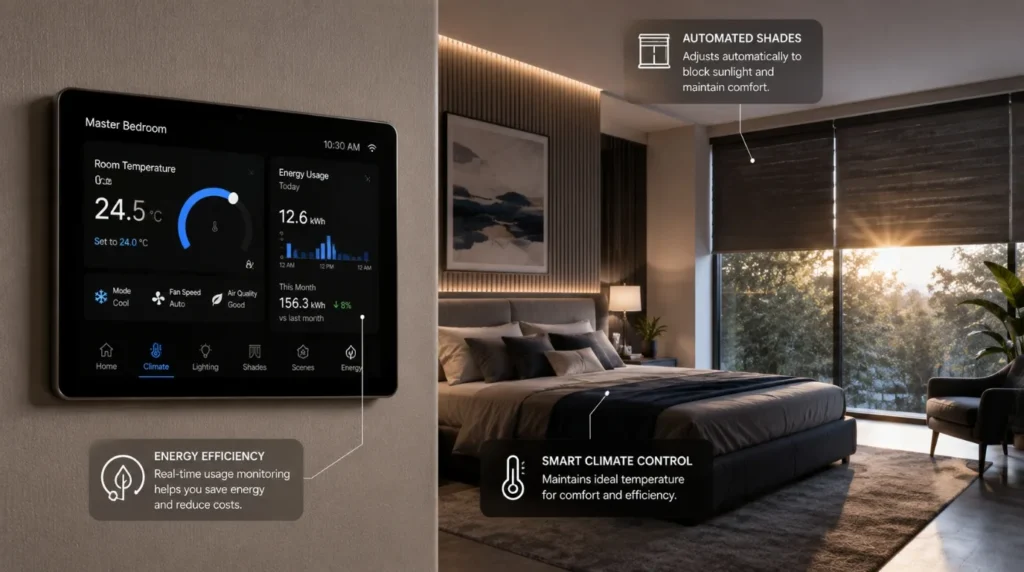
Energy management is increasingly becoming part of sophisticated smart homes. Systems can monitor:
- Electricity consumption
- Major loads
- HVAC usage
- Lighting
- Energy patterns
The objective isn’t simply to show information. A properly integrated system can help homeowners understand and optimize how their home uses energy.
7. Sensors and Automation Logic
Sensors are what allow a home to react to its environment. Examples include:
- Motion sensors
- Occupancy sensors
- Temperature sensors
- Light sensors
- Door sensors
A sensor detects something. A controller processes it. An actuator acts.
For example: Occupancy detected → Controller processes event → Lights turn on
This sensor-controller-actuator structure is a fundamental part of professional automation systems.
8. Centralized or Unified Control
One strong sign of a truly smart home is control of many systems from one simple interface. This could be:
- Smartphone
- Touchscreen
- Wall keypad
- Voice assistant
- Automation controller
The goal is to reduce complexity rather than create more of it. Instead of six different apps, the homeowner should ideally have a simple control experience.
Is a Smart TV Enough to Qualify as a Smart Home?
No.
A common misconception when researching what qualifies as a smart home is assuming that a few connected appliances are enough to make the entire property smart. A smart TV makes one appliance connected. It doesn’t make the entire home intelligent. Similarly:
- One smart bulb ≠ smart home
- One Wi-Fi camera ≠ smart home
- One smart speaker ≠ smart home
- One smart lock ≠ complete smart home
These can be components of a smart home, but the defining characteristic is the ability to control or automate multiple functions.
Does a Home Need Voice Control to Be Smart?
No. Voice assistants are convenient, but they aren’t a requirement. A professional smart home can use:
- Physical switches
- Touch panels
- Mobile apps
- Sensors
- Automated schedules
- Voice commands
In fact, the best systems often provide multiple control methods. Voice control should complement good automation rather than replace it.
Does a Smart Home Need Wi-Fi?
Not necessarily. This is an important distinction. Another important consideration when determining what qualifies as a smart home is the technology used to connect and control the various systems.
Wireless smart homes can use technologies such as:
- Wi-Fi
- Zigbee
- Z-Wave
- Matter
Professional wired systems can use technologies such as KNX.
Techtastic says KNX is a wired automation standard best for luxury homes, villas, and large residential projects. Wireless systems can work well for apartments, existing homes, and retrofit projects.
Therefore, Wi-Fi is one possible technology—not the definition of a smart home.
Does a Smart Home Need KNX?
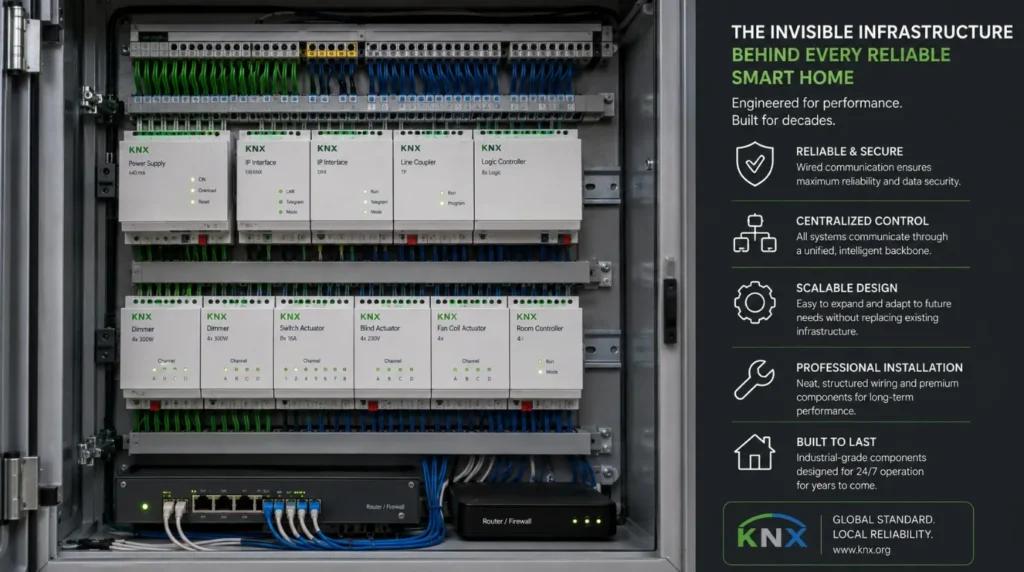
No. KNX offers a professional automation option, but you don’t need it to create a smart home. However, KNX can be particularly valuable for:
- Luxury villas
- Large residences
- New construction
- Long-term automation projects
Its dedicated infrastructure provides strong reliability and scalability. For new builds, Techtastic recommends planning your KNX wiring during construction, well before electrical installation begins.
Smart Home vs Connected Home
This distinction is useful when understanding what qualifies as a smart home.
| Connected Home | Smart Home |
|---|
| Devices connect to the internet | Systems communicate and automate |
| Often controlled individually | Multiple systems can work together |
| Mostly manual commands | Automation and scenes |
| Multiple apps possible | Unified control preferred |
| Limited interaction | Sensors and logic can trigger actions |
| Device-focused | Lifestyle-focused |
A connected home has smart products. A smart home has smart behaviour.
What Is the Minimum Smart Home Setup?
You don’t need to automate an entire property immediately. A practical starting point could include:
Essential
- Smart lighting
- Smart switches
- Reliable networking
- Smart security or access control
Intermediate
- Motorized curtains
- Sensors
- Climate control
- Voice control
Advanced
- KNX automation
- Whole-home lighting
- Home theatre
- Multi-room audio
- Energy management
- Integrated security
Techtastic recommends starting with everyday-use systems and building toward a scalable automation foundation rather than buying disconnected devices one at a time.
New Home vs Existing Home
The answer to what qualifies as a smart home doesn’t change based on whether the property is new or old. However, the best technology may change.
Existing Home
Wireless or hybrid automation can be attractive because it minimizes rewiring.
New Construction
Wired infrastructure can be planned from the beginning.
This makes it easier to integrate:
- Lighting
- HVAC
- Curtains
- Security
- Networking
- Entertainment
For new luxury construction, Techtastic recommends planning automation early. You can make key decisions much more easily before finishing walls and ceilings.
A Simple Smart Home Qualification Test
If you’re still wondering what qualifies as a smart home, the following checklist provides a simple way to evaluate your property.
Ask these five questions:
1. Can I control multiple home systems?
Yes → Good sign
2. Can my home perform actions automatically?
Yes → Good sign
3. Can different systems work together?
Yes → Strong indicator
4. Can sensors trigger useful actions?
Yes → Advanced automation
5. Can the system expand in the future?
Yes → Future-ready
If your home satisfies most of these criteria, it can reasonably be described as a smart home.
Representative Example
Illustrative Example: This scenario demonstrates what an integrated smart home could look like and is not presented as a specific Techtastic client project.
Imagine a 4 BHK luxury apartment with:
- Smart lighting
- Motorized curtains
- Smart lock
- Video door phone
- Climate control
- Home theatre
- Occupancy sensors
At 7:00 AM: Curtains open → Lights brighten → Climate adjusts
When the family leaves: Lights turn off → Doors lock → Security activates
At night: “Good Night” → Curtains close → Lights turn off → Security arms
This is more than a collection of smart products. It is a connected automation ecosystem.
How Techtastic Approaches Smart Homes
At Techtastic, the objective isn’t to install the largest possible number of devices.
It’s to create an automation system that is:
- Reliable
- Intuitive
- Scalable
- Appropriate for the property
- Designed around the homeowner
Techtastic’s broader smart-home methodology combines lighting, curtains, security, climate, entertainment, energy management, networking, sensors, controllers, and automation logic into an integrated ecosystem.
Key Takeaways: What Qualifies as a Smart Home?
- A home becomes genuinely smart when you control, monitor, automate, and integrate its connected systems.
- A smart TV or smart bulb alone doesn’t make an entire home smart.
- Smart lighting, security, curtains, climate, entertainment, and energy management are common components.
- Sensors and automation logic allow the home to respond automatically.
- Wi-Fi isn’t mandatory; wired technologies such as KNX can also form the foundation.
- Existing homes can use wireless or hybrid systems.
- New luxury homes can benefit from professionally planned wired infrastructure.
- The best smart homes focus on your lifestyle rather than the number of devices you install.
Frequently Asked Questions
1. What Qualifies as a Smart Home?
A smart home is a house with connected systems. You can control, monitor, and automate them. This can improve convenience, security, comfort, energy efficiency, and entertainment.
2. How many smart devices do you need to have a smart home?
There is no official minimum number. Integration and automation matter more than device count.
3. Does a smart TV make a house a smart home?
No. A smart TV is simply one connected device. A smart home normally involves multiple connected or automated systems.
4. Does a smart home require Wi-Fi?
No. Smart homes can use wired, wireless, or hybrid technologies. KNX, Wi-Fi, Zigbee, Z-Wave, and Matter are examples of technologies used in different architectures.
5. Is KNX required for a smart home?
No. KNX is a professional automation option particularly suitable for larger, premium, and new-construction projects.
6. Can an existing house become a smart home?
Yes. Wireless and hybrid automation systems can make retrofitting existing homes significantly easier.
7. What are the most important smart home features?
Smart lighting, security, reliable networking, motorized curtains, climate control, and centralized automation are among the most useful starting points.
8. Is voice control necessary?
No. Voice control is an optional interface. A smart home can operate through switches, sensors, touchscreens, apps, schedules, and automated scenes.
9. What is the difference between a connected home and a smart home?
A connected home contains internet-connected devices. A smart home goes further by allowing systems to communicate, automate tasks, and respond intelligently to conditions or routines.
10. Should I plan automation before building my home?
Yes. For new construction, early planning can make wiring, networking, sensor placement, lighting control, curtain automation, and future expansion much easier.
Collaboration Opportunities for Developers, Architects & Interior Designers
Smart home planning works best when automation is considered alongside architecture and interiors.
Techtastic collaborates with:
- Architects
- Interior Designers
- Builders
- Developers
- Project Management Consultants
- Luxury Villa Developers
Collaboration can include:
- Smart Home Planning
- KNX System Design
- Lighting Automation
- Motorized Curtain Integration
- Smart Security
- HVAC Integration
- Structured Networking
- Home Theatre Planning
- Technical Drawings
- Programming
- Testing & Commissioning
Early collaboration allows automation to become part of the design rather than an afterthought.
Areas We Serve
Techtastic provides smart home automation solutions across: Navi Mumbai • Nashik • Lonavla • Sangli
We also maintain a broader service presence across Mumbai and Thane.
Ready to Make Your Home Smarter?
Understanding what qualifies as a smart home is the first step toward choosing the right level of automation. You don’t need to automate every appliance. You need to identify the systems that will genuinely improve the way you live.
At Techtastic, we design smart home solutions around your property’s architecture, lifestyle, technology requirements, and plans. Whether you are upgrading an apartment, you need the right automation strategy.
If you are planning a new luxury villa, you also need the right automation strategy. It can turn connected devices into a smart home.
Talk to Techtastic about what qualifies as a smart home. Plan a smart home that’s reliable, intuitive, and ready for the future!
Contact Techtastic
Website: Techtastic Website
Call / WhatsApp: 9769145145
Operational Hubs: Navi Mumbai • Nashik • Lonavla • Sangli