
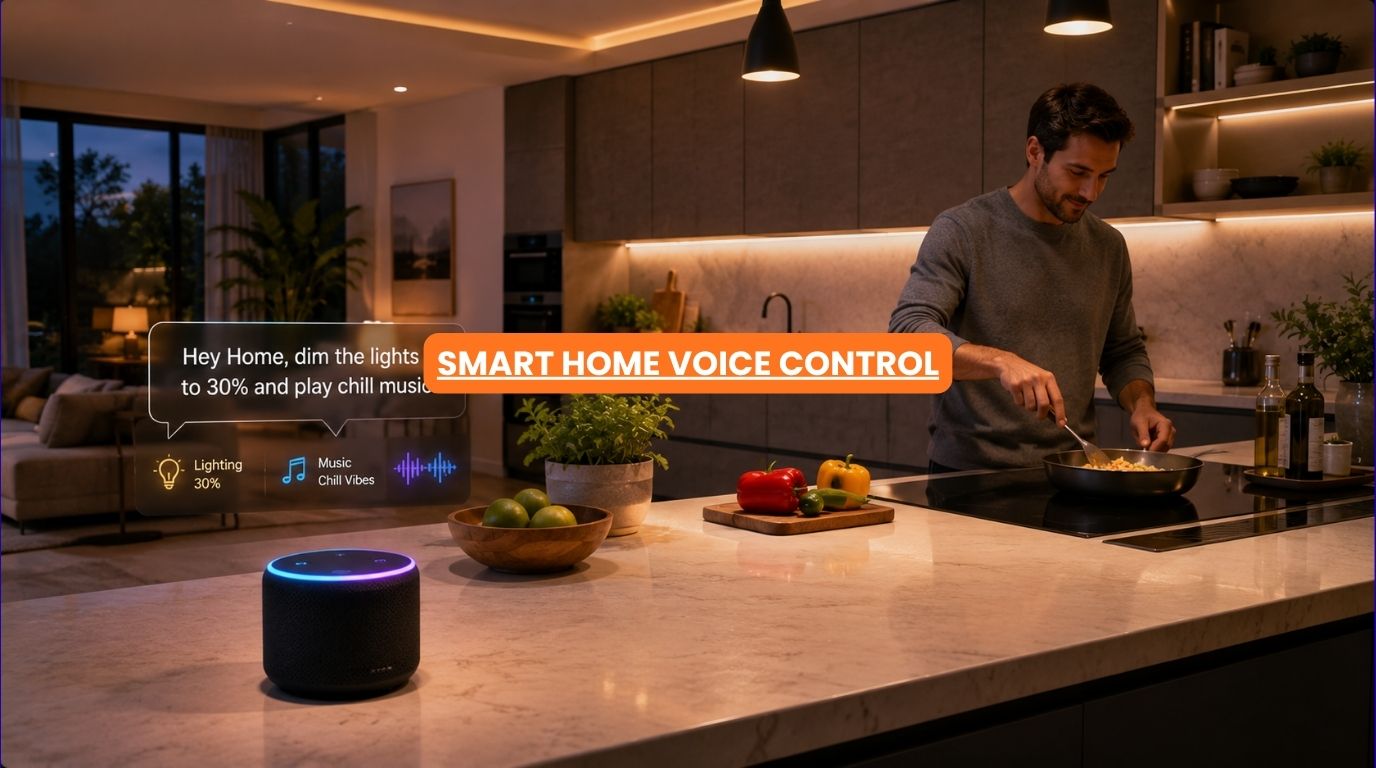
“Alexa, turn off the living room lights.” “Hey Google, close the curtains.” “Siri, set movie mode.”
Voice assistants have quickly become one of the most recognizable features of modern smart homes. For many homeowners, voice control is often the first smart home experience they encounter. The ability to control lights, music, security systems, and other devices using simple spoken commands feels convenient, intuitive, and surprisingly futuristic.
But how do voice assistants actually work with smart homes?
At Techtastic, we often explain that voice assistants are not the smart home itself. Instead, they act as an additional control method that makes interacting with smart home technology easier.
Understanding the relationship between voice assistants and home automation can help homeowners make better decisions when planning a connected living environment.
Summary
Smart home voice control allows homeowners to operate connected devices using spoken commands through voice assistants such as Amazon Alexa, Google Assistant, and Apple Siri. Voice assistants act as a control layer between users and smart home systems, enabling hands-free control of lighting, climate, security, entertainment, motorized curtains, and automation scenes. While voice control improves convenience, the most effective smart homes combine voice commands with automation, sensors, mobile apps, and centralized control systems.
Quick Answer
Voice assistants work with smart homes by connecting to compatible devices and automation platforms, allowing homeowners to control lighting, security systems, climate control, entertainment, motorized curtains, and other connected technologies using spoken commands. Popular voice assistants such as Alexa, Google Assistant, and Siri act as user-friendly interfaces that simplify smart home control while integrating with broader home automation systems.
What Is Smart Home Voice Control?
Smart home voice control allows homeowners to interact with connected devices using spoken commands.
Instead of manually operating:
- Light switches
- Thermostats
- Curtains
- Security systems
- Entertainment devices
Users can simply speak commands through a voice assistant.
The system interprets the request and triggers the appropriate action.
Voice control adds convenience but works best as part of a larger smart home ecosystem.
What Is a Voice Assistant?
A voice assistant is software that listens for voice commands and performs actions based on user requests.
Popular voice assistants include:
Amazon Alexa
Found in Echo devices and many third-party smart home products.
Google Assistant
Available through Google Home and Nest devices.
Apple Siri
Integrated into Apple devices and HomeKit-compatible smart homes.
Each platform supports smart home integration in slightly different ways.
How Voice Assistants Connect to Smart Homes
A voice assistant typically acts as the communication layer between the homeowner and the smart home system.
The process usually works like this:
Step 1
The homeowner speaks a command.
Example:
“Turn on the dining room lights.”
Step 2
The voice assistant processes the request.
Step 3
The command is sent to the smart home platform.
Step 4
The connected device performs the requested action.
The result feels instantaneous and seamless.
What Can Voice Assistants Control?
Smart Lighting
Lighting is one of the most common voice-controlled features.
Examples:
- Turn lights on or off
- Adjust brightness
- Activate lighting scenes
- Control multiple rooms
Voice control simplifies everyday lighting management.
Motorized Curtains
Homeowners can use commands such as:
- Open the curtains
- Close the blinds
- Set privacy mode
This is particularly useful in large living spaces.
Climate Control
Voice assistants can control:
- Air conditioning
- Temperature settings
- HVAC schedules
- Climate zones
Comfort becomes easier to manage throughout the day.
Smart Security Systems
Voice control may allow interaction with:
- Security cameras
- Alarm systems
- Smart locks
- Access control systems
However, sensitive security functions often require additional authentication for safety.
Home Entertainment
Entertainment systems are highly compatible with voice control.
Examples include:
- Playing music
- Controlling TVs
- Managing home theatres
- Selecting streaming content
Voice assistants significantly improve entertainment convenience.
Voice Control vs Home Automation
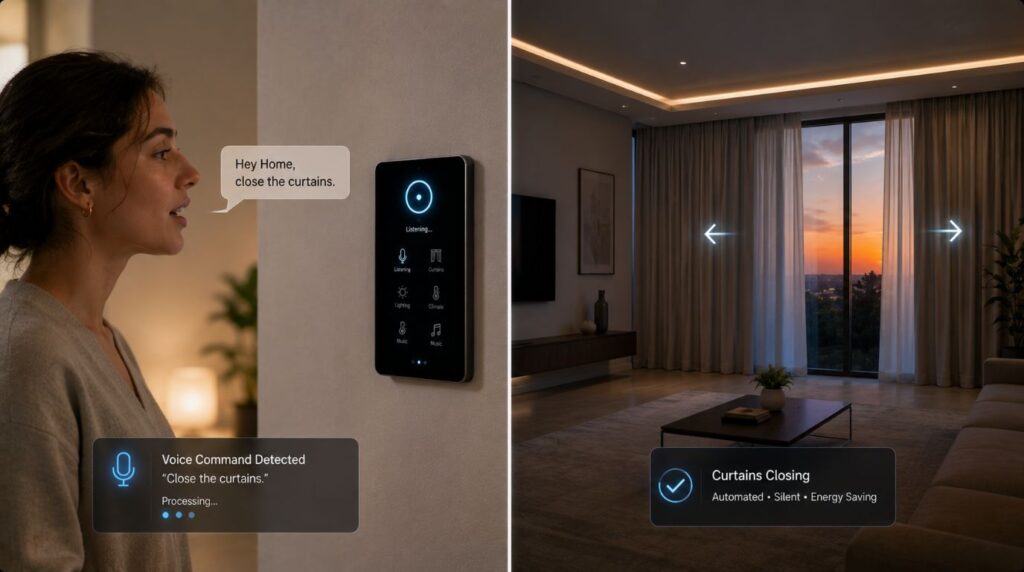
One of the biggest misconceptions is that voice control and automation are the same thing.
They are not.
| Voice Control | Home Automation |
|---|---|
| User gives command | System acts automatically |
| Reactive | Proactive |
| Requires interaction | Works in the background |
| Convenience focused | Efficiency focused |
| Command driven | Scenario driven |
Example:
Voice Control
“Turn off the lights.”
Automation
Lights automatically turn off when everyone leaves the house.
The best smart homes combine both approaches.
Popular Smart Home Voice Commands
Homeowners frequently use commands such as:
Lighting
- Turn on the lights
- Dim the lights
- Activate evening mode
Security
- Lock the front door
- Check camera status
Climate
- Set the temperature to 22°C
- Turn on cooling mode
Entertainment
- Play music
- Start movie mode
Curtains
- Open curtains
- Close blinds
Simple commands make smart home interactions more natural.
Benefits of Voice-Controlled Smart Homes
Hands-Free Convenience
Control devices while cooking, working, or relaxing.
Accessibility
Voice control can improve usability for:
- Elderly residents
- Children
- Individuals with mobility challenges
Faster Interaction
Many tasks become quicker than using apps or switches.
Enhanced User Experience
Voice control often makes technology feel more intuitive and approachable.
Limitations of Voice Assistants
Voice assistants are useful but not perfect.
Potential limitations include:
Internet Dependency
Many voice assistants rely on cloud processing.
Privacy Considerations
Some homeowners prefer additional control over data-sharing settings.
Command Recognition
Background noise can occasionally affect accuracy.
Not a Complete Automation Strategy
Voice control complements automation—it does not replace it.
Which Voice Assistant Is Best for Smart Homes?
The best choice often depends on the homeowner’s existing ecosystem.
| Platform | Best For |
|---|---|
| Alexa | Broad smart home compatibility |
| Google Assistant | Strong search and AI integration |
| Siri | Apple ecosystem users |
Each platform can support powerful smart home experiences when integrated properly.
Smart Home Voice Control and KNX Systems
Many homeowners ask whether professional automation systems can support voice assistants.
The answer is yes.
Modern KNX and professional automation platforms can often integrate with:
- Alexa
- Google Assistant
- Siri
- Mobile apps
- Touch panels
This allows homeowners to enjoy voice convenience while maintaining the reliability and scalability of professional automation infrastructure.
Why It Matters for Modern Homes
Today’s homeowners expect technology to be:
- Convenient
- Intuitive
- Accessible
- Connected
Voice control helps meet these expectations by making smart home interactions feel more natural.
As voice technology continues to evolve, it is becoming an increasingly important part of modern home automation experiences.
Our Perspective at Techtastic
At Techtastic, we view voice assistants as one component of a complete smart home ecosystem.
While voice control offers impressive convenience, we typically recommend combining it with:
- Automation scenes
- Sensors
- Touch panels
- Mobile control
- Reliable networking
- Centralized automation platforms
The most successful smart homes do not rely on a single control method.
Instead, they provide homeowners with multiple ways to interact with technology depending on the situation.
Voice control is often the feature that homeowners use first—but automation is what delivers long-term value.
Collaboration Opportunities for Developers, Architects & Interior Designers
Voice-enabled living experiences should be considered during project planning.
At Techtastic, we collaborate with:
- Architects
- Interior designers
- Luxury home builders
- Residential developers
- Hospitality consultants
- Commercial project planners
Voice-Ready Smart Home Design
Create homes optimized for intuitive control.
Integrated Automation Planning
Combine voice control with broader automation systems.
Entertainment & AV Integration
Enhance media experiences through voice-enabled control.
Security & Access Integration
Improve convenience while maintaining safety.
Luxury Residential Projects
Deliver premium connected living experiences.
Hospitality & Commercial Applications
Implement intelligent voice-enabled environments.
Early planning ensures voice control integrates seamlessly into the overall smart home experience.
Key Takeaways
- Smart home voice control allows homeowners to operate devices using spoken commands.
- Alexa, Google Assistant, and Siri are the most popular voice assistants.
- Voice assistants act as a control layer rather than the automation system itself.
- Lighting, climate, entertainment, curtains, and security systems can all be voice-controlled.
- Voice control and automation serve different purposes.
- The best smart homes combine voice commands with sensors, automation, and centralized control.
Frequently Asked Questions
1. How do voice assistants work with smart homes?
A: Voice assistants connect to compatible smart home devices and automation systems, allowing homeowners to control them using spoken commands.
2. Which voice assistant is best for smart homes?
A: Alexa, Google Assistant, and Siri all offer strong smart home capabilities. The best option depends on your preferred ecosystem and devices.
3. Can voice assistants control lights and curtains?
A: Yes. Most modern smart home systems allow voice control of lighting, motorized curtains, and other connected devices.
4. Do voice assistants require internet access?
A: Many voice assistants rely on internet connectivity for command processing and cloud-based features.
5. Are voice assistants secure?
A: Modern voice assistants include security features, although homeowners should follow best practices for account and network protection.
6. Can KNX systems work with Alexa or Google Assistant?
A: Yes. Many professional automation platforms can integrate with popular voice assistants.
7. Is voice control the same as home automation?
A: No. Voice control requires user interaction, while automation operates automatically based on predefined rules or conditions.
8. Can voice assistants control an entire smart home?
A: Yes. When properly integrated, voice assistants can manage lighting, security, climate control, entertainment systems, and automation scenes.
Conclusion
Voice assistants have transformed the way homeowners interact with smart home technology. By enabling simple spoken commands, they make lighting, security, entertainment, climate control, and other connected systems more accessible and convenient.
At Techtastic, we help homeowners, architects, and developers create intelligent smart home ecosystems where voice control works seamlessly alongside automation, security, networking, and centralized control platforms.
📞 Call/WhatsApp: 9769145145
📍 Our Operational Hubs: Navi Mumbai | Nashik | Lonavla | Sangli
While voice assistants provide an intuitive way to interact with technology, their true value emerges when they become part of a thoughtfully designed smart home experience.
Looking for the best features to start with? Check out our practical guide on Ultimate Smart Home Control Panel: Understanding KNX (2026) – a system that everyone can use effortlessly.