
Summary
Designing high-end home theater systems often involves balancing technology with aesthetics. You want a deep cinematic experience without the clutter of a commercial theater or tangled wires.
The secret lies in “Invisible Home Theater Systems.” We use motorized lifts, in-wall speakers, and ventilated cabinets to hide large screens and subwoofers. This guide shares five ways to integrate home theater systems into a minimalist design. This ensures your room stays a peaceful sanctuary by day and a powerful cinema by night.
Invisible Cinema: 5 Ways to Hide Your Home Theater Systems in a Minimalist Living Room
I’ve seen many minimalist living rooms in South Mumbai and Dubai that look clean and simple, showing only basic furniture and art. But with one tap on a smartphone, a screen descends from a hidden slot in the ceiling, the lights dim, and the walls begin to breathe sound.
This is the “Invisible Cinema.” I balance technical SEO audits with smart home design, and I’ve learned that the best technology remains invisible. Minimalist design still allows for a 100-inch screen; we just must be clever about where we hide the equipment.
Here are five ways we make the home theater systems disappear.
1. The Ceiling-Recessed Projector Lift
In traditional home theater systems, the projector is a bulky box hanging from a bracket in the middle of the room. In a minimalist living room, that’s a visual dealbreaker.
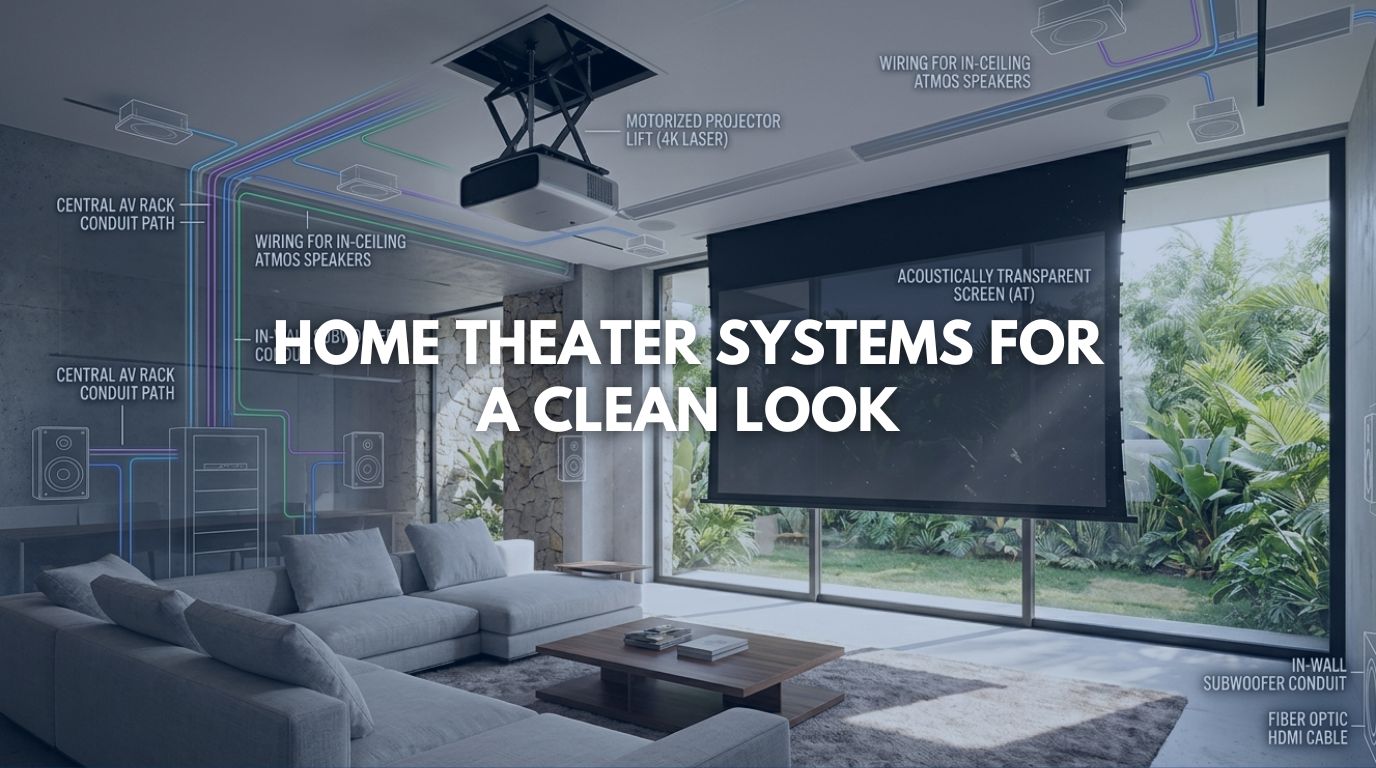
Instead, we use a motorized projector lift. We install this device inside the false ceiling. When the system is off, all you see is a clean, white panel that sits flush with the ceiling. When it’s movie time, the lift lowers the projector to the exact calibrated height.
To make this work, you need to plan your ceiling depth during the “gray structure” phase. Usually, 12 to 15 inches of space is enough to hide even a high-end 4K laser projector.
2. Architectural “In-Wall” Speakers
Nothing ruins a minimalist vibe faster than five or seven large floor-standing speakers occupying corner space. To hide the sound, we move the audio into the structure.
Manufacturers design in-wall and in-ceiling speakers to mount flush with the drywall. The grilles are paintable, meaning they can perfectly match the exact shade of your “Off-White” or “Cloud Grey” walls.
But here is the technical secret: for a true cinema experience, you can’t just use basic ceiling speakers. Use “aimable” drivers to angle the sound toward the seating area. We also use Acoustically Transparent (AT) screens.
We can hide the large center-channel speaker, which carries all dialogue, directly behind the screen. The sound comes right through the fabric, just like in a professional cinema.
3. Hidden Equipment Racks and “The Ghost Cable.”
You can hide the theater’s core—the receiver, amplifiers, and media players—outside the living room. In fact, it shouldn’t be.
We often designate a Centralized AV Rack in a nearby closet or under-stair space. One single “Ghost Cable” (an active optical HDMI cable) runs from that rack to your projector. By moving the hardware out of the room, you eliminate the blue blinking lights, the fan noise, and the clutter of wires.
If you must keep the equipment in the room, we design ventilated cabinetry with Infrared (IR) Pass-throughs. This setup lets you point your remote at a tiny, invisible sensor on the cabinet. The sensor then sends signals to the hardware hidden behind the solid wooden doors.
4. Motorized Drapes as “Acoustic Armor” for Home Theater Systems

Minimalist rooms often have a lot of hard surfaces—marble floors, glass windows, and clean walls. These are an acoustic nightmare because they reflect surround sound, creating an echo that makes dialogue hard to hear.
We solve this using Motorized Acoustic Drapes. During the day, the drapes tuck into ceiling pockets to keep your windows clear. Activating the “Movie Scene” glides them shut. These curtains feature heavy, sound-absorbing linings to improve your experience.
These fabrics black out the room for a better picture and act as “acoustic armor” to keep the sound quality crisp. Using tandem motors ensures that even heavy acoustic fabrics move silently and quickly.
5. Subwoofers in Disguise
The subwoofer is usually a giant black cube that everyone trips over. In invisible home theater systems, we use In-Wall Subwoofers or “Couch-Pounders.”
We build in-wall subs into the wall studs, using the wall cavity as an enclosure. If the wall isn’t an option, we hide “Slim-Profile” subwoofers under the sofa or inside custom-built ottomans. You’ll feel the vibration of an explosion in an action movie, but you’ll never see where it’s coming from.
Final Thoughts: Planning for the Invisible
Creating an invisible cinema isn’t more expensive than a traditional one, but it does require more forethought. You must decide to hide speakers in the ceiling before the POP (Plaster of Paris) work finishes.
When I work with architects in Navi Mumbai or Nashik, I always suggest a “Tech Review” at the blueprint stage. Planning the projector lift and speaker pockets early ensures the technology fits the architecture, not the other way around.
Your home should be a place where you can enjoy the highest level of entertainment without living in a laboratory. Invisible home theater systems give you the best of both worlds.
Collaboration Opportunities for Builders and Architects
I work with developers, architects, and interior designers to enhance residential projects by integrating smart home theater systems during the planning and design stages. My team ensures that these home theater systems align seamlessly with your design layouts, electrical infrastructure, and interior concepts.
I invite you to partner with Techtastic to implement high-quality home theater systems for your upcoming projects in Nashik, Navi Mumbai, Sangli, and Lonavla.
Contact Techtastic Technologies at 9769145145 for a professional consultation to see how expert home theater systems can elevate your design vision.
Technical FAQs
Q. Do in-wall speakers sound as good as floor-standing ones?
High-end brands like Sonance or Focal specifically engineer architectural speakers to provide theater-grade sound. Large floor-standing speakers offer more volume, but modern in-wall speakers use “aimable” technology to provide great sound for any living room.
Q. How do you prevent the projector lift from vibrating or making noise?
We use high-quality lifts with stabilized “scissor” mechanisms and silent DC motors. When calibrated correctly, the lift moves smoothly and stops at the exact millimeter every time without a shake.
Q. Will hiding my AV receiver in a closet make it overheat?
Yes, if the closet isn’t ventilated. We always install “Smart Fans” in the AV rack that pull hot air out and push cool air in. Temperature sensors trigger these fans, so they only run when needed.
Q. Can I use a regular TV instead of a projector for an invisible cinema?
Absolutely. We use “Art TVs” that look like paintings when off, or motorized lifts that hide the screen inside furniture or the floor. The screen only pops up when you are ready to watch.
Q. Is it possible to retrofit these “invisible” features into an existing home?
It is more challenging but possible. Ultra-slim speakers and battery-powered drapes provide a minimalist look without needing to break down walls. However, for a 100% invisible look, a renovation or new build is best.
Q. Does “Invisible Cinema” work in small apartments?
It’s actually better for small apartments. Hiding speakers in walls and screens in ceilings saves floor space by removing bulky equipment.