
Summary
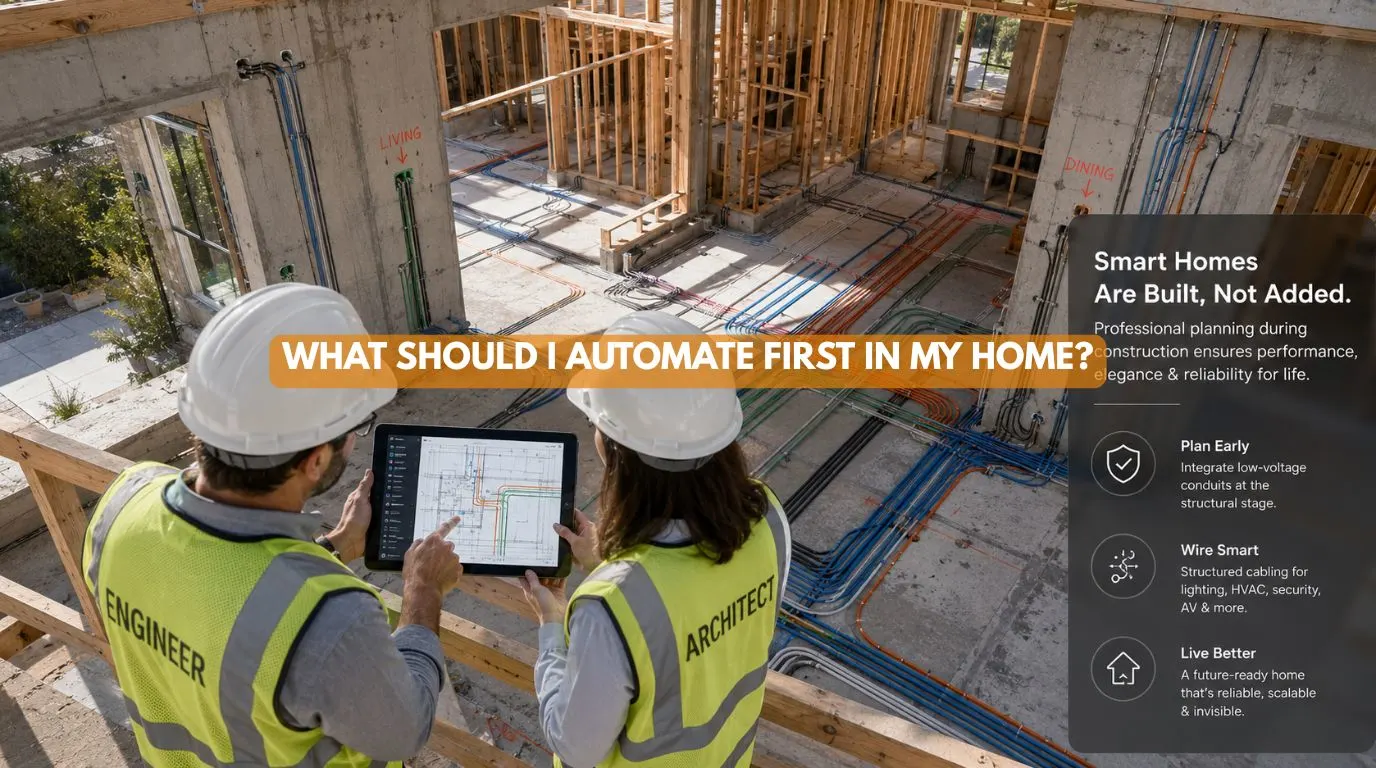
You should prioritize your core building infrastructure—specifically, centralized architectural lighting control (DALI-2) and climate integration (VRF AC)—as the very first things to automate in your home, as per the smart home automation guide by experts. By establishing an offline, hardwired communication network (like the global KNX standard) during the raw civil shell or renovation phase, you lay down a permanent infrastructure asset.
This structural foundation delivers instant, sub-10ms response speeds and immediately slashes whole-home energy consumption by 30% to 50%, completely bypassing the network lag, battery upkeep, and rapid software obsolescence typical of cheap, retrofitted wireless retail gadgets.
What Should I Automate First in My Home?
The absolute fastest way to ruin a premium home renovation or new build is to treat automation like a collection of fun tech accessories you buy at an electronics store. When I walk onto luxury residential sites across Navi Mumbai, Nashik, or Lonavla, homeowners often excitedly show me wireless smart speakers, app-controlled retail plugs, and DIY smart bulbs they plan to install after the paint dries. This comprehensive smart home automation guide is designed to steer you away from that incredibly expensive engineering mistake.
This approach is an incredibly expensive engineering mistake. Mass-market wireless gadgets rely on crowded Wi-Fi networks and public cloud servers that drop out whenever your internet connection stumbles. Furthermore, high-density brick walls, reinforced concrete pillars, and metallic low-E glass coatings act as physical shields that block airborne radio frequencies, leading to frozen apps and commands that drop entirely.
If you start your smart home journey with superficial consumer gadgets, you are building on quicksand. True architectural luxury demands that you automate your structural infrastructure first—wiring your home’s heavy mechanical and electrical loads directly into a hardwired backbone while the brickwork is exposed and the conduits are empty. This smart home automation guide is here to help you.
Who Is This Smart Home Automation Guide For?
If you’re planning to build, renovate, or upgrade your home, one of the biggest questions you’ll face is where to begin with smart home automation. The answer depends entirely on your property, your lifestyle, and your long-term goals.
We’ve created this smart home automation guide specifically for:
- Homeowners building a new bungalow or villa
- Families renovating an existing home
- Luxury apartment owners planning premium automation
- Architects designing future-ready residences
- Interior designers are integrating technology into beautiful living spaces
- Property investors looking to increase long-term home value
Whether you’re planning basic lighting automation or a fully integrated KNX smart home, this smart home automation guide will help you understand what should be automated first, what can wait, and how to avoid expensive mistakes that are difficult to correct once construction is complete.
Why Should Lighting Be the Baseline of a Smart Home Automation Guide?
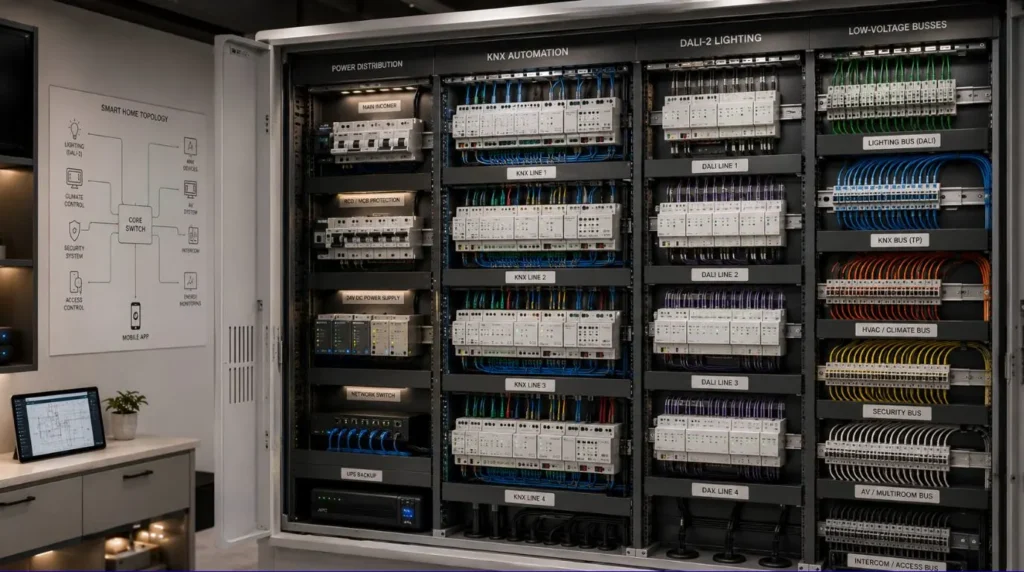
Lighting should be the very first system you automate because it forms the baseline infrastructure layer of your entire property, directly dictating your home’s daily energy footprint, mood, and visual aesthetics. Any professional smart home automation guide will emphasize that centralizing your lighting layout shifts the switching intelligence out of your living rooms and groups it securely inside your main distribution boards, replacing messy wall clutter with low-voltage data pads.
The Mastery of Architectural DALI-2 Dimming
Traditional manual switches or basic retrofitted smart modules operate on crude, high-voltage circuits that burn your luxury LED drivers at 100% capacity all day long, shortening their lifespans and causing noticeable flickering when dimmed. By following this smart home automation guide to build a professional digital addressable lighting interface (DALI-2) loop, each fixture receives its own digital address over a shielded data line.
This physical architecture enables perfectly smooth, whisper-quiet dimming down to 0.1% without a hint of buzz, completely transforming how your interior spaces look and feel.
Eliminating Multi-Gang Wall Clutter
In a traditional high-end home, controlling five or six separate lighting loops in a large living space requires a massive, ugly row of plastic switches that ruins your interior designer’s clean wall concept.
Automating your lighting loops first allows us to run those circuits in a star topology back to the central panel, letting you replace that bulky row of switches with a single, elegant, flush-mounted tactile keypad. One touch gracefully triggers complex, pre-programmed ambient scenes across the entire room.
The Benefits You’ll Notice Every Day
The biggest advantage of a professionally designed smart home isn’t the technology itself—it’s how effortlessly everything works together.
After installing a centralized automation system, homeowners often notice improvements such as:
- Lights automatically adjust based on occupancy.
- Curtains respond to changing sunlight throughout the day.
- Air conditioning maintains comfortable temperatures while reducing energy usage.
- Fewer wall switches and cleaner interior aesthetics.
- Improved home security when travelling.
- Better sleep through automated lighting scenes.
- Lower monthly electricity bills.
- A home that feels more intuitive and comfortable every day.
When multiple systems work together instead of operating independently, the entire home becomes more efficient, responsive, and enjoyable to live in.
How Does Early Climate Control Integration Save Your Infrastructure?
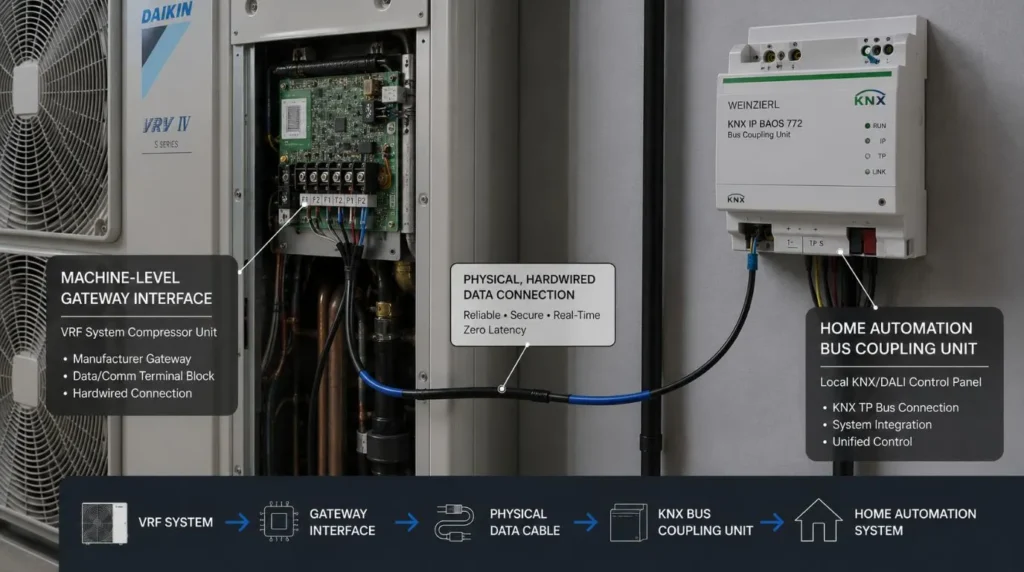
An advanced smart home automation guide must highlight that early climate control integration saves your infrastructure by directly linking your heavy variable refrigerant flow (VRF) air conditioning compressors with your building’s core automation logic via hardwired physical data lines. Connecting your climate loops directly at the machine level prevents your heating and cooling systems from fighting against your architectural shading, maximizing thermal comfort while protecting expensive compressors from premature wear.
[Presence Sensor Matrices] ──┐
[Automated Shading Loops] ──┼─(Unified Local Logic Line)─> [Central VRF AC Interface]
[Window Magnetic Contacts] ──┘ │
(Optimizes Compressor Load)
Eliminating Closed-Cloud App Conflicts
Most homeowners try to manage their climate control by sticking uncoordinated, third-party wireless thermostats on their finished walls, which rely on volatile internet servers to communicate with the AC units. This creates a messy lag where your cooling runs at full power even when your motorized blinds are wide open and letting in intense afternoon heat.
Hardwiring your VRF gateways into an offline infrastructure allows your HVAC units to respond instantly to physical environmental data, completely safe from internet drops or cloud failures.
Automated Environmental Setback Logic
When your climate architecture is integrated natively from day one, the house optimizes its own thermal efficiency without you ever opening an app. If a flush-mounted ceiling matrix sensor notes that your guest suite or home theater has been empty for over 20 minutes, the local automation backbone automatically triggers a temperature setback routine.
By scaling down the cooling load based on real-time presence data, the system protects your mechanical equipment and slashes your monthly utility bills by up to 50%.
What Role Does Automated Window Shading Play in Core Energy Efficiency?
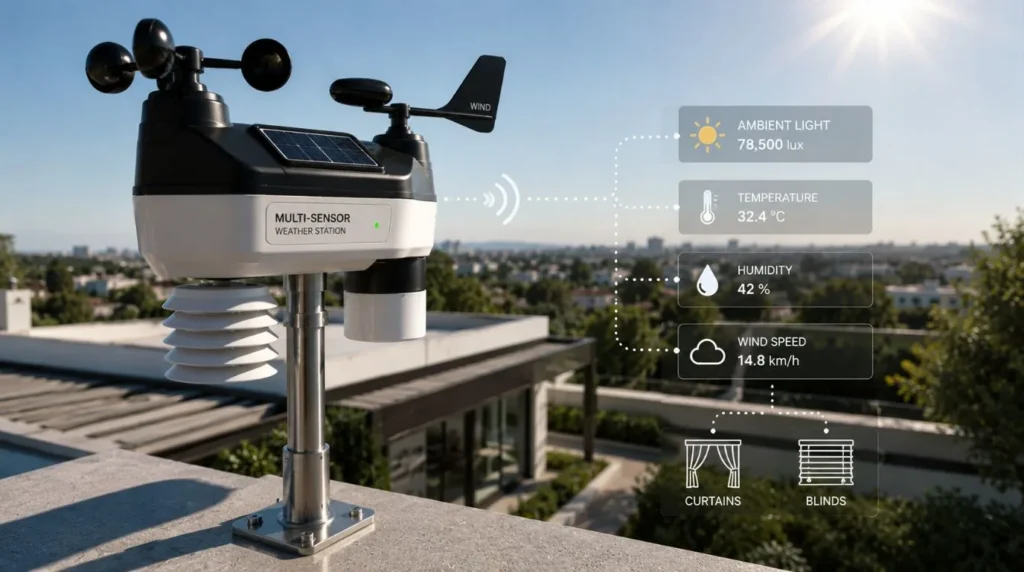
Automated window shading plays a critical role in core energy efficiency by functioning as your home’s primary physical shield against thermal solar heat gain, significantly reducing the cooling burden placed on your air conditioning units. By using this smart home automation guide to coordinate your motorized curtain tracks and external blinds alongside your lighting and climate loops, you create an integrated, self-regulating environmental shield.
The Architecture of Daylight Harvesting
As per this smart home automation guide, instead of allowing intense afternoon sunlight to stream through your windows and overheat your interiors, an automated shading network continuously tracks the sun’s position using a roof-mounted digital weather station.
The system automatically adjusts your motorized drapes or exterior venetian blinds to block out harsh heat rays while still letting in comfortable, natural ambient light.
[Sun Intensity Rises] ──> [Weather Station Triggers Bus] ──> [Shades Lower to 60%] ──> [DALI Lights Dim to 20%]
This integrated approach keeps your rooms perfectly illuminated using natural light, allowing your DALI-2 architectural lighting to automatically dim down to save up to 60% on electricity.
Protecting Your Interiors from UV Damage
Luxury homes across coastal Navi Mumbai or sunny vacation spots like Lonavla feature expensive custom artwork, premium wood paneling, and delicate imported upholstery fabrics that fade and warp under continuous, direct UV exposure.
As per this smart home automation guide, automating your shading tracks first allows you to program protective solar-tracking routines that safeguard your valuable interior investments completely automatically, keeping your home pristine even when you are traveling away from the property for weeks at a time.
Infrastructure Comparison: What to Automate First vs. What to Avoid
| Core Smart Home Automation Guide Priority | System Architecture Design | Long-Term Operational Benefit | Why It Beats Retail Gadgets |
| 1. Architectural Lighting (DALI-2) | Centralized Panel Star Topology | Eliminates wall clutter; extends luxury LED lifespans significantly. | Avoids flaky wireless bulb pairing and constant network dropouts. |
| 2. Climate Integration (VRF AC) | Hardwired Direct Machine Gateway | Slashes monthly compressor energy consumption by 30% to 50%. | Bypasses uncoordinated, cloud-dependent wall thermostats. |
| 3. Motorized Shading Tracks | Recessed Structural Ceiling Pockets | Blocks solar heat gain automatically to protect premium interiors. | Replaces ugly plug-in wireless dongles with hidden, whisper-quiet lines. |
| 4. Whole-Home Safety Loops | Panel-Level Interlocked Safety Relays | Shuts off water main valves instantly if an internal leak is detected. | Operates entirely locally and offline, independent of your internet connection. |
Protecting Your Automated Foundation Against Grid Power Surge Damages
In many prominent Indian residential markets and rural monsoon hideaways, the single most destructive moment for your home’s electronic foundation is the exact millisecond municipal grid power cuts back on after an unannounced blackout. The sudden, high-voltage inrush current surge can instantly fry the delicate circuit boards of your variable refrigerant flow (VRF) climate units, imported kitchen appliances, and luxury LED drivers.
Our smart home automation guide provides an uncompromising engineering answer to this massive financial risk: building intelligent, industrial-grade power recovery logic directly into our centralized electrical distribution panels. Instead of allowing your property to draw maximum current all at once when power returns, our panel-mounted actuators safely delay and stagger high-load electrical loops online, sequence-by-sequence over several seconds. This keeps your entire technology infrastructure safe from terminal electrical damage and ensures it runs reliably for decades.
How Much Does Smart Home Automation Cost?
One of the biggest misconceptions is that every smart home requires a massive budget.
In reality, automation systems can be designed to match different property sizes and homeowner requirements.
| Property Type | Typical Automation Scope |
|---|---|
| Apartment | Smart lighting, smart locks, voice control |
| 2–3 BHK Home | Lighting, climate, curtains, security |
| Luxury Villa | Complete KNX automation, home theater, energy management |
The final investment depends on several factors, as per the smart home automation guide, including:
- Number of lighting circuits
- Air conditioning zones
- Motorized curtain requirements
- Home theater integration
- Security systems
- Audio distribution
- Networking infrastructure
Rather than purchasing random smart gadgets over time, we recommend investing in a properly planned automation foundation that can expand as your family’s needs evolve.
Building an Invisible, Self-Optimizing Real Estate Asset for Generations
Renovating or building a premium estate is a major long-term investment meant to secure a peaceful, permanent sanctuary for your family. If your smart home automation guide requires you to constantly reboot wireless internet routers, look at messy, dangling power cords, or change dead batteries inside your walls, your technology has failed to deliver true luxury.
At Techtastic, we don’t look at home automation through a superficial retail lens. We view your property through an uncompromising engineering lens, using globally standardized, hardwired backbones to transform your electrical infrastructure into an invisible, self-optimizing asset. We take care of the complex low-voltage conduits, physical panel dynamics, and mechanical hardware interlocks using the smart home automation guide, so you can stop managing your technology and finally start experiencing true environmental comfort.
Why Homeowners Choose Techtastic As The Best Smart Home Automation Guide
Designing a smart home isn’t just about installing devices—it’s about creating an integrated living experience that continues to perform reliably for years.
At Techtastic, we work alongside homeowners, architects, and interior designers from the earliest stages of construction to ensure the best smart home automation guide – every lighting circuit, automation panel, low-voltage cable, and control interface is planned with long-term performance in mind.
Our approach focuses on building automation systems that are:
- Reliable even without internet connectivity.
- Scalable for future technologies.
- Easy to maintain.
- Energy efficient.
- Beautifully integrated into modern interiors.
- Built around the way your family actually lives.
Rather than recommending generic retail gadgets, we engineer complete automation ecosystems designed specifically for each property’s architecture and lifestyle requirements.
🤝 The Partnership Corner
- For Luxury Homeowners: We join your project during the raw civil shell phase to design an unshakeable, offline-first automation blueprint, executing every strategy found in this smart home automation guide to save you from battery hassles, network lag, and expensive wall modifications down the line.
- For Premium Architects & Interior Designers: We coordinate seamlessly with your construction teams from day one, providing detailed electrical wiring schematics, exact pocket dimensions, and panel wire maps to keep your interior design absolutely flawless.
Let’s engineer a digital foundation built to endure for generations using the smart home automation guide by experts.
📞 Call/WhatsApp: 9769145145
📍 Engineering Premium Reliability Across: Navi Mumbai | Nashik | Lonavla | Sangli
Technical FAQs on Smart Home Automation Guide
1. What should I automate first in my home?
A: We recommend starting with your home’s core infrastructure, including lighting, climate control, motorized curtains, networking, and security. Planning these systems during construction or renovation creates a reliable foundation that can easily support future smart home upgrades.
2. Is it better to install smart home automation while building a new house?
A: Yes. Installing automation during construction allows wiring, control panels, and devices to be integrated before walls and ceilings are finished. This reduces installation costs, avoids future modifications, and delivers a cleaner, more reliable system.
3. Can I automate an existing home without major renovations?
A: Absolutely. Existing homes can be upgraded using wireless smart switches, retrofit smart locks, motorized curtains, smart lighting, and security devices. We’ll recommend the best solution based on your home’s structure and your automation goals.
4. Does smart home automation work without the internet?
A: Yes. A professionally designed wired automation system continues operating even if your internet connection goes down. Lighting, curtains, climate control, and automation scenes continue to function because the system runs locally.
5. How much does smart home automation cost?
A: The cost depends on your home’s size, the systems you want to automate, and the level of customization. We design solutions that match your budget and allow future expansion instead of recommending unnecessary features.
6. Can I expand my smart home system later?
A: Yes. We always design automation systems with future expansion in mind. You can start with essential features today and add lighting, security, entertainment, or climate automation as your needs evolve.
7. Which smart home features provide the best value?
A: Lighting automation, climate control, motorized curtains, smart security, and energy management usually provide the greatest long-term value by improving convenience, efficiency, and everyday comfort. These are recommended by priority by our smart home automation guide experts.
8. Can smart home automation increase my property’s value?
A: Yes. Professionally integrated smart home systems are increasingly viewed as premium features that improve a property’s appeal, functionality, and long-term resale value.
Conclusion: Build the Right Foundation Using This Smart Home Automation Guide
Smart home automation isn’t about filling your house with disconnected gadgets—it’s about creating a home that works intelligently, efficiently, and effortlessly around your lifestyle. The decisions you make during the planning stage will determine how reliable, scalable, and future-ready your home remains for years to come.
At Techtastic, we’ve learned that the most successful smart homes always start with the right foundation. By prioritizing architectural lighting, climate control, networking, motorized shading, and a robust automation backbone before adding individual smart devices, you create a system that’s faster, more reliable, and significantly easier to expand as your needs evolve.
Whether you’re looking for a smart home automation guide, building a new villa, renovating your dream home, or planning automation for a luxury apartment, investing in a professionally designed smart home infrastructure today can save you substantial time, money, and frustration in the future.
If you’re unsure where to begin, we’re here to help. We’ll work with you, your architect, and your interior designer to create a customized automation roadmap and a smart home automation guide that fits your home, your lifestyle, and your budget—ensuring every technology works together seamlessly from day one.
Ready to build a smarter, future-ready home using our smart home automation guide?
Contact Techtastic today to schedule a consultation and discover how we can design a smart home automation system that’s built to perform reliably for decades, not just the next few years.
📞 Call/WhatsApp: 9769145145
📍 Serving: Navi Mumbai | Nashik | Lonavala | Sangli