
Summary
Yes, professionally integrated sustainable smart homes significantly reduce your carbon footprint by lowering residential greenhouse gas emissions by 25% to 40%. An automated home minimizes environmental impact by cutting heating and cooling (HVAC) waste through zone-specific presence tracking, eliminating electrical standby “vampire” loads via physical circuit isolation, and lowering lighting power consumption using constant daylight harvesting loops. Rather than depending on manual conservation or volatile, cloud-connected wireless gadgets, a hardwired local automation infrastructure enforces carbon reductions automatically at the building’s core electrical distribution panel.
The Ecological Blind Spot: The Structural Reality of Residential Emissions
Residential properties are silent carbon drivers. When I audit premium villas and luxury high-rise estates, property owners frequently highlight their electric vehicles or solar panel installations, completely overlooking a massive environmental liability: uncoordinated building systems.
A home filled with heavy centralized HVAC loads, extensive architectural lighting, and constantly running luxury appliances consumes vast amounts of grid energy, generating a substantial carbon footprint. The core of this problem is that standard buildings operate on a fixed-power model, drawing maximum current regardless of whether rooms are empty or natural daylight is available.
Piecemeal smart plugs or basic wireless DIY gadgets cannot fix this environmental issue. These consumer-grade devices run on crowded Wi-Fi networks that suffer from range limits, require frequent battery replacements, and cannot adjust core power paths.
To achieve a true, low-carbon residential legacy, you must move past superficial retail tech and establish an open, hardwired infrastructure protocol that treats energy optimization as a fundamental structural asset. Building high-performance, sustainable smart homes requires anchoring your technology directly into the gray-structure phase of construction.
How do Automated Climate Loops Directly Lower a Home’s Greenhouse Gas Emissions?
Automated climate loops directly lower greenhouse gas emissions by up to 50% by using hardwired presence tracking and window-status logic to prevent heating and cooling systems from conditioning empty spaces or competing with structural thermal leaks. Because residential HVAC systems represent the largest single source of carbon emissions in a luxury home, optimizing these thermal cycles is the primary design strategy when engineering sustainable smart homes.
Localized Presence-Driven Setbacks
In a traditional luxury layout, centralized air conditioning compressors run continuously at maximum velocity across empty bedrooms, dining spaces, or home theaters. High-performance sustainable smart homes resolve this by connecting flush-mounted ceiling presence sensors directly with your VRF climate actuators via a dedicated low-voltage green bus cable.
The moment a zone is cleared, the system automatically triggers a setback profile, shifting the target temperature by 2°C to 3°C. This small adjustment significantly reduces compressor power demands and lowers daily carbon emissions, without requiring you to manually adjust a single thermostat.
Concealed Frame Interlock Controls
A massive amount of energy is wasted when sliding glass doors or balcony partitions are left unsealed while the air conditioning runs. I eliminate this structural waste by embedding magnetic contacts directly inside your window and door frames.
If a balcony door is left cracked open to the outside air, the local bus network instantly places that specific room’s indoor AC unit into a standby lockout mode. This stops the system from wastefully trying to cool an open space, conserving power and protecting the environment.
Can Constant Daylight Harvesting Loops Decrease Lighting Energy Consumption?
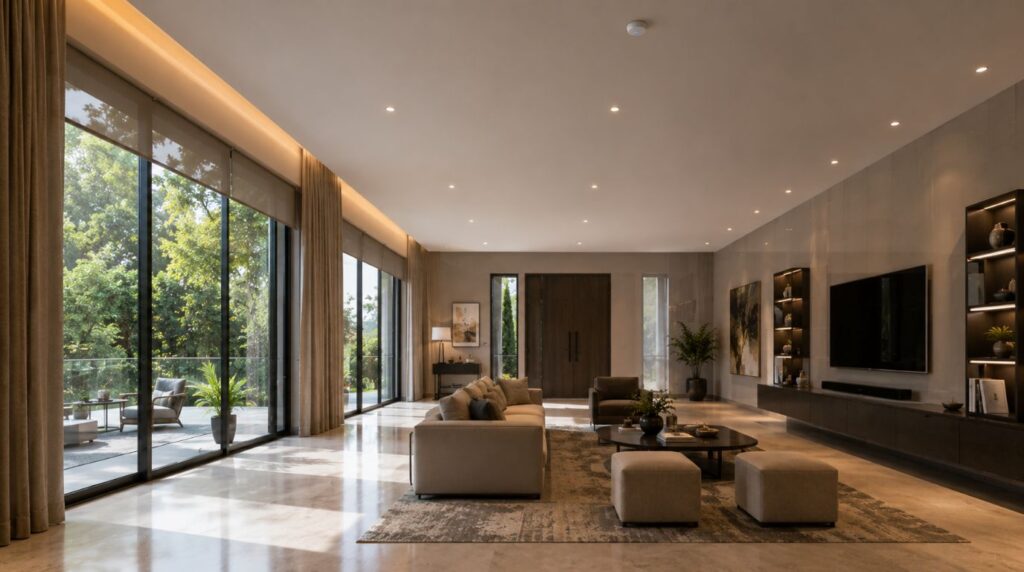
Yes, constant daylight harvesting loops decrease lighting energy consumption by up to 60% by linking high-precision ceiling lux sensors with digital dimming drivers to automatically reduce artificial light output as natural sunlight fills the room. This dynamic control method ensures your lights only draw the minimal wattage required to maintain your target brightness, checking off a critical metric for certified sustainable smart homes.
Closed-Loop Architectural Dimming
Standard lighting controls rely on manual, fixed toggles, which often leave high-output architectural downlights burning at 100% intensity even during bright afternoon hours. Modern sustainable smart homes utilize a continuous closed-loop control system to prevent this.
Ceiling sensors continuously measure the ambient natural light reflecting off interior surfaces. As daylight increases through your large windows, the KNX network smoothly dims your DALI-2 architectural lighting in real-time, matching the sun’s natural arc and minimizing grid energy use.
Relay-Level Vampire Load Elimination
High-end home automation touchscreens, electronic transformers, AV racks, and premium kitchen appliances constantly draw “vampire” or standby power even when turned off via software. Over an entire luxury estate, this silent standby power drain can account for hundreds of kilograms of unnecessary carbon emissions each year.
To solve this, I design centralized distribution panels with high-amperage switching actuators. When you tap a “Goodnight” or “Away” scene on your keypad, the infrastructure physically severs the power feed to non-essential sub-circuits at the relay level, stopping standby power draw entirely and showcasing the true efficiency of sustainable smart homes.
Why are Hardwired Automation Backbones Essential for True Sustainable Smart Homes?
Hardwired automation backbones are far more sustainable than wireless setups because they eliminate the high lifecycle waste of short-lived consumer electronics and operate entirely offline with an industrial lifespan of over 30 years. True sustainable smart homes must avoid wireless devices, which carry a heavy hidden carbon footprint due to rapid battery replacements and short software obsolescence windows.
Eradicating Toxic Battery Waste
A large-scale wireless smart home setup can easily require 100 to 200 individual batteries to power its various motion sensors, security contacts, and wireless smart switches. Over ten years, this leads to the disposal of hundreds of lithium coin cells, creating significant hazardous waste.
By contrast, a hardwired bus network routes both data and safe, low-voltage power through a single physical cable, completely removing batteries from your environmental infrastructure.
Eliminating the Consumer Electronics Lifecycle Trap
Mass-market wireless smart gadgets are built with inexpensive components and rely on proprietary cloud servers that manufacturers can discontinue or alter at any time. When a cloud app goes obsolete, your entire array of wireless switches can become useless wall waste overnight.
Developing long-lasting, sustainable smart homes requires implementing globally standardized, hardwired open protocols like KNX. Backed by hundreds of international manufacturers, this system architecture is built to function reliably for decades, keeping technology out of landfills and embedded securely within your property’s structure.
Technical Carbon Mitigation Matrix: System Architecture Analysis
| Environmental & Engineering Metric | Conventional Luxury Estate | Consumer Wireless Tier | Sustainable Smart Homes (KNX Structure) |
| Average Whole-Home Carbon Savings | Baseline (0% reference) | 5% to 12% (Highly unstable) | 25% to 40% (Verified operational data) |
| HVAC Carbon Emission Control | Manual thermostat control | Uncoordinated mobile scheduling | Up to 50% Saved via physical interlocks |
| Lighting Circuit Power Optimization | Fixed-wattage manual switches | Basic app-based grouping | Up to 60% Saved via DALI-2 luxury lux loops |
| Standby Power Control | Constant vampire grid leak | Manual socket smart plugs | Instant 100% hardware circuit isolation |
| Hazardous Household Waste | Minimal battery dependency | High (Hundreds of dead batteries) | Absolute Zero (Continuous bus line power) |
| Operational Lifespan Expectancy | Subject to hardware wear | 3 to 5 years (Rapid obsolescence) | 30+ Years (Industrial building durability) |
Moving Beyond Greenwashing into True Environmental Legacies
True eco-luxury is an invisible, high-performance asset that actively protects our planet while safeguarding your home’s capital and comfort. Reducing a property’s carbon footprint cannot rely on superficial green trends, manual habits, or temporary wireless gadgets. It requires a permanent building framework engineered from the ground up to handle real-world energy challenges efficiently.
At Techtastic, I don’t build our reputation on temporary tech toys or volatile cloud-connected boxes. I look at sustainable smart homes through an uncompromising engineering lens, using hardwired international standards to transform your property into an invisible, self-optimizing ecosystem that reduces emissions and preserves capital for generations.
🤝 The Partnership Corner
- For Discerning Homeowners: I design custom, offline-first automation blueprints that maximize your home’s energy efficiency, lowering your carbon footprint through every season and monsoon storm.
- For Luxury Architects & MEP Consultants: I collaborate directly with your design teams during the raw brickwork phase, providing precise electrical panel schematics, load calculations, and conduit maps to secure verified building efficiency scores for your sustainable smart homes pipeline.
Let’s build a sustainable digital foundation engineered to endure.
📞 Call/WhatsApp: 9769145145
📍 Engineering Premium Reliability Across: Navi Mumbai | Nashik | Lonavla | Sangli
Technical FAQs on Sustainable Smart Homes
Q: Can sustainable smart homes genuinely help reduce my household’s carbon footprint?
A: Yes. Verified engineering data proves that a fully integrated, hardwired automation network reduces a luxury property’s overall carbon footprint by 25% to 40%. It achieves this by cross-linking your HVAC, lighting, and shading systems over a single physical control layer, making sustainable smart homes exceptionally eco-friendly.
Q: Why are hardwired systems considered more eco-friendly than wireless smart devices?
A: Hardwired systems are far more sustainable because they operate entirely without batteries, removing toxic battery disposal from your home’s environmental impact. Additionally, hardwired standards feature an industrial lifespan of over 30 years, completely avoiding the rapid software obsolescence and electronic waste common to consumer wireless gadgets.
Q: How do sustainable smart homes eliminate standby “vampire” power loads?
A: Unlike basic smart plugs that work on individual wall sockets, a centralized hardwired automation panel incorporates heavy-duty switching relays that physically isolate and cut power to non-essential electrical circuits the moment you activate an “Away” or “Night” scene, dropping your standby power consumption to absolute zero.