
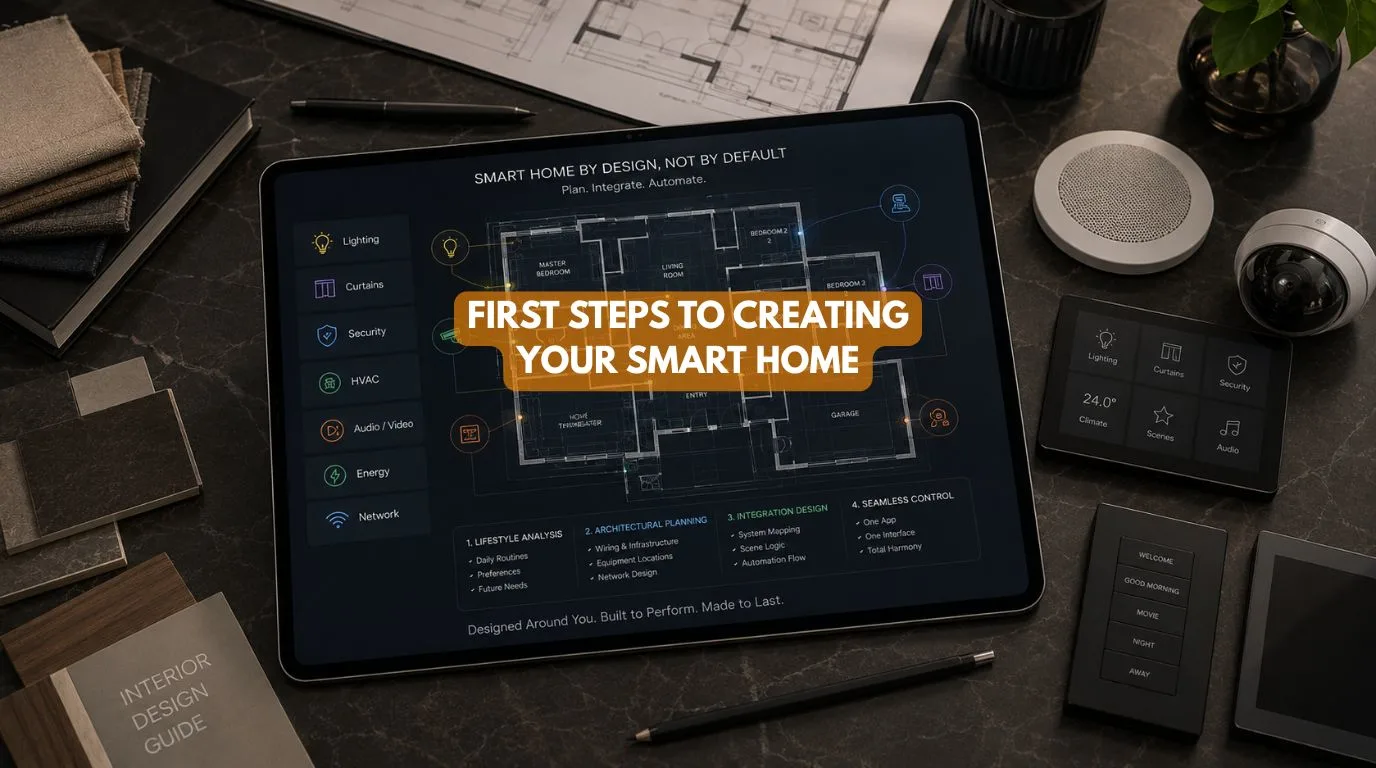
Setting up your smart home system can feel overwhelming when you face many devices, technologies, brands, and automation options. Should you start with smart lights? Motorized curtains? Security? Voice control? KNX? Wi-Fi devices?
The answer is simpler than you might expect.
The first steps to creating your smart home should begin with your lifestyle and requirements—not with buying smart home devices. A well-designed smart home starts by identifying what you want to improve, deciding which systems need automation, selecting the right technology architecture, and planning the infrastructure before installation begins.
Whether you’re upgrading an apartment, renovating a home, or building a luxury villa, this guide helps you. It walks you through the first steps to creating your smart home, in the right order.
Quick Summary
The First Steps to Creating Your Smart Home are:
- Define your goals
- Identify what you want to automate
- Prioritize rooms and systems
- Choose wired, wireless, or hybrid technology
- Plan your network and electrical infrastructure
- Set a realistic budget
- Check device compatibility
- Plan automation scenes
- Choose an experienced installer
- Test and commission the system
Start with your lifestyle, then choose the technology—not the other way around.
Quick Answer
The first steps to creating your smart home are to define your goals.
Identify the systems you want to automate. Prioritize the most useful features. Choose a suitable wired or wireless setup. Plan your networking and electrical needs. Set a budget. Select compatible products. Work with a smart home installer who fits your project. Ideally, you should plan new construction before electrical and interior work begins.
What Are the First Steps to Creating Your Smart Home?
The first mistake many homeowners make is starting with products. They see a smart bulb, smart lock, or motorized curtain and immediately ask:
“Should I buy this?”
Instead, ask:
“What do I want my home to do automatically?”
That’s the foundation of the First Steps to Creating Your Smart Home.
For example, perhaps you want:
- Lights to turn on automatically
- Curtains to open in the morning
- Security to activate when you leave
- AC to adjust automatically
- One-button movie scenes
- Better energy management
Once you know the outcome you want, you can determine which technology will deliver it.
Step 1: Define Your Smart Home Goals
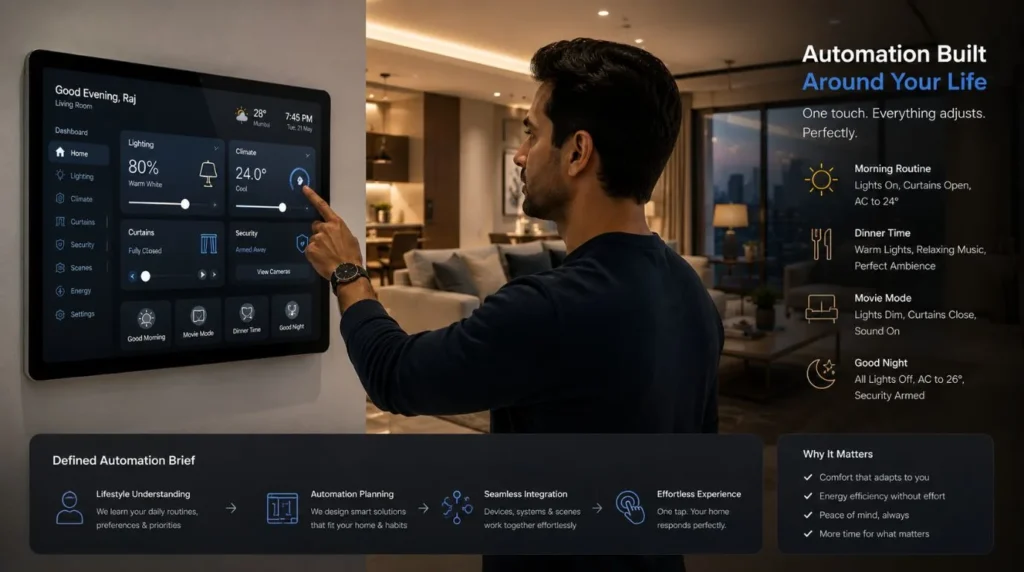
The first of the first steps to creating your smart home is defining your objectives. Think about your daily routines.
Ask:
- What do I repeatedly do every day?
- What do I forget to switch off?
- Which rooms need better lighting control?
- Do I want better security?
- Do I want automated curtains?
- Do I want centralized entertainment?
- Do I want energy monitoring?
Your answers create your initial automation brief.
Example
Instead of saying: “I want a smart home.”
Say: “I want lighting, curtains, security, climate control, and home theatre to work together.”
That’s much easier for an installer to design around.
Step 2: Identify What You Want to Automate
The next step is creating a list of systems. Common smart home categories include:
- Smart lighting
- Motorized curtains
- Security
- Smart locks
- HVAC and climate control
- Home theatre
- Multi-room audio
- Energy management
- Sensors
- Access control
Don’t assume you need everything. The best smart home is not necessarily the one with the most technology. It’s the one where the technology provides genuine value.
Step 3: Prioritize Your Rooms
Another important part of the first steps to creating your smart home is choosing where automation will help most.
| Room | Useful Automation |
|---|
| Living Room | Lighting, curtains, AV, climate |
| Bedroom | Lighting, curtains, climate |
| Kitchen | Lighting, appliance control, safety |
| Home Theatre | Curtains, lighting, AV |
| Entrance | Security, access control, lighting |
| Outdoor Areas | Lighting, security, irrigation |
Start with the rooms where automation solves real problems. You can expand later.
Step 4: Choose Wired, Wireless, or Hybrid
One of the most important first steps to creating your smart home is choosing the system architecture.
Wireless
Wireless automation can be suitable for:
- Existing homes
- Apartments
- Smaller projects
- Retrofit installations
It can reduce the need for extensive rewiring.
Wired
Wired automation can be particularly suitable for:
- New construction
- Luxury villas
- Large residences
- Whole-home automation
KNX is one example of a professional wired automation standard.
Hybrid
A combination of wired and wireless technologies can sometimes provide the best balance between infrastructure, flexibility, and cost.
The right choice depends on the property—not simply on which technology is currently popular.
Step 5: Plan Your Infrastructure
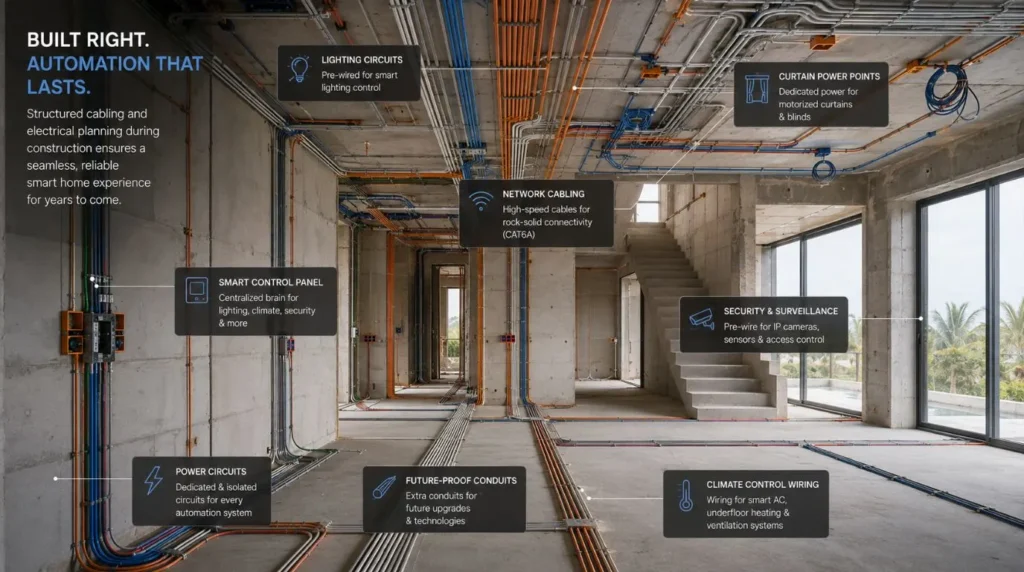
Infrastructure is one of the most overlooked first steps to creating your smart home.
For a new home, think about:
- Electrical wiring
- Network cabling
- Wi-Fi access points
- Automation panels
- Sensor locations
- Curtain power points
- Equipment racks
- Internet connections
For KNX projects, planning the wiring before electrical work begins is particularly important.
Why?
Because it can be significantly more difficult to retrofit infrastructure once workers have finished the walls, ceilings, and interiors.
Step 6: Set a Realistic Budget
Smart home budgets can vary dramatically. A small apartment with automated lighting is different from a large luxury villa with:
- KNX automation
- Whole-home lighting
- HVAC integration
- Motorized curtains
- Security
- Home theatre
- Energy management
Create three categories:
Essential
Systems you definitely want.
Preferred
Features that would improve the experience.
Future
Features you may add later.
This approach lets you create a scalable system without trying to automate everything on day one.
Step 7: Choose Compatible Technology
One of the most important First Steps to Creating Your Smart Home is checking compatibility before buying individual devices. Don’t assume that two products will automatically communicate because both are labeled “smart.”
Check:
- Communication protocols
- Automation platform
- API/integration support
- Voice assistant compatibility
- Local vs cloud operation
- Future support
- Expansion options
This is particularly important when integrating lighting, curtains, HVAC, security, and entertainment.
Step 8: Plan Your Smart Scenes
Automation becomes useful when individual devices start working together. Think about your daily routines.
Good Morning
Curtains open → Lights brighten → Climate adjusts.
Leaving Home
Lights off → Curtains close → Security activates.
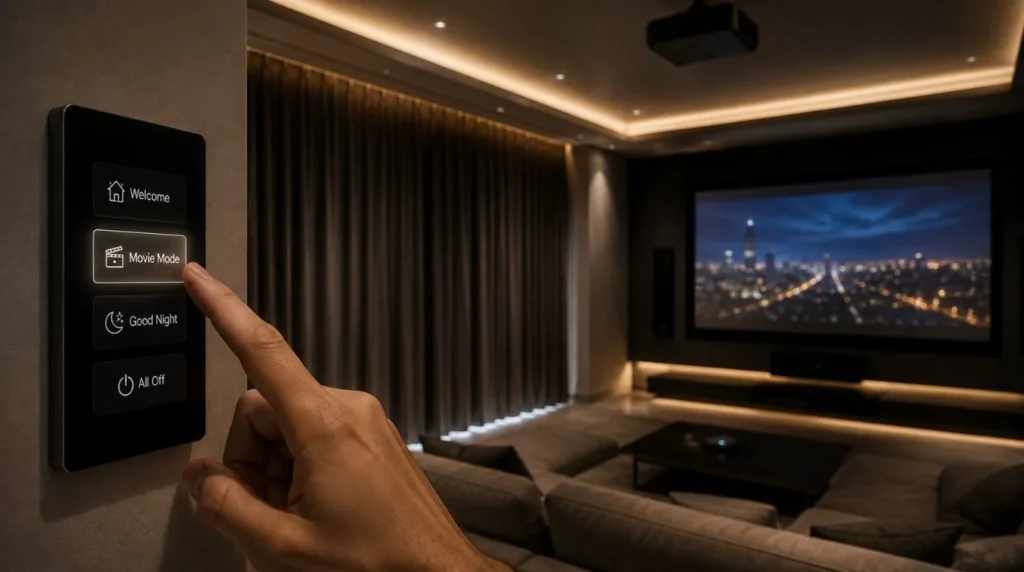
Movie Mode
Curtains close → Lights dim → Home theatre starts.
Good Night
Lights off → Curtains close → Security activates → Climate changes.
Design these scenes around how you actually live, not simply around what the technology can do.
Step 9: Choose the Right Installer
Choosing an installer is one of the most important first steps to creating your smart home. Don’t evaluate an installer only by the number of brands they sell.
Ask:
- Do they provide system design?
- Can they explain the architecture?
- Do they understand networking?
- Can they integrate multiple systems?
- Do they provide programming?
- Do they test and commission the system?
- Is after-sales support available?
- Can the system be expanded later?
For a large or luxury project, choose an integrator who can work with your architect and designer.
They should also coordinate with your electrician, HVAC contractor, and other project teams.
Step 10: Test and Commission the System
Installation isn’t the final step. Test the system under real-world conditions.
Check:
- Lighting scenes
- Curtain movement
- Security alerts
- Climate control
- App access
- Voice control
- Sensors
- Automation schedules
- Manual overrides
The installer should also provide a basic handover, so homeowners understand how to use the system.
New Home vs Existing Home
The first steps to creating your smart home can differ depending on your property’s construction stage.
New Construction
You have greater freedom to plan:
- Wiring
- Network infrastructure
- KNX
- Sensors
- Curtain motors
- Central equipment
- Concealed installations
Ideally, involve the automation company before electrical work begins.
Existing Home
You may prefer:
- Wireless devices
- Battery-powered sensors
- Retrofit curtain motors
- Hybrid automation
This can reduce civil work and make installation easier.
Common Mistakes to Avoid
Avoid these mistakes when following the first steps to creating your smart home.
Buying Devices Before Planning
This can lead to incompatible products.
Automating Everything
Not every appliance needs automation.
Ignoring Networking
A smart home needs reliable communication.
Choosing Technology Only by Price
The cheapest device may not provide the best long-term value.
Forgetting Future Expansion
Leave room for additional automation.
Planning Too Late
For new construction, late automation planning can create unnecessary wiring and interior coordination problems.
A Simple Smart Home Planning Checklist
| Planning Question | Your Answer |
|---|
| What do I want to automate? | __________ |
| Which rooms need automation? | __________ |
| Wired, wireless, or hybrid? | __________ |
| What is my initial budget? | __________ |
| Which systems need integration? | __________ |
| Do I need KNX? | __________ |
| What scenes do I want? | __________ |
| Who will install and program it? | __________ |
| What might I add later? | __________ |
Completing this checklist before purchasing equipment can make the project much easier to manage.
Representative Example
Illustrative Example: This scenario demonstrates a typical planning approach and is not presented as a specific Techtastic client project.
Imagine a homeowner building a new luxury villa. Instead of immediately purchasing smart devices, they define five priorities:
- Lighting
- Motorized curtains
- Security
- Climate control
- Home theatre
The automation team then evaluates the property and determines that a wired or hybrid architecture is appropriate. Infrastructure is planned alongside electrical work.
The system is then programmed around scenes such as: Good Morning → Away → Evening → Movie → Good Night
This approach creates a much more coherent result than purchasing individual devices after construction is complete.
What Should You Do First?
If you’re still wondering about the first steps to creating your smart home, keep it simple.
Don’t begin with:
“Which smart device should I buy?”
Begin with:
“What do I want my home to do for me?”
Then follow: Goals → Rooms → Systems → Architecture → Infrastructure → Budget → Products → Installation → Programming → Testing
That sequence can help you avoid many compatibility, networking, cost, and usability problems that homeowners face.
Key Takeaways: Steps to Creating Your Smart Home
- The first steps to creating your smart home should begin with lifestyle and automation goals.
- Decide what you actually want to automate before purchasing devices.
- Prioritize rooms and systems based on usefulness.
- Choose wired, wireless, or hybrid architecture according to your property.
- Plan networking and electrical infrastructure early.
- Set a realistic budget and leave room for future expansion.
- Confirm product compatibility before purchasing.
- Design scenes around everyday routines.
- Choose an installer who can design, program, integrate, and support the system.
- Test and commission the complete system before handover.
Frequently Asked Questions
1. What are the first steps to creating your smart home?
The first steps to creating your smart home are to start by defining your goals. Identify which systems you want to automate. Prioritize rooms. Choose an automation architecture. Plan the infrastructure. Set a budget. Select compatible technology.
2. Should I buy smart devices before hiring an installer?
Usually, no. It’s better to establish the system architecture and requirements first, so you don’t purchase incompatible or unsuitable products.
3. Should I choose wired or wireless smart home automation?
Wireless systems can work well for many existing homes and retrofit projects. Wired automation can be particularly suitable for new luxury homes and larger whole-home installations.
4. Is KNX necessary for a smart home?
No. KNX is one professional automation option. The appropriate technology depends on the property, project scope, budget, and long-term requirements.
5. How much does it cost to create a smart home?
There is no single price. Costs depend on the number of rooms, systems, devices, infrastructure, automation platform, installation complexity, and level of integration.
6. Can I create a smart home gradually?
Yes. A scalable architecture allows you to start with essential systems and add additional automation later.
7. What should I automate first?
Lighting, security, curtains, climate control, and frequently used scenes are often good starting points. The best choices depend on your lifestyle.
8. When should smart home automation be planned during construction?
Ideally, before electrical work begins. Early planning provides more flexibility for wiring, sensors, networking, curtain motors, and concealed equipment.
9. Do I need a professional smart home installer?
For a few standalone devices, professional installation may not be necessary. For whole-home automation, KNX, luxury villas, and multi-system integration, we strongly recommend professional design and commissioning.
10. What makes a smart home future-ready?
A scalable design, reliable infrastructure, compatible technology, clear code documentation, and easy future integration support a smart home.
Collaboration Opportunities for Architects & Interior Designers
Considering automation alongside architecture and interior design makes the first steps to creating your smart home much easier.
Techtastic can collaborate with:
- Architects
- Interior Designers
- Builders
- Developers
- Luxury Villa Developers
- Project Management Consultants
Areas of collaboration include:
- Smart Home Planning
- KNX System Design
- Lighting Automation
- Motorized Curtain Planning
- HVAC Integration
- Smart Security
- Home Theatre Automation
- Structured Networking
- Technical Drawings
- Programming
- Testing & Commissioning
Early coordination helps ensure technology fits into the architecture, instead of being added after interiors are finished.
Areas We Serve
Techtastic provides smart home automation systems across: Navi Mumbai • Nashik • Lonavla • Sangli
The company also serves projects across the wider Mumbai and Thane region.
Ready to Start Creating Your Smart Home?
The first steps to creating your smart home don’t involve buying the latest gadgets. They involve understanding your lifestyle, defining your priorities, selecting the right architecture, and planning the system around your property.
Whether you are upgrading an apartment, renovating a home, or building a luxury villa, good planning helps. It makes your automation more reliable, intuitive, and scalable.
At Techtastic, the approach is simple: Understand → Design → Integrate → Program → Test
The result should be technology that works naturally in the background. It should also give you more control over how your home operates.
Talk to Techtastic about planning your smart home before you start buying devices and to know the right steps to creating your smart home.
Contact Techtastic
Website: Techtastic Website
Call / WhatsApp: 9769145145
Service Areas: Navi Mumbai • Nashik • Lonavla • Sangli