Motorized curtain systems have become one of the most popular smart home upgrades in modern residences. They offer effortless control, enhanced comfort, improved privacy, and seamless integration with lighting, climate control, and home automation systems.
However, one question homeowners often ask before investing in automated window treatments is: “How much electricity do motorized curtain systems actually use?”
It’s a reasonable concern. As homeowners become increasingly conscious of energy consumption and sustainability, understanding the power requirements of smart home technologies is more important than ever.
At Techtastic, we frequently reassure clients that motorized curtain systems consume surprisingly little electricity. In fact, many homeowners are surprised to learn that the energy consumed by a motorized curtain system is often negligible compared to other household devices.
Let’s take a closer look at how motorized curtain systems use electricity, what affects their energy consumption, and whether they can actually help reduce overall household energy costs.
Summary
Motorized curtain systems use very little electricity because their motors operate only for short periods while opening or closing the curtains. Most residential curtain motors consume between 30 and 100 watts during movement and virtually no power when idle. In many homes, the annual electricity cost of operating motorized curtain systems is minimal. When integrated with smart home automation, motorized curtain systems can actually contribute to energy savings by reducing HVAC usage, managing solar heat gain, and optimizing natural daylight.
Quick Answer
Motorized curtain systems typically use between 30 and 100 watts of electricity while actively moving and consume very little power when idle. Since most curtains operate only a few times per day for short durations, their overall energy consumption is extremely low. In many cases, automated curtain systems can help reduce total household energy usage by improving temperature control, minimizing heat gain, and optimizing natural lighting throughout the day.
How Do Motorized Curtain Systems Use Electricity?
Motorized curtain systems rely on a small electric motor that moves the curtain track when activated.
The motor receives power through:
- Wired electrical connections
- Rechargeable battery systems
- Low-voltage automation infrastructure
Electricity is only consumed when the motor is actively moving the curtains.
Once the curtains reach their desired position, power consumption drops significantly.
This is one reason motorized curtain systems are considered highly energy-efficient.
Typical Power Consumption of Motorized Curtain Systems
While exact figures vary depending on the manufacturer and curtain size, most residential systems fall within predictable ranges.
| Curtain Motor Type | Typical Power Usage |
|---|---|
| Small residential motor | 30–50 watts |
| Standard motorized curtain motor | 50–70 watts |
| Heavy-duty large curtain motor | 70–100 watts |
| Standby mode | Minimal power consumption |
Importantly, these power levels only apply while the curtain is moving.
Most curtain movements last between:
- 10 seconds
- 30 seconds
- 60 seconds
depending on window size and track length.
How Much Electricity Do Motorized Curtain Systems Use Per Day?
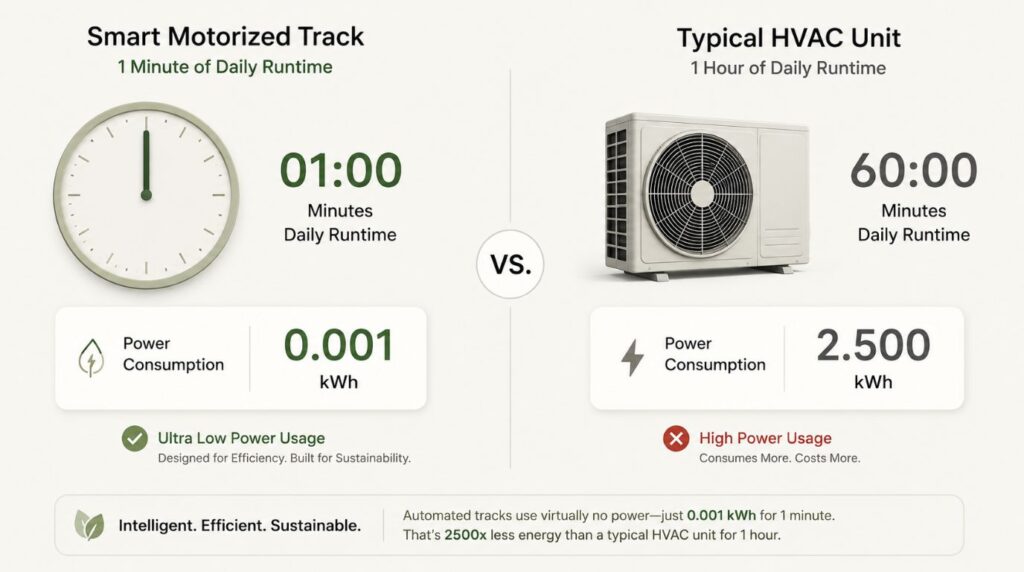
Let’s look at a practical example.
Assume:
- Motor power = 60 watts
- Opening time = 30 seconds
- Closing time = 30 seconds
- Two movements per day
Daily operating time:
- Total = 1 minute per day
Energy consumption:
- 60 watts × 1 minute
- Approximately 0.001 kWh per day
This amount is extremely small compared to many common household appliances.
Comparing Motorized Curtain Systems to Everyday Appliances
To put things into perspective:
| Device | Typical Energy Usage |
|---|---|
| Motorized curtain systems | Very low |
| LED television | Moderate |
| Refrigerator | Continuous daily use |
| Air conditioner | High |
| Water heater | High |
| Electric oven | Very high |
Even frequent curtain operation contributes only a tiny fraction of a home’s overall energy consumption.
Do Battery-Powered Motorized Curtain Systems Use More Electricity?
Battery-powered systems consume similar amounts of energy during operation.
The main difference is how the energy is supplied.
Wired Systems
- Continuous power supply
- No charging required
- Ideal for large installations
Battery-Powered Systems
- Rechargeable batteries
- Periodic charging required
- Popular for retrofit projects
Battery systems remain highly efficient because the motors operate only for brief periods.
Depending on usage, many battery-powered curtains can operate for several months between charges.
Can Motorized Curtain Systems Actually Save Energy?
This is where the conversation becomes particularly interesting.
Although motorized curtains consume electricity, they can often help reduce overall household energy usage.
Reducing Solar Heat Gain
During hot weather:
- Curtains close automatically during peak sunlight hours.
- Less heat enters the home.
- Air conditioning systems work less.
This can significantly reduce cooling loads.
Improving Winter Insulation
During colder periods:
- Curtains help reduce heat loss through windows.
- Indoor temperatures remain more stable.
- Heating systems operate more efficiently.
Maximizing Natural Daylight
Automated schedules can:
- Open curtains during daylight hours.
- Reduce reliance on artificial lighting.
- Improve energy efficiency.
This benefit is particularly noticeable in homes with large windows.
Smart Curtain Automation and Energy Efficiency
Motorized curtains become even more valuable when integrated into a smart home ecosystem.
Examples include:
Sunlight-Based Automation
Curtains respond automatically to sunlight levels.
Temperature-Based Control
Curtains adjust based on indoor temperature conditions.
Occupancy-Based Automation
Curtains operate according to room usage patterns.
Seasonal Optimization
Different schedules can be applied throughout the year.
These intelligent strategies help maximize energy savings while improving comfort.
Factors That Affect Curtain Motor Energy Consumption
Curtain Size
Larger curtains require more motor effort.
However, the difference in overall energy consumption remains relatively small.
Fabric Weight
Heavy blackout curtains generally require more powerful motors.
Even so, operating costs remain extremely low.
Frequency of Operation
Curtains that open and close multiple times per day consume more energy than those operating only once or twice.
Nevertheless, total consumption remains minimal compared to most household appliances.
Motor Quality
Premium motors are typically:
- More efficient
- More reliable
- Quieter
- Better optimized for long-term use
Higher-quality systems often deliver superior energy performance.
Common Myths About Motorized Curtain Energy Usage
“Motorized Curtains Use a Lot of Electricity”
False.
Most systems consume very little electricity due to their short operating cycles.
“The Motors Run Constantly”
False.
The motor only operates during opening and closing actions.
“Battery Systems Waste Energy”
False.
Modern battery-powered motors are highly efficient and designed for low power consumption.
“Automation Increases Energy Bills”
In many cases, automation helps reduce overall household energy costs through smarter management of sunlight and temperature.
What Does Motorized Curtain Operation Cost Per Year?
The exact figure depends on:
- Motor specifications
- Usage frequency
- Local electricity rates
However, for most homeowners, annual operating costs are typically very low compared to the energy consumed by HVAC systems, refrigerators, water heaters, and entertainment devices.
In practical terms, energy consumption is rarely a deciding factor when evaluating motorized curtains.
Why Motorized Curtains Matter for Modern Homes
Today’s homeowners want solutions that combine:
- Convenience
- Comfort
- Energy efficiency
- Aesthetics
- Smart home integration
Motorized curtains deliver all of these benefits while consuming very little electricity.
As homes become increasingly automated, intelligent window treatments are becoming a standard component of energy-conscious residential design.
Our Perspective at Techtastic
At Techtastic, we view motorized curtains as one of the most practical and energy-efficient smart home upgrades available.
While homeowners often focus on the electricity required to operate the motors, the bigger picture is the impact automated curtains can have on overall home performance.
We regularly integrate motorized curtain systems with:
- Smart lighting
- Climate control
- Occupancy sensors
- Home automation platforms
This allows homeowners to improve comfort while simultaneously reducing unnecessary energy consumption.
In our experience, the energy used by the curtain motors themselves is minimal compared to the potential energy savings they help create.
Collaboration Opportunities for Developers, Architects & Interior Designers
The most successful motorized curtain installations begin during the planning phase.
At Techtastic, we collaborate with:
- Architects
- Interior designers
- Luxury home builders
- Real estate developers
- Hospitality consultants
Smart Window Treatment Planning
Integrate automated curtains seamlessly into architectural designs.
Daylight Management Strategies
Optimize natural light while improving comfort and efficiency.
Energy-Conscious Building Design
Support sustainability objectives through intelligent shading solutions.
Smart Home Integration Planning
Ensure compatibility with broader automation ecosystems.
Luxury Residential Projects
Create premium living experiences that balance convenience and efficiency.
Hospitality & Commercial Applications
Implement scalable shading solutions for hotels, offices, and public spaces.
Early planning results in cleaner installations and superior long-term performance.
Key Takeaways
- Motorized curtains use very little electricity.
- Most motors consume between 30 and 100 watts only while moving.
- Daily operating energy consumption is extremely low.
- Battery-powered and wired systems are both highly efficient.
- Automated curtains can help reduce HVAC and lighting energy usage.
- Smart integration increases energy-saving potential even further.
Frequently Asked Questions
1. How much electricity do motorized curtains use?
A: Most residential motorized curtains use between 30 and 100 watts while operating and very little power when idle.
2. Do motorized curtains increase electricity bills?
A: Typically, the impact on electricity bills is minimal because the motors operate for only short periods each day.
3. Are battery-powered motorized curtains energy efficient?
A: Yes. Modern battery-powered curtain systems are designed for low energy consumption and can often operate for months between charges.
4. Can motorized curtains reduce energy costs?
A: Yes. Automated curtain schedules can help reduce cooling, heating, and lighting energy usage.
5. Do motorized curtains use electricity when not moving?
A: Most systems consume little to no electricity when idle, depending on the motor and control system design.
6. Are motorized curtains suitable for large windows?
A: Yes. Heavy-duty motors are available for large glass facades and oversized curtain installations.
7. What’s more energy efficient: motorized curtains or manual curtains?
A: The motor itself uses some electricity, but automation can create overall energy savings through better daylight and temperature management.
8. Are motorized curtains worth it from an energy perspective?
A: For many homeowners, yes. Their low operating costs, combined with potential HVAC savings, make them a highly efficient smart home feature.
Conclusion
So, how much electricity do motorized curtains use?
The answer is surprisingly little. Most curtain motors consume only small amounts of electricity during brief operating periods, making their overall energy impact negligible for most households.
More importantly, when integrated into a smart home ecosystem, motorized curtains can help improve energy efficiency by managing sunlight, reducing HVAC loads, and optimizing natural daylight.
At Techtastic, we help homeowners, architects, and developers design intelligent window treatment solutions that enhance comfort, convenience, and sustainability.
📞 Call/WhatsApp: 9769145145
📍 Our Operational Hubs: Navi Mumbai | Nashik | Lonavla | Sangli
Whether you’re planning a new smart home or upgrading an existing space, motorized curtains remain one of the most efficient and practical automation investments available today.