
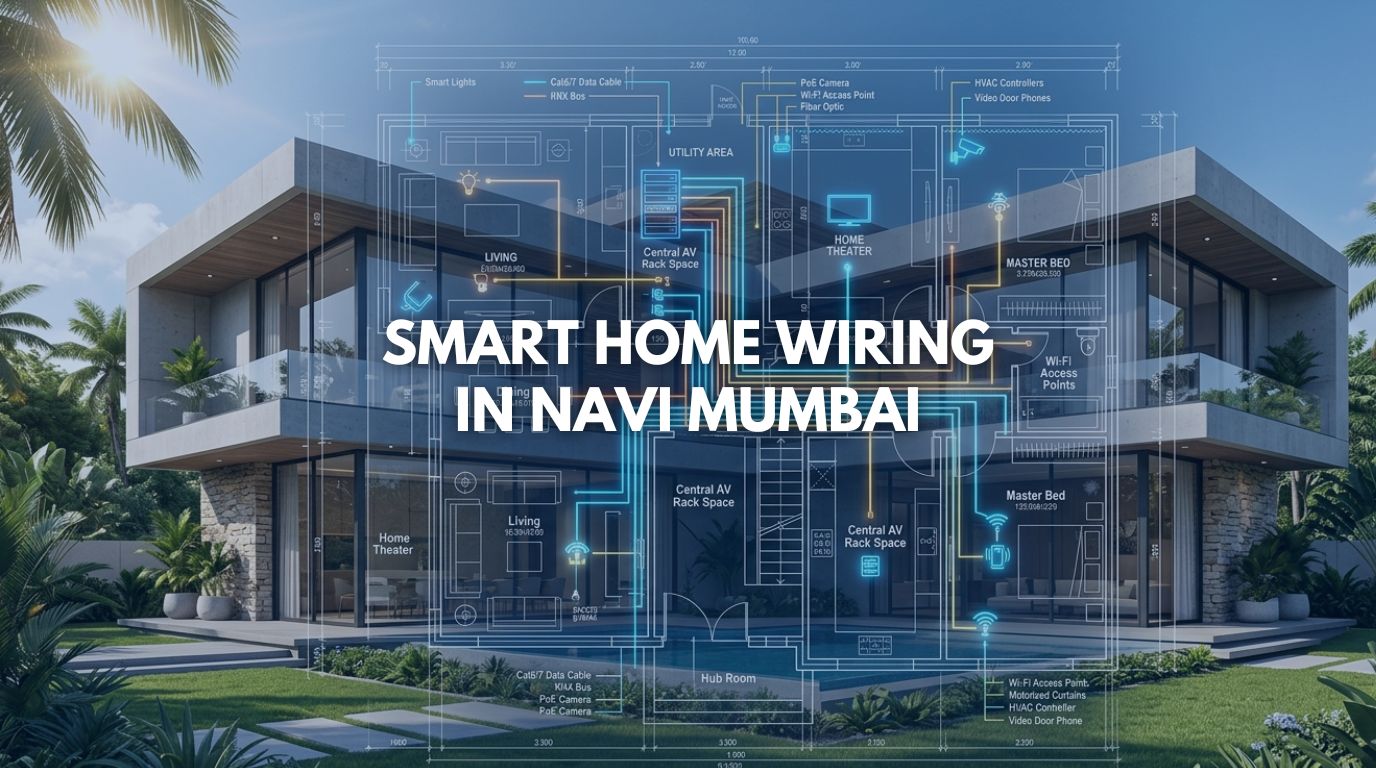
Building a new bungalow in Navi Mumbai is a massive undertaking. Building a “forever home” in areas like Kharghar or Palm Beach Road involves balancing modern architecture with coastal humidity. These major factors often cause homeowners to overlook critical technical details.
This guide focuses on the “skeleton” of your smart home system: the smart home wiring. We focus on structured cabling, central hubs, and reliable protocols like KNX or Zigbee that perform best in tropical climates. Planning for “invisible technology” during the initial construction ensures your home stays adaptable and functional for decades. This approach provides a luxury experience without the need to break walls for future upgrades.
Smart Home Wiring for New Bungalows in Navi Mumbai
Every new bungalow project in Nerul or Belapur starts with a unique sense of potential. But as an architect, I also see the potential for a major headache: the “afterthought” smart home.
Too often, homeowners think about smart technology only when the painting is almost finished. By then, it’s too late. To get a home that truly responds to you, we have to discuss what’s happening behind the plaster. We need to discuss the smart home wiring.
Why “Wireless” Still Needs Wires
The biggest myth I encounter is that “smart” means “wireless.” Smart speakers and phones are wireless, but a 5,000-square-foot bungalow needs more than basic Wi-Fi. Big homes need a solid foundation to keep all the technology running smoothly.
In Navi Mumbai, we tend to build with heavy RCC (Reinforced Cement Concrete) and thick brickwork to withstand the monsoon and heat. These materials are “Wi-Fi killers.” If you rely solely on a wireless mesh system, you’ll find dead zones in the master suite or the home theater.
A professional smart home wiring starts with Structured Cabling. Install physical Cat6 or Cat7 cables at every major location, including TVs, smart security cameras, access points, and motorized curtains. This creates a dedicated “data highway” for your smart home devices.
The Hub: Your Home’s Brain
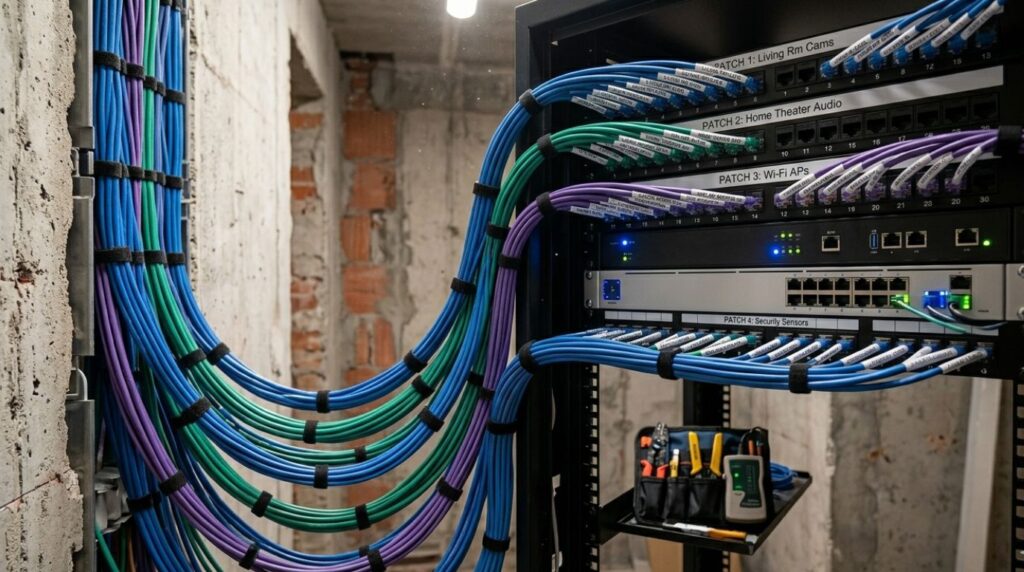
In a traditional home, the electrical DB (Distribution Board) is tucked behind a door. In a smart bungalow, we design a Centralized AV Rack Space.
Think of this as the brain of the house. Instead of cluttering your TV areas, you can house all equipment in a single ventilated rack. We run the wires from this rack to the rest of the house.
This smart home wiring setup creates a cleaner look and prevents hardware from overheating. Maintaining cool temperatures is essential, given our local humidity and heat.
Lighting: Beyond the Switch
In a standard setup, you have a physical switch that cuts power to a bulb. In a smart bungalow, we use Bus Wiring.
Instead of running thick bundles of electric wires to every switchboard, we use a single, thin “Bus” cable. This cable connects all your switches to a central controller, significantly reducing the amount of wiring needed. This allows for “Scene Control.” When you leave for work, a single button by the front door can turn off every light, shut the AC, and lower the drapes.
I always tell my clients: don’t just automate your lights; automate your lifestyle. You want the lights in the foyer to dim to 20% automatically after 11:00 PM. That requires a wired backbone that doesn’t “drop out” when the internet is slow.
Climate Control and the Navi Mumbai Factor
The heat in Navi Mumbai is no joke. AC has the most energy consumption in any bungalow. Connecting your HVAC system to a smart controller allows sensors to manage it automatically. These sensors monitor room temperature and occupancy to ensure the system runs only when needed.
Imagine sensors that detect when a room is empty for more than 20 minutes and nudge the AC up by two degrees. Or, better yet, drapes that close automatically on the west-facing windows during the afternoon sun to reduce the heat load. This isn’t just about luxury; it’s about making a large bungalow sustainable and cost-effective to run.
Security System: The Invisible Shield
Security is more than just a camera at the gate.
- PoE (Power over Ethernet) Cameras: We wire these directly to the rack. They don’t need separate power plugs and are far more reliable than Wi-Fi cameras.
- Sensors: During the smart home wiring phase, we hide magnetic reed sensors inside the door frames and motion sensors in the ceilings.
- Video Door Phones: We install Cat6 cables at the gate and on every floor for your video door phone. This setup allows you to see visitors from your smartphone or a dedicated touch panel in the kitchen.
Future-Proofing: The “Conduit” Strategy
Technologies change. What is cutting-edge today will be old news in ten years. The best gift I can give a homeowner is the ability to upgrade without demolition.
We do this by installing Oversized Conduits. Using 1-inch or 1.5-inch PVC pipes instead of narrow ones provides more space for future tech. Leaving pull-strings inside the walls allows technicians to easily pull through new fiber-optic cables or future technologies. This method ensures you can upgrade your system without breaking any surfaces.
My Advice for the “Gray Structure” Phase
If your bungalow is currently at the brick-laying stage, this is your golden window.
- Identify your “Heavy Hitters”: Decide where the home theater, the home office, and the outdoor deck will be. These areas need extra data points.
- Don’t skimp on the Rack Room: Ensure it has dedicated cooling. Hardware generates heat, and heat kills electronics.
- Consult early: An architect designs the space, but a system integrator ensures the technology breathes life into it. Get them in the same room before the first pipe is laid.
Building a bungalow in Navi Mumbai is a dream for many. By focusing on the smart home wiring now, you ensure that the dream stays smart, silent, and seamless for years to come.
Collaboration Opportunities for Builders and Architects
I work with developers, architects, and interior designers to enhance residential projects by integrating smart home wiring during the planning and design stages. My team ensures that smart home wiring aligns seamlessly with your design layouts, electrical infrastructure, and interior concepts.
I invite you to partner with Techtastic to implement high-quality smart home wiring solutions for your upcoming projects in Nashik, Navi Mumbai, Sangli, and Lonavla.
Contact Techtastic Technologies at 9769145145 for a professional consultation to see how expert smart home wiring can elevate your design vision.
Technical FAQs
Q: Can’t I just use smart bulbs and a good Wi-Fi router?
For an apartment, yes. For a multi-floor bungalow, no. RCC slabs block signals. Physical wiring (Cat6) ensures that your 4K streaming, security cameras, and automation commands never lag or fail.
Q: What is the difference between Zigbee and KNX?
Zigbee is a wireless “mesh” protocol, great for retrofitting or smaller areas. KNX is a wired international standard. For a new-build bungalow, KNX is the preferred choice because of its extreme reliability. It also allows hardware from different brands to communicate seamlessly within a single system.
Q: Should I wire my motorized curtains?
Absolutely. While battery-operated motors are available, smart home wiring them during construction removes the hassle of charging. Hardwired motors also provide a faster and quieter response.
Q: How much space does a central AV rack need?
Usually, a small walk-in closet or a dedicated corner in a study (roughly 3×3 feet) is enough. It needs to be dust-free and well-ventilated.
Q: Does smart home wiring increase the cost significantly?
The initial investment in cabling and conduits is relatively low—roughly 1-2% of the total construction cost.