
Summary
A professional, hardwired smart home installation timeline spans 12 to 24 weeks, aligning entirely with your property’s civil construction or major renovation phases. The deployment breaks down into four critical milestones: Phase 1 (Weeks 1–4) involves architectural MEP schematic design; Phase 2 (Weeks 5–12) covers raw structural conduiting and physical bus cable pulling; Phase 3 (Weeks 13–18) focuses on centralized panel engineering; and Phase 4 (Weeks 19–24) encompasses final programming and system commissioning. This synchronized timeline prevents costly civil reworks, completely avoids wireless signal dropouts, and secures an industrial-grade, energy-efficient system built to last for decades.
The Synchronization Crisis: Why Automation Timelines Fail Without Civil Integration
The absolute most expensive assumption you can make is thinking a smart home system is something you simply buy and install at the very end of your project. When I audit premium residential sites across Navi Mumbai, Nashik, or Lonavla, I regularly see homeowners attempting to treat high-end automation like a loose consumer appliance. Tacking technology onto a finished space forces you into an immediate compromise: settling for volatile, battery-dependent wireless gadgets, or breaking open freshly painted walls and pristine Italian marble to run forgotten data paths.
True building intelligence requires a strict timeline that mirrors your site’s physical civil progress. Because an enterprise-grade automated framework (like the global KNX standard) depends on a dedicated low-voltage physical communication cable, the structural infrastructure must be baked directly into the building’s bones while the walls are raw brick and the conduits are entirely exposed.
To achieve absolute reliability and a system lifecycle that scales past 30 years, you must understand exactly how your technology milestones overlay onto your civil construction calendar.
What Happens During The Initial Smart Home Installation Timeline of The Planning and Design Phase?
During the initial planning and design phase of the smart home installation timeline, which spans Weeks 1 to 4, I map out your entire electrical load profile, design custom system logic, and create comprehensive engineering schematics before a single brick is touched on-site. This blueprint phase aligns your automation objectives directly with your architect’s furniture layouts and mechanical, electrical, and plumbing (MEP) parameters.
The Architecture and MEP Alignment Blueprint
I sit down with your design team during the early drawing phase of the smart home installation timeline to analyze how each room will actually be utilized. We catalog every DALI-2 architectural lighting loop, VRF climate zone, motorized drapery track, and surveillance asset onto a unified master document. This upfront engineering prevents trade conflicts later, ensuring your electrical contractor receives exact conduit routing instructions well ahead of schedule.
Selecting Hardware and System Topology
During this month-long window of the smart home installation timeline, we finalize the physical channel allocations and select your premium wall keypads, flush ceiling presence matrices, and external weather stations. By locking in these hardware requirements early, we calculate the precise physical dimensions required for your centralized distribution panels, ensuring they fit discretely into dedicated service corridors or utility rooms without encroaching on your living spaces.
How Long Does The Raw Civil Wiring and Cable Pulling Stage Take?
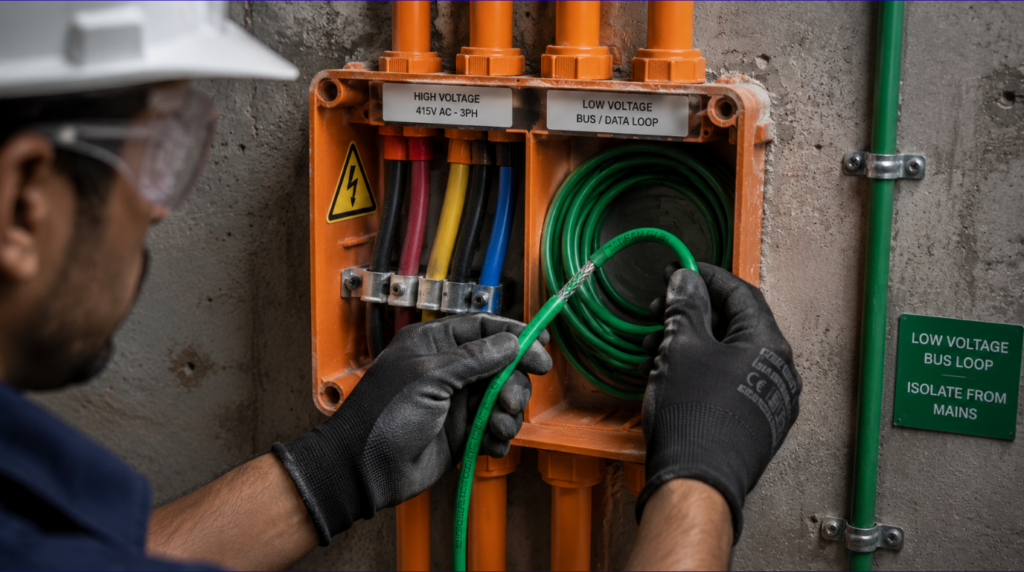
The raw civil wiring and cable pulling stage in the smart home installation timeline typically takes 6 to 8 weeks (Weeks 5 to 12), running completely in parallel with your site’s core electrical piping, structural brick cutting, and false ceiling framing. This is the most critical physical phase of the entire smart home installation timeline, where the permanent low-voltage data highway is embedded into your home’s framework.
[Raw Brick Stage] ──> [Conduit Piping Installed] ──> [Shielded Green Bus Cable Pulled]
Running Separate High and Low Voltage Conduits
To protect your building’s communication network from electromagnetic interference, I enforce strict physical separation between utility lines. Our dedicated low-voltage conduits run parallel to, but completely isolated from, the heavy high-voltage mains cables.
We pull a continuous, shielded green bus cable in a secure star-loop topology directly to every single switch box, climate interface point, and automated window pocket across the estate.
Preparing Custom Structural Framing and Enclosures
While the conduits are being locked into the masonry, we supervise the structural site preparations for your heavy mechanical assets. This includes checking that your interior team frames deep, recessed motorized curtain pockets (minimum 150mm depth and width) with localized mains power connections.
Simultaneously, we mount the heavy-duty sheet-metal enclosures for our centralized distribution boards into the walls, preparing them for final panel termination.
What is Involved in The Centralized Panel Engineering and Hardware Mounting Phase?
Centralized panel engineering and hardware mounting occur during Weeks 13 to 18 of the smart home installation timeline, focusing on assembling, testing, and terminating all industrial-grade DIN-rail actuators inside your main distribution boards once the dirty civil dust-work settles. This phase of the smart home installation timeline moves the switching and dimming intelligence out of your living rooms and groups it into a single, easily serviceable service area.
Terminating Core Electrical Loads
Once your walls are plastered and dry, our engineering team steps onto the site to wire the incoming electrical circuits directly into our panel modules. Every lighting circuit, motorized shade line, and climate relay is neatly organized, labeled, and landed onto heavy-duty DIN-rail switching and dimming actuators. This centralized arrangement eliminates traditional messy wiring behind your wall switches, leaving only a clean, safe low-voltage connection at the room keypads.
Integrating Centralized Protection Logic
During panel assembly, we build high-performance grid surge protection and power recovery networks directly into the distribution boards. Rather than exposing your imported appliances or luxury LED drivers to the volatile voltage spikes common when municipal power returns after a blackout, our panel logic is engineered to safely stagger and sequence high-load circuits back online over several seconds, protecting your expensive infrastructure from terminal damage.
How are The Final Programming and System Commissioning Phases of The Smart Home Installation Timeline Executed?
The final programming and system commissioning phases of the smart home installation timeline are executed over the last 4 to 6 weeks (Weeks 19 to 24) of the timeline, transforming the physical wiring infrastructure into a live, self-optimizing residential ecosystem as your interiors near completion. This final smart home installation timeline stage involves flashing local software configurations onto each device microprocessor and conducting extensive real-world performance tests.
Flashing Local Offline Software Parameters
Unlike consumer wireless gadgets that rely on internet connections and unstable external cloud servers, we configure your entire home network to run completely offline. We use professional engineering software to flash custom logic profiles directly onto the flash memory of each wall keypad, presence sensor, and panel actuator over the green bus wire. Your system operates entirely on its own local microprocessors, executing automation commands with sub-10 millisecond response speeds even if your fiber-optic internet connection drops completely.
Calibrating Closed-Loop Efficiency Routines
The final week of commissioning is dedicated to real-world calibration. We tune your ceiling-mounted lux sensors to track changing natural light angles, ensuring your daylight harvesting loops dim your architectural lights perfectly to save up to 60% on lighting costs.
We test your HVAC window contacts, calibrate your roof-mounted weather station for automated sun-tracing blinds, and walk through every customized “Master Scene” with you to guarantee that your home operates with absolute fluid efficiency from the very first day you move in.
The Master Smart Home Installation Timeline Roadmap
| Smart Home Installation Timeline Phase | Civil Site Condition | Primary Automation Action | Core Infrastructure Benefit |
| Phase 1: Planning (Weeks 1–4) | Blueprint & MEP Drafting | Map all electrical, climate, and shade loads onto schematics. | Eliminates trade conflicts and accidental civil change-order costs. |
| Phase 2: First-Fix (Weeks 5–12) | Raw Brick & Exposed Frame | Install dedicated low-voltage conduits and pull green bus cable. | Establishes a rock-solid, interference-free physical data highway. |
| Phase 3: Second-Fix (Weeks 13–18) | Plastering & False Ceilings | Mount centralized panels and terminate all electrical lines. | Moves intelligence to a safe area, avoiding messy in-wall clutter. |
| Phase 4: Commissioning (Weeks 19–24+) | Final Painting & Handover | Flash offline device software and calibrate daylight lux loops. | Delivers a fully tailored, zero-latency, energy-efficient property asset. |
Securing Your Property Legacy with Precise Engineering Milestones
Building or thoroughly renovating a premium estate is a major life milestone intended to create a peaceful, lifelong sanctuary for your family. If your smart home installation timeline is uncoordinated, it quickly devolves into an ongoing nightmare of broken walls, mismatched third-party systems, and constant technical troubleshooting that dampens the joy of your new home.
At Techtastic, we do not view home automation as a collection of superficial retail additions or tech toys. We treat it through an uncompromising engineering lens, using the unshakeable, hardwired international KNX standard to turn your building infrastructure into an invisible, self-optimizing asset. We manage the detailed low-voltage pathways, physical panel dynamics, and rigorous testing phases from day one of the smart home installation timeline, so you can stop wrestling with technology and finally start experiencing true environmental comfort.
🤝 The Partnership Corner
- For Luxury Estate Owners: We step directly into your raw design phase to engineer a rock-solid, offline-first automation timeline, saving you from long-term battery hassles, system lag, and expensive civil reworks down the line.
- For High-End Architects & MEP Consultants: We coordinate seamlessly with your project managers during the gray-structure phase, providing complete electrical wiring schematics, precise panel dimensions, and conduit blueprints to keep your interior aesthetics absolutely immaculate.
Let’s build a digital foundation engineered to endure for generations.
📞 Call/WhatsApp: 9769145145
📍 Engineering Unshakeable Reliability Across: Navi Mumbai | Nashik | Lonavla | Sangli
Technical FAQs on Smart Home Installation Timeline
Q: Why does a professional smart home installation timeline require 12 to 24 weeks to complete?
A: A professional smart home installation operates on a centralized, hardwired framework rather than using cheap wireless plugs. Every individual lighting circuit, climate zone, and motorized drapery track must route directly back to your central panels through dedicated conduits installed during the raw civil shell phase, requiring the project to run in lockstep with your home’s natural building timeline.
Q: Can I integrate a hardwired KNX automation system after my home’s plastering and painting are finished?
A: No. Attempting to install a centralized hardwired architecture after finishing civil works forces you to break through your completed plaster, walls, and false ceilings to run the necessary low-voltage green bus data cables. To protect your interiors, hardwired automation conduits must be laid out during the raw first-fix brickwork phase.
Q: What happens to the automation schedule if my civil construction or interior works get delayed?
A: Because our infrastructure timeline is built to be modular, our milestones easily adapt to site delays. Once the first-fix green bus cables are pulled and safely tucked into their boxes, the wiring can sit safely for months while your civil teams finish their work. We only return to mount the sensitive panel hardware and final keypads once the dusty interior works are finished, ensuring your equipment stays pristine.