
Summary
Smart home automation provides more than just convenience; it effectively boosts sustainability and lowers costs. In a climate where cooling costs dominate monthly expenses, a “passive-first” automation strategy is essential.
This guide shows how smart home energy efficiency can lower your utility bills. Automate your home’s energy use by combining motorized shades, occupancy-based cooling, and smart dimmers. By letting your home react intelligently to its environment, you can cut energy usage by 30% while staying comfortable.
Lowering Your Bills: How to Make a Home Smart for Maximum Energy Efficiency?
When I discuss bungalow projects with new clients, we usually start with “cool” features like voice-controlled lights, hidden cinema screens, or remote control gates. But recently, a new priority has taken center stage: the electricity bill.
As energy costs rise and summers become harsher in places like Navi Mumbai and Delhi, our homes work harder than ever to stay cool. I’ve realized that smart technology is more than a luxury; it is an investment for long-term savings.
A truly smart home isn’t just one that listens to you; it looks out for your wallet. Here is how we design homes for smart home energy efficiency without sacrificing an ounce of comfort.
1. The “Passive First” Rule of Smart Home Energy Efficiency: Automating the Sun
The biggest enemy of your electricity bill is “Solar Heat Gain.” Large, beautiful windows are a hallmark of modern architecture, but they act like giant radiators. If your AC is fighting the afternoon sun, you are literally throwing money out the window.
The cleverest way to save energy is to automate your motorized curtains and blinds. Instead of waiting until the room feels like an oven to close the drapes, we install Sun Intensity Sensors. These sensors monitor the outdoor light levels.
When the sun hits a certain threshold on the southern or western facade, the house automatically lowers the shades. By blocking the heat before it enters the room, you reduce the “thermal load.” This means your AC doesn’t have to work at 100% capacity just to maintain a baseline temperature.
2. Occupancy-Based Climate Control
In a large home or bungalow, we often waste a staggering amount of energy cooling empty rooms. We’ve all been guilty of leaving the air conditioners (AC) on in the study or the guest room “just in case.”
A smart home eliminates this waste through Occupancy Sensing. By placing small, discreet motion and PIR sensors in every zone, your home tracks exactly where people are.
We program the system with “Drift Logic.” If a room remains empty for 20 minutes, the system allows the temperature to “drift” up by 2 or 3 degrees. This avoids turning the AC off completely, which prevents the unit from overworking to cool the room later.
This small adjustment is invisible to the user but results in massive savings over a month. When you walk back into the room, the sensor detects you and immediately returns the AC to your preferred setting.
3. The Magic of Smart Dimming for Smart Home Energy Efficiency
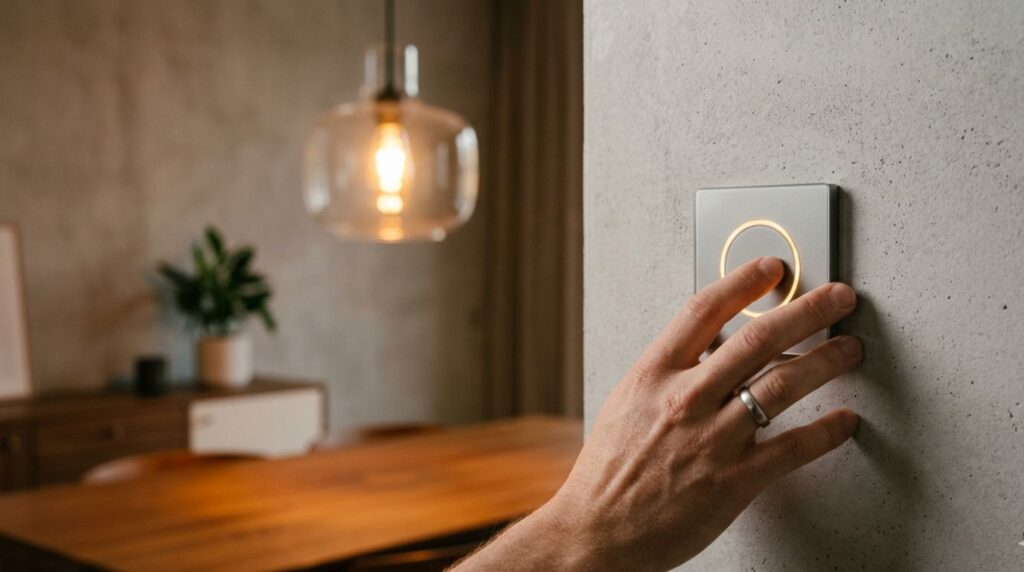
We often think of lights as either “on” or “off.” However, most of the time, we don’t actually need 100% brightness.
By using Smart Dimmers instead of standard switches, you can set “Default Levels.” For example, you can set your hallway lights to 70% brightness during the day and 20% at night. This setup creates a sophisticated ambiance and directly reduces power consumption.
We also use Daylight Harvesting, where sensors measure natural light to adjust your indoor lighting. If sunlight fills your living room, the system dims artificial lights to the bare minimum. This ensures perfect illumination while removing wasted energy.
4. “Phantom Load” and Smart Plugs
We have a hidden culprit in your home known as “Phantom Load” or “Vampire Power.” Devices like TVs, coffee machines, and chargers consume this energy when you plug them in, but do not use them. Even in “Standby Mode,” these devices are slowly sipping electricity.
In a smart home, we use Smart Power Strips and Relays. We can program your home to cut power to non-essential outlets when you activate the “Away” or “Goodnight” scenes. While these small power draws seem minor, managing them is a key pillar of smart home energy efficiency as they can account for 5–10% of a large household’s total annual energy consumption.
5. Real-Time Energy Monitoring for Smart Home Energy Efficiency
You cannot manage what you cannot measure. One of the most humanizing aspects of smart home devices is the Energy Dashboard. Instead of waiting for a bill at the end of the month, you can see a real-time graph of your home’s “heartbeat.” You can see exactly how much power the kitchen appliances are pulling versus the home theater.
When homeowners see the data, their behavior changes. You might notice an old refrigerator using triple the expected power, or a pool pump running two hours longer than needed. This data helps you make better decisions about home upgrades and maintenance.
Final Thoughts: Smart Home Energy Efficiency is the New Luxury
For a long time, “going green” felt like a sacrifice—smaller windows, less AC, dimmer rooms. But with modern automation, efficiency is synonymous with luxury.
A home that automatically manages its curtains, lights, and maintenance offers the ultimate living experience. Whether you are building a new bungalow or upgrading an apartment, remember that the goal of smart home energy efficiency is to create a space that eventually pays for itself.
Collaboration Opportunities for Builders and Architects
I work with developers, architects, and interior designers to enhance residential projects by integrating smart home energy efficiency technology during the planning and design stages. My team ensures that automation aligns seamlessly with your design layouts, electrical infrastructure, and interior concepts.
I invite you to partner with Techtastic Technologies to implement high-quality smart home energy efficiency for your upcoming projects in Nashik, Navi Mumbai, Sangli, and Lonavla.
Contact Techtastic today at 9769145145 for a professional consultation to see how expert smart home energy efficiency automation can elevate your design vision.
Technical FAQs: Smart Home Energy Efficiency
Q: Does the energy used by smart devices (sensors, hubs) cancel out the savings?
A: Not even close. Modern smart sensors and hubs operate on extremely low-power protocols like Zigbee or Bluetooth LE. A typical sensor might run on a single coin battery for two years. The smart home energy efficiency observed by optimizing your AC and lighting is hundreds of times greater than the energy these systems consume.
Q: Can I automate my old “non-smart” AC units?
A: Yes! We use Smart IR Blasters. These small devices mimic the signal of your AC remote. They connect to your Wi‑Fi or Zigbee network, and sensors, timers, and smartphone apps control your old AC just like the newest models.
Q: Is it better to turn the AC off completely or let the smart system “drift” the temperature?
A: In most cases, “drifting” is better. Cooling a room from 32°C to 24°C requires significantly more energy and strains the compressor more than maintaining it at 27°C and dropping it to 24°C when you enter.
Q: How do “Sun Sensors” know the difference between a cloudy day and a sunny one?
A: These sensors measure “Lux” (light intensity). On a cloudy day, the Lux level remains below a certain threshold, so the curtains stay open to let in natural light. Only when the intensity reaches a “harsh” level does the automation trigger the closing of the drapes.
Q: Do smart dimmers work with all LED bulbs?
A: Ensure your LED bulbs carry the “Dimmable” label. Not all LEDs are designed to handle voltage changes. Using a smart dimmer with a non-dimmable LED can cause flickering or shorten the lifespan of the bulb.
Q: What is the single biggest factor in smart home energy efficiency?
A: Without a doubt, it is the integration of motorized shades with the HVAC system. Controlling the heat gain through your windows is the most effective way to reduce the overall energy demand of your home.