
Summary
Most people think of home security as just a few cameras and a doorbell that alerts their phone. However, in 2026, most of these are just “notifying” systems, not truly “automated” ones. A real automated home security system does more than just send alerts—it acts on its own without you having to do a thing.
By using sensors and professional wiring like KNX, your home can protect itself. It can automatically close shutters during a break-in or turn lights on and off to make it look like you are home.
This guide explores the world of smart home security systems.
Is There Any Real Automated Home Security System?
We have all been there: you’re at a dinner or on vacation, and your phone buzzes with a motion alert. You open the app, wait for the cloud to load the footage, only to realize it was just a stray cat or a tree branch swaying in the wind.
This is the state of most “smart” security today. It relies on you being awake, having a stable internet connection, and being ready to call for help.
But the question remains: Is there a real automated home security system that actually secures your home? The answer is yes, but it looks drastically different from the DIY camera kits you find online. A real automated home security system doesn’t just watch; it anticipates and reacts.
1. Reactive vs. Proactive: The Great Security Divide
Most off-the-shelf security products are “notifiers.” They are digital witnesses. If someone breaks a window, they tell you about it.
A real automated home security system is proactive. It uses a “Sense-Think-Act” loop to prevent the incident from escalating.
- The Reactive Way: A camera detects a person, records them, and sends a notification. You see the video ten minutes later.
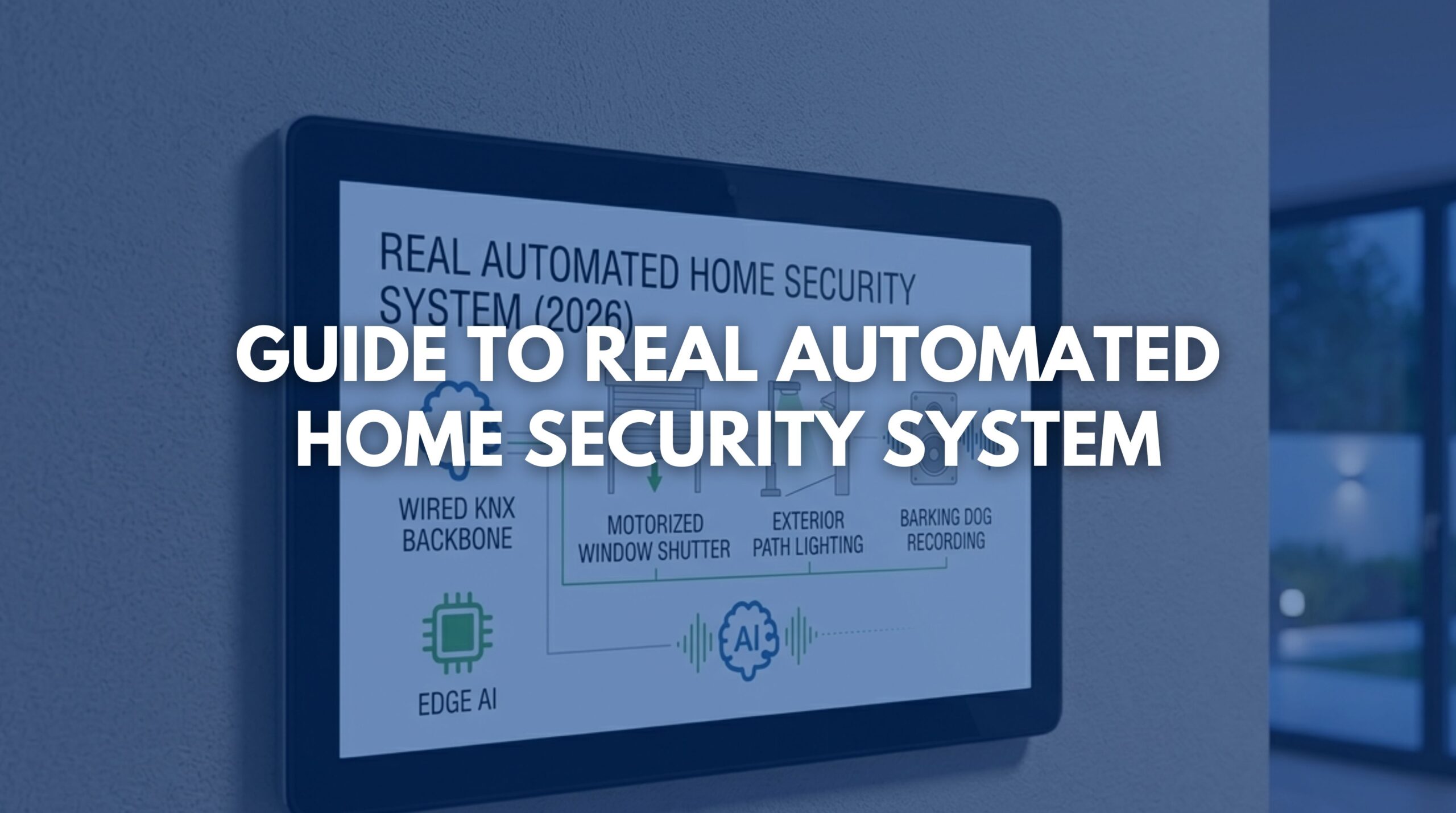
- The Automated Way: A perimeter sensor detects a vibration on the boundary wall at 2 AM. The automated home security system instantly turns on garden lights, lowers ground-floor shutters, and plays a barking dog sound. These actions happen before an intruder even reaches the windows.
2. The “Nervous System” of Real Security
To achieve true automation, your security cannot rely on the “Cloud.” If a burglar cuts your internet line, a cloud-based camera becomes a paperweight.
A professional-grade system uses Local Control. The “brain” of the security logic lives inside your walls—usually on a wired KNX or similar bus system. This ensures that even if the world’s internet goes dark, your sensors can still talk to your sirens and lights. This local “nervous system” allows for split-second decisions that don’t depend on a server in another country.
3. Presence Simulation: The Best Defense is a “Busy” House
The most effective way to secure a home is to make it look like you never left. Traditional timers turn a light on at 7 PM and off at 10 PM—a pattern any seasoned thief can spot.
A real automated home security system uses Presence Simulation. The system records your daily habits, such as when you dim the lights, open the blinds, or turn on the TV. When you are away, it plays back these exact patterns to make your home look occupied.
When you toggle “Away Mode,” the house plays back these exact patterns. To an observer on the street, the house looks perfectly lived-in, making it a much less attractive target.
4. Beyond Cameras: The Power of Integrated Sensors
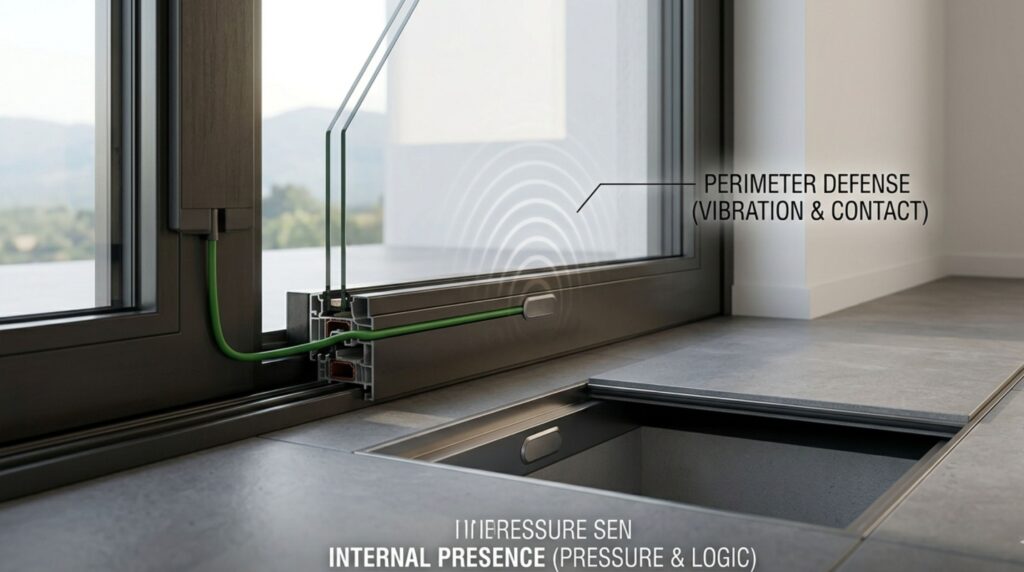
Cameras are great for evidence, but sensors are the workhorses of automation. In a truly intelligent home, security is woven into the everyday infrastructure:
- Pressure Sensors: Under a rug or a specific floor tile to detect footsteps in a hallway.
- Vibration sensors on your window frames can set off the alarm systems before the glass even breaks.
- Logic-Based Presence: If the “Goodnight” scene runs and the bathroom motion sensor triggers, the system knows it’s just you. But if a window “contact sensor” opens while that scene is active, it knows it’s a breach.
5. What Happens During an Emergency?
In a real automated home security system, an “Alarm State” isn’t just a loud noise. The whole house works together to keep everyone inside safe.
- Visual Deterrence: Indoor lights flash to confuse intruders, while outdoor lights stay on so neighbors and police can see the house.
- Pathway Safety: If a smoke sensor triggers, the system automatically opens all motorized curtains for a clear exit. It also lights a dim path to the front door, helping you see in a smoky room without glare blinding you.
- Internal Lockdowns: You can smart lock specific rooms to create a “safe room” for your family while the alarm stays active in the rest of the house.
6. The 2026 Standard: Privacy and Reliability
In 2026, luxury is defined by privacy. A real automated system doesn’t upload your private living room moments to a third-party server for “AI analyzing.” Instead, the system uses Edge AI. The processing happens locally on your hardware.
This means your security data never leaves your house, protecting you from both physical intruders and digital hackers.
Conclusion: Moving Toward a Thinking Home
So, is there a real automated home security system? While this is true, the system is more than just a single gadget. You can achieve this result by choosing the right infrastructure, such as a wired KNX backbone. This allows you to integrate your lights, motors, and sensors into a single, central “brain.”
True security is the “magic” of a house that takes care of itself. The peace of mind comes from knowing your home won’t just tell you there’s a problem—it will actively work to solve it.
The Techtastic Perspective
At Techtastic Technologies, we believe security shouldn’t be a source of anxiety. You shouldn’t have to check your phone every time a leaf blows past your door. We specialize in building “invisible” security layers into homes across Navi Mumbai, Nashik, Sangli, and Lonavla.
We focus on local, wired setups to protect your home with a system that’s just as reliable as the walls themselves. Real security isn’t about the loudest siren; it’s about the smartest house.
Collaboration Opportunities for Builders and Architects
Developers, architects, and interior designers can enhance residential projects with an automated home security system during the planning and design stages.
Techtastic collaborates with industry professionals to ensure automation technology integrates seamlessly with design layouts, electrical infrastructure, and interior design concepts.
Partner with Techtastic to implement an automated home security system for your upcoming residential projects in Nashik, Navi Mumbai, Sangli, and Lonavla.
Contact Techtastic today at 9769145145 for a professional consultation and see how the best automated home security system can elevate your design vision.
Technical FAQs
Q: Can I turn my existing DIY cameras into a real automated home security system?
To an extent, yes, by using a local hub that supports “Logic Rules.” For 100% reliability, professional systems use wired sensors. This is because smart intruders can sometimes “jam” wireless signals, but they can’t mess with a physical wire.
Q: Does an automated home security system work during a power cut?
Yes, provided you have a Battery Backup (UPS) for the central controller and sensors. Professional wired systems like KNX use low voltage. They can run for hours on a small backup battery, which keeps the sensors and the central “brain” working during a power cut.
Q: Won’t I get a lot of false alarms with “automated” reactions?
This is not an issue if you use “Double Knock” logic. The alarm only goes off if two different sensors detect activity at the same time. This prevents false alarms.
Q: Is local control harder to use than a mobile app?
In fact, the process is quite simple. While you still have an app for remote checks, the system’s “intelligence” means you don’t have to constantly manage it. It learns your daily routines and knows when you are home and when you aren’t.