
Summary
By 2026, smart home automation will have moved beyond just buying gadgets. Modern home automation gadgets create a home that takes care of you. It lowers your electricity bills while making your daily routine more comfortable and relaxed.
Instead of messy, complicated setups, you can now upgrade one room at a time. This “modular” approach means you can make your home smarter without breaking a single brick or dealing with construction dust.
A modern smart home automation system acts like a silent assistant. It adjusts air conditioners to your sleep patterns and controls lighting to help you rest better.
Smart Gadgets: The New Rules of Smart Home Automation in 2026
For years, many people viewed smart homes as simple party tricks, such as changing light colors or asking voice assistants to tell jokes. But as we move through 2026, the novelty has worn off, and utility has taken over.
The modern smart home hub isn’t a collection of expensive toys; it is a functional ecosystem. If you’ve felt overwhelmed by the options before, it’s likely because the focus was on the gadgets rather than the results. Here is how to approach smart automation today with a focus on efficiency, privacy, and simplicity.
The “Invisible” Upgrade: Why Retrofitting is Winning
The biggest change in 2026 is the death of the “total renovation.” Most homeowners in cities like Mumbai or Delhi don’t want to deal with the dust and cost of rewiring their entire flat.
This is where Retrofit Modules have changed the game. These tiny, intelligent chips slide behind your existing designer switchboards.
- The Result: Your home looks the same. Your expensive brass or matte-finish switches still work. But now, your phone and sensors connect to those same switches.
- The Strategy: You can start with just the living room. Once you see the utility, you can add the master bedroom six months later.
Circadian Wellness: More Than Just “Smart Bulbs”
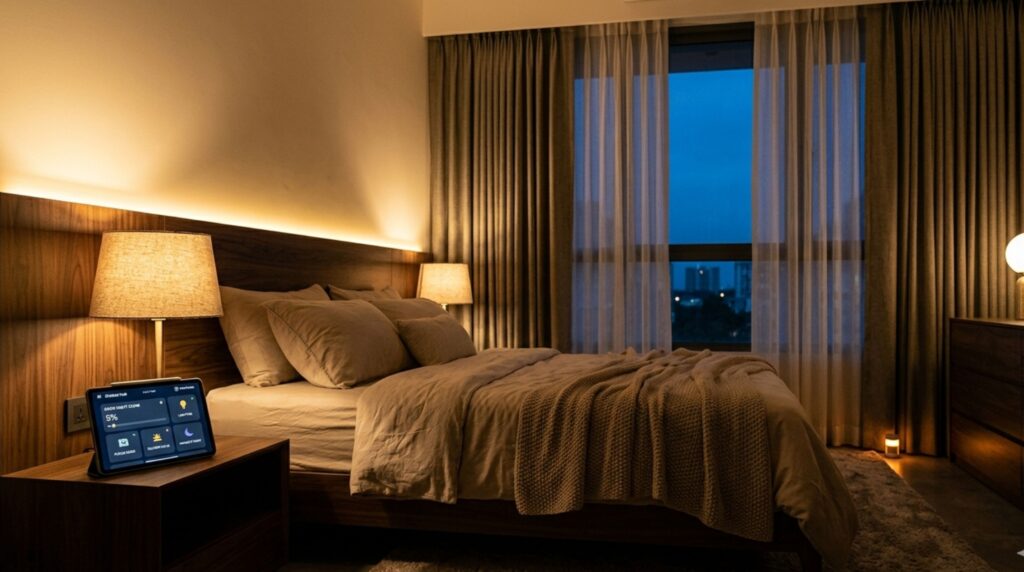
The sun tunes our bodies, but our indoor lives often disrupt that rhythm.
In a 2026 smart home, your lighting is a health tool:
- Focus Mode: At 10:00 AM, the lights shift to a crisp, bright white that mimics daylight. This helps you stay alert while working from home.
- The Golden Hour: As evening approaches, the system automatically strips away blue light, shifting to warm, low-intensity tones. This tells your brain it’s time to produce melatonin.
- The Midnight Guide: Motion sensors now trigger “Path Lighting.” If you get up at night, the floor-level lights glow at just 5% brightness—enough to see your way, but low enough to keep your brain in a “sleep state.”
Intelligent Climate: The End of the “Freezing Morning”
Many people set the AC to 22°C in a hot room, only to wake up cold at 4:00 AM searching for the remote.
Today’s Smart Climate Managers act as a middleman between you and the machine.
By 2026, these smart home systems will use “Thermal Comfort Logic.” They don’t just stay at one temperature; they follow a curve. They might start cool to help you fall asleep, then slowly raise the temperature by 1 or 2 degrees during your deepest sleep cycle. This doesn’t just feel better—it can slash your monthly cooling costs by up to 25%.
The Privacy Revolution: Local vs. Cloud
In the early days, every light switch command traveled to a distant server and back just to turn on a bulb.
The “Gold Standard” in 2026 is Local Control. Using the Matter protocol, your devices talk to a local “hub” inside your house.
- Speed: Responses are near-instant because the signal never leaves your walls.
- Security: We don’t store your daily routines, camera feeds, and habits on a public cloud. If your internet goes down, your home stays just as smart.
Scalable Security: The Proactive Porch
Security has moved from recording a crime to preventing it. Smart home devices, like a smart video doorbell in 2026, are your digital gatekeeper. Smart home technology distinguishes between a regular delivery person and a stranger lingering at the door late at night.
With Active Deterrence, the system doesn’t wait for you to check your phone. It can play a pre-recorded message or pulse the porch lights to let the “visitor” know someone spotted them. For families or those living alone in high-rise apartments, this peace of mind is the most valuable part of the smart home system.
The Cost of Entry: A Phased Approach
Smart home automation is no longer a “luxury-only” service. In 2026, it fits into three clear tiers:
- The Starter Kit (₹12,000 – ₹18,000): Perfect for a rental or a single room. Includes a smart hub, a few retrofit switches, and an AC controller.
- The Comfort Tier (₹60,000 – ₹90,000): Full automation for a 2BHK. This covers all lighting, heavy appliances (geysers/ACs), and a smart doorbell.
- The Full Ecosystem (₹2 Lakhs+): This professional setup includes motorized curtains, multi-zone security, and integrated home theater controls.
Conclusion: The Shift from High-Tech to Human-Centric
As we look toward the end of 2026, the definition of a “smart home” has fundamentally changed. It is no longer about how many gadgets you can pack into a room; it is about invisible technology that works quietly in the background.
The most successful setups today prioritize results over novelty. Whether it’s saving on electricity or ensuring your home is at the perfect temperature, the focus has shifted from “high-tech” to “human-centric.”
Collaboration Opportunities for Builders and Architects
Developers, architects, and interior designers can enhance residential projects by using smart home products during the planning and design stages.
Techtastic collaborates with industry professionals to ensure automation technology integrates seamlessly with architectural layouts, electrical infrastructure, and interior design concepts.
Partner with Techtastic to implement the best home automation ideas for your upcoming residential projects in Nashik, Navi Mumbai, Sangli, and Lonavla.
Contact Techtastic today at 9769145145 for a professional consultation and see how the best home automation ideas can elevate your architectural vision.
Technical FAQs
Q: Can I still use my physical switches?
Absolutely. Retrofit modules allow physical switches to maintain their original functionality. The “smart” features are an addition, not a replacement. This feature accommodates guests or elderly family members who prefer using traditional buttons.
Q: How can a “Mesh” network help?
Older smart devices used Wi-Fi, which would get crowded and slow down. The thread creates a “team” network. Each device (like a smart plug) acts as a signal booster for the next one. This makes the connection rock-solid and keeps your main Wi-Fi fast for your phones and laptops.
Q: What about my data privacy with AI cameras?
The best systems today use Edge AI. This means the “thinking” happens inside the camera or your home hub, not on a corporate server. Your face-recognition data and video logs stay on your local storage (SD card or local drive).
Q: How long does installation take?
A professional team typically completes the installation of retrofit modules in a standard 3BHK within one day. Since you don’t need to break walls or paint, the work doesn’t disrupt your life.