
Summary
When choosing between KNX vs WiFi for a smart home, KNX is the best choice for permanent, luxury estates that require 100% reliability, while Wi-Fi is suitable for minor retrofits and rental apartments. KNX uses a hardwired, decentralized bus system that operates entirely without internet dependency, preventing signal drops caused by thick concrete walls. Wi-Fi systems are highly vulnerable to network congestion, interference, and routine device dropouts.
For large architectural properties, a wired KNX infrastructure is the only industry-standard solution that guarantees a future-proof investment for decades.
The Sunset Blackout: Why Your Wireless Luxury Home is a Ticking Time Bomb
I recently sat down for tea at a gorgeous penthouse in Navi Mumbai. The homeowner proudly showed me his wireless smart setup, controlled entirely through an app. But just as the sun began to set, a simple local router reboot threw the entire house into chaos. The master bedroom lights refused to respond, the motorized shades froze halfway down, and his smartphone screen flashed an exhausting, endless loop of “Device Offline” errors.
This is what I call the “Wireless Exile.” You have spent an immense amount of money to build a world-class residence, yet you are completely at the mercy of a consumer-grade internet router.
The “Industry Wound”—the mass-market lie pushed by big tech brands—is that professional-grade automation can be built reliably on a wireless network. They tell you that Wi-Fi is “plug-and-play,” but they hide the ugly truth about signal dead zones, constant battery replacements, and the inevitable lag that occurs when fifty wireless gadgets fight for bandwidth on the same network.
The truth is simple: a permanent physical structure requires a permanent physical infrastructure. Relying on Wi-Fi for a luxury estate is like building a skyscraper on a foundation of sand. The definitive solution for absolute stability is a hardwired KNX system. Let’s see the reasons for the choice of KNX vs WiFi below.
What is The Main Difference Between KNX vs WiFi Smart Home Systems?
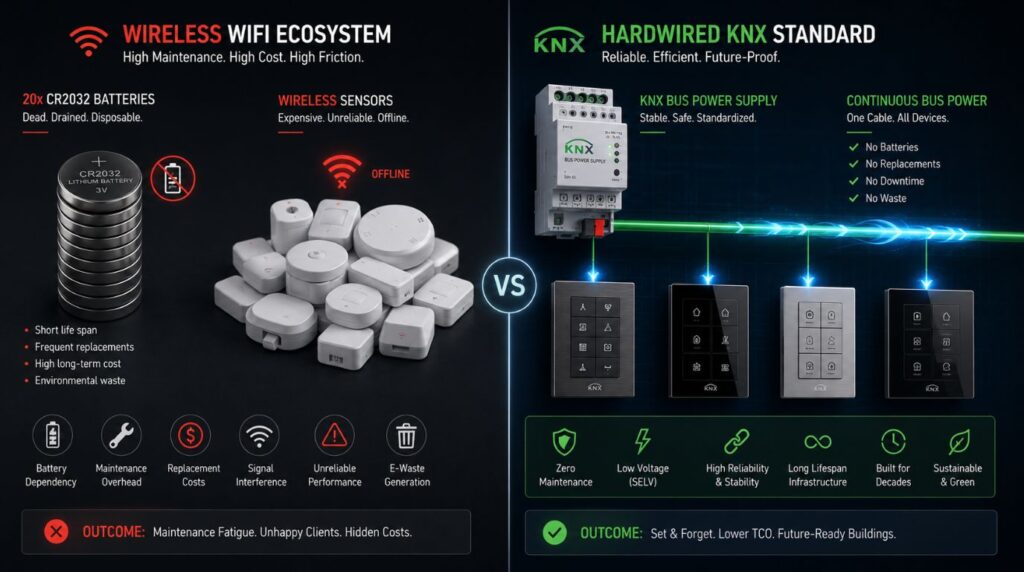
The main difference between KNX vs Wi-Fi smart home systems is that KNX is a hardwired, decentralized industrial standard that relies on a physical bus cable, whereas Wi-Fi is a wireless consumer standard that relies on a central router to transmit data packets over radio frequencies. This fundamental KNX vs WiFi contrast means KNX functions perfectly even if the internet fails, while Wi-Fi systems suffer from signal blockages and router congestion.
Decentralized Intelligence vs. Central Hub Failure
In a standard Wi-Fi ecosystem, if your central router or cloud server crashes, your smart home ceases to exist. KNX operates on decentralized logic. Every keypad, sensor, and actuator contains its own tiny micro-brain; they communicate directly across the physical green cable, ensuring that if one device ever breaks down, the rest of the home continues to function normally.
The Concrete Wall Interference Factor
Modern Indian homes are built like fortresses, using thick reinforced concrete and dense brickwork. Wi-Fi signals degrade heavily when passing through these dense materials, leading to “smart home lag” where a light takes several seconds to turn on. A KNX cable system runs through your physical walls inside conduits, delivering instant, millisecond response times regardless of your home’s layout.
Why is a Hardwired KNX System More Reliable Than Wireless Automation?
In KNX vs WiFi, a hardwired KNX system is more reliable than wireless automation because it utilizes a shielded, low-voltage physical cable that is completely immune to electromagnetic interference, signal dropouts, and network hacking. Wireless networks suffer heavily from radio frequency congestion caused by neighboring routers, smart TVs, microwaves, and changing atmospheric conditions during the monsoon season.
Eliminating the “Battery Maintenance Nightmare”
Wireless smart home sensors and wall switches are essentially “maintenance vampires.” They require frequent lithium battery changes every 6 to 12 months. In a large 8,000-square-foot villa in Lonavla or Nashik, you could easily have over a hundred wireless nodes, leaving your domestic staff trapped in a never-ending cycle of battery troubleshooting. KNX sensors draw their low-voltage power directly from the green bus wire, requiring zero battery upkeep.
True Data Security and Privacy
Every wireless device connected to your Wi-Fi router represents a potential entry point for digital hackers. Because a KNX system transmits its data locally through physical wires inside your walls, it creates an air-gapped network. It cannot be intercepted from outside your property line, providing top-tier data security for high-profile estates.
Is a KNX Automation System Worth the Higher Upfront Cost Compared to WiFi?
Yes, in KNX vs WiFi, a KNX automation system is highly worth the initial investment because it is an open, global interoperable standard backed by over 500 manufacturers, which adds long-term capital value to your property and lasts for more than 30 years without becoming obsolete. Wi-Fi smart gadgets operate on closed, proprietary software ecosystems that are frequently discontinued, requiring you to rip out and replace your entire system every few years.
The “Interoperability” Insurance Policy
When you buy into a specific wireless smart home brand, you are locked into its walled garden. If that company changes its app software, charges a subscription fee, or goes bankrupt, your smart switches become useless electronic waste. KNX is a globally governed standard. A KNX keypad made by a luxury brand in Belgium works seamlessly on the exact same wire as a KNX controller made by an engineering firm in Germany.
KNX vs WiFi Comparison Table:
| Feature Comparison | Hardwired KNX Standard | Consumer Wireless Wi-Fi |
| Expected Lifespan | 30+ Years (Industrial Grade) | 3–5 Years (Consumer Grade) |
| Internet Dependency | Zero (Works 100% Offline) | High (Requires Cloud/Router) |
| Wall Penetration | Flawless (Physical Cables) | Poor (Blocked by Concrete) |
| Property Value | Permanent Architectural Utility | Temporary Gadget Add-on |
KNX vs WiFi: How Do I Choose Between KNX vs WiFi for My Specific Property?
You should choose a KNX system if you are currently building or renovating a large, permanent premium bungalow or commercial property where long-term value, architectural integration, and absolute reliability are non-negotiable. You should only choose a Wi-Fi system if you live in a rented apartment, are working with a strict minor retrofit budget, or cannot open up your walls to lay physical conduits.
The “Gray Structure” Window of Opportunity
If your property is currently in the brickwork or raw concrete stage of construction in regions like Navi Mumbai, Nashik, or Sangli, you are in the perfect position to lay a KNX cable system. This is the moment to invest in your building’s core infrastructure, ensuring that your automated lighting, climate control, and motorized drapes are deeply integrated into the home’s architecture.
The Hybrid Reality
Choosing KNX in KNX vs WiFi as your core backbone does not mean you lose the convenience of wireless interfaces. At Techtastic, we utilize the ultra-stable KNX system to manage all your critical infrastructure—your lights, HVAC, security, and shading—while layering on a clean, integrated Wi-Fi interface so you can still use voice commands or your smartphone when you are relaxing on the couch.
From a Fragile Tech House to an Unshakeable Legacy Estate
True luxury is defined by things that work perfectly without demanding your attention. In KNX vs WiFi, when you choose a wired KNX cable infrastructure, you step away from the role of an exhausted “Estate Manager” constantly resetting routers, and you step into the role of an “Estate Guest” enjoying an environment that adapts to your life.
At Techtastic, we don’t just sell components; we engineer the unshakeable digital backbones that turn homes into legacies. We choose KNX in the KNX vs WiFi contrast!
🤝 The Partnership Corner
- For Architects: We provide precise cable topology maps to ensure your structural spaces are perfectly planned before the electrical team begins.
- For Interior Designers: We ensure all technical keypads blend elegantly into your custom walls, eliminating clutter and “switchboard bloat.”
Let’s design a system that endures.
📞 Call/WhatsApp: 9769145145
📍 Our Specialized Service Areas: Navi Mumbai | Nashik | Lonavla | Sangli
Technical FAQs on KNX vs WiFi
Q: What is the main difference between KNX vs WiFi smart home systems?
A: KNX is a hardwired, decentralized global standard that uses a dedicated physical bus cable to connect devices directly, whereas Wi-Fi relies on wireless radio frequencies sent through a central internet router, making it prone to lag, signal blockages, and frequent dropouts.
Q: Why is a hardwired KNX system more reliable than wireless automation in KNX vs WiFi contrast?
A: KNX is completely immune to wireless network congestion and physical blockages from thick concrete walls. It runs entirely locally and offline without any cloud or internet dependence, and it eliminates the need to replace batteries in hundreds of wireless wall switches and sensors.
Q: Is a KNX automation system worth the higher upfront cost compared to WiFi?
A: Yes, because KNX is a global, open architecture standard supported by over 500 manufacturers, guaranteeing that components installed today will remain future-proof and compatible for over 30 years. Consumer Wi-Fi gadgets are proprietary, have a short 3-to-5-year lifespan, and face rapid software obsolescence.