
Summary
Yes, a hardwired KNX smart home for the elderly provides an ideal, life-saving environment and assisted living needs by automating critical safety, lighting, and environmental systems. Unlike fragile consumer wireless gadgets that drop connections or require constant battery changes, a hardwired KNX infrastructure runs locally and entirely offline. This KNX smart home for the elderly ensures zero-latency autumn path lighting, automatic water shut-off valves, and real-world fallback switches that function with absolute reliability during medical emergencies, power grid drops, or network outages.
The Fragility of Assisted Living: Why Wireless Gadgets Fail the Elderly
When engineering modern living spaces for aging parents or family members with physical limitations, reliability is not a luxury—it is a critical safety parameter. In my field engineering work across luxury residential estates, I frequently witness families attempting to safeguard their elderly relatives using cheap, off-the-shelf wireless smart plugs, plastic panic buttons, or cloud-dependent camera networks.
This creates a dangerous illusion of security. High-density brick walls and reinforced concrete slabs act as structural shields that block airborne radio frequencies, causing smart sensors to drop offline without warning.
Furthermore, expecting an elderly individual or someone with cognitive challenges to navigate a smartphone app, debug a frozen Wi-Fi router, or manage dozens of devices that require frequent battery replacements is unrealistic and stressful. True assisted living technology must be integrated directly into the physical structure of the home. Building a dependable KNX smart home for the elderly means operating natively at the electrical panel level without depending on the internet cloud.
How Does an Offline KNX System Improve Safety for Elderly Family Members?
An offline KNX smart home for the elderly improves safety for them by executing automated emergency routines—such as illumination pathways and water leak cut-offs—instantly through a localized, hardwired green bus cable network. Because the system runs entirely on internal microprocessors rather than an active internet connection, critical life-safety functions execute in under 10 milliseconds even during a total fiber-optic internet outage.
Automated Low-Level Orientation Lighting
Trips and falls during late-night bathroom visits represent a major health hazard for senior citizens. I eliminate this risk by programming low-level orientation paths and building a safe KNX smart home for the elderly.
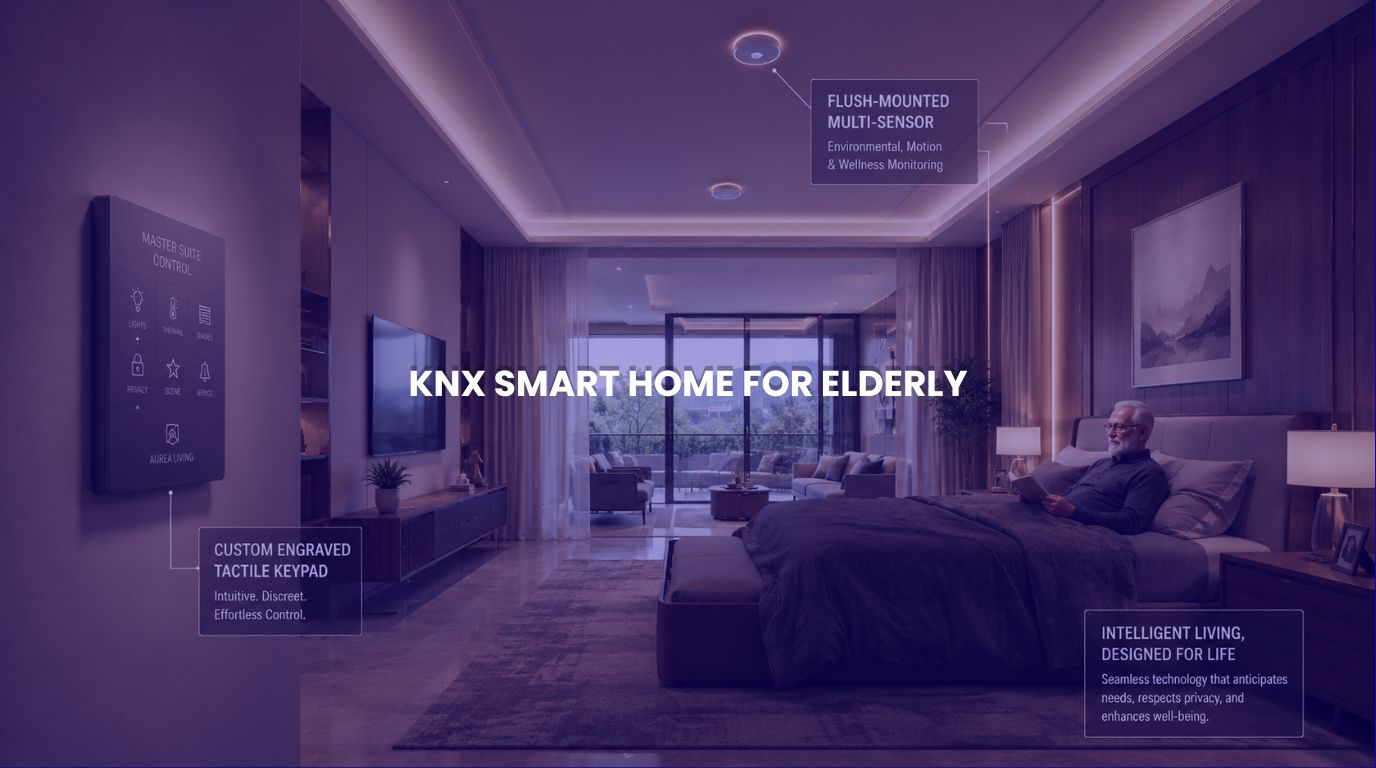
When a flush-mounted ceiling matrix sensor detects movement near a bed between 11:00 PM and 6:00 AM, the hardwired bus line smoothly fades on floor-level LED skirting lights to a soft 15% brightness. This clearly illuminates the path to the bathroom without blinding the resident or requiring them to fumble for a manual wall switch in the dark.
Preventive Leak and Appliance Lockouts
Forgetfulness can lead to serious environmental hazards, such as an open faucet causing a major flood or a kitchen cooktop left running unattended. My infrastructure designs counter this by linking specialized monitoring loops directly to the building’s main valves and circuits.
If a floor sensor detects moisture in the bathroom for more than 60 seconds, the central KNX panel instantly triggers a motorized main valve to shut off the incoming water supply. Simultaneously, if a kitchen zone remains vacant for over 15 minutes while a heavy appliance circuit is drawing power, a panel-level relay safely severs the circuit to eliminate fire risks.
Can Hardwired Automation Help Individuals with Severe Mobility Challenges?
Yes, a hardwired KNX smart home for the elderly with automation helps individuals with severe mobility challenges by consolidating multi-system operations—including climate control, motorized shading, and access gates—into a single physical interface or touchless automation routine. By moving the operational logic out of standalone applications and into an open physical standard, we remove physical friction from daily home management.
[Presence Sensor / Bed Keypad] ──> [Shielded Green Bus Cable] ──> [Central Panel Actuators]
├── Opens Motorized Drapes
├── Sets Ideal VRF Climate
└── Unlocks Entrance Gate
Contactless Environmental Adaptation
For residents with severe arthritis or limited motor control, pressing traditional mechanical toggle switches can be genuinely painful. We resolve this by tailoring a KNX smart home for the elderly with high-precision presence and lux tracking matrices.
As a resident enters a living space, the home automatically adjusts itself: motorized drapes glide open to harvest natural sunlight, architectural lighting matches comfortable ambient levels, and the central VRF climate loops dial into a perfect pre-set temperature, all without the user touching a single device.
Integrated Bedside Panic and Access Routines
During a sudden medical emergency, a resident inside a KNX smart home for the elderly can press a dedicated, clearly labeled “Help” macro button positioned directly next to their bed. This single hardware input immediately unlocks the front entrance electronic deadbolt to allow emergency responders inside, flashes all exterior landscape lights to guide emergency vehicles, and sends encrypted local alerts to family members, ensuring zero time is wasted during critical moments.
Why are Hardwired Networks Superior to Wireless Smart Tech for Accessibility?
Hardwired networks are superior to wireless smart tech for accessibility when designing a KNX smart home for the elderly because they carry an industrial-grade 30+ year operating lifespan and are completely maintenance-free, removing the constant need to track, debug, and replace batteries across hundreds of device nodes. Wireless systems are prone to rapid software obsolescence and frequent signal drops, making them highly unreliable for long-term assisted care environments.
The Eradication of Toxic Battery Dependency
A typical consumer wireless smart home setup can easily require dozens of individual lithium coin batteries to power its scattered motion sensors, panic buttons, and window contacts. Managing an ecosystem like that requires constant vigilance, as a dead battery means a critical safety sensor or panic button stops working entirely.
By pulling a safe, low-voltage shielded green bus cable directly to every device during the raw brickwork phase, a high-performance KNX smart home for the elderly provides continuous local power, creating an absolutely maintenance-free layout.
Eliminating the Threat of App Obsolescence
Mass-market wireless smart gadgets depend entirely on proprietary cloud servers and continuous mobile app updates. If a tech manufacturer changes their business model, updates an app interface, or retires an older hub version, the entire user experience changes, which can be highly disorienting for elderly users.
An international open standard like KNX keeps all logic stored locally on flash memory chips that remain identical for decades, ensuring a button pressed today inside a KNX smart home for the elderly performs the same mechanical action ten or twenty years down the line.
Engineering Matrix: Wireless Gadgets vs. Hardwired Assisted Living Infrastructure

| Assisted Care Technical Metric | Mass-Market Wireless Setup | Hardwired Industrial Plan (KNX) |
| Command Response Latency | Highly variable (Subject to Wi-Fi/Cloud) | Guaranteed sub-10 milliseconds |
| Internet Outage Vulnerability | Total Failure (System goes completely dark) | 100% Functional via Local Offline Chips |
| Device Maintenance Overhead | High (Continuous battery tracking) | Absolute Zero (Continuous bus line power) |
| System Lifecycle Expectancy | 3 to 5 years (Rapid product aging) | 30+ Years (Built to match concrete frame) |
| Water & Fire Risk Mitigation | Basic software app notifications | Panel-Level Physical Circuit Isolation |
| User Interface Consistency | Volatile (Prone to sudden app changes) | Permanent, Physical Tactile Keypads |
Designing an Uncompromising Safe Haven and a Permanent Family Legacy
Providing a safe, dignified environment for elderly parents or family members with specific accessibility needs requires moving far past superficial retail technology or temporary smart trends. When a family member’s safety and well-being are on the line, you cannot afford to depend on a glitchy wireless router or a volatile internet connection. It requires a permanent building framework engineered from the ground up to protect your family automatically.
At Techtastic, we don’t build our reputation on temporary tech toys or fragile cloud-connected boxes. We look at assistive home automation through an uncompromising engineering lens, using hardwired international standards to transform your property into an invisible, self-optimizing ecosystem that actively protects your loved ones and preserves capital for generations.
🤝 The Partnership Corner
- For Discerning Families: We step directly into your raw construction or renovation phase to design an offline-first, highly reliable accessibility blueprint, removing long-term technical friction and battery maintenance entirely.
- For Luxury Architects & Care Consultants: We collaborate directly during your gray-structure design phase, providing complete electrical wiring schematics, panel calculations, and conduit maps to keep your physical layouts immaculate.
Let’s build a safe, digital foundation engineered to endure.
📞 Call/WhatsApp: 9769145145
📍 Engineering Unshakeable Reliability Across: Navi Mumbai | Nashik | Lonavla | Sangli
Technical FAQs on KNX Smart Home for the Elderly
Q: Why is a hardwired KNX smart home for the elderly safer than standard wireless smart devices?
A: A hardwired KNX system operates entirely offline through local microprocessors and a physical data cable, making it completely independent of unstable Wi-Fi networks or external internet dropouts. This ensures that critical life-safety automations inside a KNX smart home for the elderly, such as night-time fall-prevention pathways and panic buttons, execute instantly with absolute reliability every single time.
Q: How can a KNX smart home for the elderly protect them with memory challenges or dementia?
A: The KNX smart home for the elderly uses automated panel-level logic to continuously monitor environmental parameters. If a bathroom floor sensor detects moisture from an overflowing sink, or if kitchen cooking circuits draw heavy current without any nearby presence detected, the centralized KNX actuators instantly isolate the circuits and shut off motorized water valves to stop a disaster before it starts.
Q: Can we customize the system interfaces for someone with severe vision or physical mobility limits?
A: Yes, absolutely. Because KNX is an open international standard supported by hundreds of manufacturers, we can integrate highly specialized physical interfaces. This includes large-format tactile keypads with high-contrast text engraving, touchless presence matrices, or offline voice engines, allowing users to control their entire environment without ever needing to navigate a complex mobile phone application.