
Summary
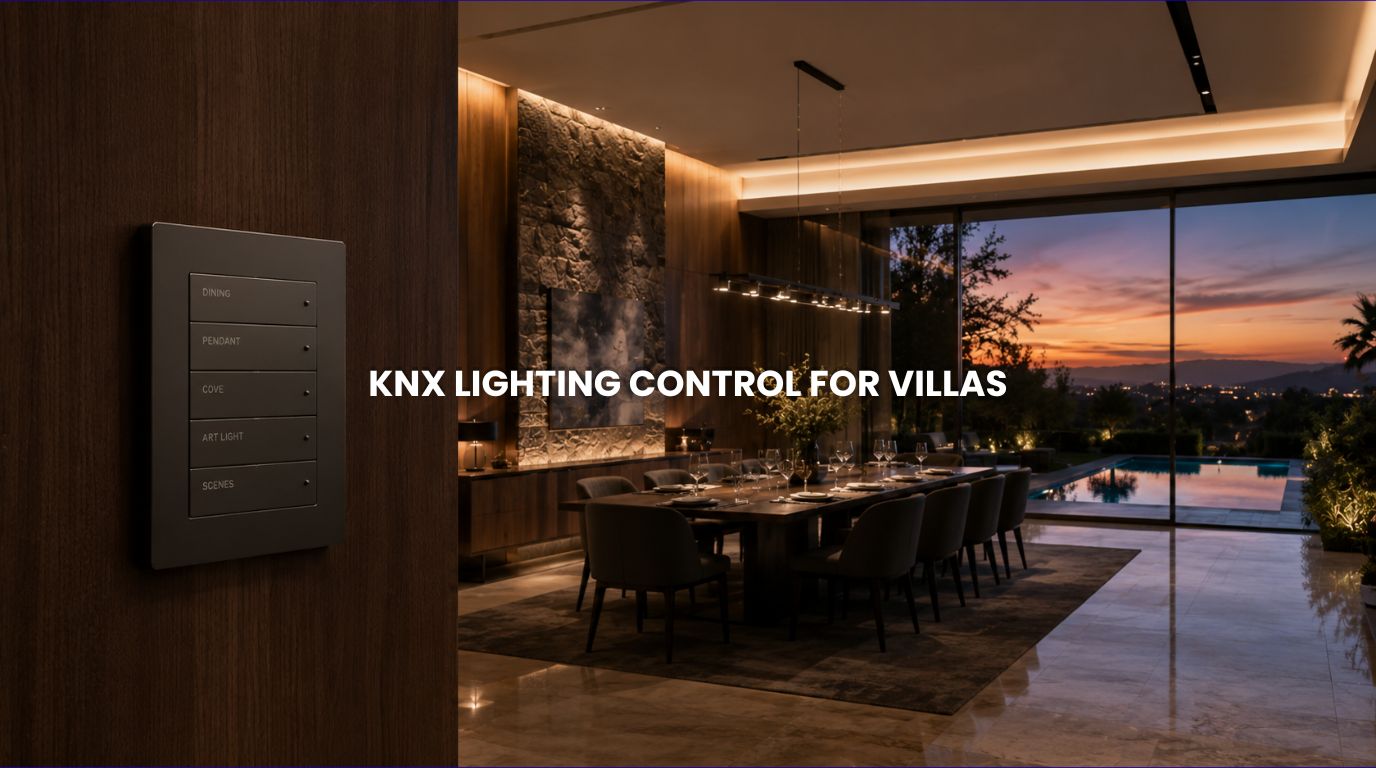
KNX lighting control is the ultimate international hardwired standard for luxury smart homes, replacing unreliable wireless gadgets with an unshakeable, offline building utility. By transmitting all commands through a dedicated physical green bus cable rather than crowded Wi-Fi networks, a KNX system eliminates signal latency, ghost commands, and cloud dependencies. It unifies complex architectural dimming, advanced DALI-2 tunable white lighting, and custom mood scenes into elegant, single-frame wall keypads. For homeowners investing in permanent luxury infrastructure, KNX provides an air-gapped, decentralized architecture engineered to operate flawlessly for over 30 years.
The Dimming Disaster: Why Multimillion-Rupee Interior Aesthetics Suffocate Under Consumer Automation
I recently walked through a sprawling, newly finished villa in Nashik just as the sun was setting. The interior design was flawless—featuring imported timber panels, natural stone textures, and millions worth of high-end architectural LED downlights designed to create a layered, gallery-like ambiance. However, the homeowner was deeply frustrated. Whenever he tried to dim his living room lights for dinner, the LEDs flickered aggressively like a cheap nightclub, two fixtures refused to drop below 20% brightness, and his wireless smart app kept showing a spinning loading wheel.
This is the hidden “Lighting Exile” that catches premium estate owners completely off guard. You invest heavily in beautiful light fixtures, but leave their control to a fragile network of consumer wireless switches and unpredictable software apps.
The “Industry Wound”—the retail myth spread by mainstream gadget brands—is that a modern lighting control system can be easily built by plastering wireless smart modules behind your switchboards or screwing in retail smart bulbs. They promise effortless scene creation and seamless dimming, but they hide the harsh engineering reality.
Modern architectural lighting relies on sensitive electronic drivers and intricate low-voltage circuits. When you force these sophisticated fixtures to communicate over crowded, airborne Wi-Fi or Zigbee mesh networks, the result is a system prone to signal dropouts, lag, and devastating voltage hums.
True luxury demands an absolute, flicker-free execution where lights fade like a slow sunrise, and keypads respond instantly. It requires moving past superficial retail gadgets and grounding your estate’s aesthetic in a hardwired, industrial-grade architectural foundation. That foundation is a KNX system.
What is KNX Lighting Control, and How Does it Work?
KNX lighting control is a standardized, hardwired building automation protocol that connects all your switches, sensors, and lighting fixtures via a dedicated, low-voltage green bus cable instead of relying on traditional 230V mains wiring or wireless networks. This physical communication line keeps the control data entirely isolated from your household electrical lines, delivering instant response times.
The Decentralized Nervous System
Unlike consumer wireless setups that collapse if a central smart hub or internet router reboots, a KNX network has no single point of failure. Every wall keypad, occupancy sensor, and dimming actuator operates as an independent mini-computer with its own onboard flash memory. If one module is physically damaged, the rest of the estate continues to communicate and execute commands perfectly, providing unshakeable operational sovereignty over your home environment.
Eliminating Circuit Box Chaos
In a traditional home, heavy electrical wires run directly from every single light switch straight to the ceiling fixtures, creating a massive, high-risk web of copper inside your walls. With a professionally integrated KNX system, your physical wall keypads only connect to the safe, low-voltage green bus cable. The heavy power lines are consolidated inside a centralized electrical panel away from your living spaces, drastically reducing electrical noise and fire hazards throughout the property.
Why Should You Choose Hardwired KNX Lighting Control over Wireless Smart Lighting?
You should choose hardwired KNX lighting control over wireless smart lighting because a physical bus cable completely bypasses the radio signal interference caused by dense reinforced concrete walls, eliminates the constant maintenance chore of changing device batteries, and secures an industrial lifecycle of over 30 years.
[Traditional System] Switch —-(High Voltage 230V Line)—-> Light Fixture (Messy & Fixed)
[Consumer Wireless] Switch . . . . (Unstable Wi-Fi/Cloud Airwaves) . . . .> Dimmer Module (Laggy)
[Hardwired KNX] Keypad ====(Shielded Green Bus Cable – Local Data)====> Actuator Panel (Instant)
Bypassing the Concrete Radio Sponge
Premium Indian homes are built to last, utilizing thick brick masonry and dense reinforced concrete slabs. While these materials provide excellent structural durability, they act as literal shields against airborne wireless signals. As you add more wireless smart bulbs and switches, they crowd your local Wi-Fi router, leading to command dropouts and delayed triggers. KNX transmits data over a heavily shielded physical cable, maintaining pristine, sub-10 millisecond execution regardless of how thick your walls are or how severe a monsoon storm is outside.
Eradicating Wall Acne Natively
A common pitfall of piecemeal wireless automation is the accumulation of messy, mismatched switches, thermostat dials, and manual fan regulators crowding your walls. KNX lighting control eliminates this visual clutter. A single elegant designer keypad from premium global manufacturers can simultaneously manage intricate lighting dimming, drop-down motorized curtains, multi-zone climate levels, and whole-home audio scenes, keeping your interior design completely seamless.
How does KNX integrate with DALI-2 for Advanced Architectural Dimming?
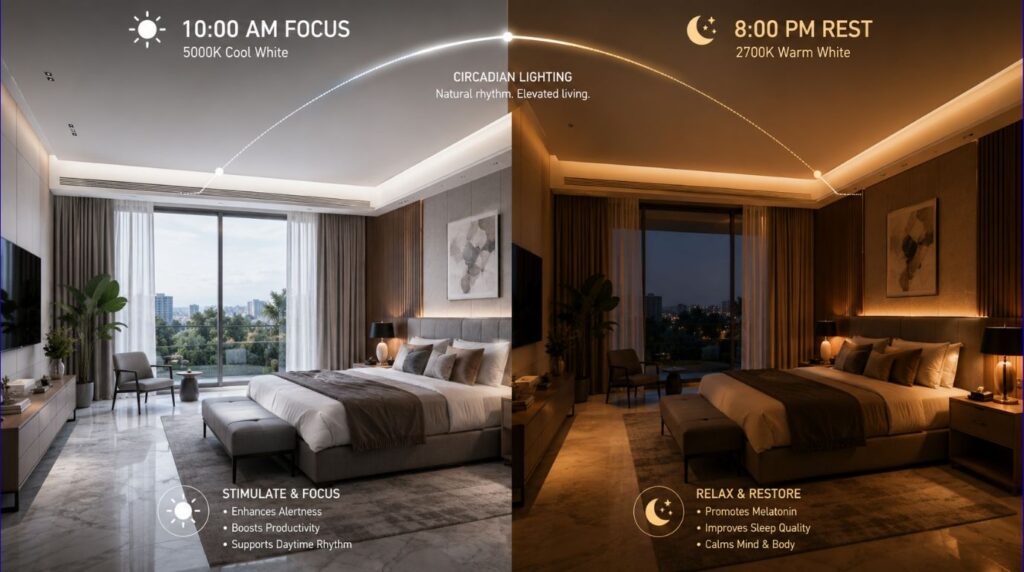
KNX integrates with DALI-2 (Digital Addressable Lighting Interface) through specialized KNX-DALI gateways, bridging the global standard for whole-home automation with the world’s most precise digital protocol for individual light fixture dimming and color management.
Flicker-Free, Ultra-Smooth Dimming Curves
Traditional analog dimming methods often cause high-end LED downlights to buzz or strobe when dropped to low levels. By linking a KNX system with a DALI-2 actuator, every single architectural luminaire receives an independent digital address. This allows you to command lights to dim smoothly from 100% down to an absolute, mirror-like 0.1% without a single hint of flickering, enabling flawless ambient transitions.
True Human Centric Lighting (HCL)
Your body’s natural rhythm is directly tied to the color temperature of the sun. Using a certified KNX DALI-2 gateway, your home can execute automated “Tunable White” schedules that shift seamlessly throughout the day. The system will automatically project crisp, energizing cool blue light (5000K) at 10 AM to enhance focus, and gently transition to a soft, amber glow (2700K) by 8 PM to stimulate melatonin production and prepare your family for deep, restorative sleep.
Summary Technical Matrix: Consumer Smart Lighting vs. KNX Infrastructure
Comparing these two execution methods clearly illustrates why a structural investment in physical infrastructure is essential for establishing a reliable luxury estate.
| Engineering Parameter | Consumer Wireless Systems | Hardwired KNX Lighting Control Standard |
| Physical Infrastructure | Airborne Radio Waves (Wi-Fi, Zigbee) | Shielded, Twisted Green Bus Cable |
| System Architecture | Centralized Hub (Single Point of Failure) | Fully Decentralized (Zero Master Hubs) |
| Dimming Precision | Phase-cut / Analog (Prone to LED Flicker) | Digital DALI-2 Integration (Smooth to 0.1%) |
| Color Temperature Control | Limited to basic RGB app color-wheels | Automated Human Centric Tunable White |
| Operational Lifespan | 3 to 5 Years (Rapid Obsolescence) | 30+ Years (Industrial Grade Durability) |
| Property Valuation | Negligible (Viewed as Temporary Gadgets) | Tangible Capital Asset (Architectural Utility) |
Can a KNX System Protect Your Expensive Lighting Investment from Voltage Surges?
Yes, a KNX system actively protects your expensive architectural lighting fixtures from voltage surges through centralized panel-level automation components equipped with heavy-duty surge suppressors and sequential power-up logic.
Shielding Sensitive LED Drivers
High-end international light fixtures use highly sensitive electronic drivers that can easily burn out when exposed to the unpredictable voltage swells common to local municipal power grids. Centralized KNX power supplies feature built-in choke filters that absorb massive electrical spikes, ensuring that dirty power never travels down the low-voltage lines to damage your premium keypads or ceiling fixtures.
Staggered Power-Up Sequences
The single most dangerous millisecond for a home’s electronics is the exact moment power returns after a blackout. The sudden rush of raw current can create a massive voltage spike. We program KNX systems to execute intelligent power recovery paths. Instead of turning on the entire villa at once, the system gently staggers circuits online loop-by-loop over several seconds, protecting your infrastructure and preserving your system’s overall health.
Transitioning from a House of Gadgets to an Unshakeable Sanctuary
A luxury home should be a place of complete rest, not an operations center where you are forced to routinely reset internet routers or tolerate flickering lights. True smart home luxury is defined by absolute silence, structural permanence, and unwavering dependability.
At Techtastic, we don’t look at lighting control as a collection of superficial tech toys or trendy smartphone apps. We build and integrate KNX lighting control systems to design robust, industrial-grade building backbones that treat automation as a permanent architectural utility, akin to premium plumbing or structural engineering. We layer the hidden foundations that allow you to stop managing your environment and finally start experiencing it.
🤝 The Partnership Corner
- For Discerning Homeowners: We design and commission tailored, offline-first KNX lighting control systems that give you absolute control over your lighting, climate, and privacy across any storm.
- For Luxury Architects & MEP Consultants: We coordinate seamlessly during your raw brickwork and gray-structure phase, providing precise panel schematics and wiring maps to ensure your structural design remains pristine.
Let’s build a digital foundation that endures for generations.
📞 Call/WhatsApp: 9769145145
📍 Engineering Unshakeable Reliability Across: Navi Mumbai | Nashik | Lonavla | Sangli
Technical FAQs on KNX Lighting Control
Q: What is KNX lighting control, and how does it work?
A: KNX lighting control is an internationally standardized, hardwired building automation protocol where all switches, sensors, and controllers communicate over a physical, low-voltage green bus cable instead of relying on traditional high-voltage wiring or unstable wireless airwaves. It uses a decentralized architecture, meaning every module functions independently with its own memory, ensuring there is no single central hub that can fail.
Q: Why should you choose hardwired KNX lighting control over wireless smart lighting?
A: Hardwired KNX completely bypasses the radio signal drops and range limitations caused by thick reinforced concrete walls and heavy brickwork common in modern premium construction. It eliminates the constant maintenance burden of replacing dead batteries in wireless sensors, operates completely offline with sub-10 millisecond response speeds, and delivers an industrial-grade operational lifespan of over 30 years without product obsolescence.
Q: How does KNX integrate with DALI-2 for advanced architectural dimming?
A: KNX connects seamlessly to the DALI-2 protocol via dedicated network gateways, allowing you to assign a unique digital address to every architectural light fixture. This integration enables ultra-smooth, flicker-free dimming down to 0.1% brightness and supports automated Human Centric Lighting (HCL) paths that automatically shift color temperatures from cool daytime white to warm evening amber to match your natural biological clock.