
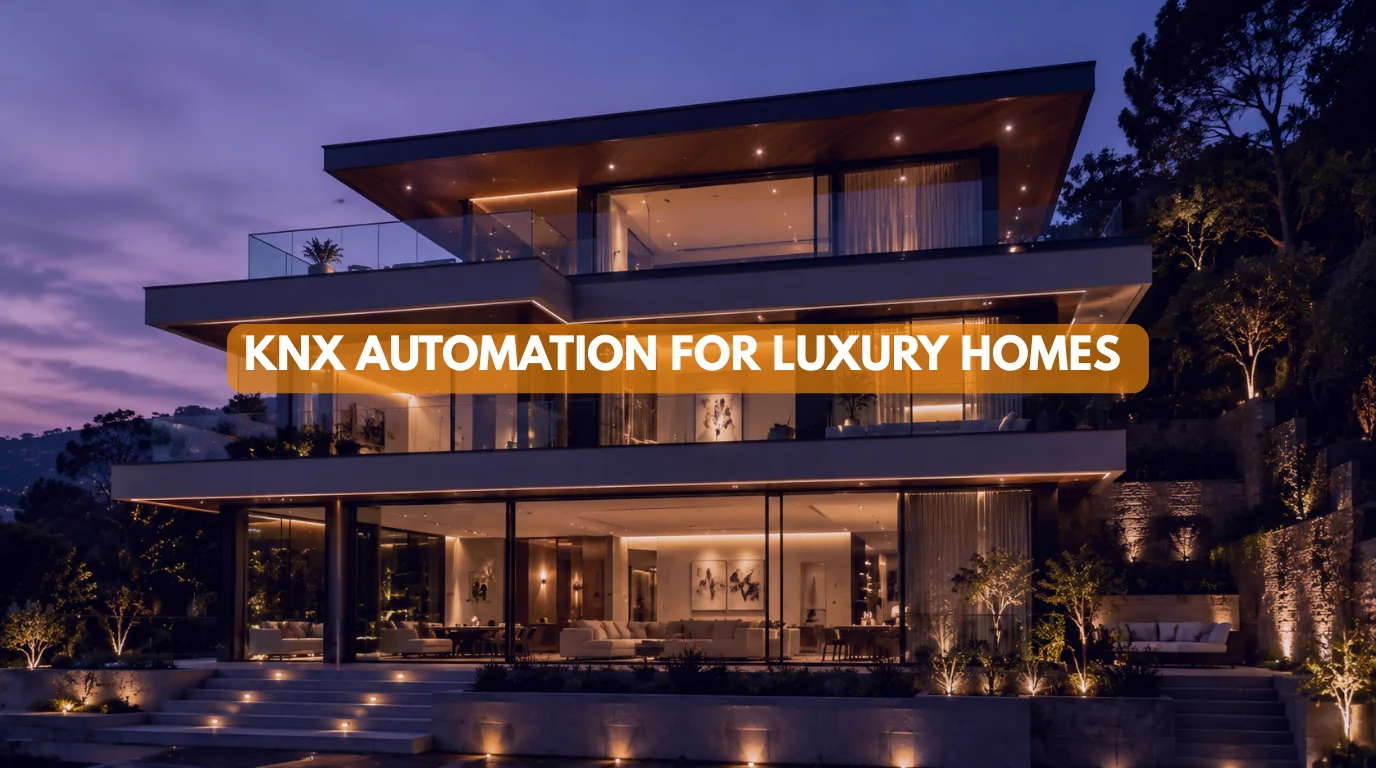
Luxury homes are no longer defined only by impressive architecture, expansive spaces, imported materials, or designer interiors. Today, homeowners increasingly expect their homes to be comfortable, secure, energy-efficient, and intelligent from the moment they move in.
This is where KNX automation for luxury homes becomes particularly valuable. Rather than installing individual smart devices that operate independently, KNX allows multiple building systems to communicate through a structured automation infrastructure.
At Techtastic, we work with homeowners, architects, interior designers, builders, and developers to create intelligent residential environments across Mumbai, Navi Mumbai, Pune, Lonavala, Nashik, and Sangli. The objective isn’t simply to make a home “smart.” It is to make technology reliable, intuitive, discreet, and useful.
In this guide, we’ll explore how KNX automation for luxury homes works, why architects choose it for premium projects, which systems can be integrated, and how to plan a future-ready smart residence.
Quick Answer
KNX automation for luxury homes is a wired building automation solution that allows lighting, climate control, curtains, security, entertainment, and other systems to communicate through a common automation infrastructure.
Unlike basic smart-home products that may depend heavily on Wi-Fi or individual apps, KNX is designed as a structured building-control system. It can provide reliable local control, multi-brand interoperability, and long-term scalability for luxury residences.
Quick Summary
✔ KNX automation for luxury homes provides a reliable wired foundation for intelligent residences.
✔ Lighting, HVAC, curtains, security, access control, and AV systems can be integrated.
✔ KNX supports products from multiple manufacturers rather than requiring one closed ecosystem.
✔ Wired infrastructure provides consistent communication throughout large properties.
✔ Automation can be expanded as homeowner requirements change.
✔ Early planning allows technology to disappear into the architecture.
✔ Professional programming is essential for creating intuitive scenes and controls.
The Growing Importance of KNX Automation for Luxury Homes
Luxury residential design has changed considerably. A decade ago, technology might have been treated as an optional addition to a premium property. Today, homeowners increasingly expect technology to be integrated into the way their homes function.
This is why KNX automation for luxury homes is becoming an important consideration during the planning of high-end residences. The biggest advantage is that automation can be designed as part of the property’s infrastructure.
Instead of asking where a smart device can be installed after the interior is complete, architects can determine where sensors, keypads, actuators, wiring, control panels, and equipment should be positioned from the beginning. The result is a much cleaner and more cohesive home.
What Is KNX Automation?
KNX is a globally recognized open standard for building automation. It allows different devices and systems to communicate over a dedicated automation network.
In a residential project, this network can connect components such as:
- Lighting controllers
- Switches and keypads
- Presence sensors
- Temperature sensors
- HVAC interfaces
- Motorized curtains
- Blind controllers
- Security interfaces
- Access-control systems
- Energy-management equipment
- Audio-visual systems
The key idea is integration. Instead of having one independent system for lighting, another for curtains, another for climate, and another for security, KNX can provide a common automation layer through which these systems can interact.
For architects planning KNX automation for luxury homes, this creates greater freedom to design the home around the homeowner’s lifestyle rather than around a collection of disconnected products.
How KNX Automation Works
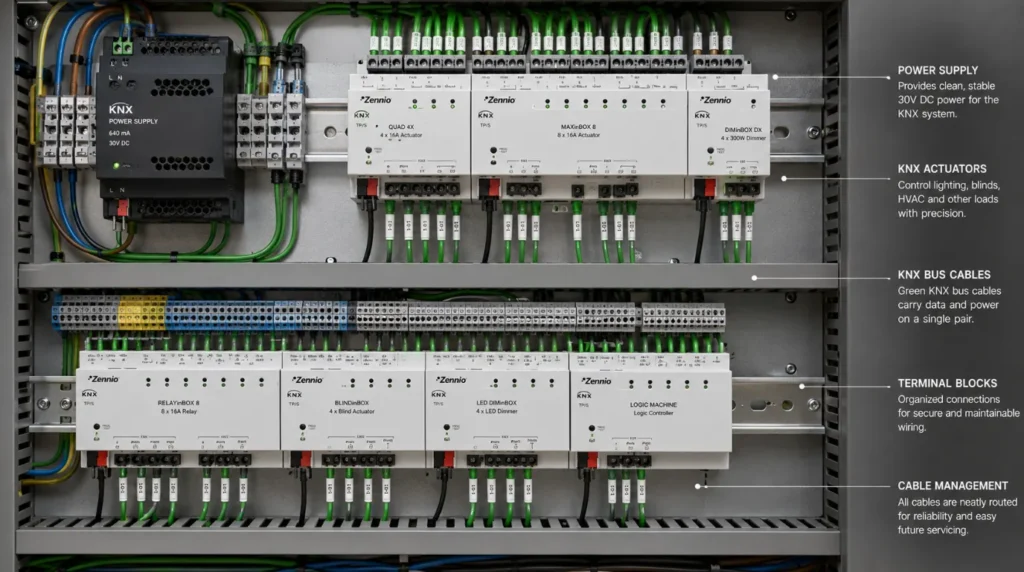
A KNX installation generally consists of several important components.
Sensors and Inputs
Sensors collect information from the environment.
These may detect:
- Movement
- Presence
- Temperature
- Light levels
- Door or window status
- Weather conditions
KNX Bus
The KNX bus provides the communication infrastructure through which compatible devices exchange information.
Actuators
Actuators receive commands and operate connected equipment.
For example, an actuator can control:
- Lights
- Motors
- HVAC equipment
- Blinds
- Other electrical loads
Interfaces and Visualization
Touch panels, keypads, mobile applications, and other interfaces allow homeowners to interact with the system.
This structure enables KNX automation for luxury homes to function as a coordinated system rather than a collection of isolated devices.
Why Architects Prefer KNX Automation for Luxury Homes
1. Reliable Wired Infrastructure
Large luxury residences can contain dozens or even hundreds of connected devices. There may be multiple floors, large living spaces, landscaped gardens, outdoor entertainment areas, guest rooms, home theatres, and extensive security infrastructure.
A reliable communication network becomes essential. One of the main reasons architects consider KNX automation for luxury homes is the stability offered by a dedicated wired automation infrastructure.
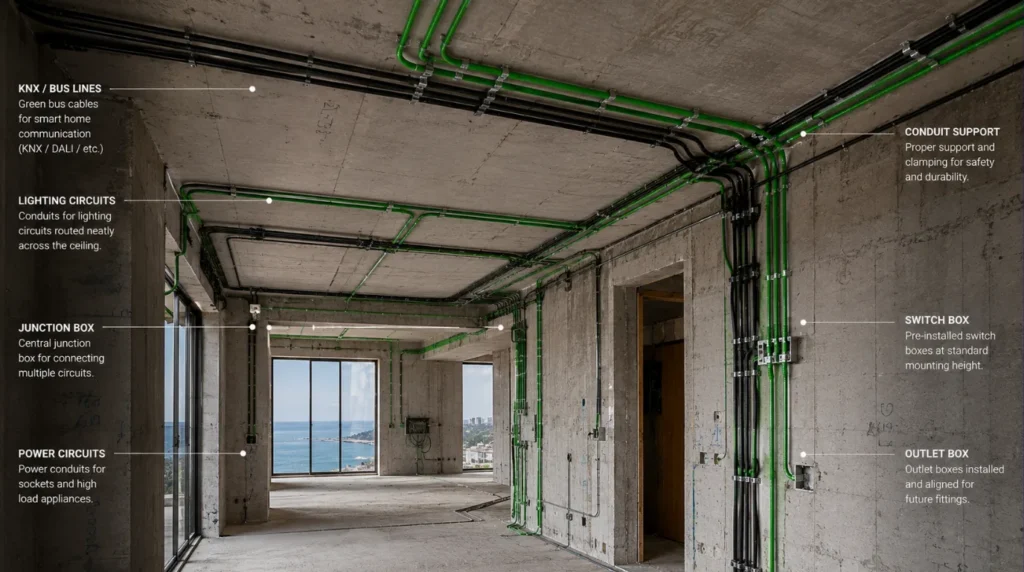
Unlike systems that depend entirely on wireless communication, KNX uses dedicated cabling for its core communication. This makes it particularly suitable for projects where consistent performance is more important than simply achieving a quick installation.
2. No Dependence on a Single Wireless Network
Wi-Fi is excellent for many consumer devices, but a luxury home’s automation system should not necessarily depend entirely on the same network used for phones, laptops, televisions, and streaming services.
A dedicated automation infrastructure separates critical building functions from everyday internet traffic. For example, if the home’s internet connection becomes unavailable, basic KNX Automation for Luxury Homes functions can continue operating locally.
This local approach is one of the reasons KNX automation for luxury homes can provide a more dependable experience.
3. Open Standard and Multi-Brand Flexibility
One concern with smart-home technology is brand dependency. A homeowner might purchase switches, sensors, hubs, and controllers from one manufacturer only to discover later that changing one component means replacing much of the system.
KNX approaches this differently, because KNX is an open standard; compatible products from different manufacturers can be used within the same overall system.
This gives architects and homeowners greater freedom when selecting:
- Switch designs
- Sensors
- Actuators
- HVAC interfaces
- Curtain controls
- Touch panels
This flexibility is particularly valuable in luxury interiors where design preferences may change from room to room.
4. Scalability for Future Requirements
Luxury homes are long-term investments. A homeowner may initially want lighting and climate control but later decide to add motorized curtains, security integration, energy monitoring, or additional entertainment systems.
A well-designed KNX infrastructure can accommodate future expansion. This makes KNX automation for luxury homes particularly useful when architects want to create properties that remain adaptable for years.
Smart Features Architects Can Integrate with KNX
1. Intelligent Lighting Control
Lighting is often the first major automation system integrated into luxury residences.
A KNX lighting system can provide:
- Dimming
- Switching
- Scene control
- Scheduled lighting
- Occupancy-based control
- Daylight-responsive lighting
- Centralized control
Instead of manually operating every lighting circuit, homeowners can create scenes.
This makes KNX automation for luxury homes an experience-driven system rather than simply an automated switchboard.
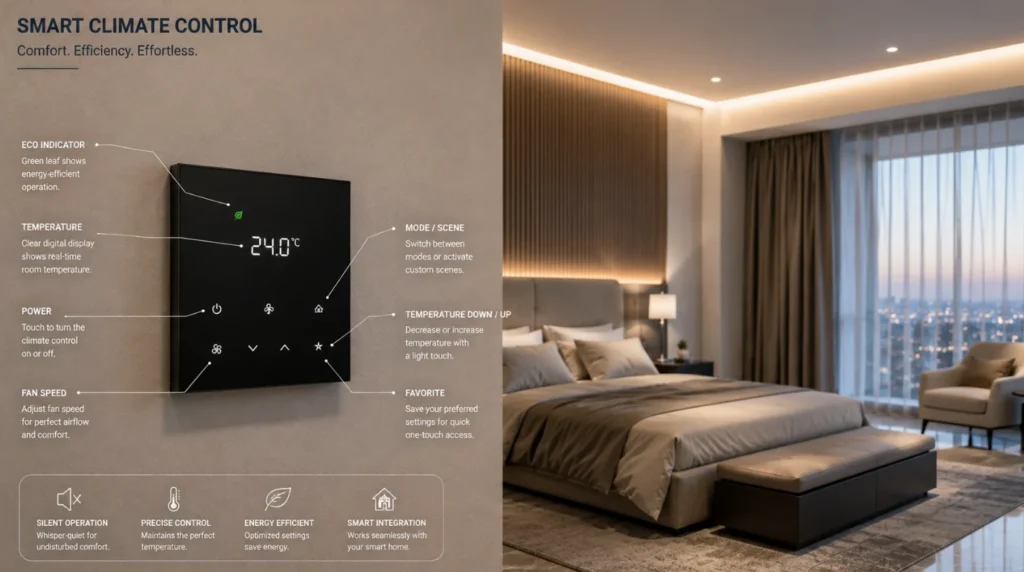
2. Climate and HVAC Management
Climate control is another major component of premium residential automation. A KNX system can coordinate HVAC equipment with temperature sensors, schedules, occupancy, and other automation logic.
When residents return, the system can prepare the environment according to predefined preferences. Multiple zones can also be managed independently. The master bedroom may have one temperature preference, while the living room and study operate at different temperatures.
This level of control makes KNX automation for luxury homes particularly useful for large properties where different areas have different comfort requirements.
3. Motorized Curtains and Blinds
Motorized window treatments can be integrated directly into the automation system.
Curtains can respond to:
- Time
- Sunlight
- Temperature
- Occupancy
- Scenes
- Security conditions
The combination of natural-light management and artificial lighting by KNX automation for luxury homes creates a more comfortable environment while supporting energy efficiency.
4. Smart Security and Access Control
Security becomes increasingly important as homes become larger and more connected. A KNX system can integrate with compatible security and access-control infrastructure.
Potential applications include:
- Door and window sensors
- Motion detection
- Access control
- Smart locks
- Gate integration
- Security scenes
- Lighting responses
The goal isn’t simply to install more cameras or sensors but to make the security environment coordinated and responsive.
5. Home Theatre and Entertainment
Luxury homes frequently include dedicated entertainment spaces. Automation can bring the room’s individual systems together.
Similarly, an entertainment scene in a living room could activate selected architectural lighting and audio equipment. This is where KNX automation for luxury homes can create a noticeable difference in the everyday experience.
6. Energy Management
Energy management is becoming increasingly important in premium homes.
A modern residence may include:
- Solar generation
- Battery storage
- EV charging
- Multiple HVAC zones
- Large lighting installations
- Swimming-pool equipment
- Water heating
KNX Automation for luxury homes can help coordinate these systems. Together, these small decisions can create a more efficient home.
Why Automation Planning Should Begin During Design
One of the most important recommendations for architects is simple: Do not wait until the interiors are complete to plan automation.
Early planning makes it easier to coordinate:
- Electrical layouts
- Automation wiring
- Lighting circuits
- Sensor locations
- Keypad positions
- Curtain pockets
- HVAC equipment
- Equipment racks
- Network infrastructure
- Security systems
When KNX automation for luxury homes is considered early, the technology can be integrated into the architecture. This avoids unnecessary modifications after the interior finishes are installed.
Centralized Control vs Intelligent Control
It is important to understand that automation isn’t simply about putting every device behind one screen. True automation reduces the number of decisions the homeowner has to make.
The objective of KNX automation for luxury homes should be to reduce repetitive actions rather than simply create another interface.
Wired KNX vs Wireless Smart Home Systems
Both wired and wireless technologies have their place. Wireless systems can be useful for existing homes and smaller upgrades because they require less structural work.
However, new luxury construction provides an opportunity to install dedicated automation infrastructure.
| Feature | KNX Wired Automation | Wireless Automation |
|---|---|---|
| Installation | Best during construction | Easier retrofit |
| Reliability | Excellent | Good |
| Network Dependency | Low for core control | Higher |
| Scalability | Excellent | Depends on network |
| Maintenance | Low | Moderate |
| Multi-System Integration | Excellent | Varies |
| Best Use | New luxury homes | Existing homes |
For new high-end residences, KNX automation for luxury homes is often worth considering because the infrastructure can be installed before walls and ceilings are completed.
Common Mistakes to Avoid
1. Treating Automation as an Afterthought
Waiting until construction is almost complete can limit wiring options and increase costs.
2. Automating Every Device
Not every appliance needs automation. Focus on functions that provide genuine convenience or efficiency.
3. Choosing Hardware Without Considering Integration
A beautiful keypad isn’t useful if it doesn’t communicate properly with the rest of the system. Compatibility should be considered from the beginning.
4. Forgetting Future Expansion
Provide infrastructure that can accommodate future technology.
5. Focusing Only on Initial Cost
Luxury automation should be evaluated as a long-term infrastructure investment rather than a collection of individual gadgets.
How KNX Can Support Future-Ready Homes
Technology will continue to evolve. Artificial intelligence, energy management, EV charging, renewable energy, advanced security, and connected appliances will become increasingly integrated into residential environments.
The hardware available today may change, but the underlying requirement remains the same: the home needs reliable infrastructure through which different systems can communicate. This is why KNX automation for luxury homes can provide long-term value.
A properly designed system doesn’t need to predict every future device. It needs to provide a flexible foundation capable of adapting to new requirements.
Techtastic’s Approach to KNX Automation
At Techtastic, we believe automation should feel effortless. The homeowner shouldn’t need to understand the technical architecture behind the system to enjoy its benefits.
Our approach begins with understanding:
- The architecture
- The electrical infrastructure
- The interior design
- The homeowner’s lifestyle
- Current automation requirements
- Future expansion plans
From there, we design the automation infrastructure, control interfaces, system logic, and integration requirements.
For KNX automation for luxury homes, our goal is to create a system that is reliable enough to disappear into the background while remaining powerful enough to coordinate the entire property.
Key Takeaways
- KNX automation for luxury homes provides a reliable foundation for premium residential automation.
- KNX can integrate lighting, HVAC, curtains, security, access control, AV, and energy management.
- Its wired infrastructure provides consistent communication.
- KNX supports compatible products from multiple manufacturers.
- Systems can be expanded as homeowner requirements change.
- Early planning allows automation to integrate naturally with architecture and interiors.
- Smart scenes can coordinate multiple systems with a single command.
- KNX can reduce wall clutter by consolidating controls.
- Professional programming is essential for intuitive operation.
- The best automation is designed around lifestyle rather than technology alone.
Frequently Asked Questions
1. What is KNX automation for luxury homes?
A. KNX automation for luxury homes is a wired building automation solution that connects systems such as lighting, climate control, curtains, security, access control, and entertainment through a common automation infrastructure.
2. Why is KNX suitable for luxury homes?
A. KNX offers reliable wired communication, scalability, multi-brand compatibility, and the ability to integrate multiple building systems. These characteristics make it suitable for large and premium residences.
3. Does KNX require Wi-Fi?
A. No. Core KNX communication takes place through the KNX bus. Internet and Wi-Fi can still be used for remote access, mobile applications, and integrations, but basic automation does not need to depend on the internet.
4. Can KNX control air conditioning?
A. Yes. With the appropriate interface, KNX can communicate with compatible HVAC systems and allow temperature, operating modes, and other functions to be integrated into the automation system.
5. Can KNX control motorized curtains?
A. Yes. Motorized curtains and blinds can be connected to KNX and incorporated into schedules, scenes, daylight-management strategies, and other automation functions.
6. Can I control a KNX home from my phone?
A. Yes. A suitable KNX server or gateway can provide smartphone and tablet access while the core automation continues operating locally through the KNX infrastructure.
7. Can different brands work together in a KNX system?
A. Yes. KNX is an open standard supported by many manufacturers. Compatible products can be combined within the same project, subject to the specific equipment and integration requirements.
8. Is KNX suitable for an existing home?
A. It can be, but KNX is particularly advantageous when planned during new construction or major renovation because the required wiring can be integrated into the building infrastructure.
9. Can KNX automation be expanded later?
A. Yes. A properly designed system can accommodate additional sensors, lighting circuits, curtains, climate-control functions, security integrations, and other compatible devices as requirements evolve.
10. When should KNX automation be planned?
A. Ideally, planning should begin during the architectural and electrical design stage. Early coordination allows wiring, equipment locations, sensors, keypads, lighting circuits, and other infrastructure to be incorporated before construction is completed.
Collaboration Opportunities for Builders, Architects & Interior Designers
The best KNX automation for luxury homes begins long before the first smart switch is installed.
At Techtastic, we collaborate with:
- Architects
- Interior Designers
- Builders
- Real Estate Developers
- Project Management Consultants
- Luxury Villa Developers
Our team can support projects with:
- KNX Automation Planning
- Electrical Layout Coordination
- Smart Lighting Design
- HVAC Integration
- Motorized Curtain Planning
- Keypad and Control Interface Planning
- Smart Security Integration
- Home Theatre Automation
- Networking Infrastructure
- Energy Management
- Future Expansion Planning
Early collaboration allows automation to become part of the architectural process rather than a separate technology layer added later.
This can reduce rework, improve aesthetics, simplify installation, and create a more cohesive homeowner experience.
Areas We Serve
Techtastic provides premium smart home automation and KNX solutions across:
- Mumbai
- Navi Mumbai
- Pune
- Lonavala
- Nashik
- Sangli
We work with homeowners, architects, builders, developers, and interior designers on luxury villas, premium apartments, farmhouses, and other high-end residential projects.
Build a Luxury Home That Thinks for You
The future of luxury living isn’t simply about adding more technology. It is about making technology work quietly in the background.
KNX automation for luxury homes provides the infrastructure needed to connect lighting, climate, curtains, security, entertainment, and other systems into one intelligent environment.
When planned correctly, homeowners don’t need to think about the technology every day. They simply experience the benefits: the right lighting, the right temperature, the right level of privacy, and the right environment at the right time.
At Techtastic, we help architects, builders, interior designers, and homeowners create intelligent residences where advanced technology and elegant design work together. If you’re planning a new luxury villa or premium residential project, involve your automation partner early in the design process.
Book your consultation today and let Techtastic design your future-ready smart home system.
Contact Techtastic
🌐 Website: Techtastic Website
📞 Phone: 9769145145
📍 Service Areas: Mumbai • Navi Mumbai • Pune • Lonavala • Nashik • Sangli
Want to simplify control across a luxury smart home? Explore our guide on KNX Keypad: Effortless Home Control Guide 2026 to discover how intuitive keypads can make everyday automation easier.