
Summary
In India, a reliable smart home hub cannot depend on a steady internet connection alone. Frequent ISP outages and fluctuating bandwidth often turn “smart” gadgets into expensive paperweights.
This guide explains the “Hybrid smart home system” approach, which combines fast local processing with convenient cloud control. Using a local hub and protocols like Zigbee or KNX keeps your home functional without internet. You will see why local control is the key to a reliable, frustration-free smart home in India.
No Internet? No Problem: Why a Hybrid Smart Home System is the Best Choice
I’ve been in many homes across Delhi and Mumbai where the excitement of a new smart home setup quickly turns into frustration. It usually happens during a sudden monsoon downpour or a routine ISP “maintenance” window. You walk into your bedroom, ask the lights to turn on, and… nothing. Or worse, you try to open your automated drapes and see a loading icon because the cloud is unreachable.
This is the reality of the “Cloud-Only” smart home automation system in India. While we are rapidly becoming one of the most connected nations, our internet stability still has its bad days. If your home relies entirely on a remote server, it is only as smart as your Wi-Fi signal.
That’s why I’m a firm believer in the Hybrid Smart Home System.
The Problem with the “Cloud-Only” Trap
Most entry-level smart devices—the kind you buy off the shelf and plug in—rely on the cloud. When you tap a button, the signal travels to a remote server and back to your device to complete the command.
In a perfect world, this happens in milliseconds. But in India, where “high-speed” can sometimes be temperamental, this creates two problems:
- Latency: That annoying 2-second delay between clicking a switch and the light turning on.
- Total Failure: If your internet goes out, your “Smart Home” reverts to a “Dumb Home.” You lose your schedules, your voice commands, and often your app control.
Enter the Hybrid System: Local First, Cloud Second
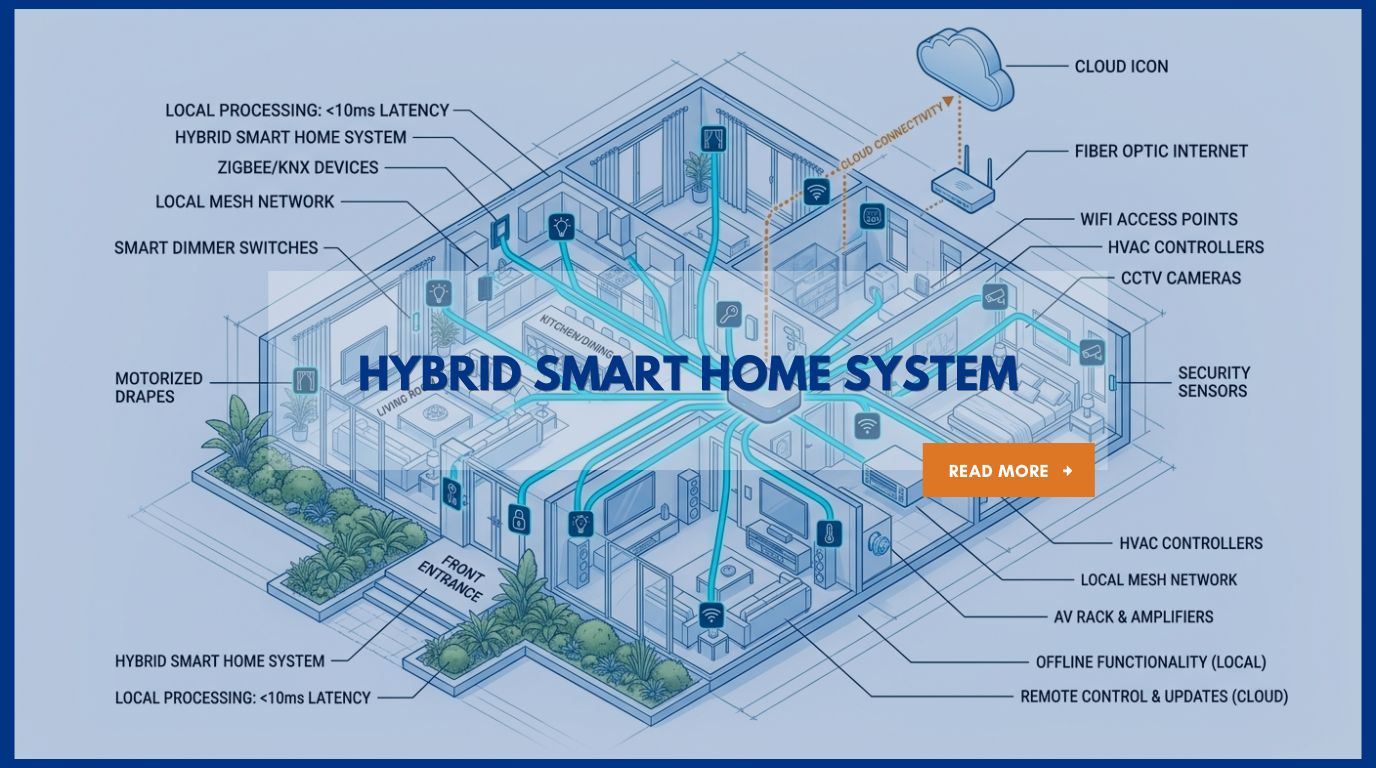
A hybrid smart home system changes the hierarchy. Instead of every device talking to the internet, they talk to a Local Hub sitting inside your home. Think of this hub as your home’s private brain.
When you press a button, the command stays within your four walls. The system only needs the internet for remote tasks, like checking cameras or receiving notifications while you are away. This “Local-First” architecture is the backbone of a truly reliable system.
The Three Pillars of a Reliable Hybrid Setup
1. The Local Brain (The Hub)
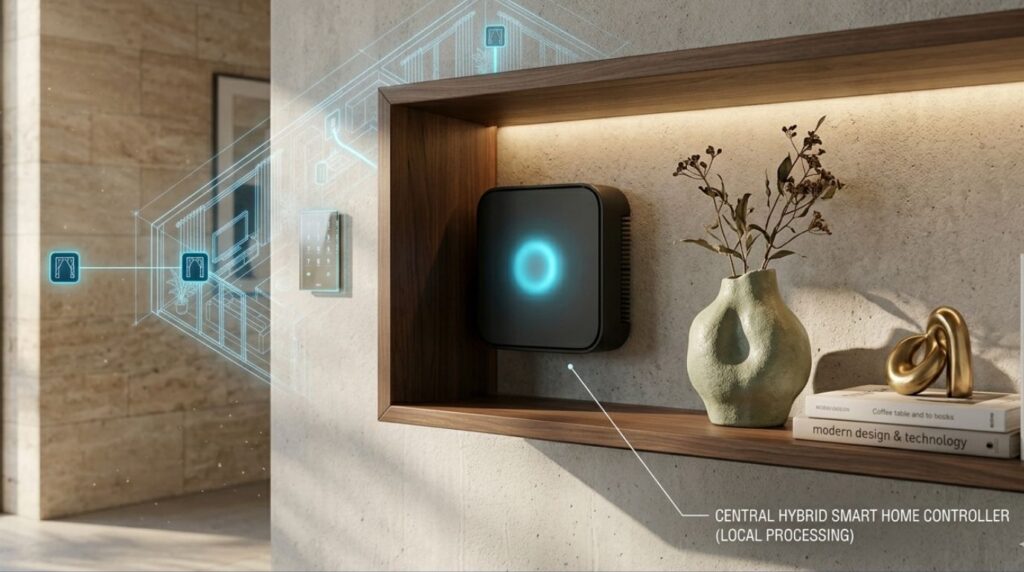
The heart of a hybrid smart home system is a controller that doesn’t need to “call home” to function. Professional systems like KNX or advanced DIY hubs like Home Assistant or Hubitat process your automation logic locally. If you program your hallway smart lights to turn on via a motion sensor, the hub handles that task directly. No internet required.
2. Using “Mesh” Protocols (Zigbee & Z-Wave)
Instead of crowding your Wi-Fi router with dozens of bulbs and switches, a hybrid smart home system uses protocols like Zigbee or Z-Wave. These devices create their own “mesh” network. They talk to each other and go back to the hub.
- The Benefit: They don’t consume your Wi-Fi bandwidth.
- The Hybrid Advantage: They work locally. Even if your internet is down, the Zigbee switch on the wall will still talk to the Zigbee motor in your drapes.
3. Wired Backbones for “Heavy Hitters.”
I always suggest a wired connection for essential features like security cameras, main lighting, or motorized curtains. Running a Cat6 cable back to your central rack ensures that your “data highway” is physical and permanent. Wired devices in a hybrid setup are more reliable because thick walls or nearby routers do not interfere with their signal.
Why This Matters for the Indian Home?
We live in a unique environment. Thick brick and concrete walls often block Wi-Fi signals in our homes. Furthermore, we face power fluctuations and ISP downtime more frequently than in many Western markets.
A hybrid smart home system is “Climate and Infrastructure Proof.” After a power outage, a hybrid system reboots and restores its local network immediately, without waiting for the internet to reconnect. Your “Good Morning” routine will still trigger at 7:00 AM, regardless of whether your ISP is having a bad morning.
Speed: The Hidden Luxury
We often discuss convenience, but we don’t talk enough about speed. In a cloud-based home, there is a perceptible lag. It feels “mechanical” and “digital.”
In a local hybrid smart home system, the response is instant. You walk into a room, and the light is on before your foot hits the floor.
The drapes move the moment your finger touches the screen. That instant response is what makes a home feel truly high-end.
Final Thoughts: Building for the Future
If you are planning a new home or renovation, don’t just ask which gadgets to get. Ask how the system functions without the internet.
A hybrid smart home system is an investment in reliability. It ensures that your home remains a sanctuary of convenience, not a source of technical stress. Prioritizing local control and smart cabling now ensures your home remains functional during any future internet issues.
Collaboration Opportunities for Builders and Architects
I work with developers, architects, and interior designers to enhance residential projects by integrating smart home technology during the planning and design stages. My team ensures that automation aligns seamlessly with your design layouts, electrical infrastructure, and interior concepts.
I invite you to partner with Techtastic to implement a high-quality hybrid smart home system for your upcoming projects in Nashik, Navi Mumbai, Sangli, and Lonavla.
Contact Techtastic Technologies at 9769145145 for a professional consultation to see how a hybrid smart home system can elevate your design vision.
Technical FAQs
Q: If I have a hybrid smart home system, can I still use Alexa or Google Home?
A: Yes! That’s why it’s called “Hybrid.” Use the cloud for voice and remote control, but rely on the local hub for critical tasks like lights and sensors.
Q: Is a hybrid smart home system more expensive than a Wi-Fi-based one?
A: The initial cost of a local hub and professional-grade smart switches can be higher than that of cheap Wi-Fi bulbs. However, the long-term value—zero subscription fees, better security, and 100% reliability—makes it much more cost-effective.
Q: Do I need a technician to manage a local hub?
A: Experts must set up systems like KNX, but you can easily manage most modern hybrid hubs through an app. Once you configure the “brain,” you can use it as easily as any other smartphone app.
Q: Does a hybrid smart home system work with my existing Wi-Fi devices?
A: Many local hubs can “bridge” your existing Wi-Fi devices into the local network. To work offline, gradually move essential devices like lights and curtains to wired connections or local protocols like Zigbee.
Q: What is the most important device to have on local control?
A: Your “Entry/Exit” points and main lighting. You should never let an internet outage lock you out of your home or leave you in the dark.
Q: How does a hybrid smart home system improve security?
A: Because your local hub stores most of your data instead of sending it to a cloud server, hackers have fewer entry points. Your private habits—when you are home, which rooms you use—stay inside your home.