
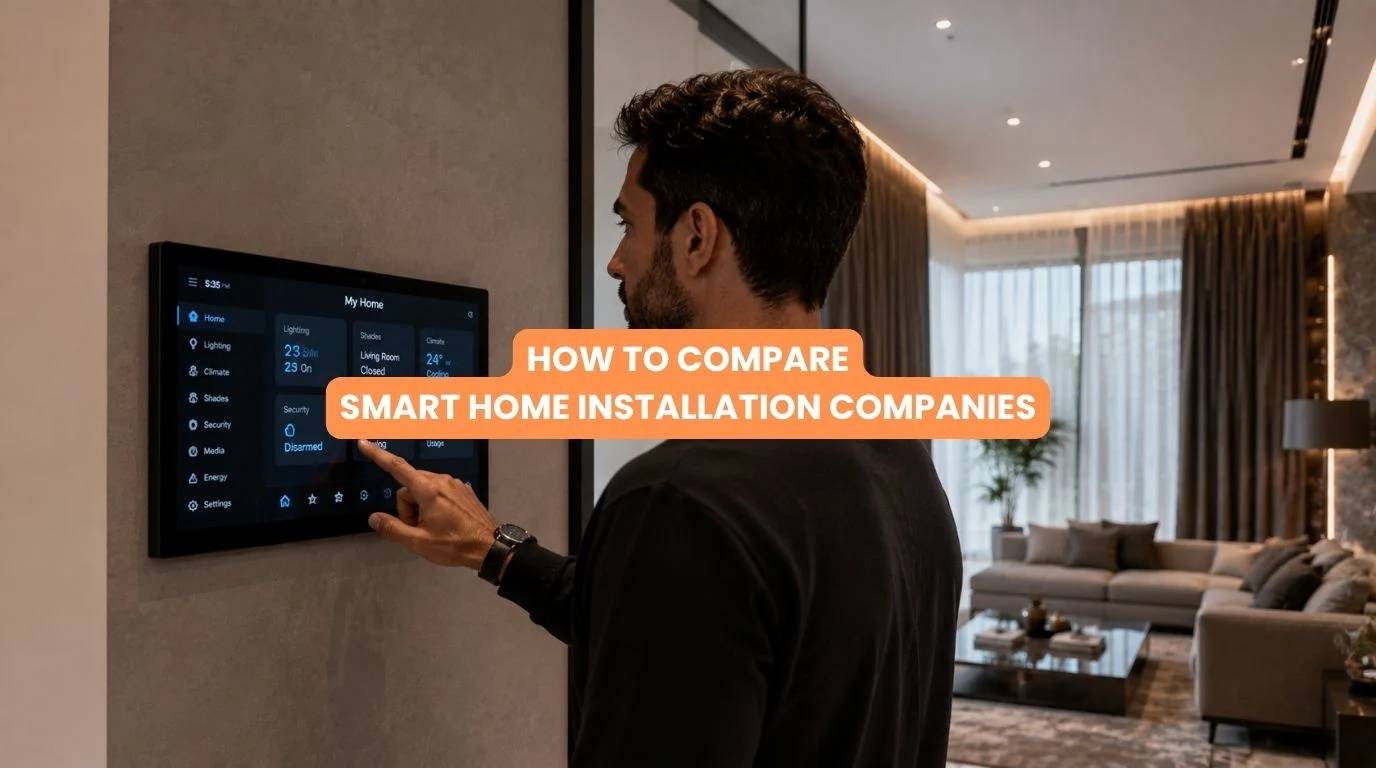
Quick Answer
To compare smart home installation companies, look beyond installation price. Evaluate their experience, automation platforms, integration capabilities, product selection, network design, programming, commissioning process, warranty, maintenance support, and ability to expand the system later. Ask each company for a detailed proposal that clearly identifies hardware, installation, programming, integration, exclusions, and ongoing support.
Choosing a smart home installer is different from buying an individual smart device. When you purchase a smart bulb or smart lock, you can usually compare products based on price and features. A whole-home automation project is different.
Your installer may be responsible for system design, electrical coordination, networking, device selection, programming, installation, integration, testing, commissioning, and future support.
That’s why homeowners should carefully compare smart home installation companies before selecting a partner.
The cheapest quotation isn’t necessarily the best value. A company with impressive hardware isn’t automatically the best integrator either. The right installer should know how different systems work together. They should design automation to fit your home and lifestyle.
This guide shows you how to compare smart home installation companies. It explains what questions to ask. It covers what to include in a quote. It also lists warning signs to watch for.
Quick Summary
When you compare smart home installation companies, evaluate:
✓ Experience and completed projects
✓ Automation platform and technology
✓ System design capabilities
✓ Brand and product quality
✓ Integration expertise
✓ Network infrastructure
✓ Installation and programming
✓ Testing and commissioning
✓ Warranty and after-sales support
✓ Scalability and future upgrades
✓ Transparent pricing
Don’t choose an installer based only on the lowest quote. Compare the complete system, implementation quality, and long-term support.
Why Does the Installer Matter?
The main reason to compare smart home installation companies is simple. Two companies can quote different systems for the same need. For example, both companies might offer:
- Smart lighting
- Motorized curtains
- Security
- HVAC control
- Home theatre
But the underlying technology, wiring, programming, networking, and integration could be completely different.
Design one system as a collection of individual devices. Someone may design another as a coordinated whole-home automation system. The difference may not be obvious from a quotation.
1. Check Experience and Portfolio
The first step when you compare smart home installation companies is to look at their experience.
Ask:
- How long have you been installing automation systems?
- How many whole-home projects have you completed?
- Have you worked on homes similar to mine?
- Do you have luxury residential experience?
- Can you show completed installations?
- Do you work with architects and interior designers?
Look for relevant projects rather than simply a long list of products. A company experienced with apartments may not necessarily have the same expertise required for a large luxury villa.
2. Compare Technology Platforms
Technology architecture is one of the most important differences between installers. Depending on the project, you may encounter:
When you compare smart home installation companies, ask each company:
What automation architecture are you recommending, and why?
A good installer should be able to explain the reasoning rather than simply naming a brand.
3. Evaluate System Design
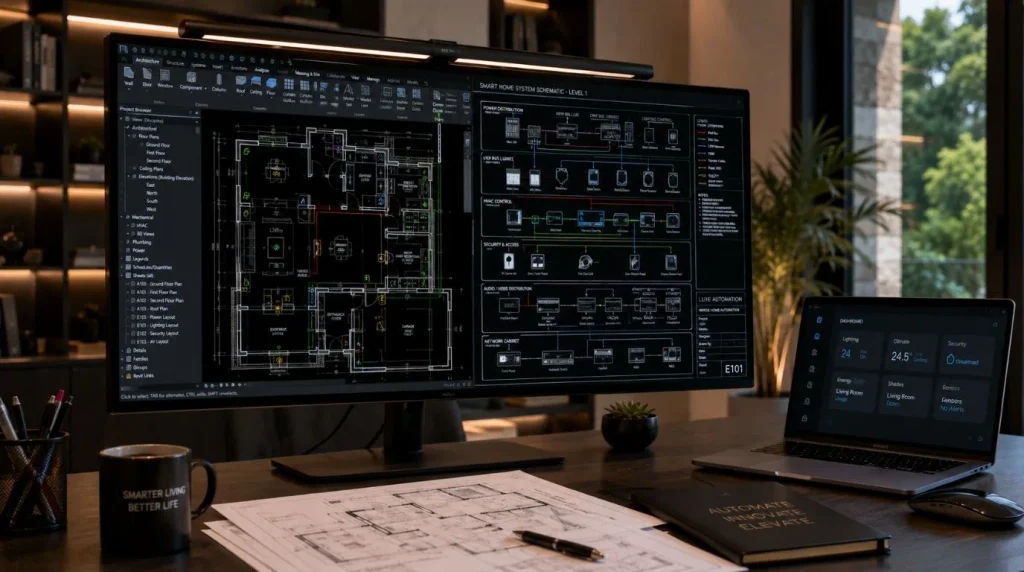
A professional smart home installer should understand the project before recommending equipment.
The design process may consider:
- Floor plans
- Lighting circuits
- Curtain locations
- HVAC zones
- Security requirements
- Network infrastructure
- AV equipment
- Electrical requirements
- User controls
- Future expansion
Be cautious if a company immediately recommends products without asking about your home, lifestyle, or requirements.
4. Compare Product Quality
When you compare smart home installation companies, don’t compare only the total quotation. Compare the actual equipment.
Ask:
- Which motors are being proposed?
- Which lighting controls does it include?
- Which sensors do you use?
- Which network equipment does the package include?
- What controllers are they installing?
- What is the expected lifecycle?
- Is replacement hardware available?
Two quotes can have completely different hardware quality despite appearing similar on paper.
5. Evaluate Integration Capabilities
Integration is what separates a collection of smart devices from a cohesive automation system.
Ask whether the installer can integrate: Lighting + Curtains + HVAC + Security + Entertainment + Access
For example:
Movie Mode
Curtains close → Lights dim → Projector activates → AV system starts.
Good Night
Lights turn off → Curtains close → Security adjusts → Selected HVAC settings change.
When you compare smart home installation companies, ask them to show real automation scenes. Reject vague claims, such as “we can integrate everything.”
6. Review Networking
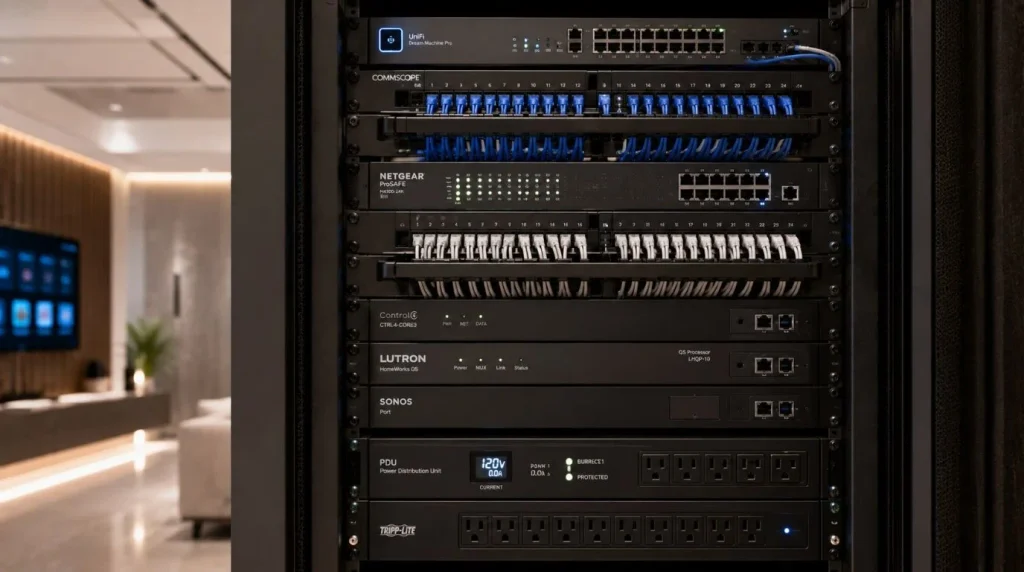
Networking is frequently overlooked during smart home planning. A larger home may require:
- Structured Ethernet
- Multiple wireless access points
- Managed switches
- Network racks
- VLAN planning
- Reliable Wi-Fi coverage
A poor network can create problems that homeowners mistakenly attribute to the automation system. Therefore, networking expertise should be part of your evaluation.
7. Compare Installation and Programming
Installation isn’t simply mounting devices. A professional project may include:
- Hardware installation
- Wiring
- Configuration
- Programming
- Integration
- Testing
- User setup
- Commissioning
When you compare smart home installation companies, ask whether programming and commissioning are included in the quoted price. Otherwise, a seemingly inexpensive quotation may become more expensive later.
8. Ask About Testing and Commissioning
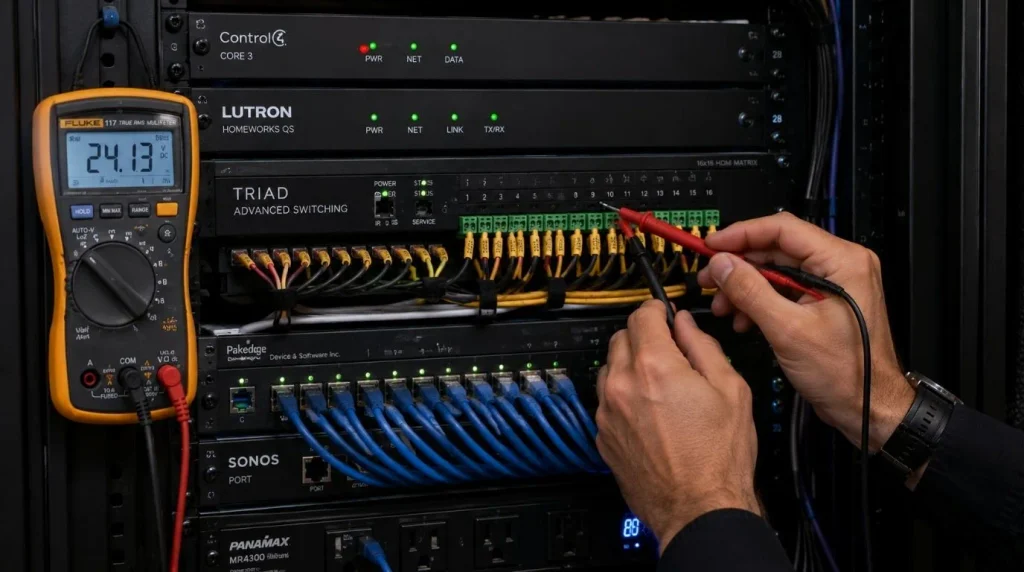
This is one of the most important questions to ask.
“How do you test the system before handover?”
A professional commissioning process should verify:
- Lighting
- Sensors
- Curtain motors
- HVAC
- Security
- Controls
- Scenes
- Network connectivity
- Mobile access
For a luxury project, commissioning should ideally happen room by room and system by system.
9. Compare the Quotation Properly
Don’t simply compare the final number. Ask each company to break the proposal into categories.
| Cost Category | What to Check |
|---|---|
| Hardware | Exact models and quantities |
| Wiring | Included or excluded |
| Installation | Labour and mounting |
| Programming | Included? |
| Integration | Included? |
| Networking | Equipment + configuration |
| Commissioning | Included? |
| Training | Included? |
| Warranty | Duration and coverage |
| Maintenance | Cost and scope |
| Future Changes | Programming/service charges |
This makes it much easier to compare smart home installation companies fairly.
10. Understand What’s Excluded
One of the most important things to check when you compare smart home installation companies is the exclusions section.
A quotation may exclude:
- Electrical work
- Civil work
- False ceiling modifications
- Networking
- Internet equipment
- Curtain fabrication
- HVAC interfaces
- AV equipment
- Programming changes
- Future integration
Ask for all exclusions in writing.
11. Evaluate Warranty and After-Sales Support
Smart homes are long-term systems.
Ask:
- What is covered by the warranty?
- Who handles failures?
- Is programming support included?
- What happens if a component fails?
- Are replacement parts available?
- Is annual maintenance available?
- How quickly does the company respond to service requests?
The best installer isn’t necessarily the company that promises everything for free.
It’s the company that clearly explains what happens after installation.
12. Check Future Scalability
Your smart home may evolve. You might eventually want:
- Additional lighting
- More motorized curtains
- Security upgrades
- Energy management
- Additional rooms
- Home theatre
- New control interfaces
When you compare smart home installation companies, ask:
Can this system be expanded five years from now?
A scalable architecture can reduce the need for expensive replacements later.
Wired vs Wireless: What Should You Ask?
| Requirement | Wired | Wireless |
|---|---|---|
| New construction | Excellent | Good |
| Existing home | More involved | Excellent |
| Battery dependence | Lower | Higher |
| Large whole-home system | Strong option | Network-dependent |
| Retrofit | Less convenient | Strong option |
| Future expansion | Structured | Flexible |
The right choice depends on the property and requirements.
For a new luxury villa, structured wired automation may be worth considering. For an existing apartment, wireless or hybrid solutions may be more practical.
How to Compare Smart Home Installation Companies: Scorecard
Use this simple scorecard when evaluating proposals.
| Evaluation Area | Weight |
|---|---|
| Relevant Experience | 15% |
| System Design | 15% |
| Technology & Hardware | 15% |
| Integration Expertise | 15% |
| Installation Quality | 10% |
| Networking | 10% |
| Testing & Commissioning | 10% |
| Warranty & Support | 5% |
| Scalability | 5% |
| Total | 100% |
These percentages are a suggested evaluation framework, not an industry-standard scoring system. The purpose is to prevent price from becoming the only decision factor.
Questions to Ask Before Hiring
When you compare smart home installation companies, ask each shortlisted company:
- What system architecture do you recommend?
- Why is it appropriate for my home?
- Which brands and exact models will you use?
- What is included in installation?
- Is programming included?
- Is networking included?
- How will systems communicate?
- How will you test everything?
- What happens if a component fails?
- What does the warranty cover?
- Do you provide maintenance?
- Can the system be expanded later?
- Who will support the system after installation?
- What costs are excluded from the quotation?
A professional company should be comfortable answering these questions.
Red Flags to Watch For
When you compare smart home installation companies, be cautious if a company:
Discuss About Brands
Technology brands aren’t a substitute for system design.
Gives an Extremely Low Quote
Ask what has been excluded.
Cannot Explain Integration
If they can’t explain how the systems communicate, investigate further.
Doesn’t Discuss Networking
A connected home needs appropriate infrastructure.
Doesn’t Offer Testing
Commissioning should be part of a serious installation process.
Promises Everything Is Compatible
Compatibility should be verified at the device and system level.
Has No Clear After-Sales Process
Learn who will support you after installation.
Representative Example
Illustrative Example: This is a planning scenario, not a specific Techtastic client project.
Imagine a homeowner receives three quotations for a luxury villa.
Company A
Lowest price, mostly individual smart devices.
Company B
Higher price, centralized automation, structured networking, programming, and commissioning.
Company C
Similar price to B, but limited integration and unclear maintenance terms.
At first glance, A appears to offer the best deal. But after comparing hardware, architecture, integration, networking, commissioning, and support, Company B may provide considerably more complete value.
This is exactly why homeowners should compare smart home installation companies based on the entire project rather than the headline price.
Is the Cheapest Smart Home Installer the Best?
Usually, price alone isn’t enough to answer that. A smart home is infrastructure.
If the system controls:
- Lighting
- Curtains
- HVAC
- Security
- Access
- Entertainment
then reliability and serviceability matter.
A lower initial price can become expensive if poor planning results in:
- Rewiring
- Hardware replacement
- Integration problems
- Additional programming
- Network upgrades
When you compare smart home installation companies, evaluate total value, not just initial cost.
Our Recommendation
The best way to compare smart home installation companies is to use a structured process:
- Shortlist experienced companies
- Review relevant projects
- Compare system architectures
- Compare exact hardware
- Compare integration capabilities
- Review networking
- Compare installation and programming
- Check commissioning
- Review warranty and support
- Evaluate future scalability
Only then should you compare the final price.
For simple smart-home projects, this process may be relatively straightforward. For luxury villas and whole-home automation involving KNX, lighting, HVAC, motorized curtains, security, and entertainment, system design and integration experience become particularly important.
Key Takeaways
- Compare smart home installation companies based on the complete system, not only price.
- Review relevant project experience.
- Understand the proposed automation architecture.
- Compare exact hardware and quantities.
- Verify integration capabilities.
- Check network infrastructure.
- Confirm programming and commissioning are included.
- Ask about exclusions.
- Evaluate warranty and after-sales support.
- Consider future expansion.
- Choose the installer that offers the best combination of technology, design, implementation, reliability, and long-term support.
Frequently Asked Questions
1. How do I compare smart home installation companies?
To compare smart home installation companies, evaluate experience, system architecture, hardware, integration, networking, programming, commissioning, pricing, warranty, and long-term support.
2. Should I choose the cheapest smart home installer?
Not necessarily. Compare the complete scope and quality of each proposal before making a decision.
3. What should a smart home quotation include?
It should clearly identify hardware, installation, wiring where applicable, programming, integration, networking, commissioning, warranty, and exclusions.
4. How important is the smart home platform?
It’s important. The platform determines how different systems communicate and how easily the home can be expanded.
5. Should I choose a wired or wireless system?
It depends on the property. Wired systems can be particularly useful in new construction, while wireless or hybrid solutions can be practical for existing homes.
6. Why is networking important?
Many smart devices depend on reliable network connectivity. Poor infrastructure can cause delays, disconnections, and unreliable automation.
7. What is commissioning?
Commissioning is the process of testing and validating the installed system. It ensures devices, controls, integrations, and automation scenes work as intended.
8. Should smart home installers provide maintenance?
For complex whole-home systems, ongoing support or maintenance can be valuable. Ask what services are available and what they cost.
9. Can I add devices later?
A properly designed system should ideally allow future expansion, although compatibility and infrastructure should be considered from the beginning.
10. How many smart home companies should I compare?
For a significant project, comparing around three detailed proposals can provide a useful balance between choice and evaluation effort.
Collaboration Opportunities for Architects & Interior Designers
When you compare smart home installation companies, also consider whether the company can collaborate effectively with the project’s architect and interior designer.
Techtastic can collaborate with:
- Architects
- Interior Designers
- Builders
- Developers
- Luxury Villa Developers
- Project Management Consultants
Services include:
- Smart Home System Design
- KNX Automation
- Smart Lighting
- Motorized Curtain Planning
- HVAC Integration
- Smart Security
- Home Theatre Automation
- Structured Networking
- Technical Drawings
- Programming
- Testing & Commissioning
Early collaboration can help coordinate automation with electrical layouts, ceiling details, curtain pockets, lighting design, AV requirements, and interior finishes.
Areas We Serve
Techtastic provides smart home automation solutions across: Navi Mumbai • Nashik • Lonavla • Sangli
The company also serves projects across the wider Mumbai and Thane region.
Choosing the Right Smart Home Installation Company
When you compare smart home installation companies, remember that you’re not simply buying devices. You’re choosing the company responsible for turning those devices into a functioning home automation system.
The right installer should be able to explain: What you’re installing → Why you’re installing it → How it integrates → How it will be supported → How it can evolve
That is far more valuable than simply receiving the lowest quotation.
At Techtastic, the focus is on designing integrated smart home systems around the property, its architecture, and the homeowner’s lifestyle.
Talk to Techtastic about planning and installing a smart home system designed for long-term reliability and integration.
Contact Techtastic
Website: Techtastic Website
Call / WhatsApp: 9769145145
Service Areas: Navi Mumbai • Nashik • Lonavla • Sangli