
Summary
Starting with a smart home automation system often feels like choosing between a few smart bulbs or rewiring your entire home. In 2026, the real secret isn’t about which gadget you buy first; it’s about choosing a “brain” that can grow with you.
This guide skips the marketing hype of flashy DIY kits and focuses on building a “Thinking Home.” You can create a home that anticipates your needs by switching from cloud-based gadgets to local, wired systems like KNX. This change turns a group of separate devices into one intelligent smart home automation system.
How Can I Start with a Smart Home Automation System?
If you’ve ever searched for “smart home technology,” ads for smart plugs, video doorbells, and voice assistants likely flooded your screen. Thinking that automation is just a collection of apps on your phone is easy. Most people eventually realize that using voice commands to turn on a light is not true automation. They have simply replaced a physical switch with a verbal one.
True home automation is invisible. True magic happens when your house recognizes you are home, adjusts the temperature at 4 PM, and secures itself when you go to bed.
To move beyond gadgets and build a home that actually thinks, start this way.
1. Define Your “Why” Before You Buy
Before looking at brands, look at your lifestyle. A smart home automation system generally falls into three buckets. Most people try to do all three at once and get overwhelmed. Pick one to be your foundation:
- The Convenience Enthusiast: You want “scenes.” A single button labeled “Movie Night” that dims the lights, closes the curtains, and starts the projector.
- The Security Realist: You want a house that protects itself. You’re interested in vibration sensors, automated shutters, and local alarms that don’t care if the Wi-Fi is down.
- The Energy Optimizer: You want to lower your bills. You need smart home systems that turn off the AC when a window opens and manage your solar power based on electricity rates.
The Pro Tip: Start with the “Nervous System.” If you are building or renovating, your first step should be cabling, not cameras. A wired backbone (like KNX) is the gold standard because it’s as permanent as your plumbing.
2. The Cloud Trap vs. Local Control
This is the single most important decision you will make.
Most “beginner” devices are Cloud-Based. This means when you press a button, that signal goes to a server in another country and comes back to your house. If your internet is slow, the light takes three seconds to turn on. If the company goes out of business, your “smart” home becomes a pile of plastic junk.
Local Control (Edge AI) means the “brain” of your house lives inside your house.
- Speed: Reactions are instant (milliseconds).
- Privacy: Your data—like who is in which room—never leaves your walls.
- Reliability: Your automation still works perfectly if someone cuts the internet line.
When you get started, choose controllers that process data on-site. This is where the difference between a “gadget” and a “smart home automation system” becomes clear.
3. Focus on “Micro-Interactions” First
Instead of trying to automate the whole house, automate one routine. A routine is a series of events that happen every day without fail.
Example: The “Welcome Home” Routine
- The Gadget Way: You open an app to unlock the door, then another to turn on the lights.
- The Automated Way: You unlock the smart locks via a keypad or geofencing. It slowly ramps up the hallway lights to 30%, sets the AC to 24°C, and disarms the indoor security sensors.
By focusing on one room or one specific time of day, you can see if the logic works for your family before scaling up.
4. The Hardware: Wired, Wireless, or Hybrid?
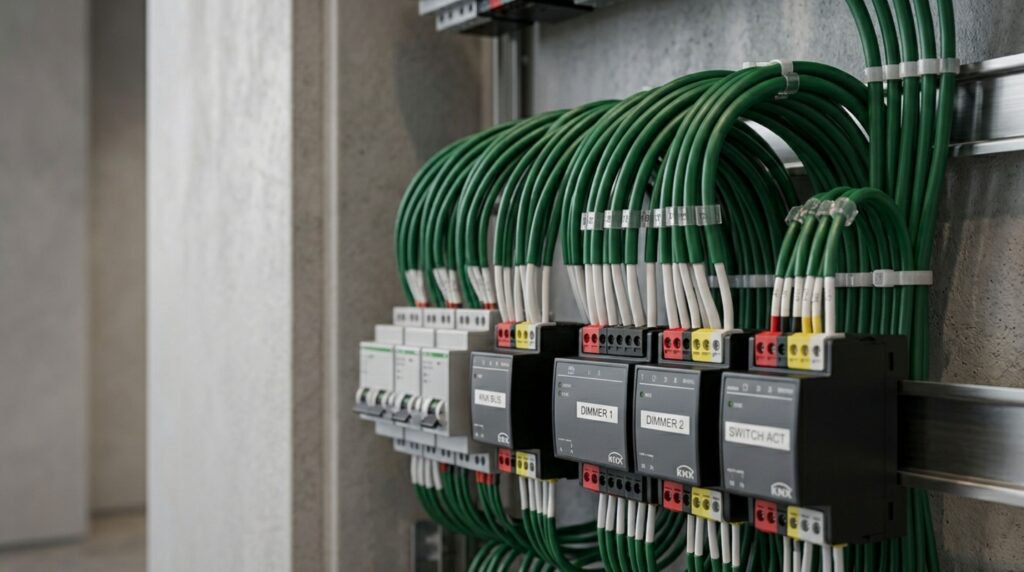
If you are an architect or a homeowner in the planning stage, go Wired. KNX connects every switch, motor, and sensor through one line so they can communicate. This is 100% reliable and adds massive resale value to the property.
If you are retrofitting an existing apartment:
- Wired: Use “Behind-the-switch” modules that fit into your existing electrical boxes.
- Wireless: Look for protocols like Zigbee or Thread. They create a “mesh” where every device helps strengthen the signal, unlike Wi-Fi, which gets congested and slow.
5. Why Sensors are Better than Apps
The ultimate goal of a smart home automation system is to delete the app. If you have to pull out your phone to do something, the automation has failed.
The “Magic” comes from sensors:
- Presence Sensors: Unlike old motion sensors, these can detect a person sitting perfectly still on a sofa, keeping the lights on while you read.
- Lux Sensors: These measure the actual brightness in a room. They won’t turn on the lights at 6 PM if the sun is still streaming through the window.
- Contact/Vibration Sensors: These detect if a window is tilted or if someone is knocking. This lets the house react instantly before anyone can get inside.
Conclusion
Home automation is evolving beyond “remote control” apps and toward the Thinking Home. The goal is to move past basic gadgets and build a home that knows what you need. A solid, wired foundation makes this happen.
When your home technology feels like a natural, invisible part of the architecture, you’ve achieved true automation.
Collaboration Opportunities for Builders and Architects
Developers, architects, and interior designers can enhance residential projects by using a smart home automation system during the planning and design stages.
Techtastic collaborates with industry professionals to ensure automation technology integrates seamlessly with design layouts, electrical infrastructure, and interior design concepts.
Partner with Techtastic to implement a smart home automation system for your upcoming residential projects in Nashik, Navi Mumbai, Sangli, and Lonavla.
Contact Techtastic today at 9769145145 for a professional consultation and see how the best smart home automation system can elevate your design vision.
Technical FAQs
Q: Do I need to change all my wiring to get started with a smart home automation system?
Not necessarily. While a wired KNX system is best for new builds, we can use “hybrid” controllers. These controllers sit in your electrical panel and communicate wirelessly with your existing switches. They provide advanced features without the need to break any walls.
Q: Will my family be able to use the house if the “brain” fails?
Yes. Any professional smart home automation system design includes “Manual Overrides.” Your light switches will still work like normal switches. A smart home should always be a “normal” home first, with an added layer of intelligence.
Q: Is a Smart Home Automation System expensive?
An investment. While DIY gadgets are cheap, they often need replacing every 2-3 years. A professional local-control system lasts over 20 years, just like the regular wiring in your home.