
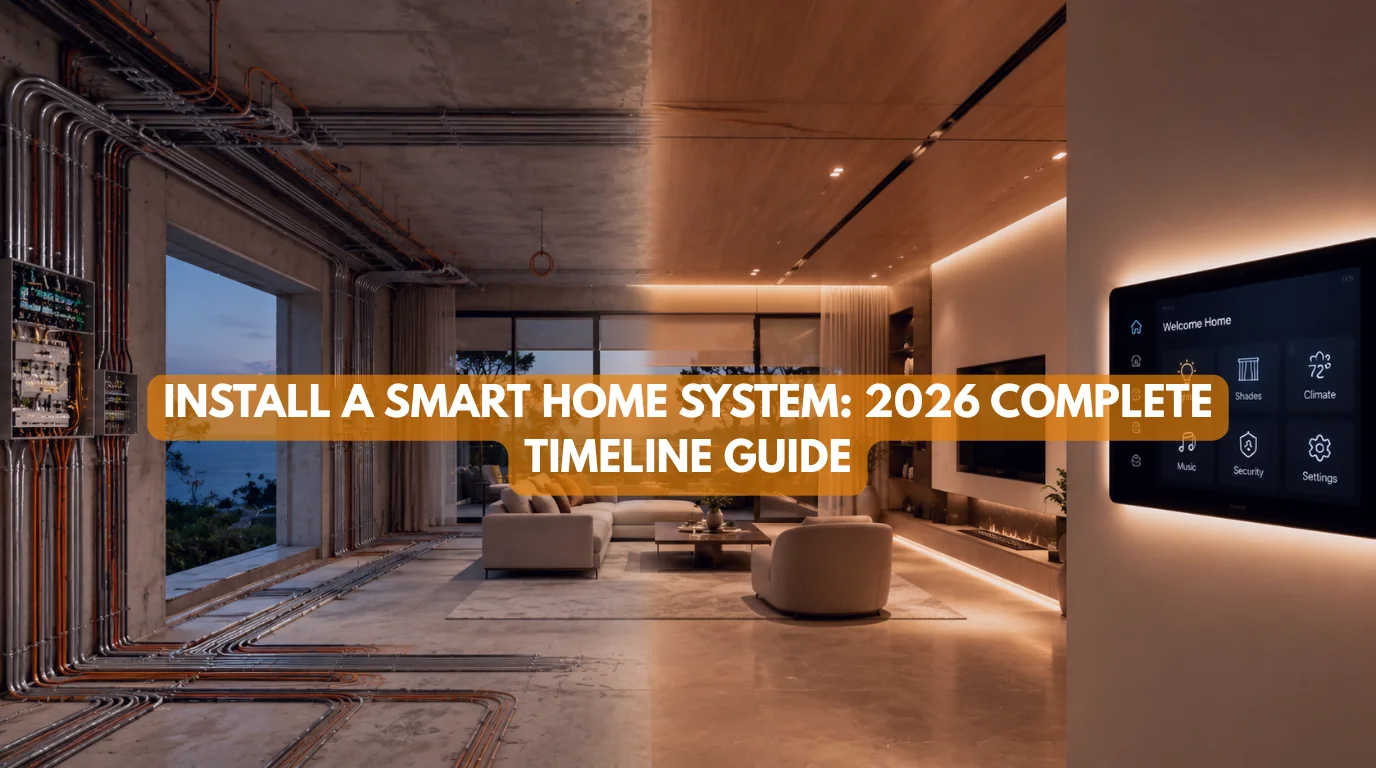
If you’re planning to automate your home, one of the first practical questions you’ll probably ask is: How Long Does It Take to Install a Smart Home System?
The answer depends on much more than the number of smart home devices you want to install.
Installing a couple of wireless smart lights or switches is quick and easy. However, building a fully connected smart home requires much more work. When you combine lighting, shades, media, security, and advanced automation. Then you need careful planning, custom wiring, programming, and thorough testing to get everything working smoothly.
At Techtastic, we treat smart home automation as an integrated engineering project rather than simply installing individual devices. Our process includes consultation, system design, infrastructure planning, device installation, programming, integration, testing, and handover.
So, if you’re asking How Long Does It Take to Install a Smart Home System, the most useful answer is: A simple retrofit can take days, while a professionally integrated whole-home system can take several weeks.
The rest of this guide explains exactly why.
Quick Answer
How Long Does It Take to Install a Smart Home System? A simple wireless smart home upgrade can take a few days. A professionally installed whole-home system can take several weeks.
New KNX builds take longer because planning, wiring, device setup, programming, testing, and coordination happen in stages. The exact timeline depends on property size, automation scope, wired vs. wireless architecture, construction stage, and programming complexity.
Quick Summary
| Project Type | Typical Installation Window* |
|---|---|
| Basic smart devices | 1–3 days |
| Small wireless retrofit | 2–7 days |
| Apartment automation | 1–3 weeks |
| Whole-home automation | 3–6+ weeks |
| Premium villa automation | 4–8+ weeks |
| Complex KNX project | Several weeks, coordinated with construction |
*These are planning ranges, not guaranteed project durations. Actual timelines vary according to scope, site readiness, procurement, electrical work, programming, and coordination with other contractors.
How Long Does It Take to Install a Smart Home System?
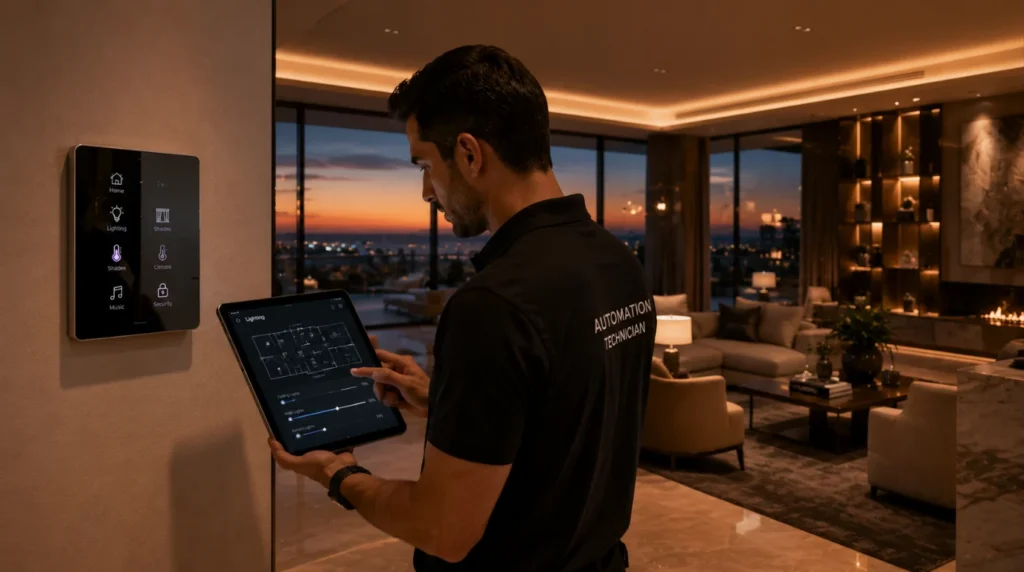
When someone asks how long does it take to install a smart home system, there isn’t one universal number.
A professional installer needs to consider:
- Property size
- Number of rooms
- Number of automation points
- Wired or wireless technology
- Electrical infrastructure
- Network requirements
- Motorized curtains
- Security systems
- HVAC integration
- Home theatre
- KNX programming
- Interior completion
- Availability of equipment
- Coordination with electricians and other contractors
A two-bedroom apartment with wireless lighting and curtain automation is completely different from a 10,000-square-foot villa with KNX lighting, climate control, security, AV, networking, and centralized automation.
That’s why how long does it take to install a smart home system should always be answered after understanding the actual project scope.
What Determines Smart Home Installation Time?
1. Size of the Property
When considering how long does it take to install a smart home system, property size plays a major role: a compact apartment can be completed much faster than a multi-floor villa.
The larger the property, the more time is generally required for:
- Cabling
- Device installation
- Testing
- Programming
- Network configuration
- Commissioning
A compact apartment can be completed much faster than a multi-floor villa.
2. Number of Automation Points
When estimating how long does it take to install a smart home system, the installation time depends heavily on how many points you’re automating.
For example:
Basic
- 10 smart switches
- 2 curtain motors
- 1 smart lock
Advanced
- 50+ lighting circuits
- 20 curtain motors
- Multiple sensors
- CCTV
- Climate control
- Home theatre
- Multi-room audio
The second project naturally requires considerably more engineering and commissioning.
3. Wireless vs Wired Automation
This is one of the biggest factors affecting “How Long Does It Take to Install a Smart Home System.”
Wireless Automation
Wireless systems can generally be installed faster because they require less dedicated infrastructure.
They can be particularly useful for:
- Existing apartments
- Finished homes
- Renovations
- Smaller automation projects
Wired Automation
Wired systems require additional planning and infrastructure.
This can include:
- KNX bus cabling
- Network cabling
- Centralized panels
- Sensor wiring
- Curtain wiring
- AV infrastructure
That makes the installation process more involved.
Wireless vs Wired Installation Timeline
When comparing setups to determine how long does it take to install a smart home system, wired vs. wireless architecture makes a major difference
| Factor | Wireless | Wired / KNX |
|---|---|---|
| Installation Speed | Faster | Slower |
| New Construction | Good | Excellent |
| Existing Home | Excellent | More disruptive |
| Dedicated Wiring | Minimal | Required |
| Planning Requirement | Moderate | High |
| Programming | Moderate | Advanced |
| Future Scalability | Good | Excellent |
| Construction Coordination | Low | High |
For KNX specifically, Techtastic recommends planning wiring before electrical installation because infrastructure decisions affect future scalability and the ability to integrate lighting, climate, security, curtains, and entertainment.
The Smart Home Installation Process
If you’re wondering How Long Does It Take to Install a Smart Home System, understanding the individual stages gives you a much more realistic answer.
Building a smart home isn’t about buying a handful of cool gadgets and plugging them in. To build a system that works seamlessly, professional installation follows a clear 9-step roadmap.
Here is how a smart home goes from an initial idea to a fully automated living space.
Phase 1: Planning & Design
Stage 1: Lifestyle Discovery
Before picking out any devices, begin by understanding how you actually live. A consultation explores:
- Daily routines: Morning, evening, and weekend habits
- Comfort & mood: Lighting preferences, shade control, and climate targets
- Entertainment & security: Audio-visual requirements, alarm setups, and access control
- Future expansion: Planning so new features can be added later
Stage 2: Site Survey
The installer evaluates the physical property to check what can realistically be integrated:
- Layout, ceiling conditions, and shade locations
- Electrical infrastructure and existing wiring
- Wi-Fi and hardwired network coverage
- Existing HVAC and security setups
Stage 3: System Design
This stage creates the technical blueprint for the home, including:
- Automation and network architecture
- Hardware choices and control locations
- Sensor placement and scene blueprints
- Custom wiring plans
Phase 2: Sourcing & Infrastructure
Stage 4: Procurement
Once the blueprint is approved, equipment is sourced:
- Automation controllers and KNX components
- Smart switches, keypads, and touchscreens
- Shade motors and sensor units
- Network gear, security hardware, and AV systems
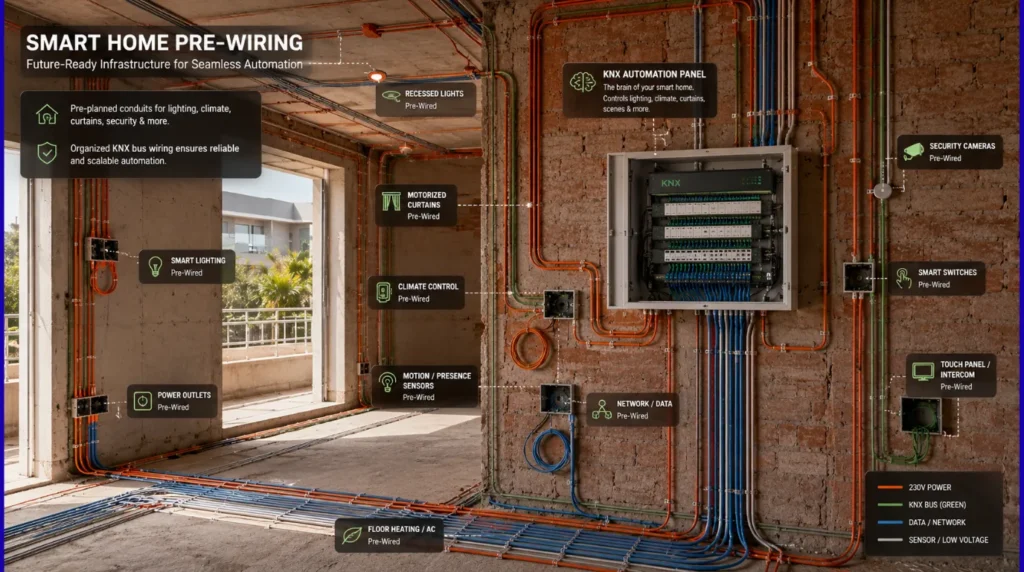
Stage 5: Infrastructure & Wiring
Before devices are installed, the physical backbone of the home is laid out:
- KNX bus cabling and CAT6 network lines
- Security, AV, and shade wiring
- Centralized automation panels
Infrastructure planning works best when coordinated before standard electrical installation begins.
Phase 3: Setup & Integration
Stage 6: Device Installation
The hardware is mounted and connected across the property:
- Smart switches, keypads, and touch panels
- Cameras, smart locks, and sensors
- Shade motors and audio components
- Central system controllers
Stage 7: Programming & Integration
Individual devices are linked together to run coordinated scenes:
- Good Morning: Curtains open → lights brighten → AC adjusts.
- Movie Mode: Curtains close → lights dim → projector starts → AV system activates.
- Good Night: Lights switch off → curtains close → security activates → climate changes.
Stage 8: Testing & Commissioning
Every trigger, switch, sensor, and voice command is tested. The entire system is run through stress tests to make sure every device operates reliably as a single ecosystem.
Stage 9: Handover & Training
The installer guides you through how to operate your new setup:
- Manual overrides and basic troubleshooting
- Mobile apps and touch panel interfaces
- Custom scene controls and voice triggers
How Long Does It Take to Install a Smart Home System in an Existing Home?
When estimating how long does it take to install a smart home system in existing homes are often faster for small wireless projects but can become more complex when significant rewiring is required.
Simple Retrofit
Examples:
- Smart lighting
- Smart locks
- Cameras
- Voice control
Potential timeline: a few days to about a week, depending on scope.
Medium Retrofit
Examples:
- Lighting
- Curtains
- Security
- Networking
- Climate control
Potential timeline: 1–3 weeks.
Complex Retrofit
Examples:
- Whole-home automation
- Extensive networking
- Home theatre
- Multiple curtain systems
- Centralized control
- Significant electrical modifications
Potential timeline: several weeks.
The more invasive the retrofit, the more the timeline depends on civil, electrical, and interior work.
How Long Does It Take to Install a Smart Home System in a New Home?
New construction works differently. Instead of completing everything in one visit, automation is coordinated with the construction process.
This means the overall project timeline can extend across several construction stages even though the automation team isn’t physically working every day.
Techtastic emphasizes that KNX wiring should be planned before electrical installation, making early coordination particularly important for new construction.
How Long Does KNX Smart Home Installation Take?
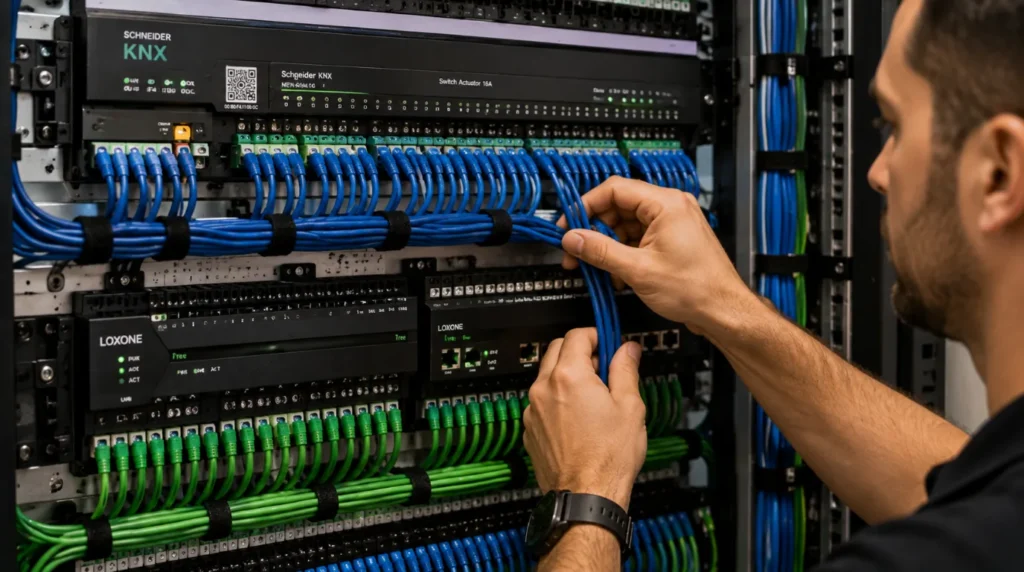
If you’re asking How Long Does It Take to Install a Smart Home System specifically for KNX, expect a longer and more structured process than a basic wireless installation.
KNX projects can involve:
- Detailed design
- Bus wiring
- Distribution panels
- Sensors
- Keypads
- Actuators
- Lighting control
- HVAC integration
- Curtain control
- Programming
- Commissioning
The benefit is a highly scalable professional automation infrastructure designed for long-term use. Techtastic identifies KNX as particularly suitable for luxury homes, villas, large residences, and premium projects.
Mistakes That Can Delay Smart Home Installation?
Knowing How Long Does It Take to Install a Smart Home System also means understanding what can slow the project down.
1. Late Design Changes
Adding new automation points after wiring is complete can require redesign or additional work.
2. Construction Delays
If walls, ceilings, or electrical infrastructure aren’t ready, automation installation may need to wait.
3. Equipment Availability
Sourcing delays on specialized controllers directly affect how long does it take to install a smart home system, as a missing component can hold up final commissioning.
4. Poor Coordination
Automation works alongside:
- Electrical
- Interior design
- HVAC
- Networking
- Security
- AV
Poor coordination between contractors can create delays.
5. Programming Changes
Homeowners sometimes change scene requirements during commissioning.
This is normal, but it can extend the final handover.
New Construction vs Retrofit: Installation Timeline
One of the easiest ways to understand how long does it take to install a Smart Home System is to compare a new home with an existing property.
| Factor | Existing Home | New Construction |
|---|---|---|
| Initial Planning | Moderate | Extensive |
| Wiring Changes | May be difficult | Easier |
| Wireless Automation | Excellent | Good |
| KNX | Possible but more involved | Excellent |
| Construction Coordination | Limited | Essential |
| Installation Speed | Faster for wireless | Spread across construction |
| Future Expansion | Depends on infrastructure | Easier to plan |
| Overall Project | Days to weeks | Integrated into construction schedule |
Wireless vs KNX: Which Is Faster?
If your only consideration is How Long Does It Take to Install a Smart Home System, wireless automation generally has an advantage.
But speed shouldn’t be the only consideration.
Wireless Automation
Best suited for:
- Existing homes
- Apartments
- Renovations
- Smaller projects
- Minimal-disruption installations
KNX Automation
Best suited for:
- New construction
- Luxury villas
- Large homes
- Premium automation projects
- Long-term integrated systems
KNX requires more infrastructure and planning, but that additional work provides a strong foundation for sophisticated automation.
Does a Bigger Smart Home Always Take Longer?
Not necessarily.
A large home with well-planned infrastructure can sometimes progress more efficiently than a smaller home where everything is being retrofitted after construction.
When estimating how long does it take to install a smart home system, the key factors are: Planning + Infrastructure + Coordination + Scope rather than square footage alone.
This is another reason why the answer to “How Long Does It Take to Install a Smart Home System” should always be based on the project rather than a generic number.
What Happens After Installation?
When asking how long does it take to install a smart home system, remember that work doesn’t end when the last device is mounted.
A professional project should include:
Testing
Every device and automation scene is checked.
Commissioning
The system is configured for the actual home.
User Training
Homeowners learn how to use:
- Apps
- Touch panels
- Scenes
- Voice commands
- Manual controls
Documentation
The homeowner should ideally receive relevant system information for future maintenance and upgrades.
Support
Professional support becomes particularly important for complex automation systems.
Our Expert Recommendation
If you’re asking How Long Does It Take to Install a Smart Home System, don’t plan your project around the shortest possible installation time.
Plan around the right installation sequence.
For an existing apartment, a wireless or hybrid system may be completed quickly with minimal disruption. For a new luxury villa, however, we recommend involving the smart home integrator before electrical work begins.
This allows:
- Better wiring
- Cleaner interiors
- Easier integration
- Better system reliability
- Fewer site changes
- Easier future expansion
At Techtastic, our goal isn’t simply to finish installation quickly. It’s to deliver a smart home that continues to work reliably after the installation team leaves.
Key Takeaways
- How Long Does It Take to Install a Smart Home System? Simple wireless installations can take days, while comprehensive whole-home projects can take several weeks.
- Existing homes are often faster for wireless retrofits.
- New construction allows better infrastructure planning but requires coordination across multiple construction stages.
- KNX projects typically involve more planning, wiring, programming, and commissioning.
- Site readiness and infrastructure decisions affect how long does it take to install a smart home system just as much as overall property size.
- Procurement, electrical work, interiors, and late design changes can affect the final schedule.
- Early collaboration with the smart home integrator is one of the best ways to prevent delays.
Frequently Asked Questions
1. How Long Does It Take to Install a Smart Home System?
A. A basic wireless system can potentially be installed within a few days, while a larger whole-home automation project can take several weeks. New-construction projects are typically coordinated with the broader construction schedule.
2. How long does a smart home retrofit take?
A. A simple retrofit may take a few days, while a more comprehensive retrofit involving lighting, curtains, security, networking, and climate control can take several weeks.
3. How long does KNX installation take?
A. KNX installation involves design, wiring, device installation, programming, and commissioning. For a large project, these activities are normally spread across the construction schedule rather than completed in one continuous visit.
4. Can smart home installation be completed in one day?
A. Simple installations involving a limited number of wireless devices may be possible in a day or a few days. A complete professionally integrated smart home normally requires considerably more work.
5. Does a new home take longer to automate?
A. The automation work is usually distributed across different construction stages. Although this can make the overall project span longer, it allows much better infrastructure integration.
6. What takes the longest during smart home installation?
A. For complex projects, design coordination, wiring, programming, integration, testing, and commissioning can take more time than simply mounting the devices.
7. Can I install smart home automation after moving in?
A. Yes. Wireless and hybrid systems make retrofitting existing homes considerably easier.
8. Does KNX take longer than wireless automation?
A. Generally, yes, because KNX projects involve dedicated infrastructure, detailed programming, and more extensive commissioning. However, the additional planning can provide better long-term scalability.
9. Can I speed up smart home installation?
A. The best way to reduce delays is to finalize requirements early, coordinate electrical and interior plans, confirm equipment availability, and involve the automation team before construction reaches critical stages.
10. Should I hire a smart home installer before construction starts?
A. For a new home, especially a luxury villa: yes. Early involvement allows the automation system to be incorporated into electrical, architectural, interior, HVAC, networking, and security planning.
Collaboration Opportunities for Developers, Architects & Interior Designers
Answering how long does it take to install a smart home system becomes much easier when the automation team is involved early alongside architects and builders
At Techtastic, we collaborate with:
- Architects
- Interior Designers
- Builders
- Developers
- Project Management Consultants
- Luxury Villa Developers
We can support projects with:
- Smart Home Planning
- KNX System Design
- Electrical Coordination
- Automation Drawings
- Lighting Automation
- Motorized Curtain Integration
- HVAC Integration
- Structured Networking
- Home Theatre Planning
- Smart Security
- System Programming
- Testing & Commissioning
Early collaboration helps reduce site conflicts and ensures that automation is integrated into the architecture rather than added after the interiors are complete.
Areas We Serve
Techtastic proudly delivers premium smart home automation solutions across:
- Mumbai
- Navi Mumbai
- Pune
- Lonavala
- Nashik
- Sangli
Whether you’re building a luxury villa, renovating an apartment, or developing a premium residential project, our team can design a customized automation solution that fits your lifestyle and long-term goals.
Ready to Plan Your Smart Home?
Knowing How Long Does It Take to Install a Smart Home System is important, but the bigger question is whether the project has been planned correctly.
At Techtastic, we design smart home systems around your property, lifestyle, construction stage, and future requirements. Whether you’re automating an existing apartment or planning a complete KNX system for a luxury villa, our team can help you understand the installation process, timeline, infrastructure requirements, and right technology for your project.
Book a consultation today and let our experts help you create a smart home that’s ready for the future.
Contact Techtastic
🌐 Website: Techtastic Website
📞 Phone: 9769145145
📍 Service Areas: Mumbai • Navi Mumbai • Lonavala • Nashik • Sangli
Planning your ideal smart home setup? Read our What Should a Smart Home Include? (2026 Smart Checklist) for the essential features to consider.