
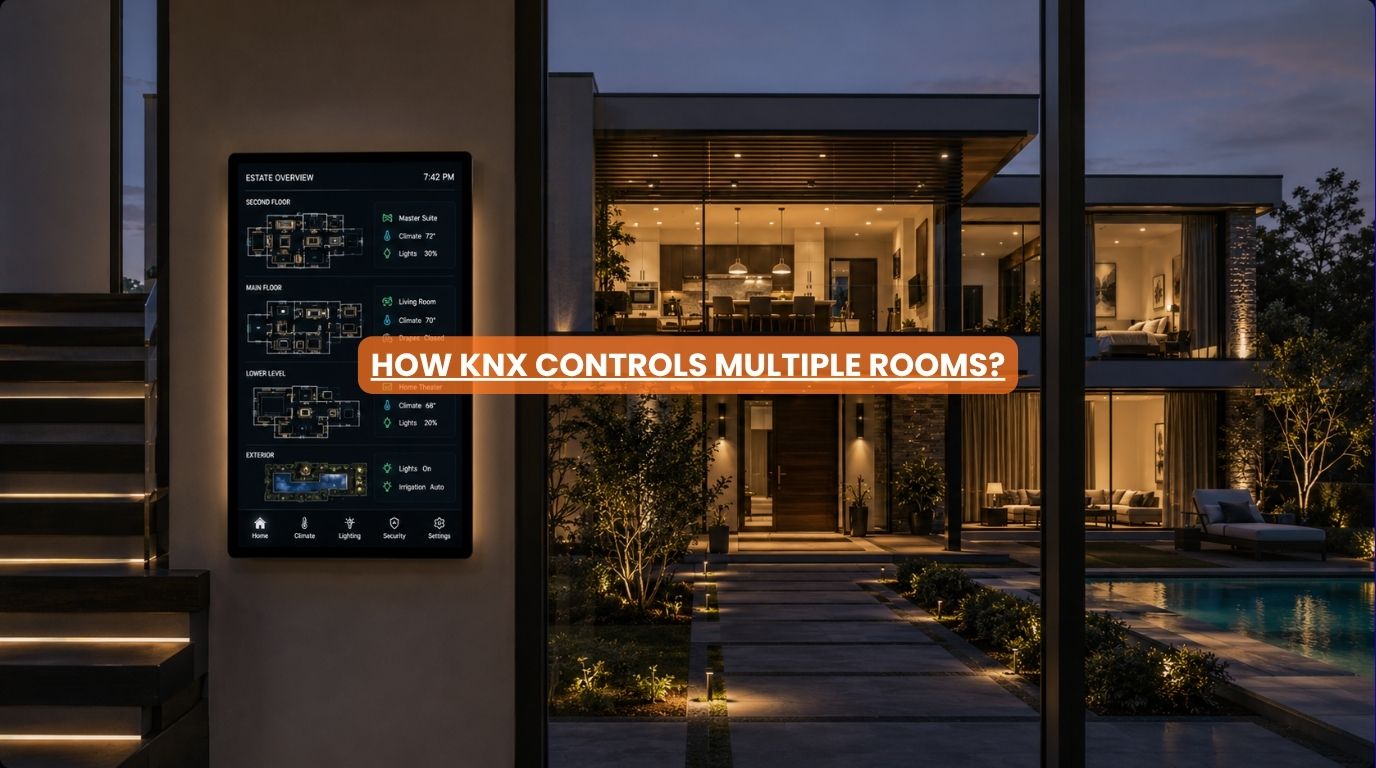
As homes become larger and smarter, one challenge quickly emerges: How do you manage dozens or even hundreds of devices spread across multiple rooms without creating complexity?
Imagine controlling:
- Living room lighting
- Bedroom curtains
- Kitchen climate control
- Security systems
- Outdoor lighting
- Home theatre equipment
All from a single, unified platform. This is exactly where KNX smart home automation excels.
At Techtastic, one of the most common questions homeowners ask during planning stages is: “Can KNX control different rooms independently while still managing the entire home?”
The answer is yes. In fact, multi-room control is one of the biggest reasons architects, developers, and homeowners choose KNX for premium smart homes. Let’s explore how it works.
Summary
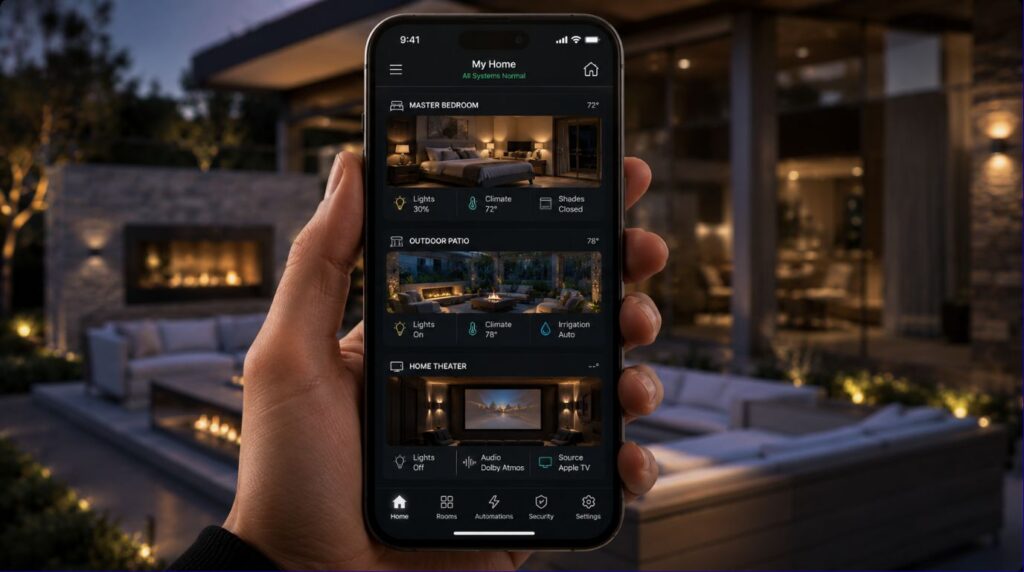
KNX smart home automation handles multiple room control by connecting lighting, climate control, motorized curtains, security systems, entertainment devices, and sensors into a centralized automation platform. Each room can operate independently or as part of larger automation scenes, allowing homeowners to manage entire floors, zones, or the whole property from touch panels, mobile apps, keypads, or automated schedules. This flexibility makes KNX one of the most scalable smart home systems available.
Quick Answer
KNX smart home automation allows homeowners to control multiple rooms independently or collectively through a centralized automation system. Lighting, climate control, motorized curtains, security, and entertainment systems can be managed by room, floor, zone, or entire property. KNX enables personalized room settings while also supporting whole-home automation scenes that coordinate multiple systems simultaneously.
What Is Multi-Room Control in KNX?
Multi-room control means that every room in the home can function as its own intelligent environment while still being connected to a larger automation ecosystem.
For example:
Living Room
- Lighting control
- Motorized curtains
- Climate control
Master Bedroom
- Personalized lighting scenes
- Temperature settings
- Privacy automation
Home Theatre
- Entertainment scenes
- Automated blackout curtains
- Acoustic lighting control
Each room can operate independently while remaining part of the same KNX smart home system.
Why Multi-Room Control Matters
Modern homes are used differently throughout the day. Different family members often have different preferences.
Examples include:
- Different temperature preferences
- Unique lighting requirements
- Individual privacy settings
- Separate entertainment needs
A smart home should adapt to these differences. KNX makes this possible through intelligent zoning and room-based automation.
How KNX Organizes Multiple Rooms
A KNX smart home uses a structured approach that allows devices throughout the property to communicate efficiently.
The system can organize automation by:
Individual Room
Single-room control.
Zone
Groups of rooms.
Floor
Entire levels of the property.
Whole House
Global automation control.
This flexibility makes KNX highly scalable.
Room-Level Control
Every room can have its own automation logic.
Examples include:
Bedroom
- Morning wake-up scene
- Automated curtains
- Personalized climate settings
Kitchen
- Task lighting
- Occupancy-based control
- Ventilation management
Study
- Focus lighting
- Quiet environment settings
Each room behaves according to its specific function.
Zone-Based Control
Sometimes homeowners want to control multiple rooms together. KNX allows rooms to be grouped into zones.
Examples:
Ground Floor Zone
- Living room
- Dining room
- Kitchen
Private Zone
- Bedrooms
- Bathrooms
- Dressing areas
Outdoor Zone
- Garden lighting
- Pool lighting
- Security systems
This simplifies management without sacrificing flexibility.
Whole-Home Control
One of KNX’s biggest advantages is the ability to control the entire property simultaneously.
Examples include:
Good Night Mode
- All lights turn off
- Curtains close
- Security activates
- Climate adjusts
Away Mode
- Unnecessary systems power down
- Security arms
- Energy-saving mode activates
Vacation Mode
- Occupancy simulation starts
- Lighting schedules activate
- Security monitoring increases
These scenes affect the entire home instantly.
How KNX Handles Lighting Across Multiple Rooms
Lighting is one of the most popular KNX smart home applications.
The system can:
Control Individual Lights
Room-by-room operation.
Manage Entire Floors
One command controls multiple areas.
Create Scenes
Examples:
- Entertaining
- Relaxing
- Dining
- Movie mode
Lighting remains flexible regardless of property size.
Climate Control Across Multiple Rooms
Temperature preferences often vary.
KNX allows:
Room-Specific Climate Control
Each room operates independently.
Zone-Based Management
Group similar areas together.
Energy Optimization
Avoid conditioning unused spaces.
This improves both comfort and efficiency.
Motorized Curtain Control
Curtains can be controlled:
Individually
Specific room control.
By Floor
All curtains on one level.
Whole Property
Single-command operation.
Automated Scenarios
Respond to:
- Sunrise
- Sunset
- Occupancy
- Temperature
This improves privacy and comfort.
Security System Integration
KNX can coordinate security across multiple rooms and zones.
Examples include:
Perimeter Security
Outdoor monitoring.
Internal Zones
Sensitive areas protected separately.
Whole-Home Security
Integrated alarm management.
Automation and security work together seamlessly.
Control Methods for Multiple Rooms
KNX smart home offers several ways to manage rooms.
Smart Keypads
Local room control.
Touch Panels
Whole-home visibility.
Mobile Apps
Remote management.
Voice Assistants
Hands-free operation.
Automated Logic
No user interaction required.
The best systems typically combine multiple control methods.
Example: A Typical Family Home
Consider a modern villa.
Morning
- Bedroom curtains open
- Bathroom lighting activates
- Kitchen climate adjusts
Afternoon
- Living room cooling increases
- Outdoor shading activates
Evening
- Entertainment lighting activates
- Security perimeter engages
Night
- The whole-home shutdown scene runs
All of this can occur automatically through KNX.
KNX vs Independent Smart Devices
| Independent Devices | KNX Smart Home Automation |
| Separate apps | Unified control |
| Limited scalability | Highly scalable |
| Device-focused | System-focused |
| Difficult multi-room management | Centralized room control |
| Inconsistent experience | Coordinated automation |
This becomes increasingly important as homes grow larger.
Why KNX Is Ideal for Large Homes
The larger the property, the greater the benefit.
KNX handles:
- Villas
- Luxury residences
- Duplex apartments
- Hospitality projects
- Commercial buildings
without becoming difficult to manage.
Its architecture was specifically designed for scalability.
Common Multi-Room Automation Scenarios
Good Morning
- Bedroom curtains open
- Hallway lights activate
- Climate adjusts
Leaving Home
- The lights switch off
- Security arms
- Energy-saving mode starts
Entertaining Guests
- Living room scenes activate
- Dining lighting adjusts
- Music systems engage
Movie Night
- Curtains close
- Lighting dims
- Home theatre activates
These scenarios demonstrate the real power of centralized control.
Why It Matters for Modern Homes
Homeowners increasingly expect:
- Simplicity
- Personalization
- Convenience
- Scalability
Managing dozens of devices individually becomes impractical.
KNX solves this challenge by creating a unified automation ecosystem that works across every room in the property.
Our Perspective at Techtastic
At Techtastic, we believe one of KNX’s greatest strengths is its ability to make complex homes feel simple.
When designing multi-room automation projects, we focus on:
- Personalized room experiences
- Intuitive control
- Scalable infrastructure
- Energy efficiency
- Long-term flexibility
The goal isn’t to add technology. The goal is to create a home that responds intelligently to how people actually live.
Collaboration Opportunities for Developers, Architects & Interior Designers
Multi-room automation performs best when planned early.
At Techtastic, we collaborate with:
- Architects
- Interior designers
- Luxury home builders
- Residential developers
- Hospitality consultants
- Commercial project planners
KNX Smart Home Infrastructure Planning
Create scalable automation foundations.
Room-Level Automation Design
Optimize user experience.
Lighting & Climate Integration
Enhance comfort and efficiency.
Smart Security Planning
Coordinate protection throughout the property.
Luxury Residential Projects
Deliver premium connected living.
Future-Ready Developments
Support evolving homeowner expectations.
Early collaboration ensures automation enhances both functionality and design.
Key Takeaways
- KNX smart home automation supports room-level, zone-level, floor-level, and whole-home control.
- Each room can operate independently while remaining connected to a centralized system.
- Lighting, climate, curtains, security, and entertainment can all be integrated.
- Automation scenes simplify the management of large properties.
- KNX scales exceptionally well for luxury homes and multi-room environments.
- Centralized control improves convenience, comfort, and efficiency.
Frequently Asked Questions
1. Can KNX control multiple rooms independently?
A. Yes. Each room can have its own lighting, climate, curtain, and automation settings.
2. Does KNX support whole-home control?
A. Absolutely. KNX can manage individual rooms, floors, zones, or the entire property.
3. Can KNX smart home control lighting in different rooms?
A. Yes. Lighting can be controlled individually or grouped into scenes and zones.
4. How does KNX handle climate control across multiple rooms?
A. KNX allows room-by-room temperature management as well as zone-based control.
5. Can KNX automate curtains throughout the house?
A. Yes. Curtains can be managed individually, by floor, by zone, or as part of whole-home scenes.
6. Is KNX smart home suitable for large villas?
A. Yes. KNX smart home is specifically designed for scalable automation across large properties.
7. Can different family members have different room settings?
A. Yes. KNX supports personalized automation preferences for different spaces.
8. Why is KNX smart home better than separate smart devices for multi-room control?
A. A KNX smart home provides centralized management, better scalability, deeper integration, and a more consistent user experience.
Conclusion
KNX smart home automation excels at managing multiple rooms because it combines flexibility with centralized intelligence. Whether controlling a single bedroom, an entire floor, or a luxury villa, KNX allows every space to function independently while remaining part of a unified automation ecosystem. The result is greater convenience, personalized comfort, improved energy efficiency, and a more seamless smart home experience.
At Techtastic, we help homeowners, architects, developers, and designers create KNX-powered environments that simplify life while supporting long-term scalability.
📞 Call/WhatsApp: 9769145145
📍 Our Operational Hubs: Navi Mumbai | Nashik | Lonavla | Sangli
When designed properly, multi-room automation doesn’t make a home more complicated—it makes it feel effortless.
Want to ensure your system investment is fully protected? Head over to our deep dive on 10 KNX Installation Mistakes to Avoid to learn how we future-proof your smart home infrastructure.