
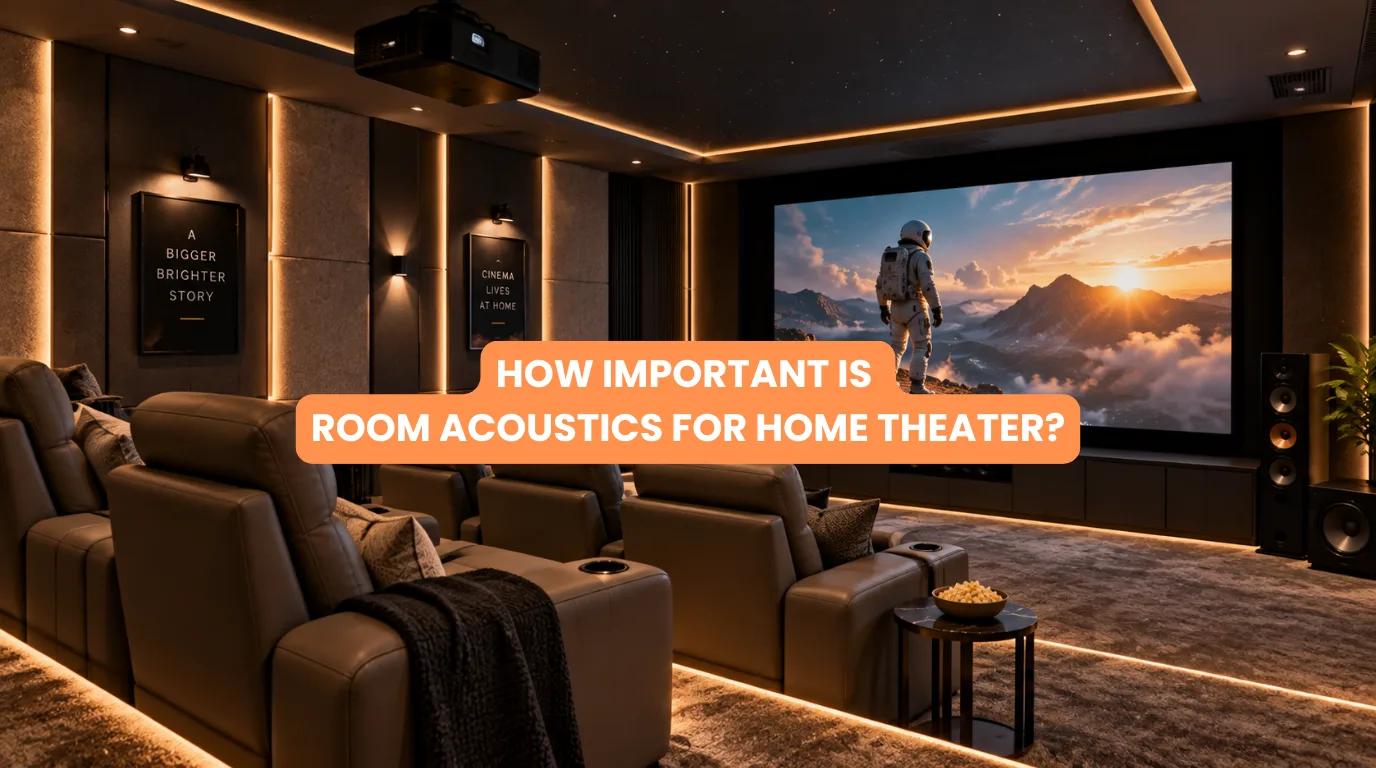
You can spend ₹2 lakh, ₹5 lakh, or even ₹10 lakh on home theater equipment and still end up disappointed with the sound. Why?
Because room acoustics for home theater can be just as important as the equipment itself. Your speakers don’t operate in isolation. Sound moves through the room. It reflects off walls and ceilings. It interacts with floors and furniture. It then reaches your ears.
If those reflections are poorly controlled, dialogue can become less clear, bass can sound uneven, and surround effects can lose their precision. A well-designed room can make a mid-priced system sound better than an expensive system. This is especially true when there is no acoustic planning.
Quick Summary
✓ Room acoustics for home theater have a major impact on sound quality.
✓ Hard surfaces create reflections that can reduce clarity.
✓ Bass problems are often caused by room dimensions and positioning, not weak subwoofers.
✓ Acoustic treatment and soundproofing are two different things.
✓ You don’t need to cover every wall with acoustic panels.
✓ Carpets, curtains, sofas, and furniture can naturally help control reflections.
✓Plan speaker and subwoofer placement together with acoustic treatment.
✓ Dolby Atmos benefits from proper room planning and speaker positioning.
✓ Acoustic treatment should ideally be considered before the theater is built.
Quick Answer
If I had to simplify the relationship, think of a home theater as: Equipment + Room + Placement + Calibration, and not simply: Expensive Equipment = Great Sound
The room acoustics for home theater determine how the sound produced by your speakers behaves after it enters the room. A speaker may have great specifications, but a room can still cause problems. Excess reflections, standing waves, or uncontrolled reverb can limit what you hear. You may not hear the system at its full potential.
What Exactly Are Room Acoustics for Home Theater?
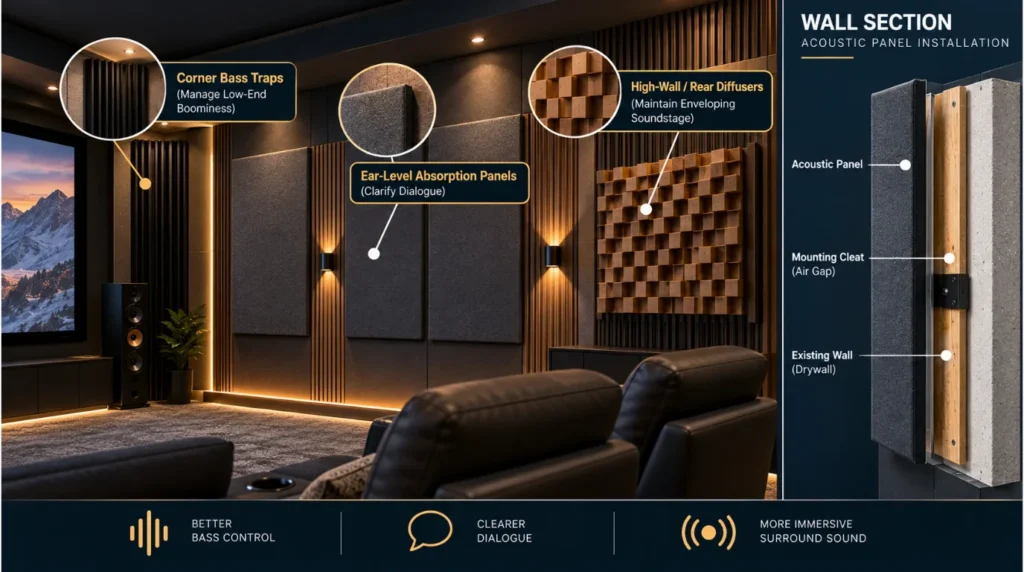
Room acoustics describe how sound behaves inside an enclosed space. When a speaker produces sound, some of it travels directly toward you. The rest interacts with the room.
It can:
- Reflect from walls
- Bounce off the ceiling
- Reflect from the floor
- Interact with furniture
- Build up in corners
- Lose energy through soft materials
- Combine with other reflections
Your ears receive a combination of direct and reflected sound. That combination determines how the theater actually sounds.
This is why room acoustics for home theater should be considered during the room-planning stage rather than after the speakers have already been purchased.
Why Do Hard Surfaces Cause Problems?
Imagine a home theater with:
- Marble flooring
- Glass windows
- Bare walls
- Hard ceiling
- Minimal furniture
Sound will continuously bounce around the room. These reflections can create:
Reduced dialogue clarity
Voices may sound less focused, particularly during fast conversations.
Excessive brightness
High frequencies can become more prominent because of repeated reflections.
Echo or reverberation
The room can sound “live” instead of controlled.
Poor imaging
You may have difficulty identifying exactly where certain sounds are coming from. This doesn’t mean hard surfaces are always bad. The objective isn’t to make the room completely dead.
The goal of room acoustics for home theater is to create an appropriate balance between direct sound, useful reflections, and controlled reverberation.
Bass Is Usually the Hardest Problem
High-frequency reflections are relatively easy to manage. Low frequencies are much more difficult. This is because bass wavelengths are long and interact strongly with room dimensions. You can experience situations where one seat has powerful bass.
Move a few feet away, and suddenly the bass feels weak. That’s not necessarily because your subwoofer is inadequate. It may be a room-mode problem. This is one of the reasons simply purchasing a bigger subwoofer isn’t always the answer.
Good room acoustics for home theater requires attention to:
- Room dimensions
- Subwoofer position
- Seating position
- Multiple subwoofers where appropriate
- Bass management
- Acoustic treatment
- Calibration
Acoustic Treatment vs Soundproofing
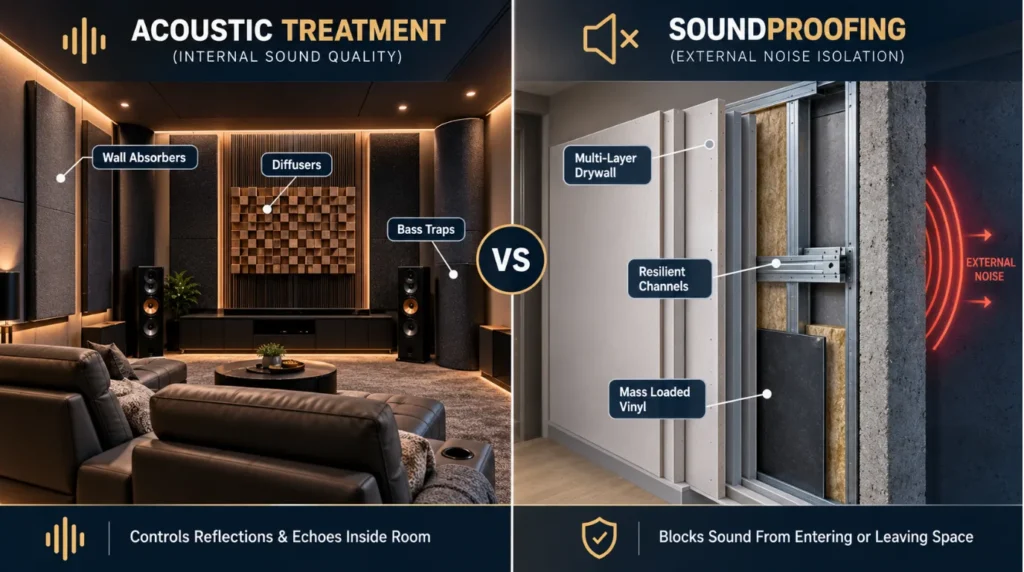
This distinction is extremely important. People frequently use these terms interchangeably. They aren’t the same.
| Acoustic Treatment | Soundproofing |
|---|---|
| Improves sound inside the room | Reduces sound transmission |
| Controls reflections | Limits sound entering/leaving |
| Improves clarity | Improves isolation |
| Uses absorbers/diffusers/bass treatment | Uses construction techniques and mass |
| Primarily affects sound quality | Primarily affects noise transfer |
If your objective is better movie sound, you’re primarily discussing acoustic treatment, but if you are trying to prevent the family from hearing your action movie at midnight, you’re discussing sound isolation. A professional theater may require both.
What Does Room Acoustics for Home Theater Require?
There is no universal treatment package for every room.
The right approach depends on:
- Room dimensions
- Speaker locations
- Seating
- Wall construction
- Floor
- Ceiling
- Windows
- Existing furniture
- Target sound profile
However, several treatment strategies are commonly useful.
1. Absorption
Absorption reduces reflections by converting some sound energy into heat. You can position acoustic panels at important reflection points. This can improve clarity and reduce excessive reverberation.
2. Bass Traps
Bass traps are designed to help manage low-frequency energy, particularly in room corners. They become increasingly useful in dedicated theater rooms where low-frequency performance is a priority.
3. Diffusion
Diffusers scatter sound rather than simply absorbing it. They can help prevent a room from becoming acoustically lifeless while controlling problematic reflections. The placement needs to be carefully considered.
How Much Acoustic Treatment Is Enough?
More is not automatically better. One of the biggest mistakes I see is turning a theater into a room covered entirely with thick absorption. That can make the space feel unnaturally dead.
A better approach is to create a balance.
Room acoustics for home theater require a treatment that should be strategically placed around the room based on reflection points and the theater’s intended listening experience. You can also use the room itself. A large sofa, carpet, curtains, and other soft furnishings naturally absorb some sound.
Does Room Size Affect Room Acoustics for Home Theater?
Absolutely.
Room dimensions influence:
- Bass response
- Reflections
- Speaker placement
- Seating positions
- Screen size
- Surround placement
- Atmos speaker locations
A rectangular room is often easier to work with than an irregularly shaped room. However, an unusual room doesn’t automatically mean you cannot build a great theater.
It simply requires more careful planning. Techtastic’s room acoustics for home theater guidance emphasizes considering room dimensions, viewing distance, and speaker placement before selecting the final equipment.
Speaker Placement and Acoustics Work Together
You cannot properly plan room acoustics for home theater without considering speaker placement.
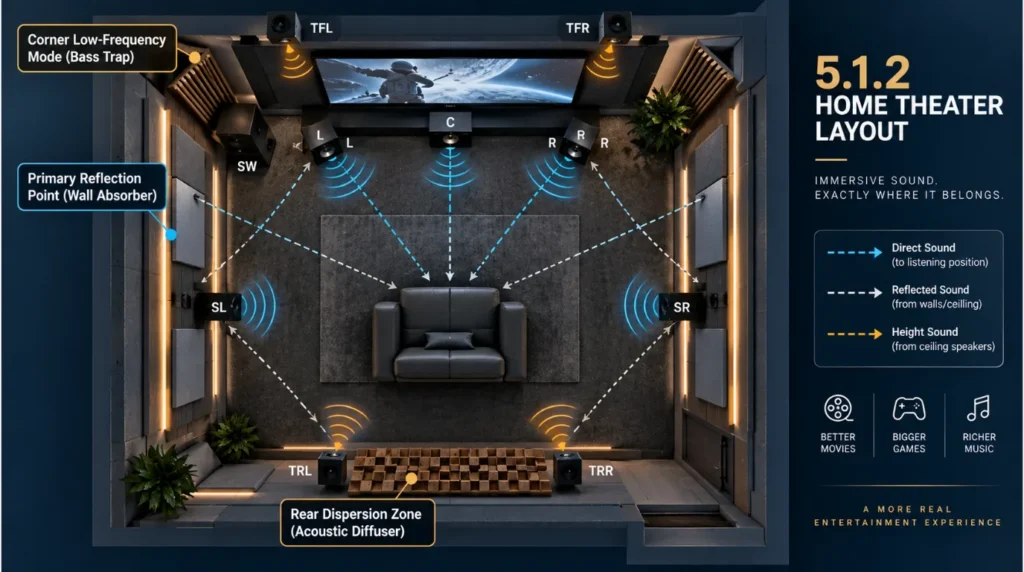
For a 5.1 system, you need to coordinate:
- Front left
- Centre
- Front right
- Surround left
- Surround right
- Subwoofer
For Dolby Atmos, ceiling or height channels add another layer of positioning requirements. The listening position is equally important. If you push your sofa directly against the rear wall, you may create acoustic and surround-placement problems.
That’s why I recommend deciding on the seating position before finalizing speaker positions.
What About Dolby Atmos?
Dolby Atmos can add a much more immersive experience by introducing sound from above. But adding ceiling speakers doesn’t automatically create good Atmos.
You still need:
- Correct speaker positioning
- Appropriate ceiling height
- Proper calibration
- Suitable room dimensions
- Controlled reflections
This is another reason room acoustics for home theater becomes increasingly important as the system becomes more sophisticated. A well-designed 5.1 system in a good room can be far more enjoyable than a poorly planned 7.2.4 system.
Can Curtains and Carpets Improve Acoustics?
Yes. You don’t need expensive products to achieve meaningful improvements in room acoustics for a home theater.
Curtains
Heavy curtains can help reduce reflections from large windows.
Carpet
Carpet helps reduce floor reflections.
Sofa
Upholstered furniture absorbs sound and reduces some reflections.
Bookshelves and furniture
Irregular surfaces can help scatter sound. These aren’t substitutes for professional acoustic treatment in a dedicated theater, but they can contribute significantly to a balanced room. This is particularly useful when your home theater is also a living room.
What About a Living Room Home Theater?
You don’t need a dedicated cinema room to benefit from room acoustics for home theater. In fact, living rooms often already contain useful acoustic elements.
For example:
- Curtains
- Rugs
- Sofas
- Cushions
- Wood furniture
- Decorative surfaces
The challenge is balancing acoustics with interior design. You don’t want your living room to look like a recording studio. That’s why acoustic treatment can be integrated into:
- Wall panels
- Feature walls
- Fabric panels
- Ceiling details
- Decorative elements
The technology and acoustic treatment should complement the interior rather than compete with it.
When Should You Plan the Room Acoustics for Home Theater?
Before construction or renovation is ideal. This allows your architect, interior designer, and automation/AV integrator to coordinate:
- Speaker locations
- Electrical points
- Cable pathways
- Ceiling speakers
- Projector position
- Screen location
- Acoustic panels
- HVAC
- Lighting
- Curtains
- Equipment rack
Late-stage acoustic treatment is still possible, but your options become more limited. This is especially important for dedicated theaters, where the walls, ceiling, and floor can match the desired acoustic performance.
How Much Does Room Acoustics for Home Theater Cost?
There isn’t a single standard price. A living-room theater may require little more than strategic furnishings and a few acoustic treatments.
A dedicated theater can require considerably more. Your cost depends on:
- Room dimensions
- Treatment quantity
- Panel construction
- Bass treatment
- Wall construction
- Ceiling treatment
- Fabric finishes
- Custom design
- Installation
So I wouldn’t create a fixed acoustic-treatment budget before evaluating the room. Instead, treat acoustics as part of the overall theater design.
Common Mistakes When Planning Room Acoustics for Home Theater
1. Buying expensive speakers first
The room should influence the speaker selection and not the other way around.
2. Putting the sofa against the wall
This can create avoidable acoustic and surround problems.
3. Using only one subwoofer without testing placement
One location may create uneven bass.
4. Covering everything with absorption
A completely dead room isn’t necessarily desirable.
5. Confusing soundproofing with acoustic treatment
One improves sound quality; the other controls sound transmission.
6. Ignoring HVAC noise
A noisy air-conditioning system can become extremely noticeable during quiet movie scenes.
7. Leaving acoustics until the end
By then, speaker positions, wiring, and architectural choices may already be fixed.
Techtastic’s Approach to Room Acoustics
At Techtastic, we don’t treat the theater as a collection of individual products. We look at the entire room. That means coordinating: Room → Seating → Speakers → Acoustics → Display → Lighting → HVAC → Automation
Our goal is to create an environment where the technology works naturally within the architecture. For a premium home theater, room acoustics for home theater can be planned alongside the architect and interior designer from the beginning.
This design integrates speakers, acoustic panels, lighting, curtains, and equipment cleanly.
Key Takeaways
Room acoustics for home Theater are not an optional luxury if sound quality matters to you.
They influence:
✓ Dialogue clarity
✓ Bass response
✓ Surround imaging
✓ Immersion
✓ Soundstage
✓ Listening comfort
✓ Overall system performance
You don’t necessarily need a completely dedicated cinema room or thousands of rupees worth of acoustic panels. You need the right acoustic strategy for your room. The best results come from combining room planning, speaker positioning, acoustic treatment, and calibration.
Frequently Asked Questions
1. How important are Room Acoustics for Home Theater?
A. They are extremely important because the room directly affects how sound reflects, is absorbed, and reaches your ears. Good equipment cannot completely overcome poor room acoustics.
2. Do I need acoustic panels in my home theater?
A. Not necessarily. The requirement depends on your room. Curtains, carpets, and furniture already provide some acoustic absorption, while dedicated theaters may benefit from professionally positioned panels.
3. Are acoustic treatment and soundproofing the same?
A. No. Acoustic treatment improves the sound inside the room, while soundproofing attempts to reduce sound transmission between spaces.
4. Can acoustic treatment improve bass?
A. Yes, particularly when appropriate bass treatment and subwoofer placement are used. However, bass problems can also require changes to seating and subwoofer positioning.
5. Does a small room need acoustic treatment?
A. Yes. Small rooms can have significant reflection and bass issues. The treatment strategy simply needs to scale to the room.
6. Can I use a living room for a home theater?
A. Absolutely. A living room can work well when seating, speaker placement, lighting, and acoustic reflections are considered together.
7. Does Dolby Atmos require special acoustics?
A. Atmos doesn’t automatically require an acoustically treated dedicated room, but correct speaker positioning, room geometry, and controlled reflections can substantially improve the experience.
8. Should I choose speakers before acoustic treatment?
A. Ideally, you should consider room dimensions, seating, speaker selection, and acoustic planning together rather than independently.
9. How can I improve room acoustics for home theater cheaply?
A. Start with practical elements such as rugs, curtains, upholstered furniture, and strategic speaker positioning. These can help before investing in specialized acoustic products.
10. When should I plan the room acoustics for home theater?
A. The earlier the better. During construction or renovation, acoustics can be coordinated with electrical, HVAC, interiors, wiring, and speaker placement.
Collaboration Opportunities for Architects & Interior Designers
Room acoustics for a home theater is an excellent area for collaboration between AV integrators, architects, and interior designers. Before finalizing the room, we recommend coordinating:
- Seating layout
- Screen dimensions
- Speaker locations
- Ceiling speaker positions
- Acoustic treatment
- Lighting
- HVAC
- Motorized curtains
- Equipment racks
- Cable pathways
This allows the final theater to look like part of the architecture rather than technology installed inside it. For luxury villas, this early collaboration is particularly valuable.
Areas We Serve
Techtastic works with homeowners, architects, interior designers, and developers across:
Navi Mumbai | Nashik | Lonavla | Sangli
We also support smart-home, AV, and home-theater projects across the wider Mumbai and Thane region.
Final Verdict: Room Acoustics for Home Theater
So, how important is room acoustics for home theater? Very important, often more important than homeowners initially realize.
You can upgrade your speakers, amplifier, or projector. But if your room still causes strong reflections, uneven bass, and poor imaging, you lose performance. The best home theater isn’t simply a room filled with expensive equipment.
It’s a carefully coordinated environment where acoustics, speakers, seating, display, lighting, HVAC, and automation work together. If you’re building or renovating a theater, plan the acoustics before the walls close, not after you hear the first disappointing movie soundtrack.
Contact Techtastic
🌐 Website: Techtastic Website
📞 Phone: 9769145145
📍 Service Areas: Mumbai • Navi Mumbai • Pune • Lonavala • Nashik • Sangli