
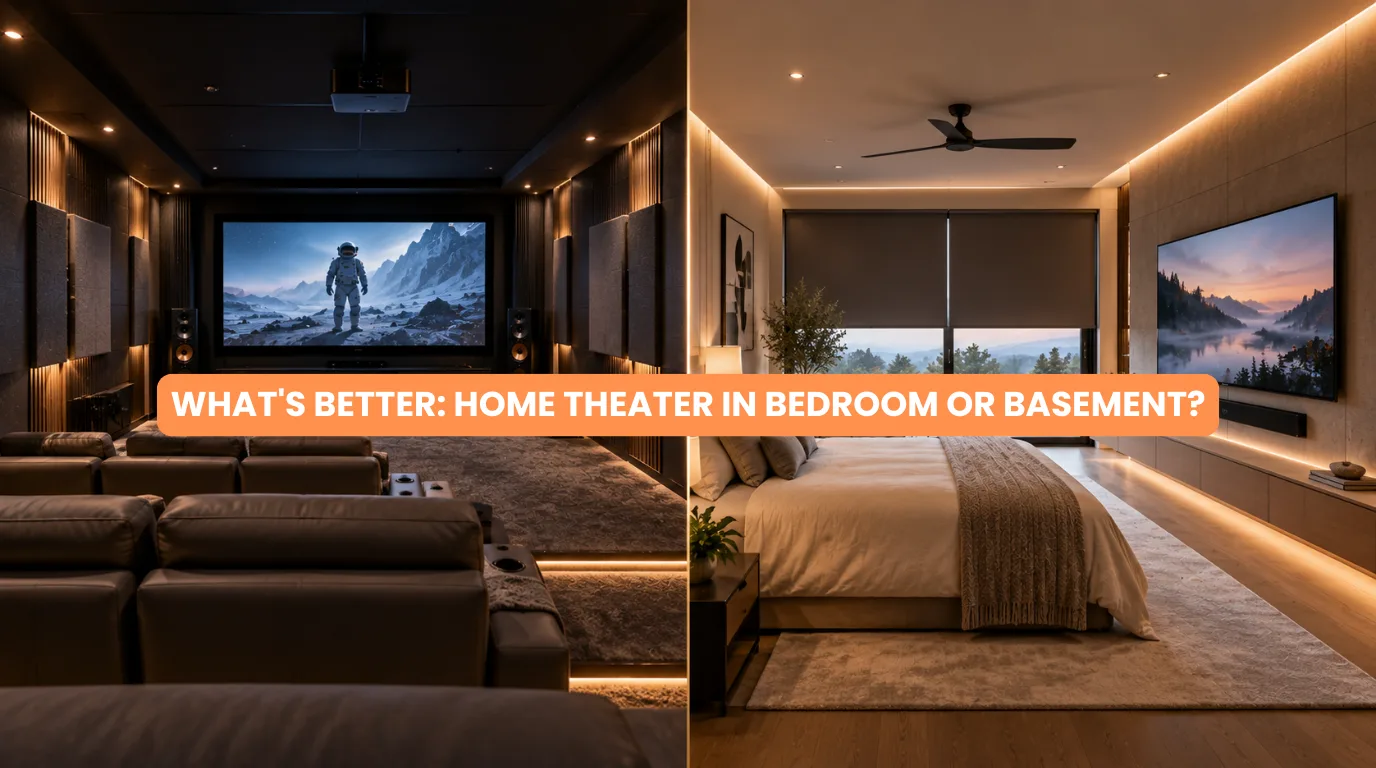
When homeowners start planning a private cinema, one of the first decisions is surprisingly difficult: Should I create a home theater in bedroom or basement? Both options can work extremely well, but they deliver different experiences.
A bedroom offers convenience, privacy, and easy access. A basement can provide better separation from the rest of the home. It also offers more flexibility and the chance to create a dedicated cinema room.
The right choice depends on your home’s architecture, available space, family usage, acoustics, budget and how serious you want the theater to be. If you’re deciding between a home theater in bedroom or basement, don’t choose based on room availability alone. Think about the experience you want to create.
Quick Summary
✓ A bedroom theater is convenient and works well for personal or couple-focused viewing.
✓ A basement is generally better suited to a dedicated cinematic experience.
✓ Basements usually provide greater privacy and better light control.
✓ Bedrooms can be easier and less expensive to convert.
✓ Acoustics need attention whether you choose a home theater in a bedroom or basement.
✓ A basement gives you more flexibility for larger screens, seating, and equipment.
✓ Bedroom theaters are excellent when space is limited.
Consider construction, moisture, ventilation, and access for basements. Make your decision alongside your architect, interior designer, and AV integrator.
Quick Answer
For the most immersive dedicated cinema, I would generally choose a basement. If you want convenience, privacy, and a compact entertainment room, a bedroom can be an excellent option. So, when comparing a home theater in bedroom or basement, the answer isn’t simply “basement is better.” It’s about matching the room to your priorities.
| Factor | Bedroom | Basement |
|---|---|---|
| Convenience | Excellent | Good |
| Privacy | Excellent | Excellent |
| Light control | Good | Excellent |
| Space | Usually limited | Usually better |
| Acoustic isolation | Moderate | Potentially better |
| Large screen | Moderate | Excellent |
| Dedicated theater design | Moderate | Excellent |
| Installation complexity | Lower | Higher |
| Cost potential | Lower | Higher |
| Best for | Personal/family viewing | Dedicated cinema |
Why Choose a Home Theater in a Bedroom?
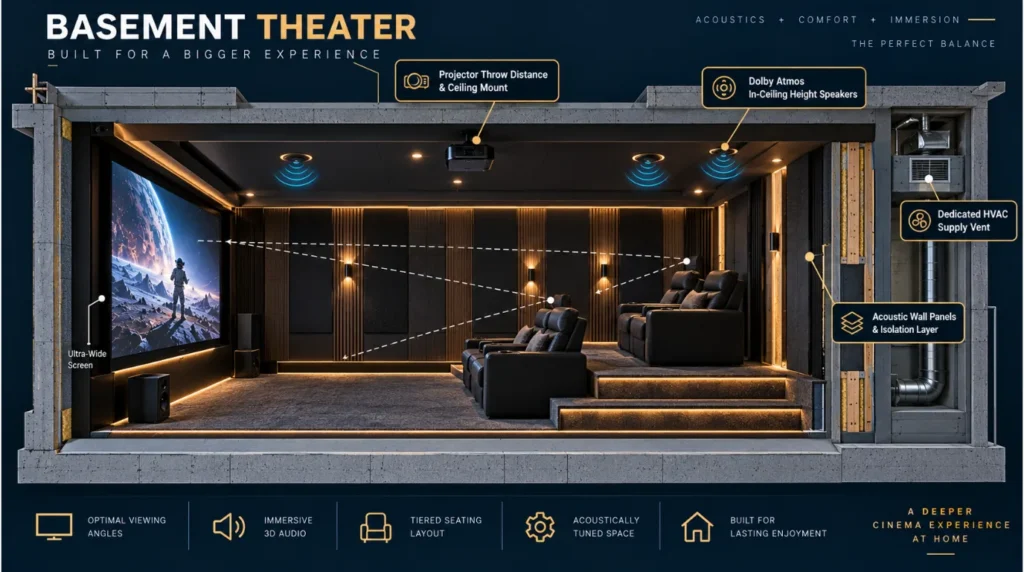
A bedroom can be an unexpectedly good location for a private theater. It already has several characteristics that work in your favor.
You usually have:
- A private space
- Soft furnishings
- Curtains
- A bed or upholstered furniture
- Controlled lighting
- Easy access
- Existing electrical infrastructure
A bedroom theater can therefore be created without converting an entirely new room. For homeowners who want a private movie-watching space without major construction, a bedroom can be the practical choice.
Advantages of a Bedroom Home Theater
1. Maximum Convenience
The biggest advantage is accessibility. You don’t have to walk to another part of the house. You can finish watching a movie and be minutes away from bed.
This makes a bedroom theater particularly attractive for:
- Couples
- Small families
- Late-night viewing
- Personal entertainment
- Gaming
When evaluating a home theater in bedroom or basement, convenience is often underestimated.
2. Lower Installation Complexity
A bedroom may already have finished flooring, electrical infrastructure, lighting, and HVAC. That can reduce the amount of construction required.
You can potentially install:
- Large TV
- 5.1 surround system
- Soundbar
- Projector
- Motorized curtains
- Smart lighting
without creating a completely new architectural space.
3. Natural Acoustic Absorption
Bedrooms typically contain soft materials.
Think:
- Mattress
- Curtains
- Upholstered furniture
- Carpets or rugs
- Cushions
These can help reduce excessive sound reflections.
That doesn’t mean a home theater in a bedroom or basement will have perfect acoustics, but a bedroom can be a more forgiving starting point than an empty room with hard surfaces.
What Are the Disadvantages of a Bedroom Theater?
The biggest limitation is space. A bedroom isn’t usually designed around:
- Large viewing distances
- Multiple seating rows
- Large speakers
- Projector throws
- Equipment racks
- Acoustic treatment
- Ceiling speakers
Furniture can also restrict speaker placement, and if you’re sharing the bedroom, the theater needs to work around sleeping requirements. This is where the home theater in bedroom or basement decision becomes more complicated.
Why Choose a Home Theater in a Basement?
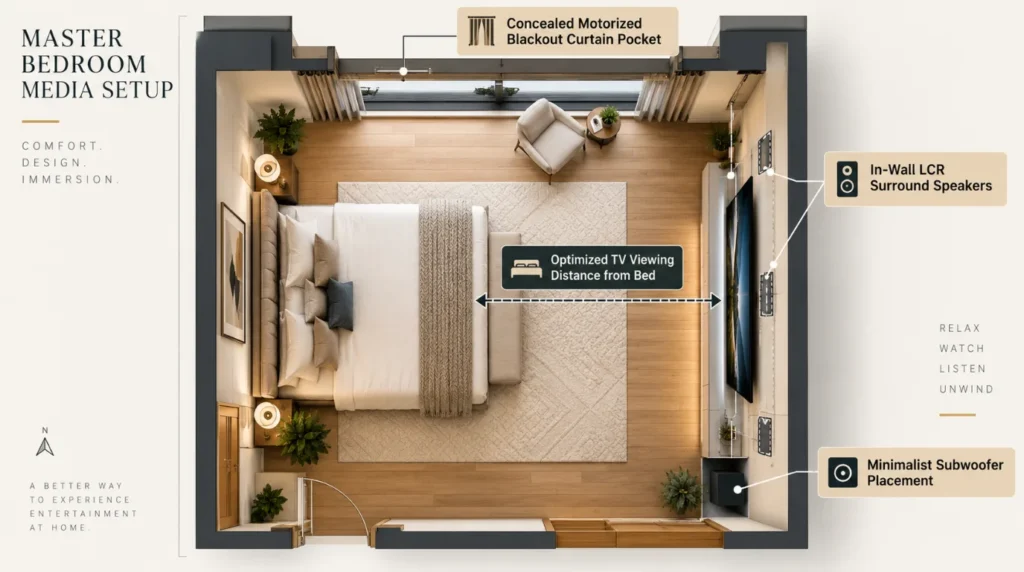
A basement is almost the opposite. It can be designed specifically around the theater. You aren’t necessarily starting with an existing bedroom layout. Instead, you can create the room around:
Screen → Seating → Speakers → Acoustics → Lighting → HVAC → Automation
This makes a basement particularly attractive for a dedicated home theater.
Advantages of a Basement Home Theater
1. Better Light Control
This is one of the biggest advantages. A projector performs best when you control ambient light. Basements often have fewer or smaller windows than bedrooms, making blackout control easier. That can help create a more cinematic environment.
2. Greater Privacy
A basement can naturally separate the theater from:
- Bedrooms
- Living rooms
- Kitchen
- Guest areas
That makes it particularly useful for long movie sessions, gaming, or watching content at higher volume. For homeowners comparing a home theater in bedroom or basement, this separation can be a major advantage.
3. More Design Freedom
A basement gives you more opportunities to create a purpose-built room. You can potentially incorporate:
- Tiered seating
- Large projection screen
- Multiple subwoofers
- Surround speakers
- Ceiling Atmos speakers
- Acoustic panels
- Equipment rack
- Movie lighting
- Decorative wall treatments
You aren’t trying to squeeze a cinema into an existing bedroom. You’re designing a cinema from the ground up.
What Are the Disadvantages of a Basement Theater?
A basement also comes with additional considerations.
Moisture
Basements need appropriate moisture management. Before investing in expensive AV equipment and interiors, make sure the room is suitable for long-term use.
Ventilation
A dedicated theater can contain several heat-producing devices. The HVAC design needs to account for:
- Occupancy
- AV equipment
- Projector
- Amplifiers
- Room size
Construction
You may need:
- New electrical circuits
- Wiring
- Acoustic treatment
- Ceiling work
- Flooring
- HVAC modifications
- Wall finishes
- Lighting
Consequently, the overall project can become significantly more expensive.
Home Theater in Bedroom or Basement: Which Has Better Acoustics?
There is no automatic winner. The room’s shape, build, speaker placement, and acoustic treatment matter more than whether it is a bedroom or basement. A bedroom may already have soft furnishings that help control reflections.
A basement may allow you to construct walls, ceilings, and acoustic treatment specifically for the theater. For a dedicated cinema, that design freedom is a major advantage.
Techtastic’s home theater in bedroom or basement planning guidance also emphasizes considering room dimensions, viewing distance, and speaker placement before selecting the final equipment.
Which Room Is Better for a Projector?
Generally, the basement. The reason isn’t simply image quality.
It’s control. A projector-based theater benefits from:
- Low ambient light
- Appropriate screen distance
- Correct projector throw
- Controlled reflections
- Proper ceiling height
- Suitable seating distance
A bedroom can absolutely use a projector, but furniture, windows and limited throw distance may make planning more difficult. If your goal is a large cinematic image, the basement usually provides more flexibility.
What About a Large 4K TV?
This makes the bedroom option much more attractive. If you are using a large television rather than projection, you don’t need to worry as much about:
- Projector throw distance
- Screen mounting
- Blackout requirements
- Projector noise
A large 4K TV paired with a good 5.1 system can create an excellent bedroom theater. For many homeowners, this is the sweet spot.
Which Is Better for Dolby Atmos?
Again, the basement generally has an advantage for a dedicated system. Dolby Atmos requires careful placement of height speakers relative to the seating position.
A bedroom may have:
- Lower ceilings
- Existing ceiling lights
- Fans
- Wardrobes
- Furniture restrictions
A basement under renovation gives you greater control over the ceiling layout. This makes it easier to integrate:
- In-ceiling speakers
- Acoustic treatment
- Lighting
- HVAC
- Projector infrastructure
So for a serious Atmos theater, I’d lean toward the basement.
Home Theater in Bedroom or Basement: What About Cost?
The bedroom generally has the advantage when comparing initial construction requirements. You may already have the room finished. The basement, however, can require substantial architectural work. Your total cost depends on whether you’re building: Basic entertainment room or Dedicated cinema room
A bedroom might need AV equipment and installation primarily. A basement might require AV equipment plus construction, acoustics, electrical, HVAC and interiors. Therefore, when comparing a home theater in bedroom or basement, don’t compare only the price of the speakers and TV. Compare the complete project cost.
Which Is Better for Home Automation?
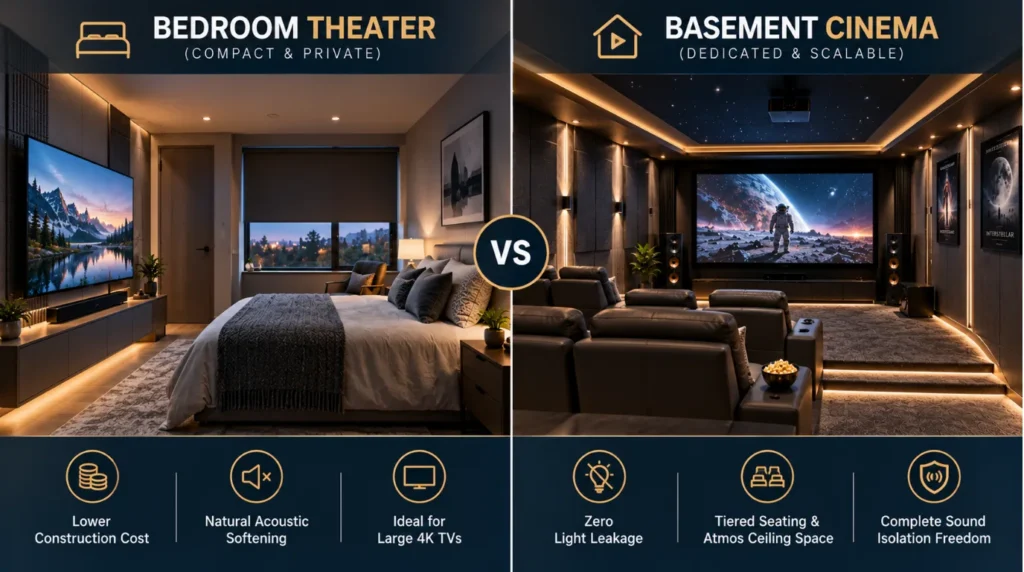
When it comes to planning for a home theater in bedroom or basement, both can be excellent. A bedroom theater could have a simple:
Movie Scene
→ Lights dim
→ Curtains close
→ TV turns on
→ AV system activates
A dedicated basement theater can go much further:
Cinema Mode
→ Main lights turn off
→ Step lights activate
→ Curtains close
→ Projector starts
→ Screen lowers
→ AV system turns on
→ HVAC adjusts
→ Movie input loads
Techtastic links home theater in bedroom or basement, with wider automation when needed. It lets lighting, curtains, HVAC, and AV work together, not as separate systems.
Home Theater in Bedroom or Basement: What About Sound Leakage?
This is an important consideration. A bedroom may be directly adjacent to another bedroom or family space. That can make high-volume movie watching disruptive.
A basement may provide greater physical separation. However, don’t assume that a basement is automatically soundproof.
Proper sound isolation depends on:
- Wall construction
- Floor/ceiling assemblies
- Doors
- Ductwork
- Structural connections
- Acoustic detailing
Remember: Acoustic treatment improves sound inside the room. Soundproofing reduces sound transmission. They solve different problems.
Which One Is Better for Families?
When planning a home theater in bedroom or basement, the choice depends on how people will use the room.
Choose a bedroom if:
You want a private, compact entertainment room.
Choose a basement if:
You want a shared family cinema that can handle longer movie sessions, gaming and larger groups. A basement also allows you to design seating around the screen instead of designing the theater around an existing bed and wardrobe.
Home Theater in Bedroom or Basement: Decision Checklist
Ask yourself these questions:
Do I want a dedicated cinema?
Yes → Basement
Do I primarily watch movies privately?
Yes → Bedroom can work
Do I want a projector?
Yes → Basement generally offers more flexibility
Do I already have a large 4K TV?
Yes → Bedroom becomes more attractive
Do I want Dolby Atmos?
Basement is usually easier to design
Do I want minimal construction?
Bedroom
Do I want multiple seats?
Basement
Do I need maximum light control?
Basement
Do I want integrated automation?
Both
Home Theater in Bedroom or Basement: My Recommendation
If you’re building a dedicated cinema, I would choose the basement whenever the architecture allows it. If you’re creating a private entertainment room, a bedroom can be an excellent solution.
The key point is not to force a dedicated cinema setup into a room that wasn’t designed for it. A carefully planned bedroom theater can outperform a poorly planned basement.
The room still needs:
- Correct viewing distance
- Appropriate speaker placement
- Acoustic planning
- Lighting control
- Comfortable seating
- Proper wiring
- Ventilation
That’s why home theater in bedroom or basement should be treated as a design decision rather than simply an equipment decision.
Common Mistakes With a Home Theater in Bedroom or Basement
1. Choosing the room based only on size
A larger room isn’t automatically better.
2. Buying equipment before measuring the room
Screen and speaker choices should follow the room.
3. Ignoring HVAC
Projectors, amplifiers and occupants generate heat.
4. Forgetting sound isolation
Especially important when the theater is near bedrooms.
5. Treating acoustics as decoration
Acoustic treatment should be strategically designed.
6. Installing wiring after interiors
Plan speaker, network, HDMI and automation wiring early.
7. Forgetting future upgrades
If you’re installing a 5.1 system today, consider whether you’ll eventually want Atmos.
Techtastic’s Approach
At Techtastic, we don’t start by asking: “Which speakers should we sell you?” We start with: “What is the room supposed to do?”
For a home theater in bedroom or basement, we evaluate:
- Room dimensions
- Seating
- Viewing distance
- Screen requirements
- Speaker placement
- Acoustics
- Lighting
- HVAC
- Wiring
- Automation
This approach allows the technology to work with the architecture instead of forcing the architecture to accommodate the technology.
Key Takeaways
When comparing a home theater in bedroom or basement, remember:
✓ Bedroom = convenience and lower complexity
✓ Basement = dedicated cinema potential
✓ Bedroom = excellent for personal viewing
✓ Basement = better for large-scale systems
✓ Both can deliver excellent sound
✓ Acoustics matter in either location
✓ Projectors generally benefit from basement conditions
✓ Large TVs make bedroom theaters easier
✓ Automation can work in both
✓ Planning matters more than simply choosing the bigger room
Frequently Asked Questions
1. Is a home theater in bedroom or basement better?
A. A basement is often better for a dedicated cinema. A bedroom can be better for convenience and private viewing. The right choice depends on your room and requirements.
2. Can I install a home theater in my bedroom?
A. Yes. A bedroom can include a TV or projector, surround sound, smart lighting, and other theater features. Plan the room well.
3. Which Is better for a projector: a home theater in bedroom or basement?
A. Usually. Basements often provide better light control and more flexibility for projector placement and large screens.
4. Which is cheaper: a home theater in bedroom or basement?
A. A bedroom is often cheaper if the room is already finished. A basement may require additional construction, HVAC, electrical and acoustic work.
5. Is a basement automatically better acoustically?
A. No. Acoustics depend on room dimensions, construction, speaker placement, and treatment. A poorly designed basement can still sound bad.
6. Can I install Dolby Atmos in a bedroom?
A. Yes. You can install Dolby Atmos in a bedroom. Consider ceiling height, seating position, and speaker placement carefully.
7. Is a bedroom home theater good for gaming?
A. Absolutely. A large 4K TV, surround sound, comfortable seating, and automated lighting can make a bedroom a great gaming room.
8. Do I need soundproofing for a basement theater?
A. Not always, but it can be worthwhile if you use the theater at high volume. It can also help if it sits below key living spaces.
9. Can I automate a basement home theater?
A.Yes. Lighting, curtains, projector, AV equipment, HVAC and other systems can be integrated into a single cinema scene.
10. What should I decide first when planning a home theater?
A. Decide on the room, seating and intended experience first. Equipment selection should follow those decisions.
Collaboration Opportunities for Architects & Interior Designers
The home theater in bedroom or basement decision should ideally happen during the architectural and interior-planning stage. Architects and interior designers should coordinate with the AV integrator regarding:
- Room dimensions
- Screen wall
- Seating
- Speaker positions
- Ceiling speakers
- Acoustic panels
- Projector mounting
- Equipment rack
- HVAC
- Lighting
- Motorized curtains
- Electrical and data wiring
For basement theaters, moisture management and ventilation should also be considered before expensive equipment and finishes are installed.
Areas We Serve
Techtastic works with homeowners, architects, interior designers and developers across:
Navi Mumbai | Nashik | Lonavla | Sangli
We also support home automation, AV and home theater projects across the wider Mumbai and Thane region.
Final Verdict: Home Theater in Bedroom or Basement
So, home theater in bedroom or basement which is better?
If you want a dedicated cinematic experience with a projector, larger seating arrangement, advanced acoustics, Dolby Atmos and extensive automation, I’d choose the basement. If you want a cozy private theater that is easy to access and needs less construction, a bedroom is a great choice.
Ultimately, the best home theater for your bedroom or basement is one that fits how your family uses the space. Don’t start with the speakers. Start with the room, seating, acoustics and experience. Then build the technology around them.
Contact Techtastic
🌐 Website: Techtastic Website
📞 Phone: 9769145145
📍 Service Areas: Mumbai • Navi Mumbai • Pune • Lonavala • Nashik • Sangli