
Summary
Common smart home problems like device dropouts, sluggish automation, and system unresponsiveness are usually caused by Wi-Fi network congestion, thick concrete wall interference, or fragile DIY software integrations. To fix these issues permanently, you must transition from congested wireless bands to a dedicated, hardwired infrastructure backbone like KNX or Control4. This eliminates single points of failure, unifies conflicting smart ecosystems, and provides offline reliability. Professional-grade hardwiring ensures that your lighting, HVAC, and security systems operate with zero latency, entirely independent of internet connectivity or router reboots.
The Smart Lock Lockout: When Luxury Technology Becomes a Hostage Situation
I recently received a frantic call from an estate owner in Lonavla who was trapped outside his own master suite. He had spent lakhs on top-of-the-line wireless smart locks, biometrics, and a beautifully designed smartphone control app. But that evening, a minor monsoon thunderstorm knocked out his primary router, and his high-end bedroom doors completely locked him out, refusing to recognize his cloud profile. He was stranded in his own hallway, waiting hours for a system reboot.
This is the “Technological Exile” that thousands of luxury property owners face when relying on fragile setups. You build a masterpiece of a home, yet you become a hostage to your own router. The “Industry Wound”—the mass-market lie pushed by consumer retail brands—is that you can build a flawless, enterprise-level smart home using nothing but wireless plug-and-play gadgets.
They sell you the dream of an “app-controlled life,” but they hide the ugly truth: consumer Wi-Fi devices are bound to create persistent smart home problems when deployed in sprawling Indian villas made of reinforced concrete. When your devices fight for bandwidth, drop offline during power fluctuations, or fail during an internet outage, your luxury home instantly transforms into an unmanageable headache.
Why do My Smart Home Devices Keep Disconnecting from The Network?
Smart home devices frequently disconnect from the network because of Wi-Fi signal attenuation caused by thick concrete walls or due to IP address conflicts on overcrowded consumer-grade routers. When too many wireless gadgets attempt to communicate simultaneously over the standard 2.4GHz band, the router runs out of processing power, dropping devices randomly offline.
The Reinforced Concrete Radio Barrier
Most premium Indian homes utilize dense brickwork, stone, and heavy reinforced concrete slabs. These materials act like a physical sponge for radio frequencies, creating massive “wireless dead zones.” A smart switch on the opposite side of a 9-inch concrete wall will constantly lose its connection, no matter how expensive your wireless router is.
How Router Overcrowding Triggers Smart Home Problems
When you add fifty or sixty individual wireless smart bulbs, switches, and speakers to a standard ISP-provided router, the router’s DHCP pool becomes choked. Devices constantly fight over the same local IP addresses, leading to internal network collisions that cause random components to drop offline and display “Device Unresponsive” errors.
How do You Fix a Smart Home System That Has Slow Response Time?
To fix a smart home system with slow response times, you must isolate your automation commands from your main internet traffic by building a dedicated, local physical network backbone like a wired KNX bus system. This ensures that every command travels through a shielded physical wire instantly, bypassing cloud servers and congested Wi-Fi channels entirely.
Bypassing the “Cloud Latency Detour”
Many wireless smart home gadgets are “cloud-dependent.” When you press a wireless switch, the command travels to your router, out to an internet server across the world, and back to your light bulb. If your internet connection slows down even slightly, you experience a jarring 3-to-5-second delay just to turn on a lamp. A hardwired system keeps all data processing local, executing commands in milliseconds and entirely bypassing cloud-based smart home problems.”
Eliminating Wireless Packet Loss and Smart Home Problems
Wireless networks suffer from “packet loss” when other household appliances, like microwaves or wireless security cameras, emit competing frequencies. Hardwiring your core infrastructure—lighting, climate, and shading—ensures a dedicated, shielded path for data that is completely immune to airborne electronic noise.
What is The Best Way to Integrate Different Smart Home Brands Together?
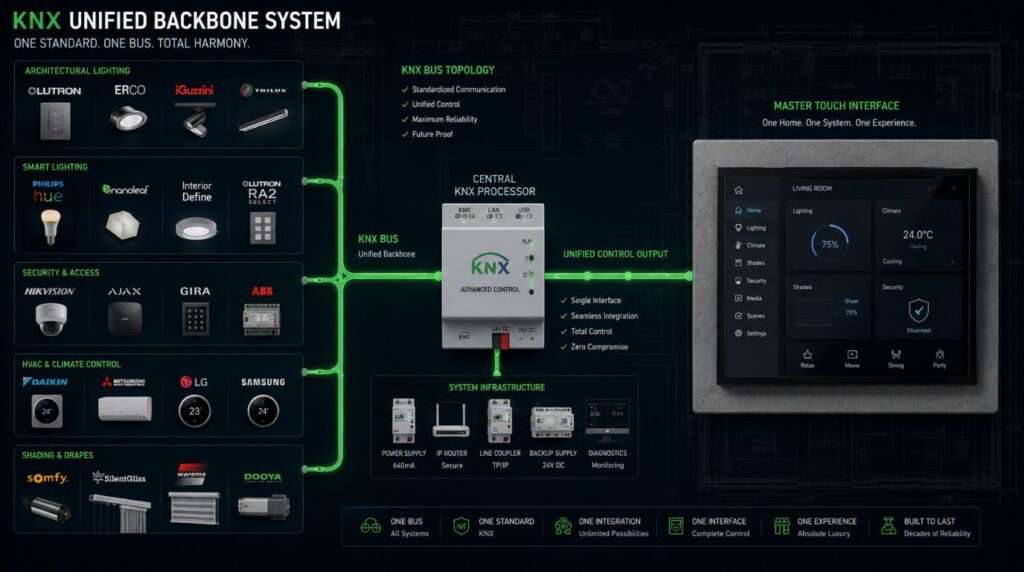
The best way to integrate different smart home brands together is to utilize a globally standardized, open-protocol wiring framework like KNX as your underlying foundation, paired with an advanced integration processor like Control4 or Savant. This ensures that hardware from completely different manufacturers can communicate natively over a shared physical cable without relying on unstable third-party software patches.
The Trap of Fragmented “Closed Loops”
Most consumer smart brands operate inside a proprietary walled garden. Brand A’s app won’t talk to Brand B’s thermostat without a fragile software bridge. If one company updates its software or changes its subscription model, your integration breaks overnight.
The Unified Architectural Utility
By using an open, interoperable standard backed by hundreds of global manufacturers, your system becomes a permanent utility. A designer keypad from an elite European manufacturer talks directly to a heavy-duty HVAC controller from a different brand over the same green bus wire. This creates a single, unified ecosystem managed from a single, elegant interface on your wall, preventing the brand incompatibility that causes typical wireless smart home problems.
Moving From a Glitchy Tech House to an Unshakeable Estate
If your automated systems leave you dealing with constant smart home problems like resetting routers, swapping out dead batteries, or apologizing to guests for a light switch that won’t respond, the technology has failed you.
True luxury is defined by technology that remains completely invisible until it serves you. You should never have to spend your evenings rebooting routers, changing batteries in wireless wall switches, or managing conflicting apps just to live comfortably.
At Techtastic, we don’t install superficial gadgets; we engineer the unshakeable digital foundations that turn complex houses into peaceful sanctuaries. We take care of the structural physics so you can stop managing your technology and start enjoying your home.
🤝 The Partnership Corner
- For Architects: We design unified cabling topologies that eliminate “switchboard bloat” and keep your interior profiles immaculately clean.
- For Project Consultants: We ensure that the smart home infrastructure integrates flawlessly with your HVAC, plumbing, and electrical loads from day one.
Let’s build an infrastructure that never has these smart home problems.
📞 Call/WhatsApp: 9769145145
📍 Our Engineering Hubs: Navi Mumbai | Nashik | Lonavla | Sangli
Technical FAQs on Smart Home Problems
Q: Why do my smart home devices keep disconnecting from the network?
A: Frequent disconnects are primarily caused by thick reinforced concrete walls blocking wireless radio signals, combined with standard internet routers becoming overloaded by too many connected wireless gadgets fighting for local IP addresses.
Q: How do you fix a smart home system that has slow response times?
A: The only permanent fix is to transition your core automation commands to a localized, hardwired infrastructure backbone like KNX. This keeps your data off congested wireless bands and eliminates dependency on slow, distant cloud servers.
Q: What is the best way to integrate different smart home brands?
A: True interoperability requires a unified open-protocol standard like KNX as your underlying physical framework, managed by a professional control processor like Control4. This forces devices from different brands to communicate directly over a shared wire, eliminating unstable app integrations.