
Summary
Many homeowners view home automation as a collection of “smart” home devices—a voice assistant here, a smart bulb there. A true home automation system is a unified ecosystem. It allows your home to think and react on its own.
It works through a three-layered process: Sensing (data collection), Processing (decision making), and Acting (executing tasks).
Whether you choose a wireless setup or a wired KNX system, the goal is the same: to eliminate manual effort. By understanding how these layers communicate, you can move from “remote-controlled” living to a truly intelligent home.
How a Home Automation System Actually Works?
Automatic lights or an AC that adjusts to the sun are perfect examples of home automation in action. But beneath that seamless experience lies a complex, fascinating network of communication.
To build a home in 2026 that actually makes your life easier, you need to look past the flashy touchscreens. You need to understand the “nervous system” of your house. Here is a humanized guide to how home automation works, from the first signal to the final action.
1. The Three-Layer Framework: Sense, Think, Act
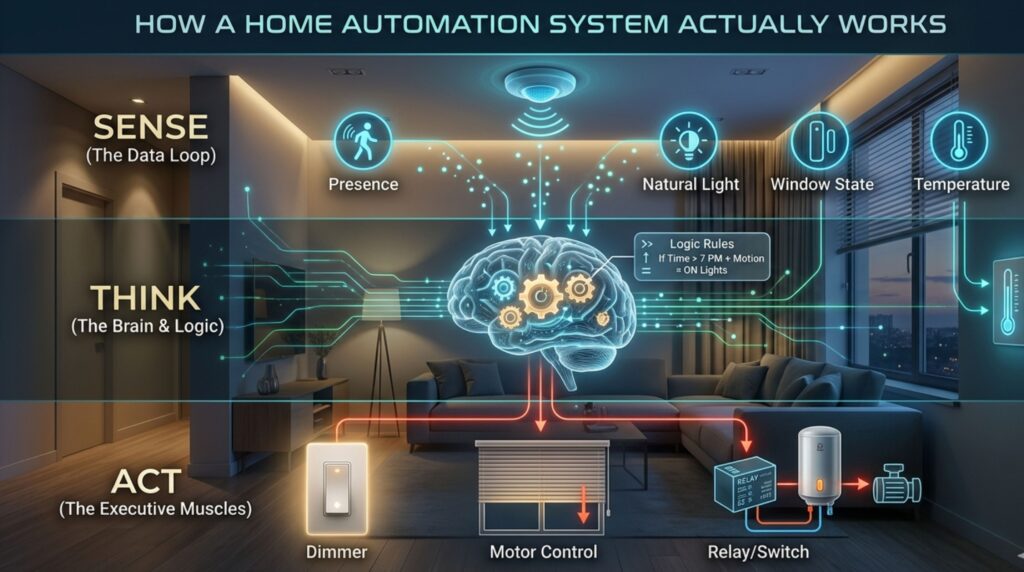
Think of your smart home like a human body. It doesn’t just do things randomly; it follows a logical loop.
The Sensors (The Five Senses)
Everything starts with data. Sensors are the eyes and ears of your smart home automation. They don’t “do” anything to your appliances; they simply observe.
- Motion & Presence Sensors: These detect when you enter a room.
- Light Sensors (Lux Sensors): These measure how much natural sunlight is coming in.
- Contact Sensors: These know if a window or door is open or closed.
- Temperature Sensors: These monitor the climate in specific zones.
The Controller (The Brain)
Once a sensor collects data, it needs to send it somewhere to be processed. This is the “Brain” of the system.
In a wireless DIY setup, this might be a central hub or a cloud server. In a professional wired home automation system like KNX, decentralized components share the role of the “brain.” This means every device has enough intelligence to make its own decisions. The system analyzes data and applies a “Logic Rule.”
For instance, when it’s past 7 PM and a sensor senses movement, the system switches on the hallway lights.
The Actuators (The Muscles)
The Actuators are the devices that physically perform the work. They receive the command from the brain and execute it.
- Dimmers & Switches: These physically cut or provide power to lights.
- Motor Controllers: These move your curtains or blinds.
- Relays: These turn your heavy appliances, like geysers or pumps, on and off.
2. The Language Problem: How Devices Talk
The biggest hurdle in smart home technology is “Protocol.” For a home automation system to work, the sensor in the balcony must speak the same language as the light in the living room.
The Wireless Approach (The “Conversation”)
Most entry-level systems use Wi-Fi, Zigbee, or Matter. Think of this like a group of people talking in a room.
Wireless systems are flexible and easy to set up. If too many devices interfere or the area is too large, it becomes difficult for the system to communicate. This is why wireless lights sometimes “flicker” or lag in large 4BHK apartments in Mumbai.
The Wired Approach (The “Dedicated Rail”)
A professional system like KNX uses a physical cable—the KNX cable—to connect everything. This is like a dedicated railway track for data. No “noise” or interference exists. When you press a button, the signal travels instantly through the wire to the light.
It doesn’t care if your Wi-Fi is down or if your neighbor is running a powerful router. It works every single time because the “road” is always clear.
3. Cloud vs. Local Control: Where does the “Thinking” happen?
This is a vital distinction for 2026.
- Cloud-Based: When you ask a voice assistant to turn on a fan, your request travels to a remote server and back to your home. If your internet is slow, the fan takes three seconds to start.
- Local Control: A robust home automation system processes everything inside your four walls. The “logic” lives in your switches and controllers. This ensures your home remains fully functional even during an internet outage. Local control is the best way to keep luxury projects private and reliable.
4. The Role of Scenes and Logic
A home automation system is truly working when you stop using an app. The goal is “Scenes.” A “Good Morning” Scene doesn’t just turn on a light. One single command (or a timer) triggers a chain reaction:
- The curtains open 20% to let in soft light.
- The geyser turns on in the master bath.
- The AC in the bedroom switches off.
- The security system disarms the motion sensors in the kitchen.
This coordination is what separates a “smart home” from a house with a few smart bulbs.
5. Integration: Making the “Un-smart” Smart
How do you control an old-school AC or a designer Italian chandelier?
- Dry Contacts: These allow the system to talk to gates and garage doors.
- IR/IP Links: These allow the smart system to “mimic” your AC or TV remote.
- Gateways: These act as translators, letting your wired KNX system work with Apple HomeKit or Google Home.
Conclusion: Choosing a Home that Thinks for Itself
Ultimately, the best smart home automation system is one you rarely have to think about. True automation is not about filling shelves with gadgets. Devices communicate effectively to serve your lifestyle. When you stop using remote controls and let sensors, processors, and actuators work together, your house becomes a responsive environment.
In 2026, complexity no longer defines luxury; reliability defines it. Whether you choose a wireless setup or a wired KNX home automation system, the goal is a home that anticipates your needs. Investing in the right infrastructure makes sure your home remains smart, efficient, and comfortable for decades.
The Techtastic Perspective
At Techtastic Technologies, we believe that a home automation system shouldn’t be a hobby that requires constant fixing. It should be as invisible and reliable as the plumbing in your walls.
Whether you are in Thane, Navi Mumbai, or Lonavla, a successful home automation system depends on the right infrastructure, not the most expensive gadgets. A system that “works” is one that you forget is even there.
Collaboration Opportunities for Builders and Architects
Developers, architects, and interior designers can enhance residential projects by using a home automation system during the planning and design stages.
Techtastic collaborates with industry professionals to ensure the home automation system integrates seamlessly with design layouts, electrical infrastructure, and interior design concepts.
Partner with Techtastic to implement a home automation system for your upcoming residential projects in Nashik, Navi Mumbai, Sangli, and Lonavla.
Contact Techtastic today at 9769145145 for a professional consultation and see how the best home automation ideas can elevate your design vision.
Technical FAQs
Q: Does a home automation system increase my electricity bill?
Actually, a well-configured system usually reduces it to a 15-20% drop. Presence sensors ensure lights stay off in empty rooms. By “harvesting” natural light to dim indoor bulbs, most homeowners see a 15-20% drop in energy consumption.
Q: Can I mix brands in one system?
If you use an open standard like KNX, yes. You can have a German sensor, an Italian switch, and a French motor controller all working together. If you choose a closed brand, you usually have to stick with its ecosystem.
Q: What is the most reliable way to connect devices?
For small apartments, Zigbee or Matter is often enough. For a forever home or luxury villa, a wired bus system is the best choice. This makes the system last for over 20 years without needing constant reboots.
Q: What happens during a power cut?
Most professional systems have “Power-on State” memory. You can program the system to either stay off when power returns or return to exactly how it was before the cut.