
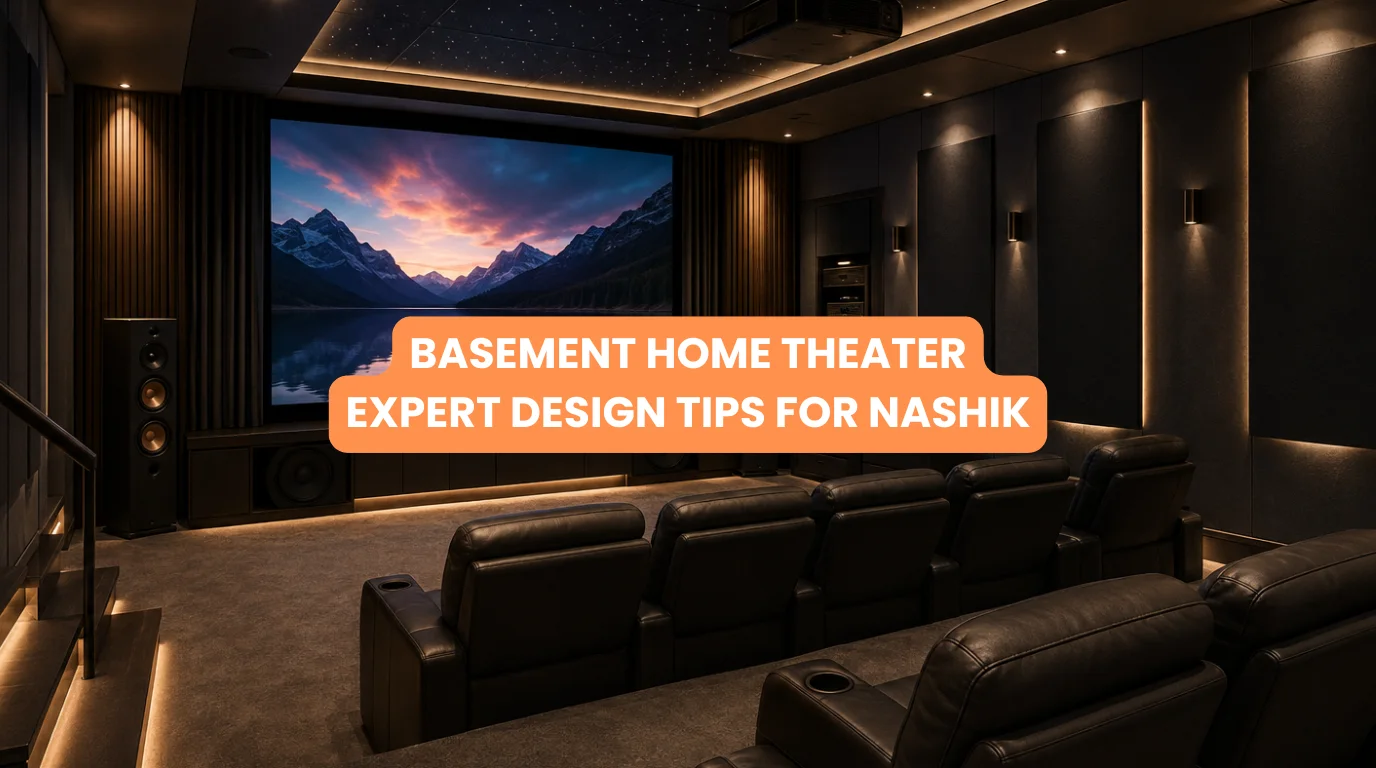
A basement home theater can be one of the most impressive additions to a luxury bungalow. The basement already offers something every cinema needs: controlled light, privacy, and separation from the main living areas. But darkness alone does not create a great theater.
A successful basement home theater requires careful planning for soundproofing, room acoustics, humidity, ventilation, electrical infrastructure, lighting, projection, and seating. If these elements are treated as an afterthought, even an expensive projector and premium speakers can deliver a disappointing experience.
This is particularly important for luxury homes in Nashik, where basements may experience increased humidity during the monsoon. Reinforced concrete construction can also transmit low-frequency vibrations throughout the property.
The right approach is to treat the basement home theater as an engineered environment rather than simply decorating a dark room with cinema equipment.
At Techtastic Technologies, we work with homeowners, architects, and interior designers to plan the technical infrastructure early, creating an immersive entertainment space where technology remains powerful but visually discreet.
Quick Answer
The best basement home theater combines structural soundproofing, acoustic treatment, controlled humidity, quiet ventilation, correctly designed room geometry, dedicated electrical circuits, concealed AV infrastructure, and professional automation.
For a luxury bungalow in Nashik, plan the theater during the gray-structure or early construction stage. This allows conduits, acoustic isolation, ventilation, projector wiring, speaker locations, lighting, and equipment racks to be integrated before the interiors are finished.
Quick Summary
✓ A basement home theater needs acoustic engineering, not just expensive equipment.
✓ Structural decoupling helps reduce bass and vibration transmission.
✓ Humidity control protects electronics, fabrics, and acoustic materials.
✓ Dedicated ventilation provides fresh air without introducing excessive noise.
✓ Room geometry has a major impact on bass response and sound clarity.
✓ Oversized conduits make future projector and AV upgrades easier.
✓ A centralized equipment rack keeps heat and visual clutter outside the theater.
✓ Smart lighting and automation can create one-touch movie scenes.
✓ Early planning makes concealed wiring and acoustic construction much easier.
✓ Professional design creates a basement home theater that performs consistently for years.
Why Most Basement Cinemas Fail
Stepping into the expansive basement of a luxury bungalow in Nashik, you’ll find a massive screen, premium recliners, a powerful projector, and an impressive array of high-end speakers, all reflecting the owner’s investment in a truly premium home theatre experience.
The subwoofer created vibrations through the floor. Dialogue became difficult to understand because of excessive reflections. HVAC noise became noticeable during quieter scenes. The equipment also generated heat inside an enclosed room.
This is the biggest mistake homeowners make when creating a basement home theater. They select the projector, speakers, screen, and seating first and think about the physical environment later.
A basement naturally appears ideal because it is dark and private. However, concrete walls and floors can reflect sound aggressively. Mechanical systems can transmit noise. Electrical and ventilation requirements can introduce unwanted openings.
A professional basement home theater therefore begins with the room itself. The goal is to create an environment where the equipment performs at its potential instead of forcing expensive equipment to compensate for poor construction.
Soundproofing: The Foundation of a Quiet Theater
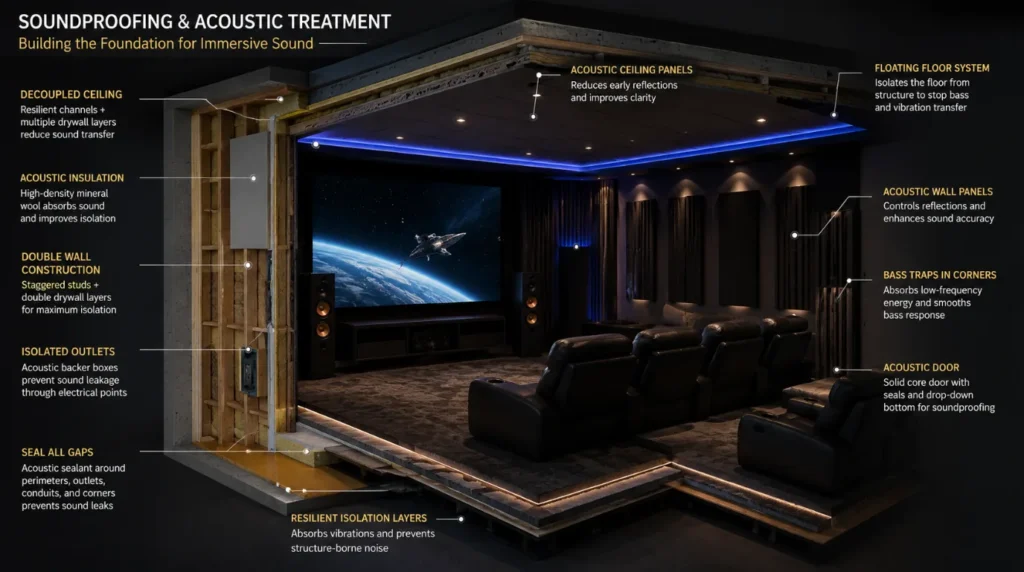
Soundproofing and acoustic treatment are not the same thing.
Soundproofing attempts to stop sound from entering or leaving the room. Acoustic treatment manages reflections and improves the sound inside the room. A high-performance basement home theater needs both.
Decoupling the Structure
Low-frequency bass can travel through building structures. Simply adding decorative acoustic panels to the walls will not prevent this structural transmission.
A room-within-a-room approach can be considered for demanding projects. Resilient channels, isolated framing, multiple layers of gypsum board, and suitable damping compounds can reduce the transfer of sound energy. The exact construction should be determined by an acoustic professional based on the building structure and performance requirements.
Managing Bass Vibration
Subwoofers produce powerful low-frequency energy. In a basement, this energy can travel through concrete floors and structural elements.
Depending on the project, solutions can include:
- Floating floor construction
- Isolated wall assemblies
- Acoustic underlayments
- Bass trapping
- Structural decoupling
- Carefully positioned subwoofers
The objective is not to eliminate bass. It is to keep the bass inside the listening environment while allowing it to sound controlled and powerful.
Sealing Air Gaps
Even small openings can compromise acoustic isolation.
A properly engineered basement home theater should therefore address:
- Door gaps
- Electrical boxes
- Service penetrations
- Ventilation openings
- Cable entry points
- Ceiling penetrations
Acoustic door seals and automatic door bottoms can significantly improve isolation around the theater entrance.
Humidity and Air Quality Matter More Than You Think
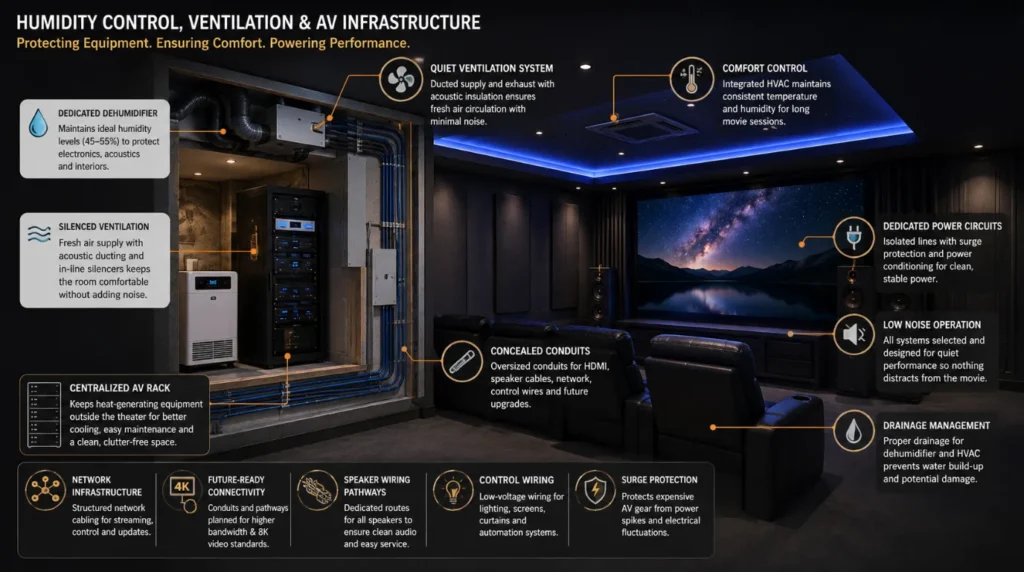
Basement environments require special attention to moisture.
Nashik experiences seasonal humidity changes, particularly during the monsoon. A theater containing expensive electronics, acoustic fabrics, wooden finishes, and upholstered seating should therefore have an appropriate environmental-control strategy.
A basement home theater should ideally maintain comfortable humidity rather than allowing the room to become excessively damp.
Dedicated Dehumidification
Standard air conditioning can remove moisture while cooling, but it may not always provide sufficient independent humidity control. Depending on the basement, a dedicated dehumidifier may be appropriate. Equipment can be located outside the primary viewing area, provided there is suitable airflow and drainage.
Protecting Acoustic Materials
Cheap foam is not automatically the best acoustic solution. A professionally designed theater may use mineral-wool or rockwool-based acoustic assemblies behind acoustically transparent fabric. These materials can be incorporated into wall and ceiling treatments according to the required acoustic performance.
Material selection should consider moisture exposure, fire safety, acoustic performance, and the overall interior specification.
Fresh Air Without Excessive Noise
A packed theater can quickly become uncomfortable if fresh-air requirements are ignored. A ventilation system should introduce fresh air while minimizing mechanical noise. Carefully designed duct paths, silencers, acoustic lining, and appropriate air velocities can help.
This is particularly important in a basement home theater, where the room may remain closed for long movie sessions.
Get the Room Geometry Right
One of the most overlooked elements of a basement home theater is the shape of the room.
Sound waves interact with walls, floors, ceilings, and each other. Certain dimensions can create stronger room modes, causing some frequencies to become excessively loud while others appear weak.
Avoiding the Perfect Cube
A room where the length, width, and height are nearly identical can create problematic modal behavior. That does not mean every square basement is unusable. It means the acoustic design must compensate for the geometry.
Before finalizing walls, an acoustic designer can evaluate the room dimensions and listening positions.
The Golden Ratio Concept
Ratios such as approximately 1:1.6:2.3 are sometimes used as a starting point for room planning. However, there is no single ratio that guarantees perfect acoustics. The actual construction, speaker placement, listening positions, acoustic treatment, and room volume all matter.
Bass Traps
Corners can accumulate low-frequency energy. Bass traps can be integrated into the architecture rather than added as obvious studio-style objects. This allows a luxury basement home theater to maintain a refined appearance while addressing acoustic problems.
Plan the AV Wiring Before the Interiors
Technology changes quickly. Your theater may use one type of HDMI connection today and require a different standard several years later. Projectors, processors, gaming systems, streaming devices, and display technologies will continue evolving. That is why infrastructure matters.
Oversized Conduits
For a new basement home theater, we recommend planning generously sized conduits wherever possible. The objective is simple: make future cable replacement possible without opening finished walls.
A conduit system can be planned for:
- Projector connections
- Speaker cables
- Network connections
- Control wiring
- Future display technology
- Additional AV equipment
The precise conduit size and cable specification should be determined by the final equipment and installation requirements.
Centralized AV Rack
Instead of placing every component below the screen, a dedicated equipment rack can be located in a ventilated technical space. This keeps amplifiers, processors, network equipment, and other electronics away from the primary viewing area.
A good rack location should provide:
- Adequate ventilation
- Easy service access
- Dedicated power
- Cable management
- Protection from moisture
- Sufficient room for future equipment
This approach makes the basement home theater visually cleaner and easier to maintain.
Design Lighting for Cinema, Not Just Decoration
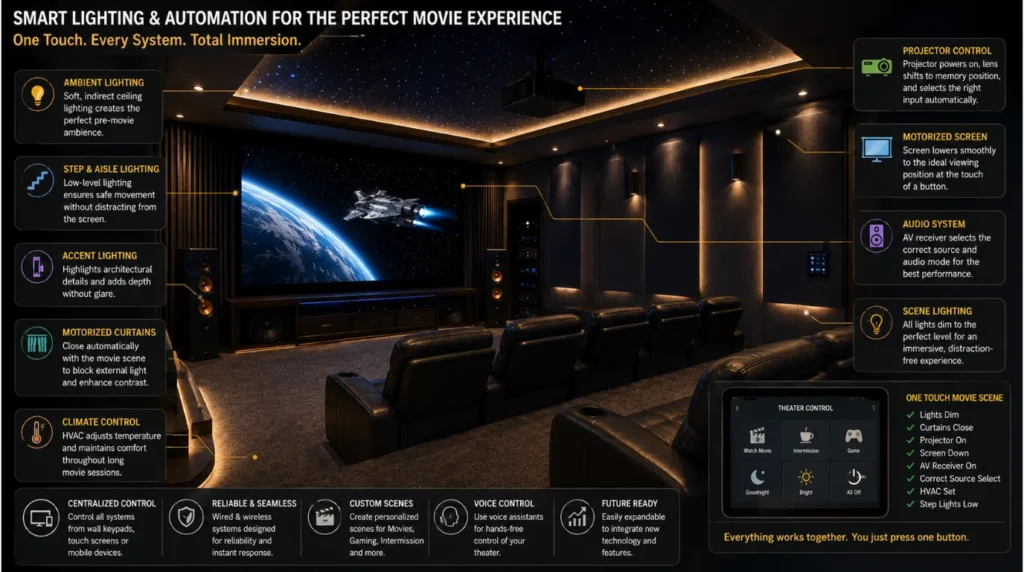
Lighting can make or break the viewing experience. A basement home theater should not depend on one ceiling light. Instead, consider multiple lighting layers that can be controlled independently.
Ambient Lighting
Soft indirect lighting can provide enough illumination before and after a movie without creating glare.
Step Lighting
Low-level lighting along stairs, walkways, or seating platforms improves safety while keeping the main screen area dark.
Accent Lighting
Architectural details can be highlighted using subtle LED strips or concealed fixtures.
Movie Scene Automation
This is where automation becomes particularly useful.
A single basement home theater movie scene can be programmed to:
- Dim the ambient lights.
- Turn on pathway lighting at a low level.
- Close motorized curtains if present.
- Start the projector.
- Select the appropriate AV input.
- Activate the required audio mode.
The homeowner does not need to operate six different remotes.
Choose the Screen and Projector Around the Room
Buying the most expensive projector does not automatically produce the best picture. Screen size, viewing distance, projector brightness, throw distance, room lighting, screen material, and projector placement all need to be considered together.
For a basement home theater, the controlled lighting environment can be a significant advantage.
Projector Position
The projector should be positioned according to its lens specifications and the desired screen size. Throw distance should be calculated before finalizing the ceiling or rear-wall construction.
Screen Selection
The screen should complement the projector and seating arrangement. An acoustically transparent screen may be useful when speakers need to be positioned behind the image. This can create a more natural front soundstage.
Concealed Projection
For an architectural approach, the projector can be concealed within a dedicated enclosure or cabinetry, provided ventilation and service access are properly designed.
The goal is to create an Invisible Cinema where the technology appears only when required.
Surround Sound Needs More Than Expensive Speakers
The sound system is the emotional engine of a basement home theater. However, simply purchasing powerful speakers i s not enough. Speaker locations should be planned around the room dimensions, screen position, seating layout, and intended audio format.
Front Soundstage
The left, center, and right channels create the primary soundstage. Their relationship with the screen and listening position is critical.
Surround Speakers
Surround channels should be positioned according to the selected audio format and room geometry.
Subwoofer Placement
Subwoofer positioning has a particularly strong effect on bass consistency. In larger theaters, multiple subwoofers may provide more even bass distribution than one extremely powerful unit. Professional calibration can then help optimize the system for the actual room.
A properly engineered basement home theater should sound clear at normal listening levels and remain controlled when the soundtrack becomes intense.
Create an Invisible Technology Experience
Luxury interiors increasingly favor technology that disappears. The objective of a basement home theater should not be to showcase cables, equipment racks, and control hardware. Instead, technology can be integrated into the architecture.
Possible approaches include:
- In-wall speakers
- Acoustically transparent screens
- Concealed projector installations
- Flush-mounted keypads
- Motorized curtains
- Hidden equipment racks
- Recessed lighting
- Concealed cable pathways
This creates an environment where the homeowner experiences the technology without constantly seeing it. For Techtastic projects, the objective is simple: the room should look like an elegant cinema and behave like an intelligent one.
Add Smart Home Theater Automation
A modern basement home theater can become part of the wider home automation ecosystem.
For example, a “Movie” scene can coordinate several systems simultaneously.
When activated:
- Theater lighting dims.
- Stair lights reduce to a safe level.
- Curtains close.
- Projector powers on.
- AV receiver selects the correct source.
- Screen lowers if motorized.
- HVAC adjusts the room temperature.
A “Goodnight” scene can reverse the process and switch off the equipment after the movie. This is particularly valuable in luxury homes where multiple systems already operate through an integrated automation platform.
Techtastic Approach to Basement Cinema Design
At Techtastic Technologies, we believe a basement home theater should be designed from the infrastructure outward. That means understanding the room before choosing the equipment.
We consider:
- Room dimensions
- Acoustic requirements
- Sound isolation
- HVAC and ventilation
- Humidity management
- Electrical infrastructure
- AV rack location
- Projector position
- Speaker layout
- Lighting design
- Automation requirements
- Future upgrade paths
This approach prevents expensive equipment from being installed into a room that was never designed to support it. The result is an entertainment space that feels effortless rather than technically complicated.
Key Takeaways
- Treat the basement home theater as an engineered room, not simply a decorated basement.
- Prioritize structural sound isolation before selecting speakers.
- Control humidity to protect electronics and interior materials.
- Plan ventilation carefully to maintain comfort without adding noise.
- Use room geometry and acoustic treatment to improve sound quality.
- Install oversized conduits so future AV upgrades do not require wall demolition.
- Keep the equipment rack ventilated and outside the main viewing area when possible.
- Use layered lighting and automation for a true cinematic experience.
- Calibrate speakers and subwoofers after installation.
- Plan the entire basement home theater with architects and automation specialists from the beginning.
Frequently Asked Questions
1. Is a basement suitable for a home theater?
A. Yes. A basement can be excellent for a basement home theater because it naturally provides controlled lighting and separation from the main living areas. However, moisture, ventilation, acoustics, and structural sound transmission must be addressed.
2. How do I soundproof a basement theater?
A. A professional approach may include structural decoupling, additional wall mass, damping layers, acoustic doors, sealed penetrations, and appropriate floor construction. The exact specification depends on the building structure and required isolation level.
3. How should humidity be controlled?
A. A suitable combination of air conditioning, ventilation, and dedicated dehumidification can maintain a comfortable environment. The correct system depends on basement size, local conditions, occupancy, and moisture loads.
4. Do I need a dedicated AV rack?
A. A dedicated rack is strongly recommended for a high-end basement home theater. It keeps equipment organized, provides service access, and moves heat-generating electronics away from the viewing area.
5. Should speakers be installed inside the walls?
A. In-wall or in-ceiling speakers can be excellent when properly selected and installed. They are particularly useful when the goal is to maintain a clean architectural appearance.
6. What lighting is best for a theater?
A. Layered lighting works best. Consider indirect ambient lighting, low-level step lighting, accent lighting, and separately controlled task lighting.
7. Can a home theater be automated?
A. Yes. A basement home theater can integrate with lighting, curtains, HVAC, projector systems, screens, and AV equipment. A single movie scene can coordinate several functions.
8. How can I make the theater future-ready?
A. Use accessible and oversized conduits, provide spare pathways, allow additional rack capacity, and plan equipment locations carefully. This makes future cable and technology upgrades easier.
9. Does room shape affect sound quality?
A. Absolutely. Room dimensions influence standing waves, reflections, and bass distribution. Acoustic modeling and treatment can help address these issues.
10. When should I start planning my theater?
A. Ideally, plan the basement home theater during the architectural and gray-structure stage. Early coordination makes soundproofing, conduits, electrical systems, ventilation, and concealed technology much easier to integrate.
Collaboration Opportunities for Architects, Interior Designers, and Bungalow Owners
A premium basement home theater is most successful when architecture, interiors, acoustics, electrical infrastructure, and AV technology are planned together.
Techtastic Technologies collaborates with architects, interior designers, builders, and homeowners to develop the technical infrastructure behind high-end entertainment spaces.
Acoustic Blueprints
We coordinate room dimensions, speaker positions, acoustic treatment, and sound-isolation requirements before interior finishes are finalized.
Conduit Mapping
We plan concealed cable routes for projectors, speakers, screens, networking, automation, and future upgrades.
Invisible Technology
From concealed speakers and motorized screens to automated lighting and centralized AV racks, we help keep the technology integrated with the architecture.
Smart Integration
We can connect the theater with wider home automation systems so lighting, curtains, climate, and entertainment operate together.
Planning a luxury bungalow in Nashik? Involve the automation and AV team before the walls are finished.
Areas We Serve
Techtastic Technologies provides smart home automation, home theater, AV integration, and related technology solutions across:
Nashik | Navi Mumbai | Lonavla | Sangli
We work with luxury homeowners, architects, interior designers, builders, and developers on premium residential projects.
Build Your Basement Home Theater with Techtastic
A basement home theater should be more than a large screen and comfortable seating. It should be engineered for acoustic performance, thermal comfort, reliable technology, clean aesthetics, and effortless automation.
Whether you are building a new luxury bungalow or planning a major renovation, early technical planning can make the difference between an ordinary entertainment room and a truly immersive cinema.
Techtastic Technologies can help you plan the acoustic infrastructure, AV wiring, projector and speaker integration, lighting automation, equipment rack, and smart control system for your project.
Contact Techtastic
🌐 Website: Techtastic Website
📞 Phone: 9769145145
📍 Service Areas: Mumbai • Navi Mumbai • Pune • Lonavala • Nashik • Sangli
Have old curtains you’d like to upgrade? Explore our guide on 7 Clear Steps To Make Old Curtains Smart And Motorized to learn how to add smart control without replacing them.