
Summary
The fundamental difference between cheap and expensive smart home systems lies in their architectural infrastructure, reliability, and lifespan. Cheap systems rely on consumer-grade wireless protocols (like Wi-Fi) that route data through external cloud servers, making them highly vulnerable to network dropouts and rapid product obsolescence. Expensive systems utilize industrial-grade, hardwired open standards (like KNX) that process all automated logic locally and completely offline. This structural divide ensures that premium systems operate with zero latency, require virtually no battery maintenance, and function as permanent building utilities lasting over 30 years.
The Illusion of Premium Living: When a Multi-Crore Villa Processes Commands Like a Budget Smartphone
I remember walking into a newly handed-over luxury duplex penthouse in Navi Mumbai. The interiors were a masterclass in clean minimalism—imported Italian stone walls, hidden architectural lighting, and floor-to-ceiling glass facades. Yet, the owner was standing in the center of his living room, visibly exasperated. He had spent months picking out premium furniture, but when he tried to activate his evening lighting scene, he was met with a jarring three-second delay. Two downlights failed to turn on entirely, and his smart speaker flatly announced it had lost its connection to the internet.
This is the frustrating reality of the “Cheap Smart Home Systems Trap.” You build a physically stunning estate, yet its operational nervous system is so fragile that it feels like a collection of temperamental tech toys rather than a seamless luxury utility.
The “Industry Wound” is the widespread myth perpetuated by consumer electronics giants: that true whole-home automation is a solved problem that can be bought off a retail shelf for a few thousand rupees. They show you slick marketing videos of plug-in gadgets and adhesive wall buttons, promising that a handful of wireless smart plugs and app downloads will magically turn your home into an intelligent sanctuary.
What they hide is the core engineering reality of modern Indian construction. Heavy brickwork, dense reinforced concrete slabs, and metallic insulation layers form a literal shield against airborne wireless signals. Forcing cheap consumer wireless smart home systems into this environment ensures that your automated life will be defined by constant router reboots, missing command signals, and dead batteries hidden inside your walls. True luxury isn’t about plastering your walls with cheap gadgets; it is about embedding an unshakeable, silent infrastructure that serves your family without a single glitch.
What Makes Smart Home Systems Cheap or Expensive?
Smart home systems are considered cheap when it relies on surface-level wireless hardware and volatile cloud computing, while expensive smart home systems are defined by their hardwired architecture, local processing power, and industrial-grade build quality. This architectural divide dictates whether your automation is a temporary accessory or a permanent part of the building.
Surface-Level Accessories vs. Structural Utility
Cheap systems are designed as retrofits. They live on top of your existing surfaces, using basic plug-in adapters or modular wireless switch modules crammed behind standard switchboards. Expensive systems are structural; they are integrated deeply into the property during the “Gray Structure” raw brickwork phase. They utilize dedicated, low-voltage control lines hidden inside your conduits to link every fixture back to a centralized automation distribution panel.
The Cloud Detour vs. Sovereign Local Logic
When you tap a button on a cheap smart system, your command travels from your smartphone, through your local Wi-Fi router, across an undersea cable to a distant cloud server, and then back down to your device to execute. Expensive systems keep 100% of their logic entirely local. The system is air-gapped from the public internet, meaning that commands are processed inside the physical hardware modules of your home within milliseconds.
Why do Cheap Smart Home Systems Fail in Concrete Luxury Villas?
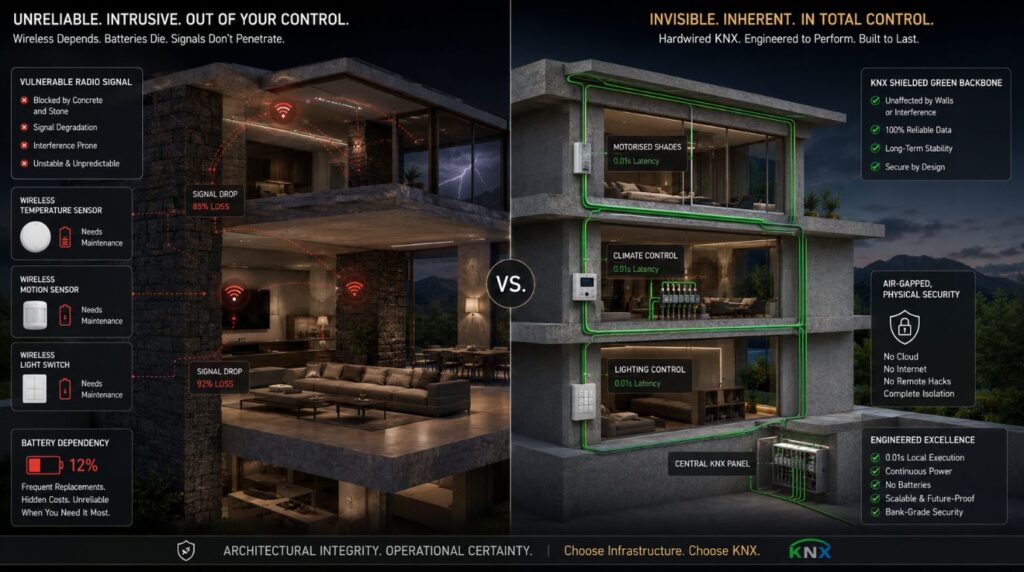
Cheap smart home systems fail in luxury villas because their airborne wireless frequencies (Wi-Fi and Bluetooth) cannot penetrate dense reinforced concrete structures and face severe signal degradation from local environmental interference. This causes devices located further away from the main router to drop off the network entirely.
The Concrete Radio Sponge
Standard Indian premium homes are built like fortresses, utilizing heavy brick masonry and thick concrete slabs to handle structural loads. To a wireless consumer device, these structural elements act as massive radio dampeners. As you add more wireless gadgets to cover a large property, they crowd the local network, fighting for bandwidth and dropping commands whenever someone streams a high-definition video or a heavy storm rolls in.
The Maintenance Nightmare of Battery Dependency
Cheap wireless systems rely on a massive web of individual battery-operated sensors to detect motion, ambient light, and doors opening. In a sprawling luxury property, tracking down which coin battery has died becomes a permanent chore. When a battery dies unnoticed inside a safety sensor, your security and lighting paths break down completely, leaving your family stranded in the dark.
How does Local Hardwired Processing Protect your Home from Internet Blackouts?
Local hardwired processing protects your home from internet blackouts by executing all automated tasks inside physical hardware modules on-site, ensuring your lighting scenes, climate control, and security routines work flawlessly even if the external fiber-optic line is cut for weeks.
Decentralized Operational Security
Expensive systems (built on international open standards like KNX) do not rely on a central computer or a single smart hub. Every keypad, actuator, and sensor functions as an independent mini-computer. Because the automation programming is burned directly into the non-volatile memory of each piece of physical hardware, there is no single point of failure. If one component is damaged, the rest of the estate continues to run perfectly.
Instantaneous Power Recovery Logic
When your home transitions from the main municipal grid to a backup diesel generator or a solar UPS system during a power cut, cheap wireless hubs take several minutes to reboot, re-acquire IP addresses, and re-authenticate with cloud servers. A hardwired system wakes up the exact millisecond it receives electrical current. It initializes instantly, executing smart load-shedding scenes to dim non-essential lights and lock out heavy AC compressors to protect your backup battery bank.
Side-by-Side Comparison: Consumer Wireless vs. Industrial Hardwired Systems
Understanding the technical differences between these two tiers demonstrates why an initial capital investment in infrastructure pays dividends over decades of ownership.
| Engineering Parameter | Consumer Wireless (Cheap Smart Home Systems) | Industrial Hardwired (Expensive Smart Home Systems) |
| Physical Backbone | Airborne Radio Frequencies (Wi-Fi, Zigbee) | Shielded Physical Bus Cable (KNX Standard) |
| Data Processing Location | External Regional Cloud Servers | Localized Hardware Modules (Offline-First) |
| Command Latency | Variable (500ms to 3+ seconds) | Instantaneous (Sub-10 milliseconds) |
| System Lifespan | 3 to 5 Years (Rapid Product Obsolescence) | 30+ Years (Industrial Build Grade) |
| Maintenance Profile | High (Routine Battery Swaps & Reboots) | Zero-Touch (Continuous Low-Voltage Power) |
| Impact on Property Value | Negligible (Viewed as Temporary Gadgets) | Tangible Capital Asset (Architectural Utility) |
Can Expensive Smart Home Systems Protect Your Property from Electrical Surges?
Yes, expensive smart home systems actively protect your property from electrical surges through heavy-duty centralized power supplies equipped with integrated choke filters and automatic isolation relays that absorb massive voltage fluctuations before they can reach your high-end interior lighting or appliances.
Staggered Sequential Power Restoration
One of the most dangerous moments for high-end LED drivers and home automation hardware is the exact second municipal power returns after a blackout. The sudden rush of current can cause a voltage spike that burns out sensitive electronic circuit boards. Premium systems are programmed to bring your home back online in waves, gently staging power loops over a sequence of seconds to prevent harmful load surges.
Electromagnetic Noise Rejection
The communication cable used in premium systems is heavily twisted and shielded with an aluminum foil layer. This physical shield drains away any induced electrical noise caused by high-voltage lines running alongside it, keeping your system’s communication line clean and completely preventing the “ghost commands” (like lights turning on by themselves at 3 AM) that plague cheap installations.
Transitioning from a Collection of Fragile Gadgets to an Unshakeable Sanctuary
A home that forces you to constantly troubleshoot routers, apologize to guests for unresponsive switches, or manage an army of individual mobile applications isn’t smart—it’s an operations liability. True luxury is defined by silence, permanence, and absolute dependability.
At Techtastic, we do not build systems out of retail boxes or fragile tech toys. We engineer robust, industrial-grade building backbones designed from the ground up to handle real-world infrastructure challenges. We design the hidden low-voltage pathways that turn complex technology into an invisible, effortless comfort that endures for generations.
🤝 The Partnership Corner
- For Luxury Estate Owners: We design completely custom, offline-first automation systems that give you absolute sovereignty over your environment through any storm or blackout.
- For High-End Architects & Consultants: We collaborate with your design team during the gray-structure phase, ensuring your clean aesthetic lines remain completely untainted by technological clutter or messy wiring.
Let’s design a digital foundation that lasts, integrating the best smart home systems.
📞 Call/WhatsApp: 9769145145
📍 Engineering Premium Reliability Across: Navi Mumbai | Nashik | Lonavla | Sangli
Technical FAQs on Smart Home Systems
Q: What makes smart home systems cheap or expensive?
A: Cheap smart home systems are built as surface retrofits using consumer-grade wireless hardware (like Wi-Fi) that routes data through external cloud servers, creating command latency and reliance on the internet. Expensive systems are integrated directly into the building’s infrastructure using hardwired, industrial open protocols (like KNX) that process all data locally and completely offline for instant execution.
Q: Why do cheap smart home systems fail in concrete luxury villas?
A: Cheap wireless systems fail because the dense reinforced concrete, brick masonry, and metallic insulation typical of high-end Indian construction act as literal radio shields, absorbing and deflecting wireless signals. This causes frequent connection dropouts, lag, and system failures, which are aggravated by the constant maintenance needed to replace dead batteries inside wireless sensors.
Q: How does local hardwired processing protect your home from internet blackouts?
A: Hardwired systems store all operational programming locally inside non-volatile memory chips on individual hardware modules instead of a central cloud hub. This decentralized architecture means that even if your external fiber line drops or a storm knocks out the neighborhood internet grid, your automated lights, climate controls, security zones, and backup generator transitions continue to run flawlessly with zero downtime.