
Summary
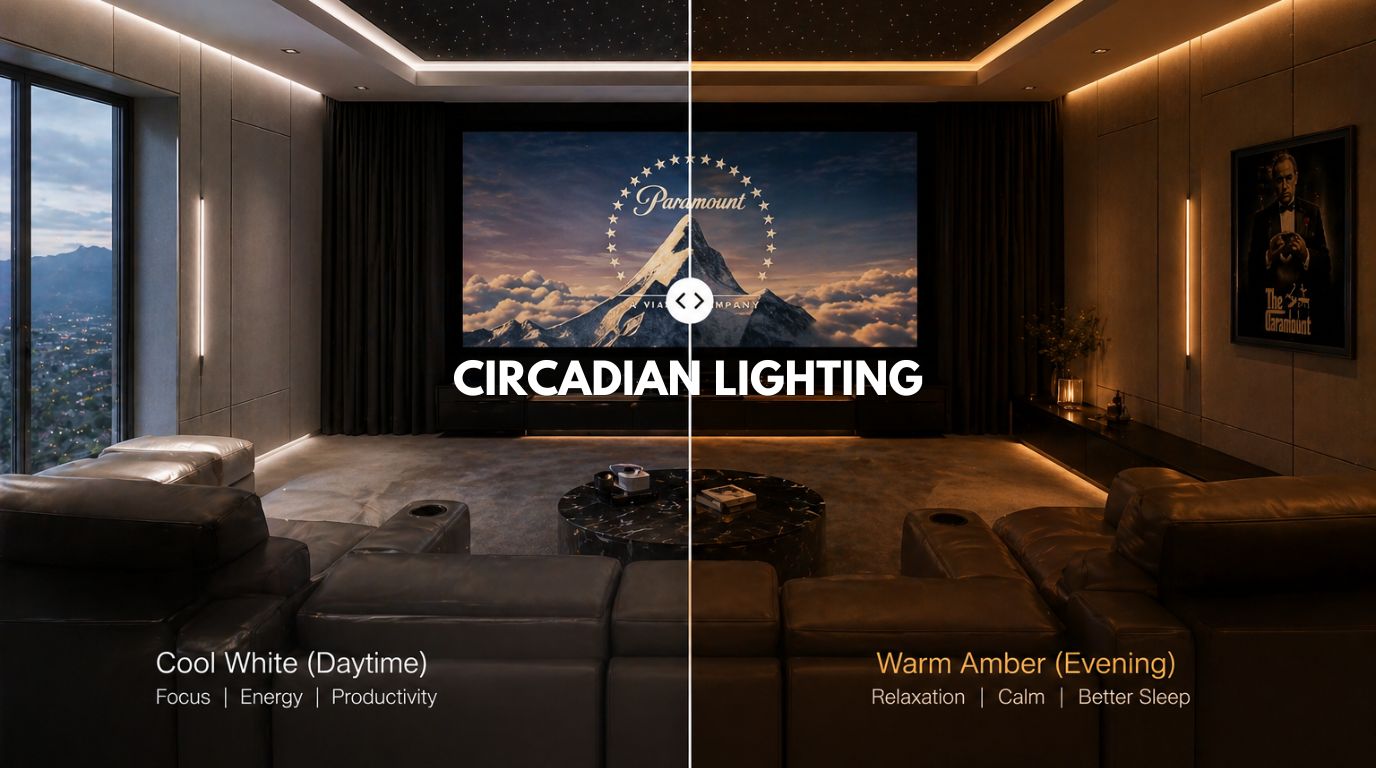
Most home theaters are designed for total darkness, but the way we light the room before and after a movie is just as critical as the screen itself. Circadian lighting—lighting that mimics the natural light cycle of the sun—is the secret to preventing “cinema fatigue” and eye strain. Instead of simple dimming, a sophisticated cinema space requires color-tunable LEDs that shift from energizing cool whites during the day to warm, sleep-inducing ambers at night.
This guide explains how integrating circadian principles into your home theater design enhances your health, improves visual comfort, and transforms your “Invisible Cinema” into a truly wellness-focused sanctuary.
Circadian Lighting in the Cinema: Why Your Home Theater Needs More Than Just “Dimming”
I’ve spent a lot of time in darkened rooms. As an executive helping clients design high-end “Invisible Cinemas” in places like Delhi, Mumbai, and Nashik, I’ve seen some of the most beautiful home theaters in the country. Usually, the focus is entirely on the “Black Out”—thick acoustic curtains, dark matte paint, and zero light leakage.
But there is a missing piece in the conversation that often leads to what I call “The Cinema Headache.” Have you ever walked out of a two-hour movie feeling slightly disoriented, or found yourself wide awake at 1:00 AM because you watched an action film before bed?
The problem isn’t the movie, but the lighting. Specifically, it’s the lack of Circadian Lighting.
In modern home theater design, we need to move past the idea that “smart lighting” just means dimming the bulbs. To create a space that is truly luxurious, we have to discuss how light affects our biology.
What is Circadian Lighting?
Before we dive into the theater, let’s simplify the science. Our bodies have an internal clock called the human circadian rhythm. The sun tunes this clock.
- Morning/Midday: The sun is bright and “cool” (blue-toned), which tells our brain to produce cortisol and stay alert.
- Evening/Sunset: The sun becomes “warm” (amber-toned) and dim, which triggers the production of melatonin, helping in our sleep-wake cycles.
When we build a home theater—which is essentially a windowless box—we are cutting ourselves off from these natural cues. If you spend three hours under bright, cool-white spotlights while watching a matinee, or worse, under harsh lights after a late-night screening, you are essentially giving yourself “digital jet lag.”
1. Beyond the Dimmer: The Power of Color Temperature
Most people think that if they dim their LED strips to 10%, they’ve solved the problem. But dimming a “cool white” LED just gives you a dim, gray, sickly light. It doesn’t change the quality of the light.
Circadian lighting uses Tunable White technology. In a premium cinema, your cove lighting and step lights should automatically shift their color temperature based on the time of day.
- 3:00 PM Matinee: When you pause the movie to get snacks, the lights should fade up to a crisp 4000K (Neutral White) to keep you energized.
- 10:00 PM Feature: When the movie ends, the lights shouldn’t just “pop” on. They should slowly fade up to a warm 2000K (Sunset Amber). This signals to your brain that it’s still nighttime, allowing you to transition to sleep moods easily after the credits roll.
2. Bias Lighting: The Secret to Reducing Eye Strain
Have you ever noticed how your eyes feel “tired” after watching a bright HDR movie in a pitch-black room? This is because your pupils are constantly dilating and contracting as the screen shifts from dark shadows to bright explosions.
We solve this with Bias Lighting—a soft glow placed behind the screen that reflects off the back wall. When integrated into a circadian system, this bias light doesn’t just stay one color. It subtly adjusts to provide a “baseline” of light that reduces the contrast between the screen and the dark room, protecting your eyes without washing out the colors on the screen.
3. “The Transition Scenes”
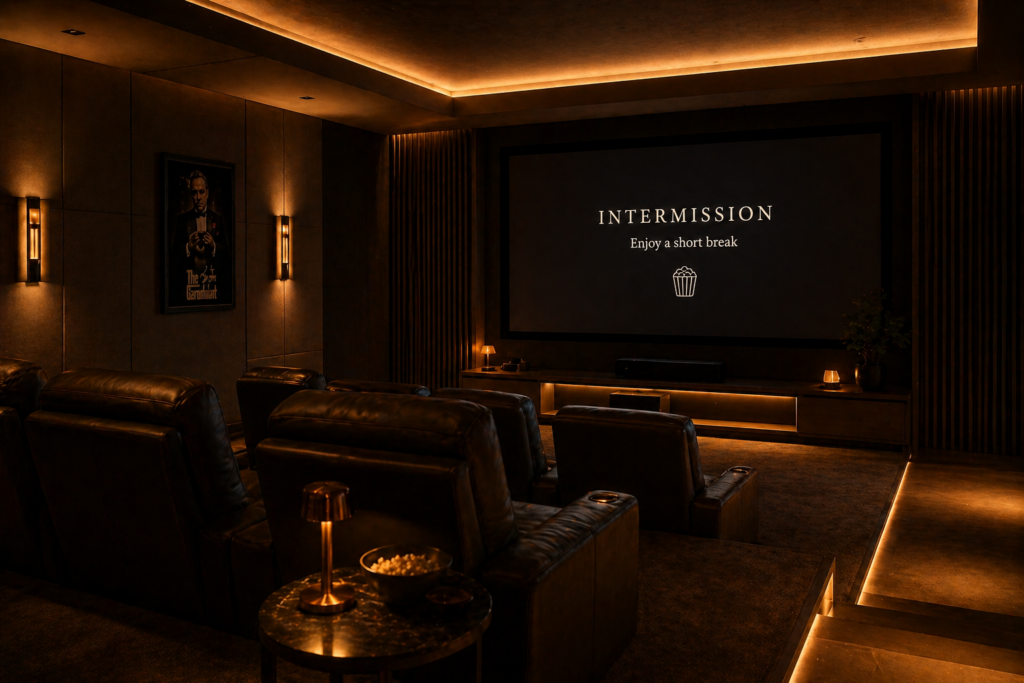
A home theater experience is a journey. It has a beginning, a middle, and an end. In a hybrid smart home system, we program “Transition Scenes” that go far beyond a simple on/off switch.
- The Walk-In: Warm, inviting light intensity bathes the room as you enter, highlighting your acoustic panels’ textures.
- The Pre-Show: As the trailers start, the lights don’t just disappear. They slowly “bleed” out, starting from the front of the room and moving toward the back, like a professional theater.
- The Intermission: If you hit pause, the lights rise only to a low, warm level—just enough to see your way out without “breaking the spell” of the movie or shocking your pupils.
4. Wellness in the “Invisible Cinema”
We are seeing a massive trend in Navi Mumbai and Lonavla villas where homeowners are asking for “Wellness Rooms.” Your home theater shouldn’t be an exception.
By using circadian-aligned lighting, your cinema becomes a space where you can actually relax. Using a Physical Bus System (like KNX), we can ensure that the lighting transition is perfectly smooth—no flickering, no sudden jumps in brightness, just a fluid move that mimics the natural world. This is the difference between a “tech-heavy” room and a “luxury” room.
5. Architectural Integrity and Hidden Tech
The beauty of circadian lighting in an “Invisible Cinema” is that you shouldn’t see the light source. We use hidden COB (Chip on Board) LED strips tucked into ceiling coves and floor skirtings.
The goal is to feel the effect of the light without seeing the “dots” of the LEDs. When the lights are off, the room looks like a clean, architectural marvel. When they are on, they wash the walls in a glow that feels like it’s coming from the structure itself.
Final Thoughts
Luxury isn’t just about having the biggest screen or the loudest speakers. What matters is how you feel in the space. By moving beyond simple dimming and embracing circadian lighting, you are designing a home theater that respects your biology.
Whether you are building a new bungalow in Nashik or a weekend retreat in Lonavla, let’s make sure your lighting is doing more than just sitting in the dark.
When was the last time you watched a movie and felt truly “rested” afterward? Let’s make that the new standard for your home.
Collaboration Opportunities for Builders and Architects
I work with developers, architects, and interior designers to enhance residential projects by integrating circadian lighting during the planning and design stages. My team ensures that automation aligns seamlessly with your design layouts, electrical infrastructure, and interior concepts.
I invite you to partner with Techtastic to implement high-quality circadian lighting for your upcoming projects in Nashik, Navi Mumbai, Sangli, and Lonavla.
Contact today at 9769145145 for a professional consultation to see how an expert home automation system can elevate your design vision.
Technical FAQs on Circadian Lighting
Q: Do I need special bulbs for circadian lighting?
A: Yes. You need “Tunable White” or “RGBW” LEDs. Standard LEDs have a fixed color temperature. Tunable LEDs have two sets of “chips”—one warm and one cool—and the controller mixes them to create the exact shade of white you need.
Q: Is circadian lighting expensive to install?
A: It requires a higher initial investment in controllers and high-quality LED strips. However, since these systems are much more energy-efficient and significantly improve the usability of the room, most of my clients consider it a foundational part of their budget rather than an “extra.”
Q: Can I control circadian lighting with my phone?
A: Yes, but the best way is to let it be automatic. A well-programmed hybrid smart home system knows the time of day and the location of the sun. You shouldn’t have to “pick” a color; the house should know what color you need.
Q: Does it affect the color accuracy of my projector?
A: Not if it’s designed correctly. Circadian lighting is for between movies or for “Ambient Mode.” During the movie, you turn the lights off or set a low-level “Bias Light” behind the screen.
Q: Can I retrofit this into an existing home theater?
A: Yes! We can often replace existing LED strips with tunable ones and update the “brain” (the controller) without needing to change the wiring, provided there is enough space in the existing coves.