
Summary
Neither system is always better.
Your choice depends on your design goals, window frame depth, and light-filtering needs. Motorized blinds are superior for precise micro-adjustments of light and privacy in compact spaces with recessed window frames. Motorized curtains are better for large, expansive glass facades, double-height ceilings, and maximum thermal and acoustic insulation. For a solid smart home, both should be hardwired to a decentralized backbone, not weak battery-powered wireless links.
The Window-Shopping Nightmare: When Premium Automation Feels Like a Compromise
I recently walked through a breathtaking, newly completed penthouse overlooking the sea in Navi Mumbai. The client had spared no expense on the architecture, yet he stood in his master bedroom looking deeply frustrated. He had installed high-end motorized blinds on his massive floor-to-ceiling glass windows. Every afternoon, light leaked through the vertical gaps in the sides, ruining his sleep and heating the room.
This is the classic “Automation Blindspot” that traps discerning homeowners. You spend lakhs on motorized window treatments expecting effortless comfort, but you live in a space that still feels compromised.
The “Industry Wound” is a mass-market illusion. Retail gadget brands promote it. It suggests you can choose window automation from a catalog based only on fabric style. They promise that any wireless, battery-powered motor mounted on a roller or rod will magically transform your room into a luxury sanctuary.
They hide the core engineering reality. Your home’s frame, concrete thickness, and exposure to strong Indian sunlight dictate the hardware you need. – It is poor design to use a roller blind where a heavy drape should be.
It is also poor design to hang bulky curtains over a clean, recessed window cavity. True luxury means your shading doesn’t just look beautiful; it dynamically controls light, heat, and privacy without a single flaw.
Which is Better for Light Control: Motorized Blinds or Motorized Curtains?
Motorized blinds are better for precise micro-management of glare and directional daylight, whereas motorized curtains are superior for achieving absolute blackout conditions. Let how the sun hits that specific room throughout the day guide your choice.
The Power of Micro-Louver Adjustments
With motorized venetian or zebra blinds, you are not limited to just “open” or “closed.” By utilizing localized automation logic, you can tilt the horizontal slats by exact percentages. This allows you to bounce harsh afternoon sunlight off the ceiling to illuminate a room naturally while eliminating glare on television or computer screens.
Eradicating Light Halos
If your ultimate goal is absolute darkness for a home theater or a bedroom, motorized curtains are the undisputed winner. Blinds inherently suffer from “light halos”—small perimeter gaps where the fabric meets the window channel. Curtains, when installed with a generous wall overlap or inside a dedicated ceiling recess, completely seal off the window perimeter, wrapping the room in total darkness.
What are The Structural and Spatial Requirements for Installing Automated Window Treatments?
The structural requirements depend on your architectural phase, where motorized blinds require deep window frames for a flush recessed finish, while motorized curtains demand a wider ceiling cavity to accommodate heavy-duty tracks and fabric stackback.
The Frame Depth Check
Motorized blinds look best when they sit flush inside the window frame. However, automated roller tubes house internal motors and electronics, making them significantly thicker than manual rollers. You need a minimum of 4 to 6 inches of clear window frame depth to prevent the blind from awkwardly protruding into your living space.
The Ceiling Track Cavity
Motorized curtains do not use traditional decorative rods; they run on heavy-duty aluminum tracks hidden inside architectural ceiling slots. Because drapery fabric folds back on itself when opened (known as the stackback), your ceiling recess must be wide enough to let the fabric breathe.
For a single motorized curtain track, you need a 6-inch-wide channel; for a dual-track setup (sheer curtains combined with blackout drapes), a minimum of 10 to 12 inches of clear ceiling cavity is non-negotiable.
Why Should You Choose a Hardwired Automation Backbone over Wireless Battery Motors?
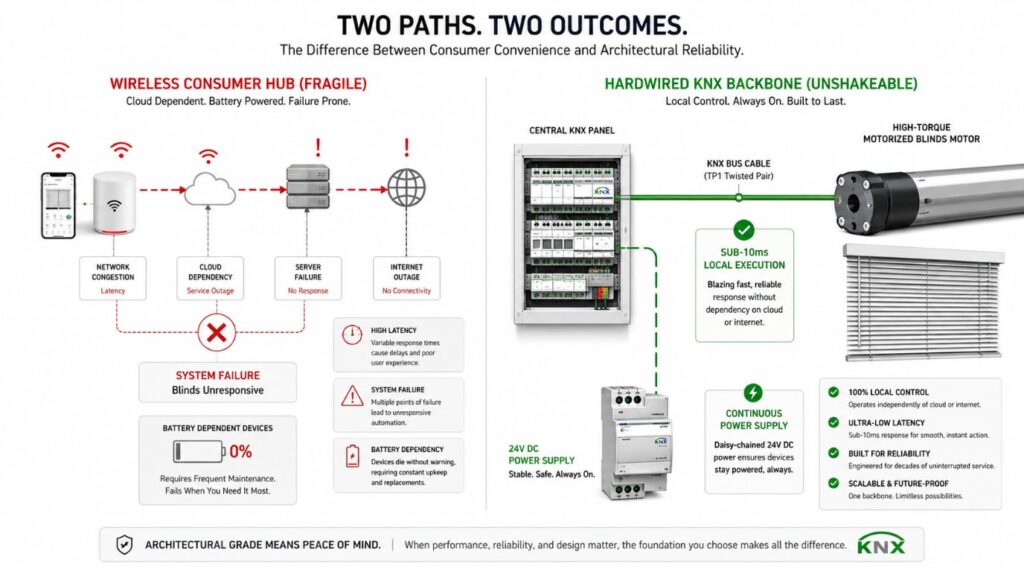
You must choose a hardwired automation backbone over wireless battery motors because physical wiring guarantees continuous power, zero communication latency, and eliminates the recurring maintenance chore of recharging dozens of heavy window units.
[Hardwired Low-Voltage Line] ——-> 100% Constant Torque (No Maintenance, Zero Latency)
[Wireless Battery Motor] ——-> Voltage Drop over Time ——> Battery Dies (System Failure)
The Battery Fatigue Reality
Wireless, rechargeable smart motors sound convenient on a retail website, but they are a logistical trap for large properties. A typical luxury home can easily feature 20 to 40 motorized windows. If you use battery-operated units, you are signing up to manually plug in and charge dozens of windows every few months.
Furthermore, as a battery’s charge drains, its motor torque drops, causing your blinds or curtains to move at uneven speeds and ruin the visual symmetry of your rooms.
Monsoon Signal Immunity
Wireless motorized blinds rely on Wi-Fi, Zigbee, or RF signals broadcast through the air. In modern Indian homes constructed with dense reinforced concrete and heavy brick walls, these airborne signals struggle to travel reliably.
During heavy monsoon storms, increased indoor humidity and electrical interference cause wireless networks to choke. A hardwired system—running low-voltage power and control commands directly through physical copper cables inside your walls—executes flawlessly every single time, completely immune to external disruptions.
How do Motorized Blinds and Curtains Compare Across Key Living Zones?
To select the right hardware, you must evaluate how blinds and curtains perform under different everyday living conditions.
| Feature / Metric | Motorized Blinds Setup | Motorized Curtains Setup |
| Primary Structural Need | Deep, recessed window frame cavities | Dedicated ceiling recesses & stackback space |
| Acoustic Dampening | Low (Hard surfaces reflect sound waves) | High (Heavy fabrics absorb room echo) |
| Thermal Insulation | Moderate (Protects against direct radiant heat) | Exceptional (Traps a thick layer of insulating air) |
| Maintenance Profile | Needs regular dusting of individual slats | Occasional fabric dry cleaning |
| Best Architectural Space | Compact modern studies, kitchens, & bathrooms | Expansive living rooms & master suites |
From a House of Gadgets to an Unshakeable Sanctuary
Automating your home is about removing the tiny friction points of daily life so you can focus on what truly matters. If you have to fight with a lagging smartphone app just to drop a shade, or if light leaks continuously wake you up at dawn, your technology has failed you.
At Techtastic, we don’t treat window automation as an afterthought or a decorative accent. We look at motorized blinds and curtains as vital architectural infrastructure. We map out the wiring paths, calculate weight loads, and design the quiet engineering backbones that turn your home into a perfectly balanced sanctuary.
🤝 The Partnership Corner
- For Discerning Homeowners: We design and install custom, hardwired window systems. They manage light and heat smoothly, without needing your attention.
- For Luxury Architects & Interior Designers: We work with you during the raw gray-structure phase. We provide exact ceiling slot dimensions and wiring plans. This keeps your visual design clean and uncluttered.
Let’s engineer a perfectly shaded space for your family.
📞 Call/WhatsApp: 9769145145
📍 Engineering Premium Seamless Luxury Across: Navi Mumbai | Nashik | Lonavla | Sangli
Technical FAQs on Motorized Blinds & Curtains
Q: Which is better for light control: motorized blinds or motorized curtains?
Motorized blinds provide superior, precise daylight filtering and glare management because you can tilt their slats in micro-percent increments. Motorized curtains are far better for total bedroom blackout conditions because they can overlap the walls and completely seal off the light halos that naturally leak through the sides of blinds.
Q: What are the structural and spatial requirements for installing automated window treatments?
A: Motorized blinds require a deep window frame cavity (4 to 6 inches) to sit flush inside a wall surface. Motorized curtains require a dedicated architectural ceiling recess slot that is at least 6 inches wide for a single track, and 10 to 12 inches wide for a dual track, ensuring the fabric folds can move smoothly without friction.
Q: Why should you choose a hardwired automation backbone over wireless battery motors?
A: Hardwired installations provide unshakeable reliability because they receive continuous power and data through low-voltage physical cables inside the walls. This eliminates the constant maintenance hassle of recharging dead batteries across a large property and prevents the communication lag, signal drops, and motor torque variations common to wireless gadgets.