
Summary
The key advantages of home automation for Indian homes include substantial energy savings through smart climate control, robust security tailored for independent bungalows, and seamless control over unpredictable voltage and power fluctuations. By integrating a centralized, wired backbone like KNX or Control4, Indian homeowners can effortlessly manage lighting, heavy HVAC loads, and water systems.
This infrastructure eliminates reliance on unstable Wi-Fi networks and fragile consumer-grade gadgets, transforming a complex estate into an automated, self-sustaining luxury environment designed to endure Indian environmental conditions.
The Summer Meltdown: Why Your Luxury Indian Villa Feels Like an Unmanaged Substation
I vividly remember walking into a magnificent, newly built 15,000-square-foot multi-generational estate in Nashik during a blistering 43°C April afternoon. The architecture was flawless, yet inside, a massive argument was brewing: the grandparents were freezing from an AC left running at 18°C in the formal living room, while the top floor was baking because the domestic staff forgot to lower the heavy western-facing drapes.
To make matters worse, a sudden local voltage drop had just tripped the home theater amplifier, leaving the owner frantically resetting circuit breakers in a sweaty basement.
This is the “Domestic Exile” that thousands of premium property owners across India face daily. You invest crores into building a sanctuary, yet you end up operating it like a full-time grid technician.
The “Industry Wound”—the fundamental lie sold by retail brands—is that “smart living” means buying a dozen cheap wireless smart plugs and pasting an AI voice puck onto every wall.
In reality, when the local transformer fluctuates or the monsoon moisture disrupts your Wi-Fi routers, those consumer-grade gadgets drop offline instantly. True luxury in the Indian context isn’t about gadgets; it’s about deploying an unshakeable, industrial-grade infrastructure that commands your home effortlessly through power cuts, voltage spikes, and heavy dust.
What are The Primary Advantages of Home Automation for Indian Households?
The primary advantages of home automation for Indian households are centralized energy management, voltage surge protection, and proactive security systems that adapt to regional climatic challenges and multi-generational living requirements. By stabilizing infrastructure through systems like KNX, homeowners protect their investments while automating repetitive daily maintenance. Key advantages of home automation are stated below:
1. Taming the Indian Smart Grid and Voltage Fluctuations
Power quality in regions like Navi Mumbai or rural Sangli can be wildly unpredictable. A professional automation system monitors incoming lines at the distribution board, automatically shedding non-essential loads or isolating sensitive home theater equipment before an overvoltage spike blows out expensive circuit boards.
2. Conquering the High-Ceiling “Thermal Pocket”
Indian villas love double-height living spaces, but these architectural marvels trap massive heat. Automation links solar tracking sensors with motorized curtains to seal the room off during peak UV hours, drastically reducing your reliance on heavy air conditioning.
3. Simplifying Multi-Generational Subsystems
An Indian home often houses grandparents, children, and domestic staff simultaneously. Professional smart homes replace confusing clusters of 8-gang switchboards with elegant, single-button keypads. Tapping a button engraved with “Satsang” or “Movie” alters the room’s entire landscape instantly.
How Does Smart Home Technology Reduce Electricity Bills in Hot Indian Climates?
Smart home technology reduces electricity bills by running high-load HVAC systems and lighting networks strictly on logic-driven schedules and environmental thresholds rather than manual operation. Implementing features like daylight harvesting and occupancy tracking across large estates can slash monthly power bills by up to 30%.
Daylight Harvesting via Lux Sensors
During bright afternoons, your indoor architectural LEDs shouldn’t be firing at maximum capacity. Automated systems read the incoming sunlight and dim interior circuits proportionally to maintain a perfect, constant indoor lux level, preventing immense energy waste.
Intelligent Inverter and Solar Integration
If your villa utilizes solar panels or hybrid backup inverters, a wired automation backbone intelligently allocates power. When the main grid drops, the system can automatically cut power to empty guest suites while preserving battery capacity for your master bedroom and security perimeter.
Can Home Automation Secure Independent Indian Bungalows from Intruders?
Yes, home automation secures independent Indian bungalows by establishing an air-gapped, proactive defense layer that integrates physical perimeter beams, vibration sensors, and automated lighting barriers before a breach occurs. Unlike standalone CCTV cameras that merely record a theft after the fact, an integrated system actively deters intruders by flooding the grounds with light and locking safe-zone doors.
Eliminating False Alarms Caused by Stray Animals
Cheap motion sensors flag every stray cat or shifting tree branch. We deploy high-resolution, dual-technology presence detectors and thermal barrier beams that intelligently distinguish a human intruder from environmental noise, ensuring your emergency alerts are 100% accurate.
Water Infrastructure and Monsoon Defense
Security in India isn’t just about uninvited guests; it’s about climate threats. Heavy monsoon downpours can flood basements or compromise overhead water tanks. Specialized water leak sensors placed near subterranean home theaters or Italian marble floors can automatically trigger motorized valves to shut off main lines, saving lakhs in structural damage.
Why is a Hardwired Automation System Critical for Architectural Villas in India?
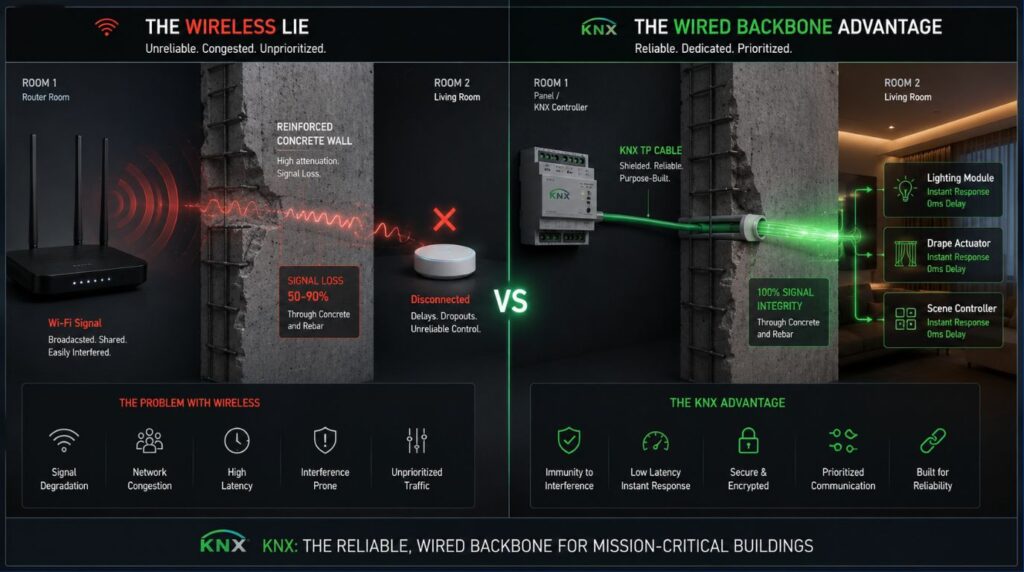
A hardwired automation system is critical for architectural villas because India’s thick internal brick walls, reinforced concrete pillars, and heavy concrete slabs completely block and degrade wireless smart home signals. Running a dedicated, shielded bus cable ensures that commands travel instantly through physical conduits, eliminating the lag, drops, and security vulnerabilities of Wi-Fi networks.
The “Monsoon Moisture” Signal Degradation
High humidity and damp coastal walls significantly alter wireless radio frequency behavior. A physical KNX or Control4 wired infrastructure is entirely immune to weather shifts, keeping your keypads, automated drapes, and climate nodes completely stable year-round.
Zero-Maintenance Architecture
Wireless setups require hundreds of small lithium batteries tucked inside switches and sensors. In a sprawling villa or a multi-story bungalow, you or your staff would be trapped in a never-ending loop of changing batteries every few months. A wired system draws its low-voltage power directly from the green bus line, running flawlessly for decades.
Moving from “Estate Manager” to “Estate Guest”
The ultimate return on investment for high-end home automation in India isn’t the technological novelty—it is the gift of friction-free living. You should never have to walk across a 10,000-square-foot house to double-check if a bathroom geyser was left running or if the front gate is locked.
At Techtastic, we design the unshakeable digital blueprints that hand control back to you using the advantages of home automation. We take care of the structural complexity so that your home behaves exactly like a world-class luxury hotel, custom-tailored to your family’s lifestyle.
🤝 The Partnership Corner
At Techtastic, we believe that the best smart homes are built on collaboration, not just cables. We specialize in providing the technical “backbone” that allows your creative vision to shine.
- For Architects: We collaborate seamlessly during your initial layout stages to hide massive electrical distribution networks behind minimalist walls using the advantages of home automation.
- For Interior Designers: We match our high-performance keypads and glass touchplates to your custom color palettes and material finishes.
Let’s secure and stabilize your estate using the advantages of home automation.
📞 Call/WhatsApp: 9769145145
📍 Our Operational Hubs: Navi Mumbai | Nashik | Lonavla | Sangli
Technical FAQs on Advantages of Home Automation
Q: What are the primary advantages of home automation for Indian households?
A: The main advantages of home automation are protecting expensive appliances from unpredictable voltage surges, drastically lowering cooling costs via automated shading, and bypassing thick concrete wall interference using robust, hardwired automation networks.
Q: How does smart home technology reduce electricity bills in hot Indian climates?
A: It integrates presence detectors with HVAC units to prevent cooling empty zones and utilizes lux sensors for daylight harvesting, which automatically dims indoor LED fixtures when natural sunlight is sufficient.
Q: Why is a hardwired automation system critical for architectural villas in India?
A: India’s dense concrete and brick construction styles severely absorb and disrupt wireless signals like Wi-Fi or Zigbee. A hardwired system ensures absolute reliability, zero signal dropouts, and eliminates the hassle of replacing batteries in hundreds of wireless devices.