
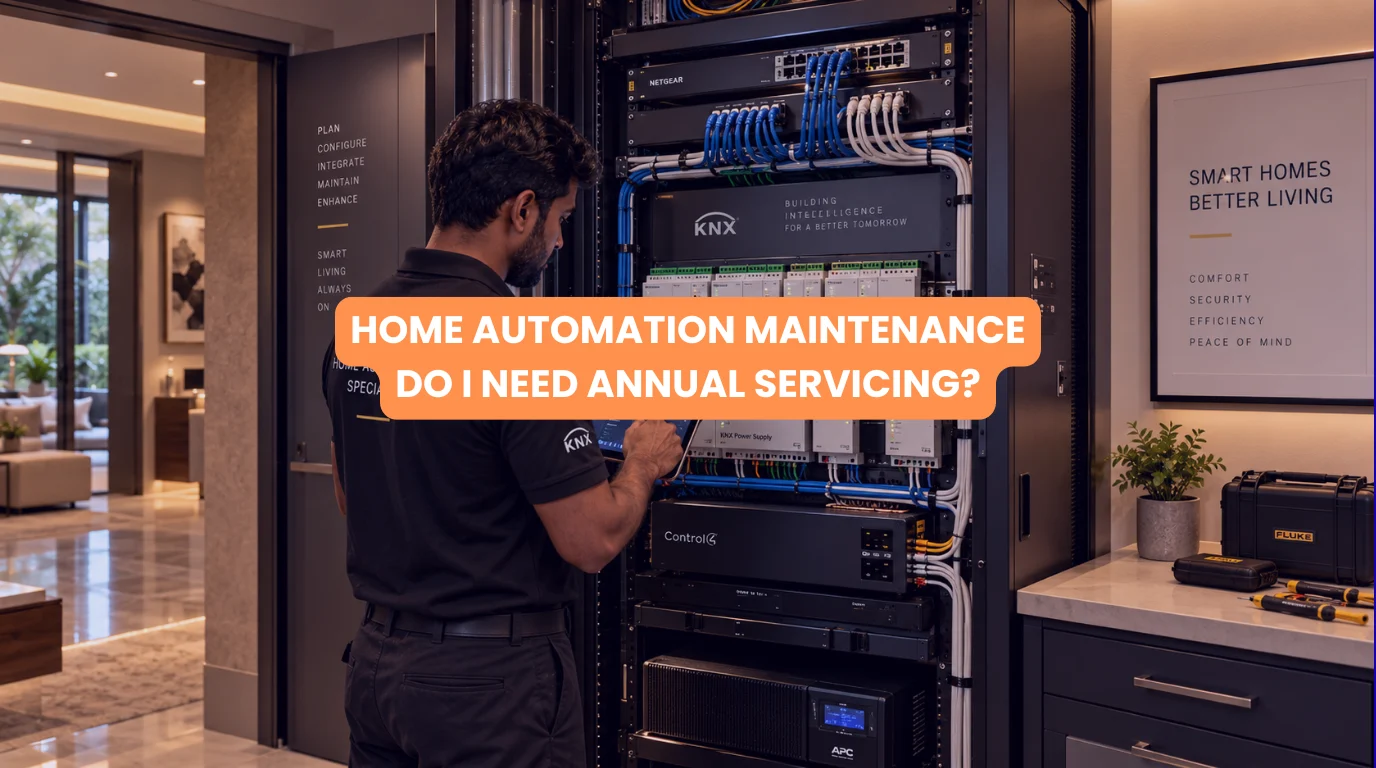
When homeowners invest in smart lighting, motorized curtains, security, HVAC automation, home theater, and whole-home control, one question often comes later: “Do I actually need home automation maintenance for all this every year?”
The answer isn’t a simple yes or no.
A basic smart bulb setup may require almost no professional attention. A large villa with KNX automation, many lighting circuits, motorized curtains, HVAC, networking, security, and AV gear is different. That’s why you should base home automation maintenance on your system’s complexity rather than an arbitrary calendar.
For most professionally installed home systems, an annual health check is a smart preventive step even if nothing seems broken.
Quick Summary
✓ Simple smart-home setups generally need minimal professional servicing.
✓ Complex whole-home automation benefits from an annual professional review.
✓ KNX systems are designed for long-term reliability but still need occasional inspection and updates.
✓ Backing up programming and configuration is one of the most important maintenance tasks.
✓ Networking problems are often mistaken for automation problems.
✓ Motorized curtains, HVAC controls and other mechanical systems need different checks from electronic devices.
✓ An AMC isn’t mandatory for every homeowner.
✓ Annual servicing becomes particularly valuable for large or mission-critical installations.
Quick Answer
Usually, yes, for complex systems, but not necessarily as a mandatory requirement. The purpose of home automation maintenance isn’t simply to fix something after it fails.
Preventive maintenance can identify:
- Devices that are becoming unreliable
- Network problems
- Outdated software
- Missing backups
- Failed sensors
- Motor issues
- Integration problems
- Changes required after renovations
- Hardware approaching replacement
Techtastic’s existing guidance similarly recommends annual reviews for complex systems, while simpler setups may need attention only when updates, batteries, or specific problems arise.
Why Does Home Automation Need Maintenance?
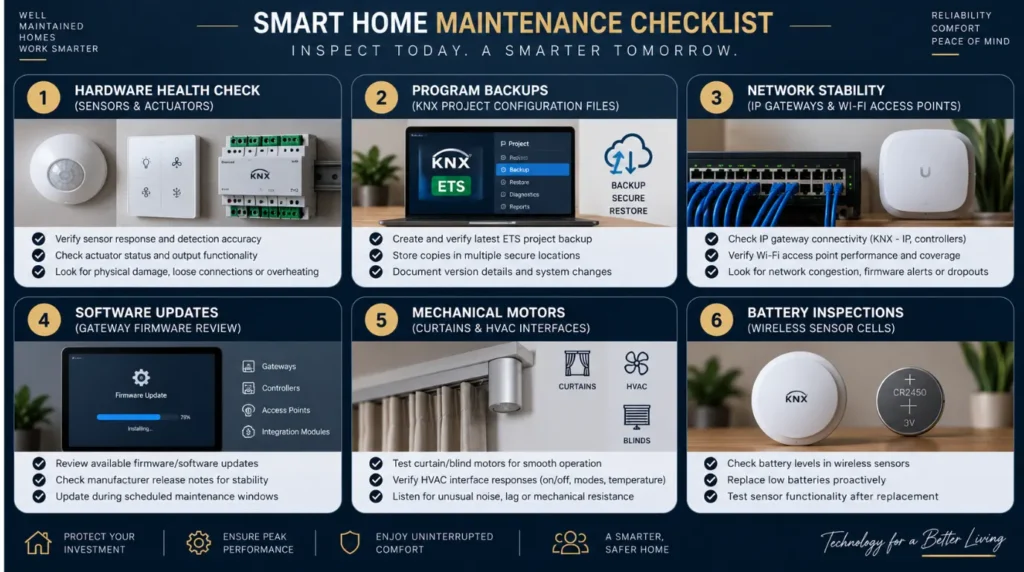
A conventional electrical switch doesn’t normally receive a firmware update. A smart home is different.
Your automation system may contain:
- Smart switches
- KNX actuators
- Sensors
- Touch panels
- Gateways
- Wi-Fi access points
- Network switches
- Motorized curtains
- HVAC controllers
- Security devices
- AV equipment
- Mobile applications
- Automation programming
Each component has its own lifecycle.
That means home automation maintenance isn’t about one single machine. It is about keeping an entire ecosystem working together.
Does KNX Require Annual Maintenance?
This is particularly important for homeowners considering professional wired automation. KNX provides long-term reliability and generally requires relatively little routine maintenance.
Its architecture relies heavily on wired communication, distributed devices, and professional programming rather than depending entirely on cloud services. That doesn’t mean a KNX home should simply be installed and forgotten.
A periodic review can include:
- Checking the KNX bus
- Inspecting devices
- Testing switches and sensors
- Checking touch panels
- Reviewing gateways
- Backing up the project
- Reviewing programming
- Checking integrations
- Making changes after renovations
Techtastic’s KNX maintenance guidance recommends annual system reviews, backups, and network checks for most residential installations.
KNX Association also maintains formal product lifecycle information for its software and ecosystem. This reinforces the value of lifecycle management over treating automation as a one-time purchase.
What Does Home Automation Maintenance Actually Include?
This is where homeowners need to look beyond the word “servicing.” A good maintenance visit should not simply involve someone walking around and asking whether the lights work.
1. Automation Hardware Inspection
The technician can check:
- Controllers
- Actuators
- Sensors
- Touchscreens
- Keypads
- Gateways
- Power supplies
- Network equipment
The goal is to identify abnormal behavior before it becomes a major failure.
2. Software and Firmware Review
Some components may receive firmware or software updates.
Updates can address:
- Bugs
- Compatibility
- Security
- Stability
- New functionality
However, updates should not be performed blindly. A professional should understand the existing system and verify that an update won’t break another integration.
3. System Backup
This is one of the most important and frequently overlooked parts of home automation maintenance.
For professional systems, maintain backups of:
- Programming
- Device configurations
- Automation logic
- System documentation
- Network information
- Integration settings
For KNX, maintaining the project/programming files is particularly important. If a device eventually needs replacement, having the original configuration can make the process significantly easier.
4. Network Health Check
Modern automation frequently depends on networking.
Even if your core automation is wired, your:
- Mobile app
- Remote access
- Cameras
- Streaming
- Voice control
- Smart TVs
- AV systems
- Gateways
may depend on the network.
A router replacement or poorly configured Wi-Fi system can therefore make homeowners think their automation has failed. In reality, the automation may be perfectly healthy, but the network may be the problem.
That’s why network health should be part of serious home automation maintenance.
5. Sensor Testing
Sensors are easy to forget because they are usually hidden.
A maintenance visit can test:
- Motion sensors
- Presence sensors
- Door/window sensors
- Temperature sensors
- Light sensors
- Water-leak sensors
Battery-powered sensors may also need battery replacement. Wired KNX sensors eliminate many of these battery-related maintenance tasks, which is one of their practical advantages.
6. Motorized Curtain Inspection
Motorized curtains combine electronics with mechanical movement.
Maintenance may involve checking:
- Motor operation
- Track movement
- Alignment
- Noise
- Remote commands
- Open/close limits
- Automation scenes
If a curtain starts moving slowly or making odd sounds, fix it early. Do not wait until the motor stops.
7. HVAC and Climate Automation
If your smart home controls air conditioning or climate systems, home automation maintenance should also verify that commands and feedback are working correctly.
For example:
“Good Night” scene
→ Lights turn off
→ Curtains close
→ AC changes temperature
→ Bedroom scene activates
If the automation command is sent but the HVAC interface does not respond, the issue may be the controller. It may also be the gateway, AC interface, or the network.
That’s why integrated systems require holistic troubleshooting.
How Often Should Home Automation Be Serviced?
There isn’t one universal schedule.
A practical framework looks like this:
| Maintenance Task | Suggested Frequency |
|---|---|
| Basic visual inspection | Every 6–12 months |
| System health review | Annually |
| Programming backup | Annually / after major changes |
| Network review | Annually |
| Firmware updates | As required |
| Battery replacement | As required |
| Curtain/motor inspection | Annually or when needed |
| Automation expansion review | Whenever features are added |
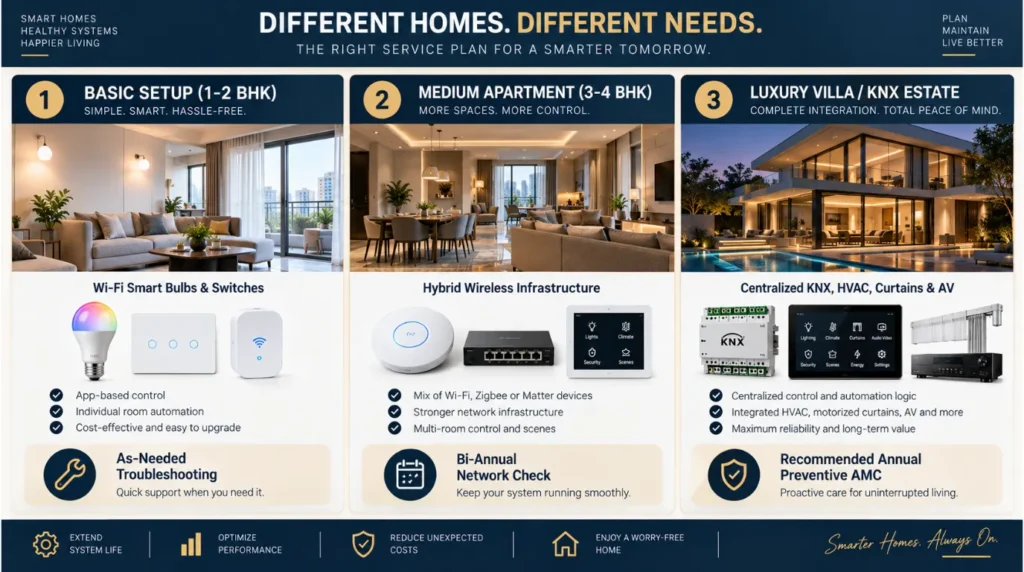
For most complex residential systems, annual home automation maintenance is a reasonable baseline. Techtastic’s current maintenance guidance similarly recommends annual reviews for residential KNX systems.
Do I Need an AMC?
Not necessarily.
An Annual Maintenance Contract makes more sense when:
- Your system is large
- Multiple brands are integrated
- You have a luxury villa
- Automation controls critical systems
- You aren’t comfortable troubleshooting technology
- You want priority technical support
- You have frequent changes or expansions
- Downtime is particularly inconvenient
For a small smart-home installation with a handful of Wi-Fi switches, an AMC may be unnecessary. For a large KNX-based residence controlling lighting, HVAC, curtains, security, and AV, professional support becomes much more valuable.
Indian automation providers offer different AMC structures, from periodic visits to broader preventive maintenance and breakdown support.
How Much Does Home Automation Maintenance Cost?
There isn’t a universal price for home automation maintenance.
The cost depends on:
- Number of automated points
- Technology used
- Number of rooms
- Brands involved
- KNX vs consumer ecosystem
- AV integration
- Security integration
- Networking
- Number of service visits
- Remote support requirements
- Whether replacement parts are included
As a broad market reference, some Indian providers price annual maintenance as a percentage of project value, while others offer fixed AMC packages based on system size and scope.
One Indian pricing guide cites about 5–10% of hardware value per year for large wired systems. Individual providers may structure their contracts differently. So don’t compare AMC quotes based only on the headline price, but compare what is actually included.
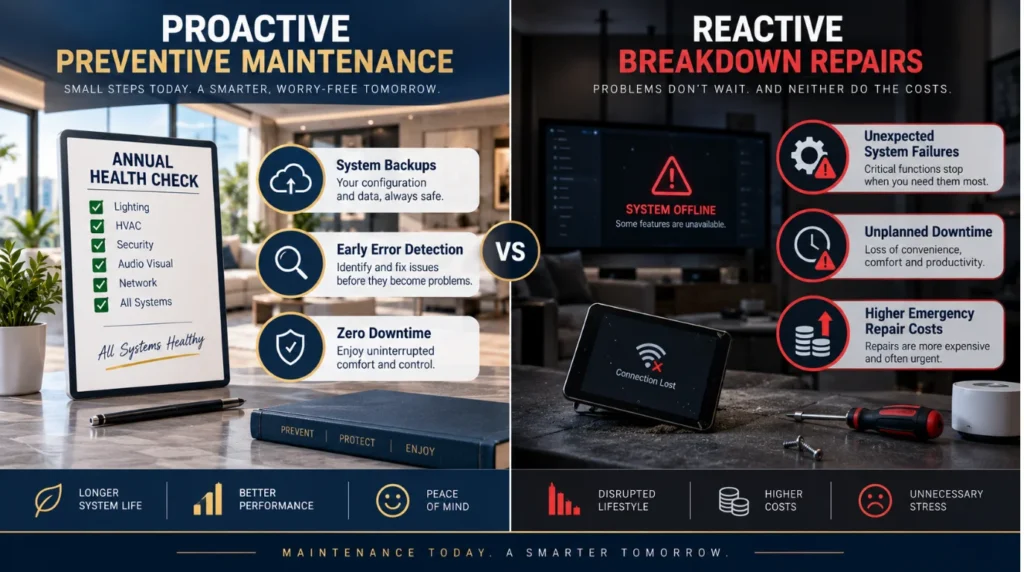
Preventive Maintenance vs Breakdown Service
These are two different approaches.
Breakdown Service
Something stops working, so you call the integrator. They diagnose it and repair or replace it.
Preventive Maintenance
The integrator checks the system before something becomes a major problem.
This may identify:
- Unstable devices
- Backup gaps
- Network problems
- Programming inconsistencies
- Mechanical wear
- Integration issues
Preventive home automation maintenance is generally about reducing surprises.
When Should You Definitely Schedule a Service?
Even if you don’t have an AMC, contact your automation professional when:
Your system starts responding slowly
This could indicate networking, controller, or integration problems.
Several devices stop responding
Don’t immediately replace the devices. Find the common point of failure.
You change your router
Network configuration changes can affect integrations and remote access.
You renovate your home
Moving walls, lights, curtains, or furniture can affect automation logic and sensor behavior.
You add new devices
New integrations can require programming changes.
Your automation company changes
Make sure you obtain the system documentation and programming backups.
You’re selling the house
A complete automation handover makes the system easier for the next homeowner to understand and maintain.
How Homeowners Can Reduce Maintenance Problems
Good home automation maintenance begins during design and installation.
I recommend homeowners focus on five things.
1. Use a coherent architecture
Avoid building your smart home from dozens of unrelated devices simply because each one is cheap.
2. Keep documentation
Maintain:
- Floor plans
- Device lists
- Programming files
- Network information
- Product details
3. Keep backups
Don’t wait until something fails.
4. Plan for expansion
Leave sufficient capacity for future requirements.
5. Work with an integrator who understands the complete system
Your lighting, curtains, HVAC, security, and AV shouldn’t be treated as completely unrelated projects when they are intended to work together.
Does a Well-Designed Smart Home Need Constant Servicing?
No, and this is an important distinction. A well-designed automation system shouldn’t require someone visiting your house every month just to keep basic functions alive.
The objective of good home automation maintenance is predictability, not constant intervention.
Professional systems such as KNX prioritize reliability, distributed control, and long-term operation in their design. Some individual KNX devices are even specified by manufacturers as requiring no routine maintenance beyond keeping them clean and protected from environmental conditions.
The more important issue is having a sensible lifecycle strategy.
Techtastic’s Approach to Home Automation Maintenance
At Techtastic, we see maintenance as part of an automation system’s lifecycle. We do not treat it as an emergency service that starts only after something breaks.
For a complex residence, our approach can include: Inspect → Test → Backup → Review → Optimize → Document
We look at the automation system as a complete environment.
That means considering:
- KNX automation
- Lighting
- Curtains
- HVAC
- Security
- Home theater
- Networking
- User interfaces
- Future expansion
This approach makes home automation maintenance much more useful than simply checking whether today’s lights turn on.
Key Takeaways
Home automation maintenance is important, but it shouldn’t be complicated. For a simple smart home, occasional troubleshooting may be enough. For a professionally integrated villa, annual servicing is a sensible preventive measure.
The most important things to maintain are:
✓ System backups
✓ Programming documentation
✓ Network infrastructure
✓ Sensors and interfaces
✓ Motorized equipment
✓ Software/firmware where appropriate
✓ Automation logic
✓ Third-party integrations
And remember: maintenance isn’t necessarily about fixing failures. It’s about preventing avoidable failures and keeping the system aligned with how your home actually works.
Frequently Asked Questions
1. What is Home Automation Maintenance?
A. Home Automation Maintenance is the periodic inspection, testing, updating, backup, and optimization of a smart-home system to keep its hardware, software, networking, and integrations operating correctly.
2. Do I need annual Home Automation Maintenance?
A. For a complex professional system, we recommend annual maintenance as a practical preventive approach. Simple systems may not require yearly professional servicing.
3. Does KNX require annual servicing?
A. KNX generally requires relatively little maintenance, but annual system reviews, backups, network checks, and inspections can help maintain long-term reliability.
4. Is an AMC necessary for every smart home?
A. No. An AMC is best for complex sites, luxury homes, and systems that need expert support and minimal downtime.
5. What happens during home automation servicing?
A. A professional may inspect hardware, test sensors and controls, review networking, check programming, update appropriate software, maintain backups, and identify potential problems.
6. How much does smart-home maintenance cost?
A. Pricing depends on system size and scope. AMC structures vary considerably between providers, so compare inclusions rather than looking only at the annual price.
7. Can I maintain my smart home myself?
A. Simple Wi-Fi devices can often be managed by homeowners. A qualified professional handles complex KNX and multi-system installations better, particularly when programming changes are involved.
8. Does home automation maintenance include repairs?
A. It depends on the service agreement. Some AMCs include preventive visits and troubleshooting but charge separately for replacement hardware, parts or major repairs.
9. How often should automation backups be taken?
A. At minimum, maintain a current backup annually and whenever significant programming or system changes are made.
10. Can maintenance prevent automation failures?
A. It can reduce the likelihood of avoidable problems by identifying issues with networking, configuration, hardware, and integrations before they become major failures.
Collaboration Opportunities for Architects & Interior Designers
Maintenance starts with good design.
For architects and interior designers, automation should be documented and coordinated with:
- Electrical drawings
- Ceiling plans
- Lighting layouts
- Curtain locations
- HVAC
- AV equipment
- Network infrastructure
- Equipment racks
- Access panels
This makes future home automation maintenance significantly easier.
A system that is beautifully hidden but impossible to access or document isn’t necessarily a well-designed system. For luxury residences, we recommend thinking about serviceability during the design stage, not after the first failure.
Areas We Serve
Techtastic works with homeowners, architects, interior designers, and developers across:
Navi Mumbai | Nashik | Lonavla | Sangli
We also support smart-home and automation projects across the wider Mumbai and Thane region.
Final Verdict: Home Automation Maintenance
So, do you need annual servicing for your home automation?
If you have a few smart bulbs and switches, probably not as a formal annual service. But if you have a professionally installed smart home system, I recommend a yearly review.
This includes control of lighting and curtains. It also covers HVAC, security, and networking, and includes AV and KNX automation too.
The objective isn’t to create another household chore but to make sure the system you’ve invested in continues to work reliably, predictably, and the way you intended it to.
Good home automation maintenance should be preventative, documented, and proportional to the complexity of your home. When you design the system properly from the beginning, maintenance should feel like a health check and not a constant repair job.
Contact Techtastic
🌐 Website: Techtastic Website
📞 Phone: 9769145145
📍 Service Areas: Mumbai • Navi Mumbai • Pune • Lonavala • Nashik • Sangli