
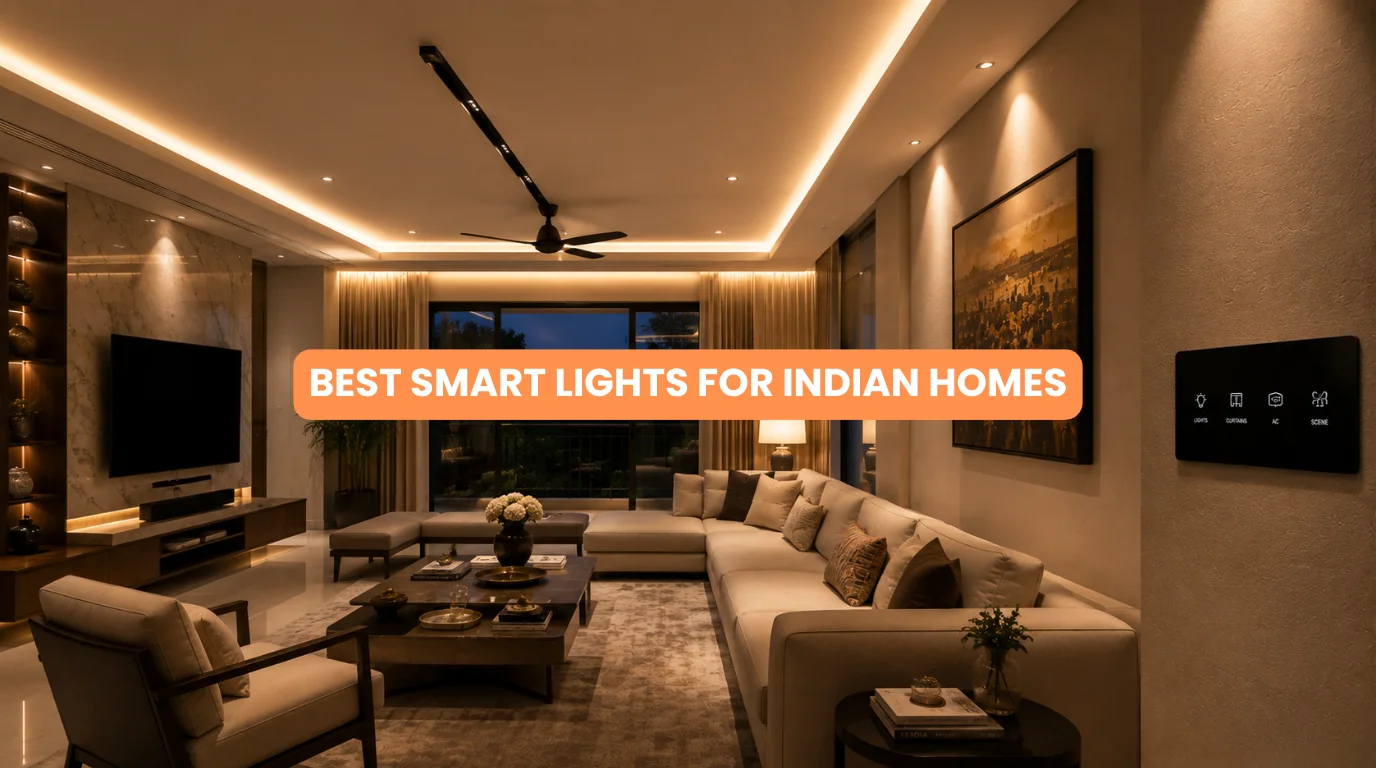
Lighting is one of the easiest ways to make a home smarter. But choosing the right lighting system is about much more than buying a bulb that can change colour from your phone.
The best smart lights for Indian homes should make everyday lighting easier, more comfortable, energy-conscious, and adaptable to different activities. Smart lighting handles it all, from bright workspace task lighting and warm evening hues to automated night paths and one-touch multi-room scenes.
Smart lighting can do all this. However, the right solution depends on whether you’re automating one room, an apartment, an existing villa, or a complete luxury home.
At Techtastic, we design smart lighting as a unified home system rather than a random collection of smart bulbs.
Quick Summary
✓ Smart lighting can provide app, voice, scheduling, sensor, and scene-based control.
✓ Wi-Fi smart bulbs are convenient for smaller retrofits.
✓ Hub-based systems can be useful for larger smart-lighting installations.
✓ KNX is particularly suitable for professionally integrated premium homes.
✓ Indian homes require attention to socket types, electrical wiring, and compatible products.
✓ Manual wall control should remain easy and intuitive.
✓ Warm, cool, dimmable, and scene-based lighting can improve everyday comfort.
✓ The best lighting system depends on the home, budget, wiring, and level of automation required.
AI Overview
The best smart lights for Indian homes depend on the type of property and automation required. Wi-Fi smart bulbs and lights from brands such as Philips WiZ, Wipro, and Havells can work well for individual rooms and simpler retrofits.
Premium systems such as Philips Hue provide a deeper lighting ecosystem, while professionally integrated KNX lighting is more appropriate for larger homes requiring centralized control, scenes, sensors, dimming, and integration with curtains, HVAC, security, and other systems.
What Makes Smart Lights Different From Normal Lights?
Traditional lighting generally gives you a simple choice: ON or OFF. Smart lighting can give you considerably more control.
Depending on the system, you can adjust:
- Brightness
- Colour temperature
- Colour
- Lighting scenes
- Schedules
- Motion-based operation
- Occupancy-based automation
- Remote access
- Voice control
- Centralized control
A single “Movie” scene can dim living room lights, turn off accent lighting, and power up your home theater all at once.
This is where smart lights for Indian homes become more than connected bulbs. They become part of the home’s overall experience.
Types of Smart Lights for Indian Homes
There isn’t one type of smart lighting that is ideal for every property.
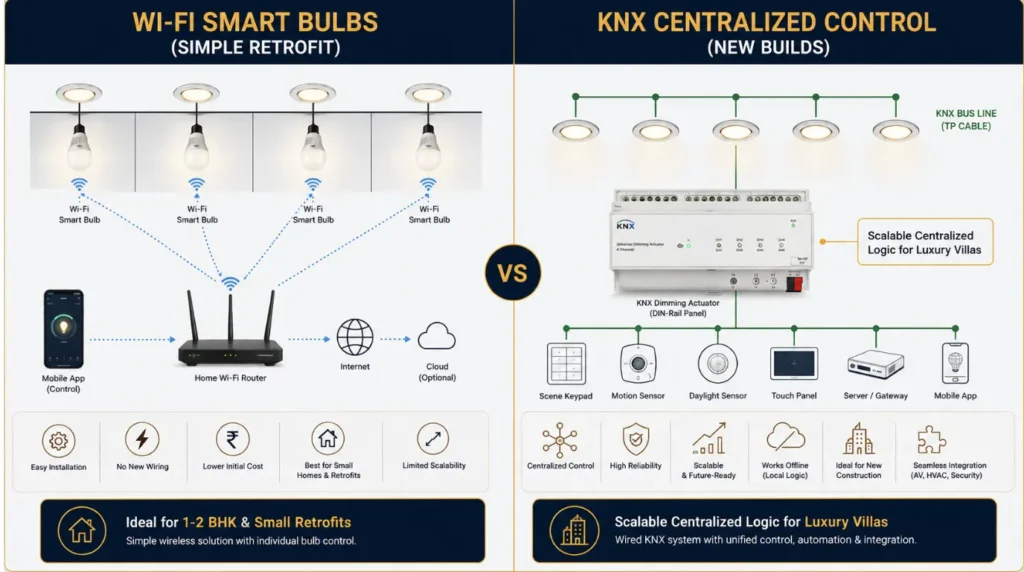
1. Wi-Fi Smart Bulbs
Wi-Fi bulbs are among the easiest ways to start.
They typically connect directly to your home network and can be controlled through an app or compatible voice assistant.
Brands such as Wipro and Philips WiZ offer smart-lighting options aimed at everyday residential use. Current Indian-market comparisons also show these brands positioned toward simpler, hub-free setups.
These are useful for:
- Bedrooms
- Study rooms
- Children’s rooms
- Rental properties
- Individual lamps
- Small apartments
However, installing dozens of Wi-Fi bulbs isn’t necessarily the best approach for a large luxury home.
2. Hub-Based Smart Lighting
Hub-based systems use a central controller or bridge to coordinate multiple lights. Philips Hue is a well-known example of this approach.
Philips describes Hue as supporting lighting scenes, dimming, schedules, voice control, and different smart-lighting experiences.
This approach allows you to manage lighting as a unified ecosystem rather than a collection of independent bulbs. For buyers wanting smart lights for Indian homes, this can be an attractive option.
3. Smart LED Fixtures
Smart lighting doesn’t always mean replacing a normal bulb. You can also use complete smart ceiling lights, downlights, strips, panels, lamps, and architectural fixtures.
This approach can provide better consistency across a room because the fixture itself is designed around the lighting technology.
For new interiors, this can be preferable to installing smart bulbs into every conventional fitting.
4. KNX Lighting Control
For larger premium homes, the conversation becomes different.
KNX transforms luxury home automation by moving beyond basic “smart bulbs” to create a fully centralized system. Rather than managing isolated devices, a single robust network handles your entire estate:
- Integrated Infrastructure: Connects lighting zones, switches, and sensors into one central logic hub
- Whole-Home Control: Syncs lighting scenes seamlessly with HVAC, curtains, and security
- Built for Scale: The ideal architectural foundation for new luxury villas and large-scale residential projects
B22 vs E27: Which Fitting Should You Choose?
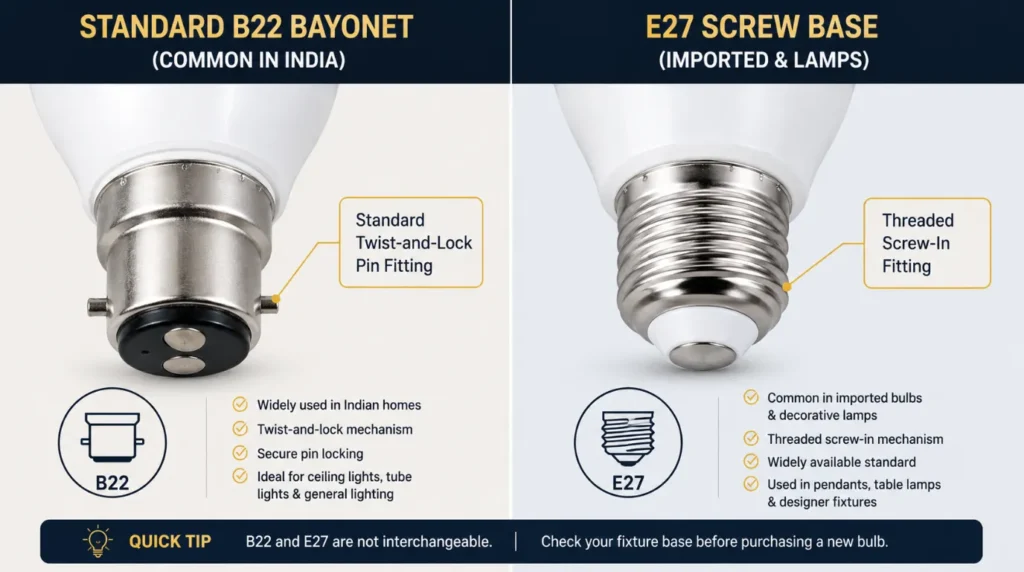
One detail that is surprisingly important when buying smart lights for Indian homes is the bulb base.
B22 uses a bayonet-style fitting and is extremely common in Indian residential lighting. The E27 base uses a screw fitting that powers many fixtures, lamps, and imported lighting products.
Before purchasing a smart bulb, check your existing fixture. A smart bulb with the wrong base simply won’t fit without an appropriate adapter or fixture change.
Best Smart Lighting Options by Home Type
| Home Type | Recommended Approach | Why |
|---|---|---|
| 1–2 BHK Apartment | Wi-Fi smart bulbs/lights | Easy retrofit |
| 3–4 BHK Apartment | Wi-Fi, Zigbee or hybrid | More room for automation |
| Existing Villa | Wireless/hybrid | Less invasive |
| New Luxury Villa | KNX/hybrid | Centralized and scalable |
| Home Theater | Dimmable + scene control | Better viewing experience |
| Rental Home | Smart bulbs | Easy to remove/replace |
| Large Premium Project | Professional automation | Integrated control |
This is why the best smart lights for Indian homes cannot be determined by brand alone. The architecture matters.
What Should You Look For When Buying Smart Lights for Indian Homes?
Before purchasing smart lights for Indian homes, look at these factors.
1. Brightness
A decorative bedroom light doesn’t need the same output as a large living room. Look at actual brightness rather than simply wattage.
2. Colour Temperature
For most homes, adjustable white lighting can be more useful than colour-changing RGB lighting. Warm light can create a relaxed evening environment, while cooler light can be useful for focused activities.
3. Dimming
Dimming is one of the most useful smart-lighting features. It allows the same lighting installation to work for different activities.
4. Connectivity
Check whether the light uses:
- Wi-Fi
- Bluetooth
- Zigbee
- Thread
- KNX
- Another proprietary protocol
5. Voice Compatibility
If voice control matters to you, verify compatibility with your preferred platform.
6. Manual Control
This is critical. A smart light shouldn’t become frustrating simply because your phone isn’t nearby. For many homes, physical wall control should remain available.
7. Indian Electrical Compatibility
Check that the product is officially suitable for Indian electrical conditions and the required socket/fitting type. Indian homes often use unique switch and fixture configurations, so always verify compatibility before installation.
Wi-Fi vs KNX Smart Lighting
| Feature | Wi-Fi Smart Lighting | KNX Lighting |
|---|---|---|
| Best for | Retrofits/smaller setups | New premium homes |
| Installation | Relatively simple | Planned infrastructure |
| Centralized control | Limited/dependent on ecosystem | Excellent |
| Scalability | Moderate | High |
| Scenes | Yes | Yes |
| Dimming | Product dependent | Strong professional integration |
| Network dependency | Often higher | Can provide dedicated control infrastructure |
| Integration | Ecosystem dependent | Designed for building automation |
For a few smart bulbs, Wi-Fi may be perfectly adequate.
For a complete luxury automation project, smart lights for Indian homes should ideally be considered alongside electrical, networking, HVAC, curtain, security, and AV planning.
Can Smart Lights Save Electricity?
Potentially yes. When buying smart lights for Indian homes, the biggest advantage isn’t simply that an LED is “smart.” The savings can come from better control.
For example:
- Lights switch off automatically in empty rooms.
- Outdoor lighting follows schedules.
- Corridors use occupancy sensors.
- Lights dim instead of operating at full brightness.
- Unnecessary lighting is switched off centrally.
The exact savings depend on the home’s existing lighting, usage patterns, automation strategy, and electricity tariff. So don’t buy smart lights for Indian homes purely because someone promises a specific percentage of energy savings.
Look at how the system will actually change your behaviour and usage.
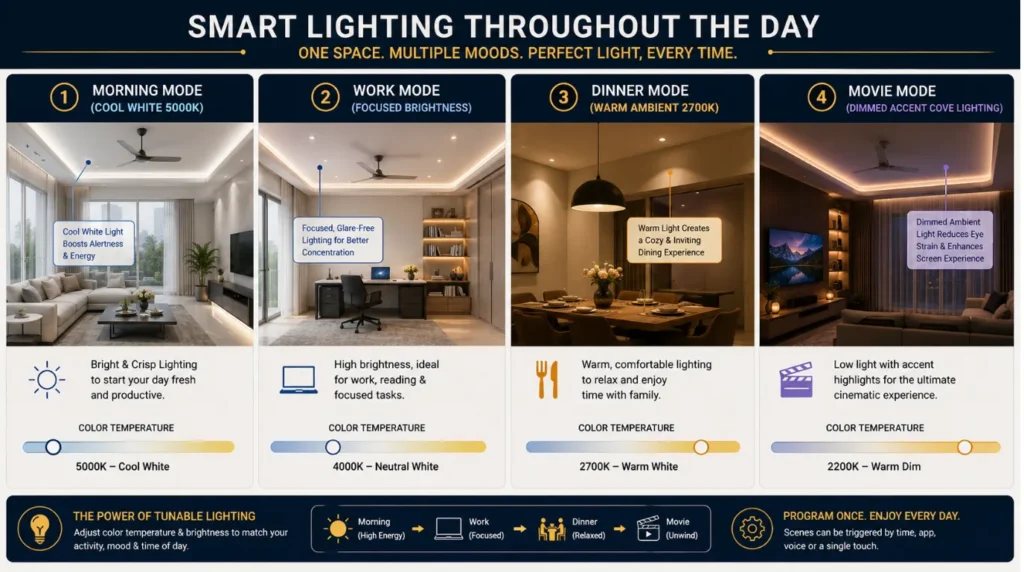
Smart Lighting Scenes for Indian Homes
Scenes are one of the biggest advantages of a properly integrated lighting system.
Morning Scene
Gradually increase bedroom and living-area lighting.
Work Scene
Use brighter, cooler lighting in the study or workspace.
Dinner Scene
Keep the dining area comfortable while reducing unnecessary background lighting.
Movie Scene
Dim ambient lighting and switch off distracting fixtures.
Night Scene
Use low-level corridor and bathroom lighting.
Away Scene
Turn off selected lights and simulate occupancy where appropriate.
These scenes are where smart lights for Indian homes move beyond simple app-controlled bulbs.
Are Smart Lights Worth It for a 3 BHK Apartment?
Yes, when we talk about smart lights for Indian homes, it includes apartments too. But you don’t necessarily need to automate every light.
A practical approach might be:
- Living room
- Master bedroom
- Dining area
- Kitchen
- Passage lighting
You can then add scenes, schedules, sensors, and smart controls where they provide genuine value. A hybrid approach offers much better value for a 3 BHK apartment than trying to make every single light bulb smart.
Are Smart Lights Good for Luxury Homes?
Yes, but luxury homes usually need more than smart bulbs.
A high-end lighting system may involve:
- Architectural lighting
- Cove lighting
- Downlights
- Decorative fixtures
- Dimming
- Scene control
- Occupancy sensors
- Daylight-based control
- Curtain integration
- HVAC integration
- Centralized automation
This is where professional smart lights for Indian homes become important. The objective is to create consistent lighting behaviour across the entire property.
Common Mistakes When Choosing Smart Lights For Indian Homes
Buying Based Only on Price
Cheap smart bulbs can be useful, but they may not be suitable for a large integrated system.
Ignoring the Existing Wiring
Electrical infrastructure can determine which smart-lighting approach is practical.
Automating Every Bulb
Sometimes smart switches or centralized lighting control are more appropriate.
Forgetting Manual Control
Always consider how family members and guests will operate the lights without an app.
Mixing Too Many Ecosystems
Multiple incompatible apps and hubs can make a smart home harder to use.
Choosing RGB Everywhere
Colour-changing lighting is fun, but adjustable white light is often more useful for everyday living.
How Techtastic Approaches Smart Lighting
At Techtastic, we don’t start by asking which smart lights for Indian homes should be installed for every room.
We first understand:
- The property
- Electrical infrastructure
- Interior design
- Lighting requirements
- Homeowner routines
- Desired scenes
- Other automation systems
Then we determine whether the project should use Wi-Fi, wireless, KNX, or a hybrid approach. This helps ensure that smart lights for Indian homes are part of a coherent automation system rather than a collection of disconnected devices.
Key Takeaways
The best smart lights for Indian homes should provide more than remote ON/OFF control.
Look for:
✓ Appropriate brightness
✓ Adjustable colour temperature
✓ Reliable dimming
✓ Suitable connectivity
✓ Manual control
✓ Indian electrical compatibility
✓ Voice and app integration
✓ Scene control
✓ Expandability
✓ Long-term support
For a simple retrofit, Wi-Fi smart bulbs may be enough. For a premium new home, professional wired or hybrid automation can deliver a much more integrated experience.
Frequently Asked Questions
1. What Are the Best Smart Lights for Indian Homes?
A. The best smart lights for Indian homes depend on your requirements. Wi-Fi options such as Philips WiZ and Wipro can be practical for simpler installations, while Philips Hue offers a deeper smart-lighting ecosystem. Professional KNX lighting is better suited to larger homes requiring centralized automation.
2. Are Smart Lights Worth It in India?
A. Yes, particularly when you use scheduling, dimming, scenes, sensors, and centralized control. They are most valuable when they solve a genuine lighting or convenience problem.
3. Which Is Better: Wi-Fi or KNX Lighting?
A. Wi-Fi can be excellent for smaller or retrofit installations. KNX is more appropriate when lighting needs to become part of a professionally integrated home automation system.
4. Do Smart Lights Work During a Wi-Fi Outage?
A. It depends on the product and system architecture. Some functions may continue locally, while cloud-dependent features can become unavailable. Always check the manufacturer’s specifications and system design.
5. Are Smart Lights Safe for Indian Homes?
A. Yes, smart lights for Indian homes are safe. Given the products are appropriate for the electrical environment and installed correctly. Avoid unsuitable grey-market products and have permanent electrical installations handled by qualified professionals.
6. Can You Control Smart Lights Manually?
A. Many smart lighting systems support physical controls. For a complete automation project, Techtastic recommends considering manual operation alongside app, voice, sensor, and scene control.
7. Do Smart Lights Need a Hub?
A. Not always. Many Wi-Fi smart lights connect directly to the network. Hub-based systems can provide different advantages for larger installations, depending on the ecosystem.
8. What Is the Best Smart Lighting for a Luxury Villa?
A. For a new luxury villa, a professionally designed wired or hybrid automation system can be more appropriate than installing individual Wi-Fi bulbs throughout the property.
9. Can Smart Lights Work With Home Automation?
A. Yes. Properly selected lighting can integrate with curtains, HVAC, security, entertainment, sensors, and other automation systems.
10. Are Smart Lights Better Than Smart Switches?
A. Neither is universally better. Smart bulbs provide control over the bulb itself, while smart switches can automate conventional lighting fixtures. The correct approach depends on the lighting design and automation architecture.
Collaboration Opportunities for Architects & Interior Designers
Lighting should be discussed before the electrical and interior-design plans are finalized.
Techtastic can collaborate with architects, interior designers, builders, and developers on:
- Lighting zones
- Smart switch locations
- Dimming requirements
- Scene design
- Sensor placement
- Cove and decorative lighting
- Curtain integration
- HVAC integration
- KNX infrastructure
- Networking
- Centralized control
Early coordination helps hide technology within the architecture while preserving the intended interior aesthetic.
Areas We Serve
Techtastic provides smart home automation solutions across:
Navi Mumbai | Nashik | Lonavla | Sangli
We also work on suitable projects across the wider Mumbai and Thane region.
Final Verdict: Smart Lights for Indian Homes
The best smart lights for Indian homesaren’t necessarily the lights with the most colours, the most features, or the lowest price. They are the lights that fit naturally into the way your home is designed and used.
For a small apartment, that could mean a few Wi-Fi bulbs, and for a larger home, it could mean hub-based smart lighting.
For a new luxury villa, it may mean KNX or hybrid automation with centralized lighting scenes, sensors, dimming, and integration with the rest of the home.
At Techtastic, we believe the best smart lighting is the lighting you don’t have to think about. It simply responds to your routines, creates the right atmosphere, and gives you control whenever you need it.
Smart technology should make lighting simpler and not more complicated.
Contact Techtastic
🌐 Website: Techtastic Website
📞 Phone: 9769145145
📍 Service Areas: Mumbai • Navi Mumbai • Pune • Lonavala • Nashik • Sangli