
Home automation can make a home more comfortable, secure, energy-efficient, and convenient. But automation is not automatically the right solution for every homeowner.
Like any technology investment, there are trade-offs.
The main disadvantages of home automation usually involve the initial cost, system complexity, dependence on technology, maintenance, compatibility, cybersecurity, and the quality of installation. The key point is that good planning and expert system design can greatly reduce most of these drawbacks.
At Techtastic, we believe smart home automation should solve real problems. It should not add technology just for its own sake.
Quick Summary
✓ Higher-quality automation systems can require significant upfront investment.
✓ Poor planning can create unnecessary complexity.
✓ Internet or network problems can affect some connected functions.
✓ Different brands may not always work seamlessly together.
✓ Smart systems require maintenance, updates, and occasional troubleshooting.
✓ You need to consider cybersecurity and privacy.
✓ Poor installation can create reliability problems.
✓ Technology can eventually become outdated.
✓ Professional planning can minimize many of these disadvantages.
Quick Answer
The main disadvantages of home automation are cost, complexity, maintenance requirements, compatibility issues, cybersecurity concerns, network dependency, and potential technology obsolescence. However, these disadvantages depend heavily on the automation architecture selected. A professionally designed wired, wireless, or hybrid system can lower these risks and provide reliable performance over time.
1. Higher Initial Cost
One of the main disadvantages of home automation is the upfront investment.
A basic smart device may be inexpensive, but a full automation system can cost much more.
It may include lighting, curtains, HVAC, security, entertainment, networking, and central control.
The cost depends on:
- Number of rooms
- Number of automated circuits
- Type of automation system
- Wired or wireless infrastructure
- Lighting requirements
- Motorized curtains
- Security integration
- Audio/video requirements
- Programming and installation
The key is to look at automation as an infrastructure investment rather than simply buying individual smart gadgets.
2. Smart Home Technologies Can Become Complicated
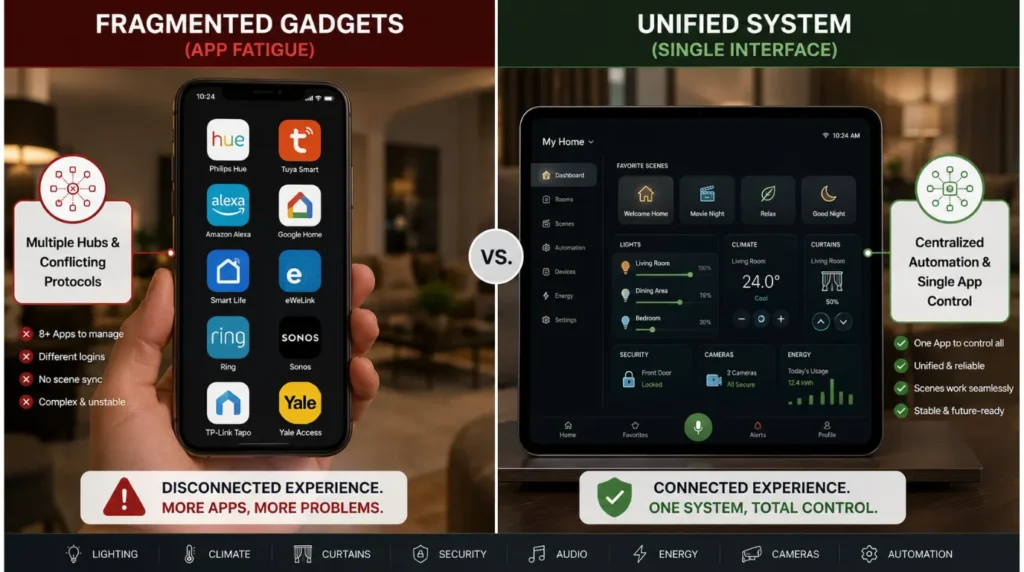
Another issue among the main disadvantages of home automation is complexity.
If a homeowner installs smart home devices from different brands without planning how they will connect, they may need many apps. They may also need multiple remotes, hubs, and other controls.
Instead of simplifying the home, automation can sometimes make it harder to operate.
A professionally designed system should aim for the opposite:
One simple experience behind a sophisticated system.
For example, a “Good Night” scene could turn off some lights, close the curtains, adjust the temperature, and arm security. It would not require the homeowner to use four different devices.
3. Dependence on Technology
Technology can fail. Power interruptions, router problems, network failures, software errors, or device failures can temporarily affect smart-home functions.
This is one of the main disadvantages of home automation that homeowners often overlook. However, system architecture matters enormously.
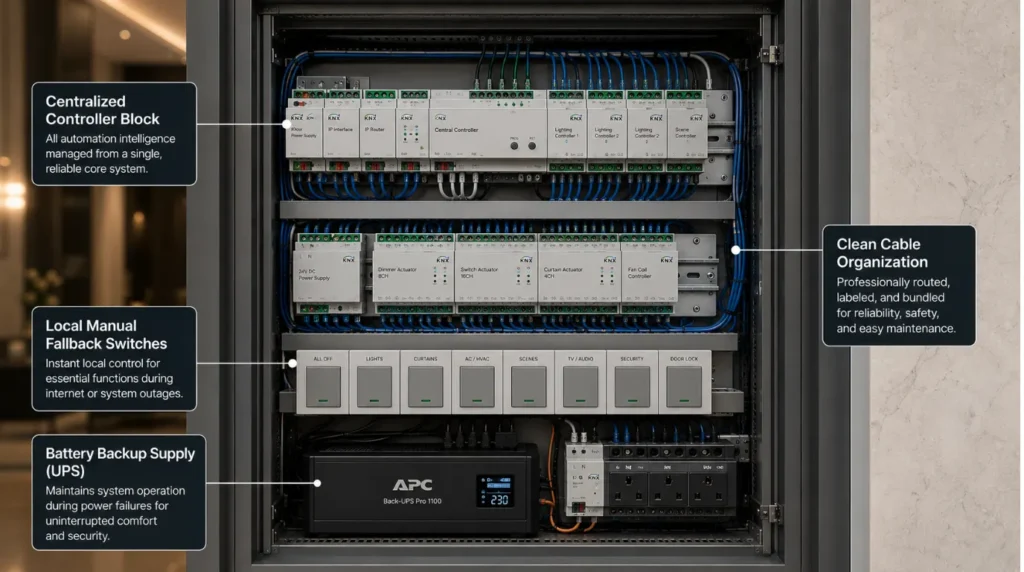
Some professionally installed systems can maintain local control for important functions rather than depending entirely on cloud services.
For critical lighting and essential controls, we recommend designing appropriate manual fallbacks wherever possible.
4. Compatibility Problems Between Brands
Compatibility is another major concern. There are hundreds of smart-home products available, but not every product communicates perfectly with every other product.
A homeowner might purchase a smart switch, curtain motor, security system, thermostat, and entertainment device separately and later discover that their desired automation scenes cannot be integrated properly.
That’s why you should consider compatibility before you buy devices, not after you install them.
Standards and ecosystems such as KNX, Matter, Zigbee, Wi-Fi, and other technologies can play different roles depending on the project.
The right choice depends on the home’s requirements.
5. Maintenance and Updates
Automation is not completely “install it and forget it” technology. Another of the main disadvantages of home automation is ongoing maintenance.
Some systems may require:
- Firmware updates
- Software updates
- Battery replacement
- Network troubleshooting
- Motor servicing
- Device replacement
- Programming adjustments
A professionally designed system with reliable components and proper documentation can make ongoing maintenance considerably easier.
Homeowners should also ask about after-sales support before selecting an automation company.
6. Cybersecurity and Privacy Risks
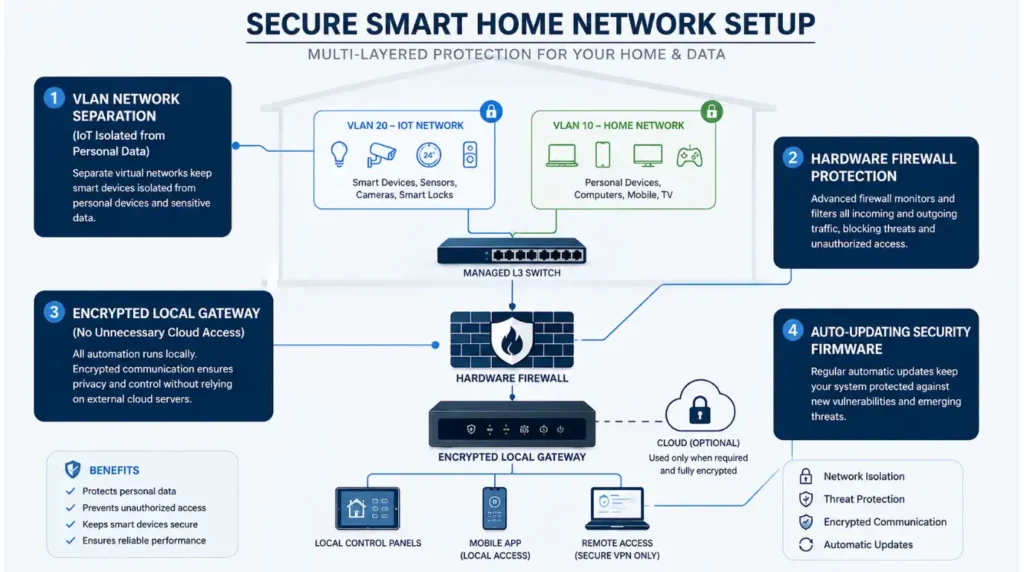
The more connected devices a home has, the more important cybersecurity becomes.
Smart cameras, door locks, sensors, voice assistants, connected appliances, and remote-access systems can expose personal data. This can happen if they are poorly configured. This is one of the main disadvantages of home automation that deserves serious attention.
Good practices include:
- Strong, unique passwords
- Secure Wi-Fi networks
- Regular firmware updates
- Proper router configuration
- Separating smart devices from sensitive networks where appropriate
- Choosing reputable manufacturers
- Limiting unnecessary remote access
Security should be part of the system design, not an afterthought.
7. Technology Can Become Outdated
Technology evolves quickly. A product that is excellent today may be discontinued, replaced, or unsupported several years later.
This potential for technological obsolescence is another of the main disadvantages of home automation. The solution is not necessarily avoiding automation.
Instead, homeowners should consider systems with:
- Open or widely adopted standards
- Expandable architecture
- Replaceable components
- Strong manufacturer support
- Professional programming
- Scalable infrastructure
This is particularly important for luxury homes, where owners expect automation to operate for many years.
8. Poor Installation Can Create More Problems
One of the most overlooked main disadvantages of home automation is actually poor implementation. Two homes can use similar equipment and have completely different experiences.
Poor wiring, weak network design, incorrect device selection, inadequate programming, or insufficient testing can result in:
- Unresponsive devices
- Unreliable scenes
- Slow controls
- Devices disconnecting
- Incorrect automation behavior
- Difficult troubleshooting
This is why the installer matters almost as much as the equipment.
A good automation project should include consultation, system design, infrastructure planning, installation, programming, testing, and support.
9. Over-Automation Can Reduce Simplicity
Not everything needs to be automated.
This may sound surprising, but one of the main disadvantages of home automation is adding automation where it doesn’t provide meaningful value.
For example, automatically controlling a rarely used appliance may add complexity without saving meaningful time or energy.
The best smart homes automate repetitive tasks while keeping everyday controls intuitive.
A Useful Rule
Automate inconvenience, not everything.
Wired vs. Wireless: Does the Technology Change the Disadvantages?
Yes.
| Factor | Wired Automation | Wireless Automation |
|---|
| Reliability | Generally strong | Depends more on network/environment |
| New Construction | Excellent opportunity | Flexible |
| Existing Homes | More invasive | Easier retrofit |
| Scalability | Excellent with planning | Depends on ecosystem |
| Infrastructure | Requires planning | Less physical wiring |
| Maintenance | Can be centralized | More individual devices/batteries |
| Best Use | Premium new builds | Retrofits and flexible installations |
A hybrid approach can make sense when some systems need wired infrastructure and others work better with wireless technology.
Are the Disadvantages of Home Automation Worth It?
For many homeowners, yes, but only when the system is designed around actual needs.
The main disadvantages of home automation are less of a problem when homeowners avoid buying random devices.
They should plan the whole system first.
For a new luxury home, automation infrastructure should ideally be considered alongside electrical, lighting, HVAC, networking, security, and interior planning. For an existing home, wireless or hybrid solutions can provide automation without major reconstruction.
The goal isn’t to have the most smart devices but to have a home that is easier, safer, more comfortable, and more efficient to live in.
How to Avoid the Main Disadvantages of Home Automation
Before starting an automation project, ask these questions:
- What problems do I actually want automation to solve?
- Which systems need to work together?
- Should the project use wired, wireless, or hybrid technology?
- What happens if the internet goes down?
- Can essential functions still be controlled manually?
- Who will provide programming and after-sales support?
- Can the system be expanded later?
- How will cybersecurity be handled?
- What happens if a component becomes obsolete?
Answering these questions before purchasing equipment can eliminate many common problems.
Key Takeaways
The main disadvantages of home automation are not reasons to avoid smart homes altogether. They are reasons to design them correctly.
The biggest concerns are:
- Initial investment
- System complexity
- Network dependence
- Compatibility
- Maintenance
- Cybersecurity
- Technology obsolescence
- Installation quality
- Over-automation
A well-designed automation system should make the home feel simpler, not more complicated.
Frequently Asked Questions
1. What are the Main Disadvantages of Home Automation?
A. The main disadvantages of home automation include higher upfront costs, technical complexity, network dependency, compatibility issues, maintenance, cybersecurity concerns, and possible technology obsolescence.
2. Is home automation difficult to maintain?
A. It can be if the system uses many unrelated devices. A professionally designed system with centralized control and proper documentation is generally easier to maintain.
3. Does home automation stop working without Wi-Fi?
A. Not necessarily. It depends on the system architecture. Some systems can continue performing important local functions even when internet connectivity is unavailable.
4. Is wired automation better than wireless?
A. Neither is universally better. Wired automation is a good choice for new builds and large premium projects. Wireless automation works well for existing homes and retrofits.
5. Can smart home security systems be hacked?
A. Any connected technology can present cybersecurity risks. Strong passwords, secure networks, software updates, reputable products, and proper configuration can reduce those risks.
6. Does home automation increase electricity consumption?
A. It depends on the equipment and how the system is designed. Automation can potentially reduce energy consumption by controlling lighting, HVAC, and other loads more intelligently.
7. Is home automation worth the cost?
A. For homeowners who value convenience, security, comfort, entertainment, and energy management, it can be worthwhile. The value depends on how effectively the system addresses their actual needs.
8. How long does a home automation system last?
A. There is no single lifespan because different components have different operating lives. Choosing scalable infrastructure and supported products can improve long-term viability.
9. Is one of the main disadvantages of home automation a lack of reliability?
A. One of the main disadvantages of home automation can be reliability when systems are poorly designed, installed, or dependent on unstable networks. Choosing quality equipment, proper infrastructure, and professional programming can significantly improve reliability.
10. Can the main disadvantages of home automation affect long-term costs?
A. Yes. The main disadvantages of home automation can include ongoing costs for maintenance, software updates, replacement devices, batteries, and upgrades. A scalable system with reliable components can help control these long-term ownership costs.
Collaboration Opportunities for Architects & Interior Designers
You should consider automation during the design stage rather than add it at the end.
Architects and interior designers can collaborate with Techtastic during planning to coordinate:
- Lighting control
- Curtain automation
- HVAC control
- Smart switches
- Sensor placement
- Home theater systems
- Networking infrastructure
- Security
- Equipment locations
Early coordination helps protect the interior design while ensuring the automation infrastructure is properly integrated.
Areas We Serve
Techtastic provides smart home automation solutions across:
Navi Mumbai • Nashik • Lonavla • Sangli
We also work on broader Mumbai and Thane-area projects depending on requirements.
Final Verdict: Main Disadvantages of Home Automation
The main disadvantages of home automation are real, but most are manageable. The biggest mistake is treating smart-home automation as a collection of gadgets rather than an integrated system.
The right approach is to start with the homeowner’s lifestyle. Understand the property. Select the right technology. Design the infrastructure. Integrate the systems. Provide proper programming and support.
At Techtastic, our approach is simple: Technology should disappear into the experience of the home.
When automation is designed correctly, you shouldn’t spend your time thinking about the technology. You should simply enjoy the comfort, convenience, security, and control it provides.
Contact Techtastic
🌐 Website: Techtastic Website
📞 Phone: 9769145145
📍 Service Areas: Mumbai • Navi Mumbai • Pune • Lonavala • Nashik • Sangli