
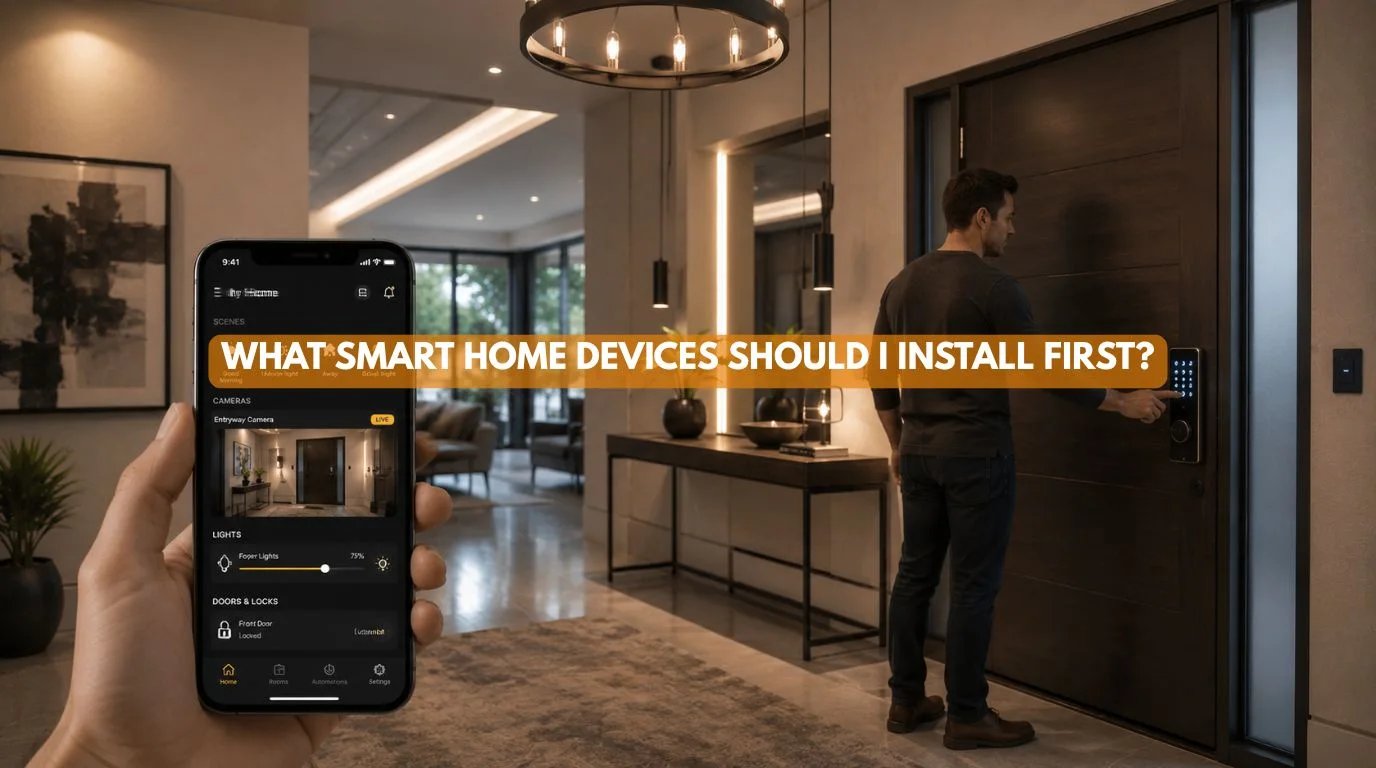
Quick Answer
If you’re starting your smart home journey, install the smart home essentials that you’ll use every day. Smart lighting, smart switches, smart door locks, security cameras, and voice assistants offer the biggest improvements in convenience and security. Once these smart home essentials are in place, you can gradually add motorized curtains, climate control, entertainment, and energy management to create a fully connected home.
Summary
The smart home essentials to install first are those that improve your everyday routine while creating a foundation for future automation. Most homeowners begin with smart lighting, smart switches, smart door locks, security cameras, and voice assistants because these devices provide immediate convenience and are easy to expand over time. If you’re building a new home or planning whole-home automation, investing in scalable systems such as KNX, structured networking, and integrated lighting control ensures your smart home remains reliable and future-ready.
What Smart Home Devices Should I Install First?
When homeowners first explore smart homes, one question almost always comes up: “Which smart home essentials should I install first?”
The internet is full of hundreds of products, including:
- Smart lights
- Smart plugs
- Cameras
- Doorbells
- Thermostats
- Smart locks
- Sensors
- Speakers
It’s easy to feel overwhelmed.
At Techtastic, we encourage homeowners to think differently. Instead of buying the newest gadget, ask: “What are the smart home essentials that will improve my daily life the most?”
Smart Home Essentials work together in stages, with each new device building on a solid foundation.
1. Smart Lighting
If we had to recommend just one upgrade, it would be smart lighting.
You’ll use it every single day.
Benefits include:
- App control
- Voice commands
- Scheduled lighting
- Motion-activated lighting
- Dimming
- Energy savings
- Lighting scenes
Smart lighting immediately makes your home feel more modern and convenient.
2. Smart Switches
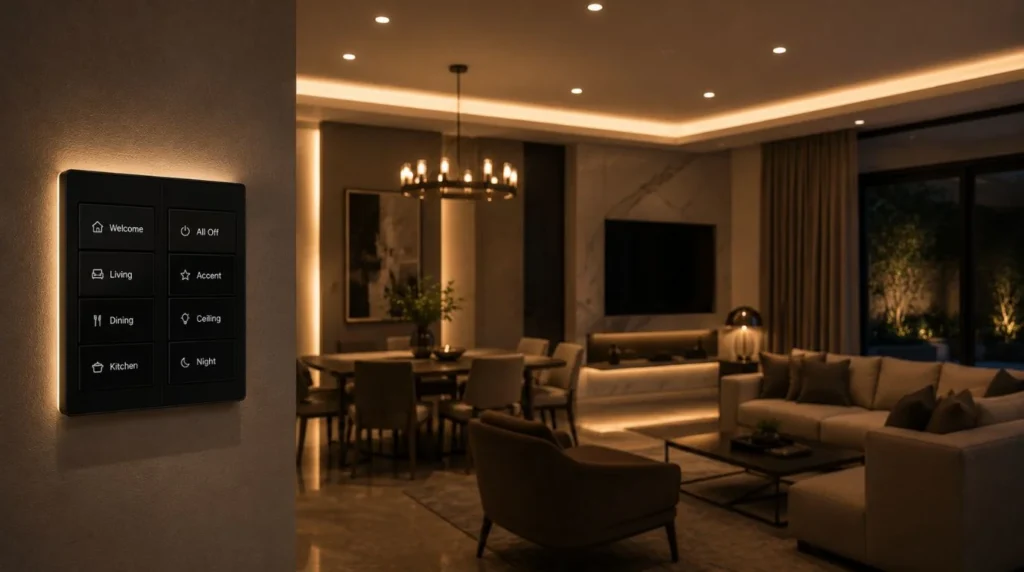
Smart switches offer a better long-term solution than relying only on smart bulbs.
Advantages include:
- Control the entire room
- Preserve normal wall switch functionality
- Better automation
- Improved reliability
- Easier family use
Among today’s smart home essentials, they provide one of the strongest foundations for future automation.
3. Smart Door Locks
One of the most practical smart home upgrades.
Benefits include:
- Keyless entry
- Temporary access codes
- Remote locking
- Visitor management
- Activity logs
You’ll never need to wonder whether you locked the door again.
4. Security Cameras
Smart security provides peace of mind whether you’re home or away.
Features include:
- Live video
- Motion alerts
- Remote monitoring
- Night vision
- Cloud or local recording
Modern systems integrate easily with other smart home essentials.
5. Video Doorbell
Know who’s at your door, even when you’re away.
Benefits include:
- Two-way communication
- Motion detection
- Visitor notifications
- Package monitoring
An excellent addition for both families and frequent travelers.
6. Voice Assistant
Voice assistants make your smart home easier to control.
Popular options include:
- Amazon Alexa
- Google Assistant
- Apple Siri
You can control:
- Lights
- Curtains
- Music
- Air conditioning
- Smart plugs
- Automation scenes
Without reaching for your phone.
7. Smart Climate Control
Air conditioning is often the largest electricity consumer.
Smart climate systems help you:
- Maintain comfort
- Schedule cooling
- Reduce energy waste
- Control the temperature remotely
Comfort and efficiency improve together.
8. Motorized Curtains
Motorized curtains quickly become one of homeowners’ favorite upgrades.
They provide:
- Automatic opening
- Privacy
- Sunlight management
- Temperature control
- Luxury convenience
When integrated with lighting and climate control, they significantly improve the overall smart home experience.
9. Smart Entertainment
Upgrade your living room with:
- Home theatres
- Multi-room audio
- Smart TVs
- Streaming automation
Create scenes like:
Movie Night
- Curtains close
- Lights dim
- Home theatre starts automatically
10. Home Energy Monitoring
Once your core automation is complete, monitor your electricity usage.
Energy monitoring helps identify:
- High-energy appliances
- Wasteful habits
- Opportunities for automation
It’s the final step toward creating an efficient smart home.
Recommended Installation Order
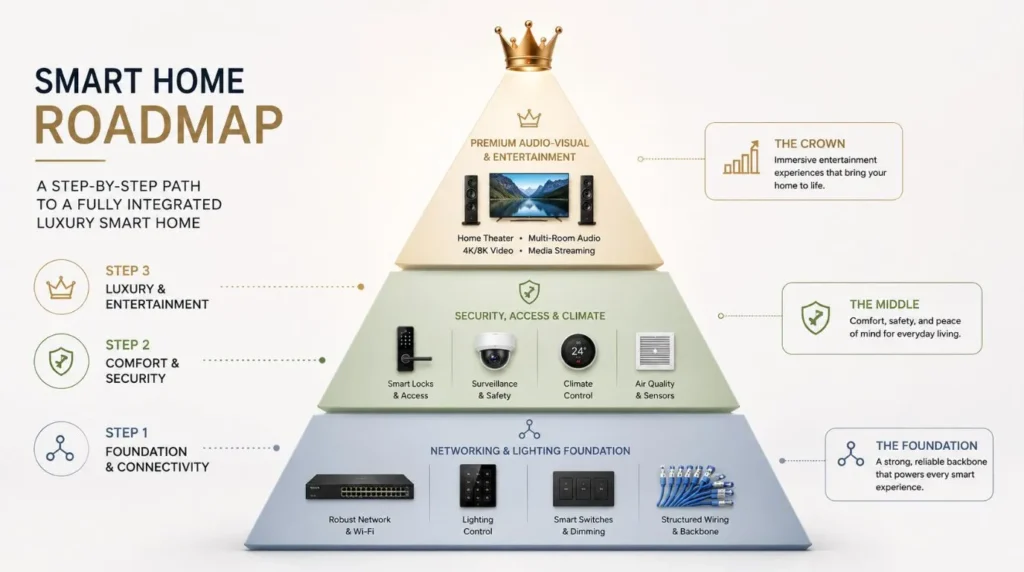
| Phases | Smart Home Device | Why Start Here? |
|---|---|---|
| Phase 1 | Smart lighting | Daily convenience |
| Phase 2 | Smart switches | Whole-room automation |
| Phase 3 | Smart door locks | Better security |
| Phase 4 | Security cameras | Peace of mind |
| Phase 5 | Voice assistant | Simple control |
| Phase 6 | Smart climate control | Comfort & savings |
| Phase 7 | Motorized curtains | Convenience & efficiency |
| Phase 8 | Entertainment | Lifestyle enhancement |
| Phase 9 | Energy monitoring | Long-term optimization |
This order gives homeowners the biggest return on investment while creating a strong automation foundation.
DIY Devices vs Smart Home Setup
Some devices are perfect for DIY installation:
- Smart bulbs
- Smart plugs
- Smart speakers
- Wi-Fi cameras
Professional installation is recommended for:
- Smart switches
- Whole-home lighting
- Motorized curtains
- Security integration
- Home theatres
- KNX home automation
Planning your smart home essentials early helps avoid compatibility issues and unnecessary costs later.
What About KNX Home Automation?
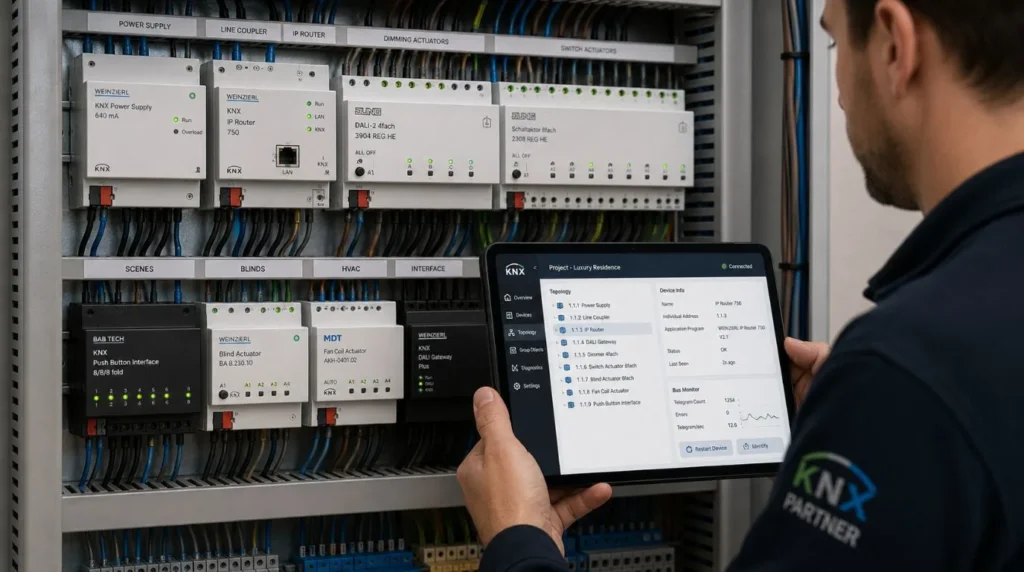
If you’re building a new home or planning a complete automation system, start with KNX home automation instead of buying individual gadgets.
KNX allows seamless integration of:
- Lighting
- Climate control
- Motorized curtains
- Security
- Entertainment
- Energy management
Everything operates through one reliable platform that’s designed to grow with your home.
Common Mistakes Beginners Make
Buying Too Many Devices at Once
Start with the essentials and expand gradually.
Mixing Too Many Brands
A single ecosystem is easier to manage.
Ignoring Networking
Reliable Wi-Fi and structured networking are critical.
Focusing Only on Price
Choose devices that offer long-term compatibility and support.
Forgetting About Future Expansion
Your first smart home essentials should fit into a larger automation plan.
Why It Matters for Modern Homes
Smart homes aren’t about owning the most gadgets.
They’re about creating a home that’s:
- Easier to live in
- More comfortable
- More secure
- More energy efficient
Starting with the right smart home essentials helps you build a home that’s reliable today and ready for tomorrow.
Our Perspective at Techtastic
At Techtastic, we always recommend starting with the devices you’ll use every day. Lighting, smart switches, and security provide immediate benefits and create a strong foundation for future automation. From there, it’s easy to expand into climate control, motorized curtains, entertainment, and energy management.
Rather than filling your home with disconnected gadgets, we design integrated systems that work together seamlessly. Whether you’re upgrading one room or building a luxury smart home, our goal is to create technology that feels simple, intuitive, and effortless for every member of the family.
Collaboration Opportunities for Developers, Architects & Interior Designers
Planning smart home essentials during the design phase ensures seamless integration and future flexibility.
At Techtastic, we collaborate with:
- Architects
- Interior designers
- Residential developers
- Luxury home builders
- Hospitality consultants
- Commercial project planners
Smart Home Planning
Create automation strategies before construction.
Smart Lighting Design
Develop intelligent lighting experiences.
KNX Infrastructure
Build scalable automation systems.
Structured Networking
Support reliable connected homes.
Premium Residential Projects
Deliver exceptional smart living experiences.
Future-Ready Developments
Design homes prepared for evolving technologies.
Early collaboration ensures better integration, cleaner installations, and long-term flexibility.
Key Takeaways
- Start with smart lighting because it’s the most frequently used smart home feature.
- Smart switches provide better long-term value than smart bulbs alone.
- Security devices such as smart locks and cameras improve safety and convenience.
- Voice assistants make daily interaction with your smart home easier.
- Motorized curtains and climate control enhance comfort and energy efficiency.
- Choose smart home essentials that can grow into a complete automation system.
- Professional planning helps create a more reliable and future-ready smart home.
Frequently Asked Questions
1. What are the first smart home essentials I should buy?
A. Most homeowners should begin with smart lighting, smart switches, smart door locks, security cameras, and a voice assistant because these devices provide the greatest everyday value.
2. Are smart switches better than smart bulbs?
A. For whole-home automation, smart switches are generally the better choice because they control entire lighting circuits while maintaining normal wall switch functionality.
3. Should I install security devices before entertainment systems?
A. Yes. Security features such as smart locks, cameras, and video doorbells usually provide greater practical value than entertainment upgrades.
4. Can I build a smart home gradually?
A. Absolutely. Many homeowners start with lighting and security before adding climate control, motorized curtains, entertainment, and energy management.
5. Is KNX better than buying individual smart devices?
A. If you’re planning a complete smart home, KNX offers superior reliability, integration, and future scalability compared to managing multiple standalone devices.
6. Do I need professional installation?
A. DIY works well for simple devices, but professional installation is recommended for integrated lighting, smart switches, KNX systems, and whole-home automation.
7. Will smart home essentials reduce electricity bills?
A. Some devices, such as smart lighting, climate control, and energy monitoring systems, can help reduce unnecessary energy consumption through automation.
8. Can smart home essentials increase property value?
A. Yes. Professionally integrated smart home features can make a property more attractive to buyers, particularly in premium residential markets.
Conclusion
Choosing the right smart home essentials from the beginning helps you build a connected home that’s both practical today and ready for tomorrow. By starting with essentials such as smart lighting, smart switches, security, and voice control, you’ll enjoy immediate improvements in convenience, safety, and comfort while creating a solid foundation for future upgrades. As your needs evolve, you can seamlessly expand into climate control, motorized curtains, entertainment, and energy management without rebuilding your system from scratch.
At Techtastic, we believe a successful smart home isn’t defined by the number of devices you own, but it’s defined by how well those devices work together.
📞 Call/WhatsApp: 9769145145
📍 Our Operational Hubs: Navi Mumbai | Nashik | Lonavla | Sangli
Whether you’re just beginning your automation journey or planning a fully integrated KNX smart home, we help you choose technologies that are reliable, scalable, and designed to simplify everyday living for years to come.
Maintaining clean system backups and a secure cabling infrastructure is essential for long-term performance. If you are planning an upgrade or a new build, explore why hiring a professional for your smart home device installation saves time and energy costs down the line.