
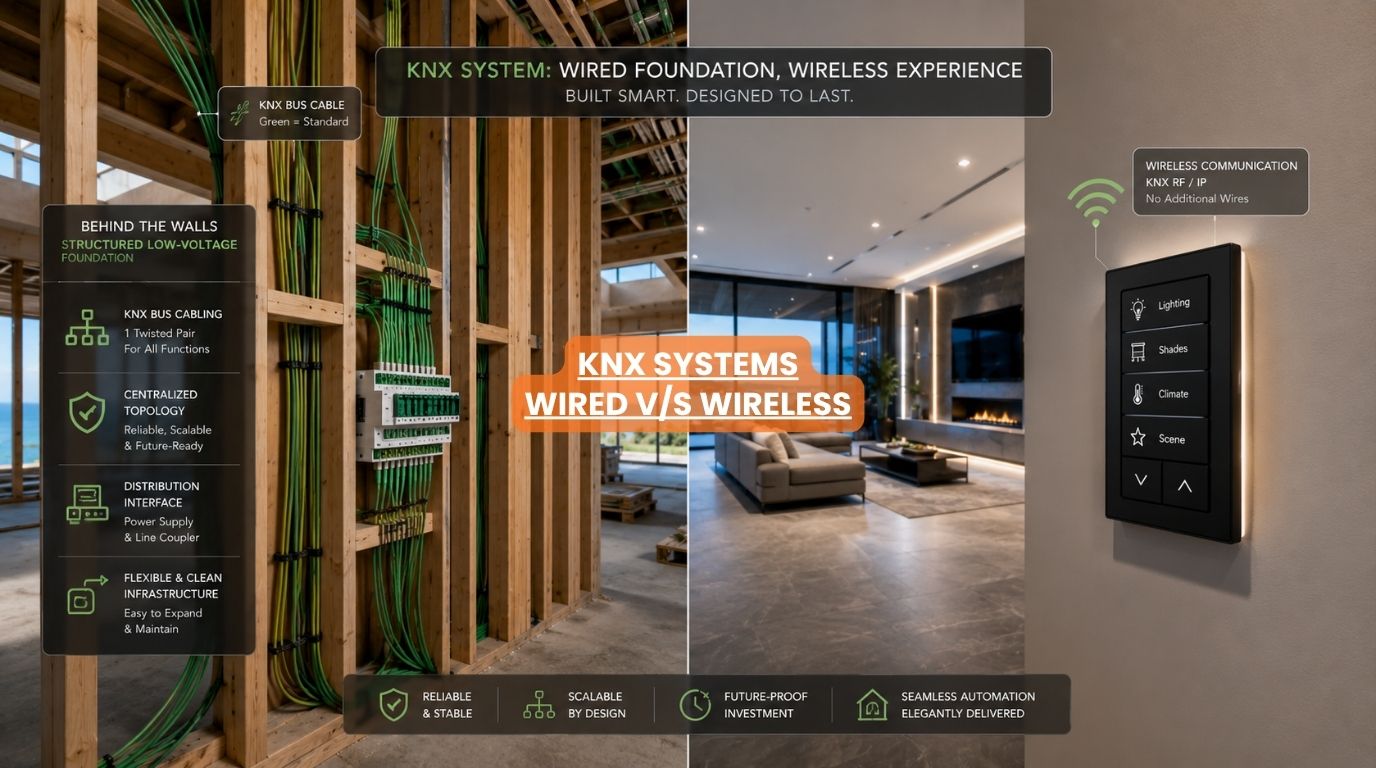
One of the first decisions homeowners face when planning automation is: “Should I choose a wired or wireless smart home system?”
It’s an important question.
Wireless devices have become increasingly popular because they appear simple to install. At the same time, professional automation systems such as KNX are often associated with wired infrastructure.
At Techtastic, we regularly help homeowners compare both approaches. The truth is that neither solution is universally better. The right choice depends on:
- Construction stage
- Home size
- Automation goals
- Budget
- Future expansion plans
Understanding the differences can help homeowners make better long-term decisions.
Summary
KNX home automation supports both wired and wireless technologies, but each serves different purposes. Wired KNX systems offer exceptional reliability, scalability, and long-term performance, making them ideal for new construction and luxury homes. Wireless solutions provide easier installation and greater flexibility, particularly in existing homes and retrofit projects. The best choice depends on the property’s construction stage, automation goals, budget, and future expansion plans.
Quick Answer
Wired KNX systems provide greater reliability, stability, and scalability, making them ideal for new construction and long-term smart home projects. Wireless automation systems offer easier installation and lower disruption, making them suitable for existing homes and renovations. For homeowners seeking maximum performance and future-proofing, wired KNX is often preferred, while wireless solutions can offer practical flexibility in retrofit situations.
What Is Wired KNX Home Automation?
Wired KNX systems use dedicated communication cables to connect:
- Switches
- Sensors
- Controllers
- Lighting systems
- Climate controls
- Motorized curtains
- Security devices
These devices communicate through a dedicated KNX bus.
Because the system does not rely entirely on wireless signals, it offers exceptional reliability.
What Is Wireless Home Automation?
Wireless systems communicate through technologies such as:
- Wi-Fi
- Zigbee
- Bluetooth
- RF communication
- Wireless KNX solutions
Devices communicate through radio signals rather than physical cables.
Wireless systems often appeal to homeowners because installation can be easier.
The Biggest Difference: Infrastructure
The primary distinction is simple.
Wired KNX Systems
Uses physical communication cables.
Wireless Systems
Use radio communication.
Both approaches can automate a home, but their long-term behavior differs significantly.
Reliability Comparison
Reliability is one of the biggest reasons homeowners choose KNX systems.
| Factor | Wired KNX Systems | Wireless Systems |
| Signal stability | Excellent | Good |
| Interference resistance | Excellent | Moderate |
| Communication reliability | Very high | Variable |
| Long-term consistency | Excellent | Good |
| Dependence on signal strength | None | Yes |
Wired communication is generally more predictable.
Installation Differences
Wired KNX Installation
Typically involves:
- Bus cabling
- Electrical planning
- Infrastructure design
Best suited for:
- New homes
- Villas
- Major renovations
Wireless Installation
Typically involves:
- Device pairing
- Network configuration
- Minimal construction work
Best suited for:
- Existing homes
- Apartments
- Retrofit projects
Installation complexity is often the biggest deciding factor.
Scalability Comparison
Modern smart homes often grow over time.
Homeowners may eventually add:
- Motorized curtains
- Climate control
- Security systems
- Home theatres
- Energy management
Wired KNX Systems
Designed specifically for expansion.
Supports:
- Large properties
- Multiple floors
- Hundreds of devices
Wireless Systems
Can scale, but complexity may increase.
Potential challenges include:
- Network congestion
- Signal limitations
- Device compatibility
Performance During Internet Outages
Many homeowners ask: “What happens if the internet goes down?”
Wired KNX Systems
Most functions continue operating locally.
Examples:
- Lighting
- Curtains
- Climate control
- Scenes
Wireless Systems
Behavior depends on the platform.
Some cloud-dependent systems may lose functionality.
Local systems generally perform better.
Maintenance Requirements
Wired KNX Systems
Typically requires:
- Minimal maintenance
- Occasional updates
- System backups
Wireless Systems
May require:
- Firmware updates
- Network troubleshooting
- Device reconnections
Both systems require maintenance, but wired systems often remain more stable over time.
Security Considerations
Cybersecurity is increasingly important.
Wired KNX Systems
Advantages:
- Dedicated communication infrastructure
- Reduced external exposure
- Greater control
Wireless Systems
Advantages:
- Modern security standards
- Strong encryption
Potential concerns:
- Network vulnerabilities
- Wi-Fi security
Proper configuration is essential regardless of technology.
Aesthetic Considerations
Homeowners increasingly prioritize clean interiors.
Wired KNX Systems
Can support:
- Elegant keypads
- Touch panels
- Integrated controls
Wireless Devices
May sometimes involve:
- Battery replacements
- Additional wall devices
Design integration often benefits from early planning.
Cost Comparison
Many homeowners assume: Wireless = cheaper.
This is not always true.
Wired KNX Systems
Higher initial infrastructure investment.
Potential benefits:
- Longer lifespan
- Greater scalability
- Lower upgrade costs
Wireless Systems
Lower initial installation costs.
Potential future costs:
- Device replacement
- Expansion challenges
- Compatibility issues
The total cost of ownership may differ from the initial investment.
Best Applications for Wired KNX Systems
Wired systems excel in:
- New construction homes
- Villas
- Luxury residences
- Large apartments
- Premium developments
- Long-term homes
Reliability and scalability become major advantages.
Best Applications for Wireless Systems
Wireless systems perform well in:
- Existing homes
- Rental properties
- Apartments
- Small projects
- Retrofit installations
They offer flexibility where wiring is difficult.
Can You Combine Wired and Wireless?
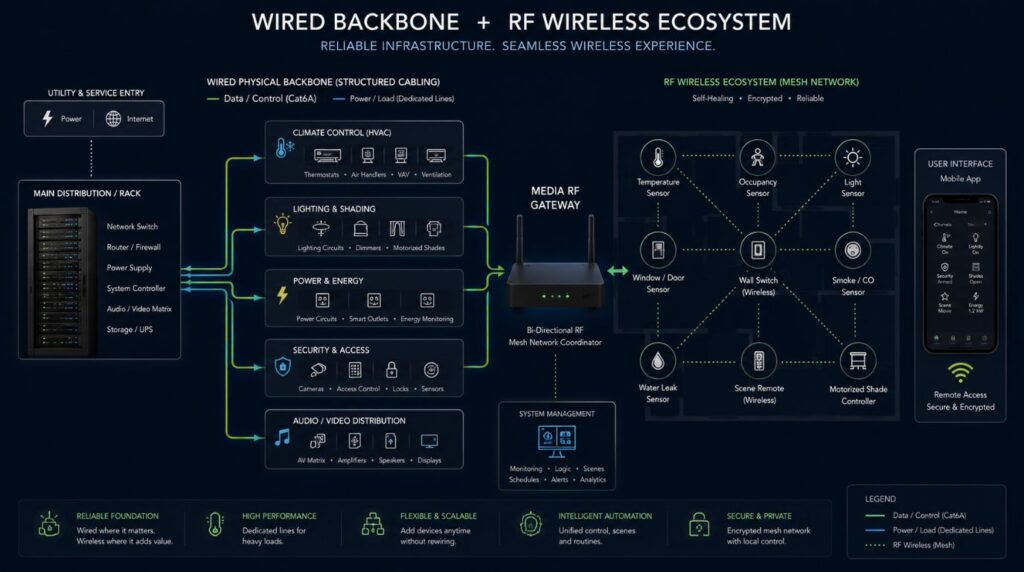
Yes. This is increasingly common.
Examples include:
- Wired lighting
- Wireless sensors
- Wired climate control
- Wireless expansion devices
Hybrid systems can provide flexibility without sacrificing reliability.
Wired vs Wireless Comparison Table
| Feature | Wired KNX | Wireless Systems |
| Reliability | Excellent | Good |
| Scalability | Excellent | Moderate |
| Installation complexity | Higher | Lower |
| New construction | Excellent | Good |
| Existing homes | Moderate | Excellent |
| Maintenance | Low | Moderate |
| Long-term stability | Excellent | Good |
| Internet dependency | Low | Varies |
| Large homes | Excellent | Moderate |
| Future expansion | Excellent | Good |
Why KNX Remains Popular
KNX has become a preferred automation standard because it offers:
- Reliability
- Scalability
- Longevity
- Multi-brand compatibility
- Professional infrastructure
Many homeowners view KNX not as a gadget but as part of the home’s electrical infrastructure.
That distinction is important.
Why It Matters for Modern Homes
Technology choices made today can affect a home for many years.
Homeowners increasingly want:
- Reliability
- Flexibility
- Future readiness
- Ease of use
Choosing the right automation architecture helps avoid costly upgrades later.
Our Perspective at Techtastic
At Techtastic, we don’t view wired and wireless as competing technologies. We view them as tools.
For new construction and premium projects, we often recommend wired KNX because of its long-term advantages. For existing homes and retrofit projects, wireless solutions can be extremely effective.
Our goal is always to match the technology to the homeowner’s lifestyle, property, and plans. The best smart home is not necessarily the most complex. It’s the one that works reliably every day.
Collaboration Opportunities for Developers, Architects & Interior Designers
Technology decisions are most effective during early planning.
At Techtastic, we collaborate with:
- Architects
- Interior designers
- Residential developers
- Luxury builders
- Project consultants
Infrastructure Planning
Determine wired and wireless strategies.
Smart Home Design
Support future expansion.
KNX Integration
Enable reliable automation.
Technology Budget Planning
Optimize investments.
Premium Residential Projects
Deliver long-term value.
Future-Ready Developments
Prepare homes for evolving technologies.
Early planning provides the greatest flexibility.
Key Takeaways
- Wired KNX offers greater reliability and scalability.
- Wireless systems provide easier installation.
- New construction projects often benefit from wired infrastructure.
- Existing homes may favor wireless solutions.
- KNX can support hybrid installations.
- Wired systems typically offer longer-term stability.
- The best solution depends on the home, budget, and plans.
Frequently Asked Questions
1. Is wired KNX better than wireless?
A. For reliability and scalability, wired KNX is generally considered superior.
2. Can KNX work wirelessly?
A. Yes. KNX supports wireless technologies for certain applications.
3. Is wireless home automation reliable?
A. Modern wireless systems can be reliable, but performance depends on signal quality and network conditions.
4. Is KNX suitable for existing homes?
A. Yes. Hybrid and retrofit solutions are possible.
5. Does wired automation require the internet?
A. No. Most KNX functions operate locally.
6. Which system is better for apartments?
A. Wireless systems often simplify installation, although wired KNX can also work in apartments.
7. Can wired and wireless systems work together?
A. Yes. Many modern smart homes combine both technologies.
8. Is wired home automation future-proof?
A. Wired KNX systems are widely considered among the most future-ready smart home infrastructures available.
Conclusion
Choosing between wired and wireless automation depends on the home’s construction stage, automation goals, and long-term plans. Wired KNX systems deliver exceptional reliability, scalability, and performance, making them ideal for new homes and premium projects. Wireless solutions provide flexibility and easier installation, particularly in existing homes and retrofit situations.
At Techtastic, we help homeowners, architects, designers, and developers choose the right technology for their unique requirements.
📞 Call/WhatsApp: 9769145145
📍 Our Operational Hubs: Navi Mumbai | Nashik | Lonavla | Sangli
Whether you select a fully wired KNX system, a wireless solution, or a hybrid approach, thoughtful planning ensures that your smart home remains reliable, scalable, and ready for the future.
Want to ensure your system investment is fully protected? Head over to our deep dive on KNX Smart Home Maintenance: Full Guide For Homeowners (2026) to learn how we future-proof your smart home infrastructure.