
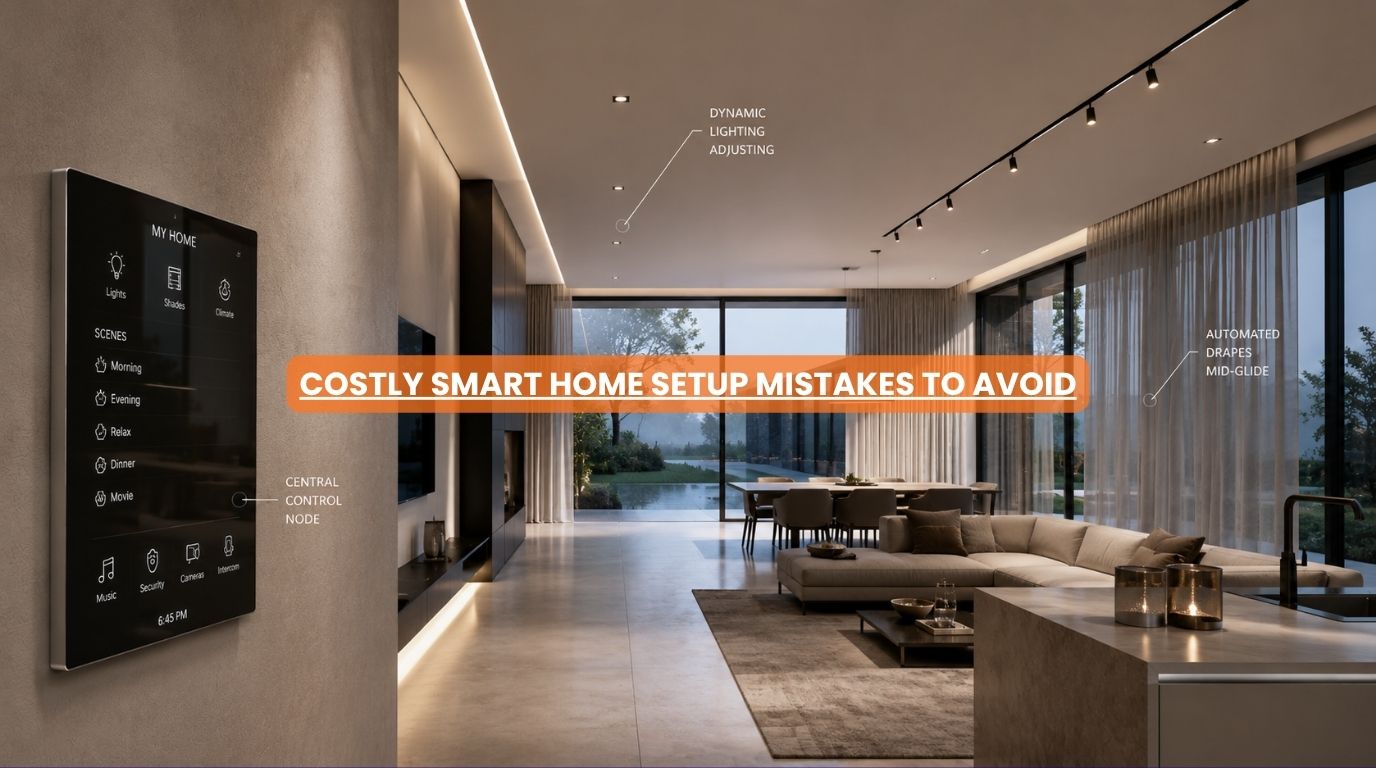
Smart home technology has never been more accessible. Today, homeowners can automate:
- Lighting
- Security
- Climate control
- Motorized curtains
- Entertainment systems
- Access control
All from a smartphone or touch panel.
Yet despite the growing popularity of smart home automation, many homeowners end up frustrated. Devices stop responding. Apps multiply. Systems become difficult to manage. And what was supposed to make life easier starts creating unnecessary complexity.
At Techtastic, we’ve helped homeowners recover from countless smart home setup mistakes. The good news?
Most of these problems are completely avoidable. Whether you’re planning your first smart home setup or expanding an existing system, understanding these common mistakes can save significant time, money, and frustration.
Summary
Many smart home automation problems occur because homeowners focus on devices rather than system design. Common mistakes include poor network planning, choosing incompatible products, ignoring future expansion, relying solely on Wi-Fi devices, neglecting security considerations, and automating without a clear strategy. A successful smart home setup starts with strong infrastructure, scalable technology, and thoughtful planning that prioritizes long-term reliability and user experience.
Quick Answer
The most common smart home automation mistakes include poor networking, buying incompatible devices, planning only for current needs, ignoring cybersecurity, relying entirely on Wi-Fi products, and automating without a clear strategy. The best approach is to start with a reliable infrastructure, focus on lifestyle goals rather than gadgets, and choose systems that can scale as your needs evolve.
Why Smart Home Planning Matters
One of the biggest misconceptions about smart home automation is that success depends on buying the right devices.
In reality, successful smart homes are built on:
- Planning
- Infrastructure
- Integration
- Scalability
Technology should support your lifestyle—not complicate it. The best smart homes feel effortless because the planning happened before the devices were installed.
Mistake #1: Buying Devices Before Defining Goals
Many homeowners start by purchasing random smart devices.
Examples include:
- Smart bulbs
- Smart plugs
- Smart speakers
- Smart cameras
Without a clear strategy, this often creates a fragmented experience.
Better Approach
Start by asking:
- What problems am I trying to solve?
- What daily tasks do I want to simplify?
- What automation features matter most?
Technology should support goals—not become the goal itself.
Mistake #2: Ignoring Network Infrastructure
This is arguably the most common smart home setup mistake. Every smart home depends on reliable connectivity.
Weak networking often causes:
- Device disconnects
- Slow response times
- Automation failures
- User frustration
Better Approach
Invest in:
- Strong Wi-Fi coverage
- Structured networking
- Proper access point placement
- Reliable internet infrastructure
At Techtastic, we often say: “A smart home is only as smart as its network.”
Mistake #3: Choosing Incompatible Products
Many homeowners buy devices from multiple manufacturers without considering compatibility.
The result?
- Multiple apps
- Limited integration
- Inconsistent user experience
Better Approach
Choose products that support:
- Common automation standards
- Future integration
- Scalable ecosystems
Compatibility matters more than individual device features.
Mistake #4: Planning Only for Current Needs
A smart home often grows over time.
Today’s priorities may include:
- Smart lighting
- Security systems
Tomorrow’s priorities may include:
- Motorized curtains
- Home theatres
- Energy management
- EV charging
Better Approach
Select systems that support future expansion. Scalability prevents expensive upgrades later.
Mistake #5: Focusing Only on Voice Control
Voice assistants are convenient. However, they are not automated.
Many homeowners assume that “Alexa, turn on the lights” equals a smart home.
In reality, it’s simply voice control.
Better Approach
Prioritize automation that works automatically.
Examples:
- Occupancy-based lighting
- Climate schedules
- Curtain automation
- Security routines
The smartest homes require the least interaction.
Mistake #6: Over-Automating Everything
Automation should improve daily life. Sometimes homeowners automate tasks that don’t need automation.
This can create:
- Complexity
- Confusion
- Maintenance challenges
Better Approach
Automate activities that:
- Happen frequently
- Improve convenience
- Save time
- Enhance comfort
Simple automation often delivers the greatest value.
Mistake #7: Neglecting Cybersecurity
Connected homes create new security considerations.
Risks include:
- Weak passwords
- Outdated firmware
- Unsecured devices
Better Approach
Use:
- Strong passwords
- Two-factor authentication
- Regular software updates
- Secure networking practices
Smart homes should be both convenient and secure.
Mistake #8: Choosing the Cheapest Solution
Budget matters.
However, selecting products solely based on price often leads to:
- Reliability issues
- Limited compatibility
- Short lifespans
Better Approach
Focus on:
- Reliability
- Support
- Scalability
- Long-term value
The lowest upfront cost isn’t always the least expensive option over time.
Mistake #9: Ignoring Physical Controls
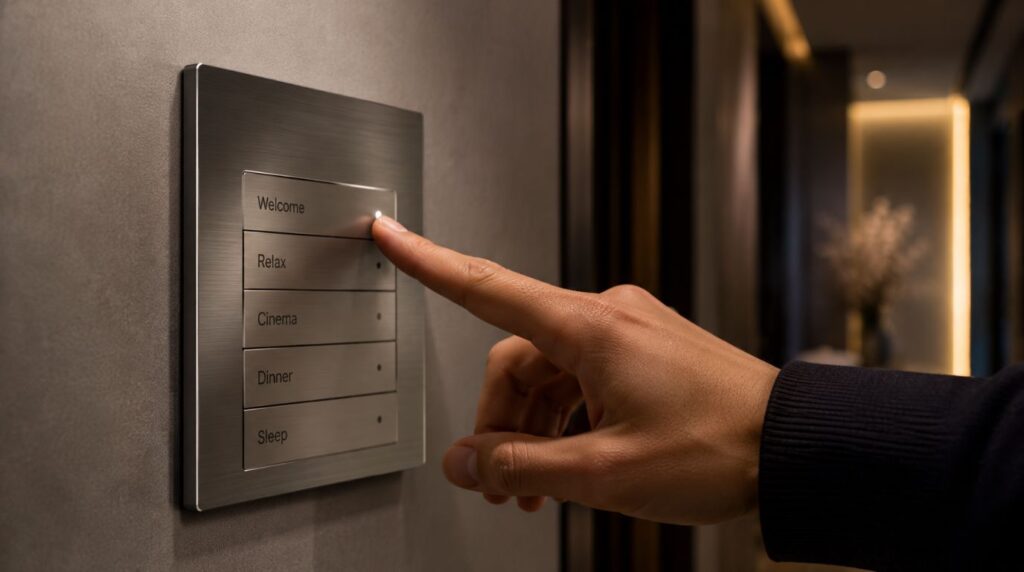
Many homeowners assume mobile apps can replace traditional controls entirely.
In reality, people still appreciate:
- Wall switches
- Keypads
- Touch panels
Especially:
- Guests
- Children
- Elderly family members
Better Approach
Provide multiple control methods.
A great smart home setup remains intuitive for everyone.
Mistake #10: Treating Smart Homes as Gadgets Instead of Systems
This is perhaps the biggest mistake of all.
Many homeowners focus on:
- Individual products
rather than:
- Overall user experience
Better Approach
Think in terms of:
- Lighting experience
- Security experience
- Comfort experience
- Entertainment experience
The best smart homes feel like one integrated system.
Common Smart Home Setup Mistakes at a Glance
| Smart Home Setup Mistake | Result |
| No planning | Fragmented experience |
| Weak networking | Frequent failures |
| Incompatible devices | Multiple apps |
| No expansion strategy | Costly upgrades |
| Voice-only focus | Limited automation |
| Over-automation | Complexity |
| Poor security | Increased risk |
| Cheapest products | Reliability issues |
| No physical controls | User frustration |
| Device-first thinking | Poor experience |
Smart Home Setup Checklist
Before smart home setup, consider:
✅ Strong networking foundation
✅ Future expansion plans
✅ Compatible products
✅ Physical control options
✅ Security measures
✅ Automation priorities
✅ Professional design guidance
This checklist helps prevent the most common smart home setup issues.
Why KNX Projects Avoid Many of These Problems
Professional platforms such as KNX are designed around:
- Integration
- Scalability
- Reliability
Rather than managing dozens of independent devices, homeowners gain:
- Centralized control
- Unified automation
- Long-term flexibility
This is one reason KNX remains popular in premium smart home projects.
Why It Matters for Modern Homes
Technology should simplify life. Poorly designed smart homes often do the opposite.
The difference between a frustrating smart home and an enjoyable one is usually not the technology itself. It’s the planning behind it.
A properly designed system provides:
- Convenience
- Comfort
- Security
- Reliability
without requiring constant attention.
Our Perspective at Techtasti
At Techtastic, we’ve found that the most successful smart home setup projects share one common characteristic: They begin with planning rather than products.
When designing automation systems, we focus on:
- Lifestyle needs
- Future growth
- Reliability
- Simplicity
- User experience
The best smart home isn’t the one with the most gadgets. It’s the one that feels invisible because everything simply works.
Collaboration Opportunities for Developers, Architects & Interior Designers
Many smart home setup mistakes can be prevented during project planning.
At Techtastic, we collaborate with:
- Architects
- Interior designers
- Residential developers
- Luxury home builders
- Hospitality consultants
- Project managers
Smart Infrastructure Planning
Create future-ready properties.
Networking Design
Build reliable foundations.
Lighting & Automation Integration
Improve functionality and aesthetics.
Security Planning
Support safer living environments.
Luxury Residential Projects
Deliver premium connected experiences.
Future-Ready Developments
Support evolving homeowner expectations.
Early collaboration significantly improves long-term outcomes.
Key Takeaways
- Most smart home setup problems originate from poor planning rather than bad technology.
- Strong networking is the foundation of reliable smart home automation.
- Compatibility and scalability should be prioritized from the beginning.
- Voice control is not the same as automation.
- Physical controls remain important.
- Cybersecurity should never be overlooked.
- Successful smart homes focus on experiences rather than devices.
Frequently Asked Questions
1. What is the most common smart home setup mistake?
A. Poor network infrastructure is one of the most common causes of smart home setup problems.
2. Should I buy smart devices before planning automation?
A. No. Start with goals and infrastructure before selecting devices.
3. Do I need a smart home hub?
A. Not always, but centralized systems often improve reliability and integration.
4. Why do smart home devices keep disconnecting?
A. Weak Wi-Fi coverage, outdated networking equipment, or device overload are common causes.
5. Is voice control the same as automation?
A. No. Voice control requires commands, while automation operates automatically.
6. How important is networking for smart homes?
A. Networking is the foundation of nearly every smart home feature.
7. Should I automate everything?
A. No. Focus on high-value automations that improve convenience and comfort.
8. How can I future-proof my smart home?
A. Choose scalable systems, strong infrastructure, and products that support future integration.
Conclusion
Smart home automation has the potential to transform how homeowners interact with their living spaces, but only when implemented thoughtfully. Most smart home frustrations can be traced back to poor planning, weak networking, incompatible products, or a lack of long-term strategy. By avoiding these common setup mistakes, homeowners can create systems that are reliable, intuitive, secure, and future-ready.
At Techtastic, we help homeowners, architects, developers, and designers build smart home ecosystems that prioritize simplicity, performance, and long-term value.
📞 Call/WhatsApp: 9769145145
📍 Our Operational Hubs: Navi Mumbai | Nashik | Lonavla | Sangli
With the right planning from the beginning, your smart home can deliver years of convenience, comfort, and intelligent living without the headaches that many homeowners experience.
Wondering how to manage all these requirements? Read our expert guide on Smart Home Connectivity Problems: Best Troubleshooting Guide (2026) to discover the best way to troubleshoot your system’s infrastructure.